
THE AZORES · NOVEMBER · THE MONTH GUIDE
November hands the Azores back to the people who live there. The summer boats thin out, the hydrangeas are long gone, and São Miguel’s south coast settles into a month that averages 67.8°F by day and 58.8°F at night. The sea is still 68.4°F, warmer than the Atlantic has any right to be in late fall. What the month takes away is light: 10 hours 11 minutes of it on the 15th, plus rain on 11.8 days out of thirty.
That trade is the whole question. Whale and dolphin boats sail here all year, the Furnas valley’s thermal water does not care what season it is, and the crater-lake lookouts are free in any month. But a November day tends to give you one clear window rather than three, and the boat that leaves at nine depends on a sea nobody controls. Plan around that and the month delivers. Plan a beach week and you have picked the wrong archipelago and the wrong four weeks.
THE MONTH AT A GLANCE · THE AZORES IN NOVEMBER
November is the driest of the three months around it at Ponta Delgada, with a 68.4°F sea and just over ten hours of daylight: come for thermal water, resident dolphins and lookouts, not for a beach week.
IPMA NORMALS 1991-2020 · STATION 513, PONTA DELGADA · 11.8 WET DAYS · SEA 68.4°F
Go for: resident dolphins on a boat that is not full, Furnas thermal pools, crater-lake lookouts at no cost, and the lowest rainfall of the fall shoulder.
Think twice before: booking a single unmovable boat date, or reading these coastal numbers as the weather at 1,105 m on Pico da Vara.
Climate: IPMA station 513 · Sea: Open-Meteo Marine · Cetaceans and sights: Visit Azores · full sources at the end
On this page
- Azores weather in November67.8°F highs and 11.8 wet days
- Can you swim in the Azores in November?A 68.4°F sea, and the caveat on that figure
- Prices, crowds and the Ponta Delgada tourist taxEUR 2 a night, capped at 3 nights
- Things to do on São Miguel in NovemberFurnas, Gorreana and the dolphin boat
- A two-day plan around 10 hours of daylightDay one and day two, hour by hour
- November against October and DecemberAir, rain and sea for all three months
- Is November a good month for the Azores?Who it suits, and who should shift the dates
One caveat before the numbers do any work. Every normal quoted here is measured at Ponta Delgada, on the south coast of São Miguel, at 35.0 m of altitude. The archipelago is nine islands, and these figures do not travel: high ground is colder and far wetter, and the other end of a single coast keeps its own weather. The neighboring months have their own pages, October and December, and the country-wide view sits in the twelve-month verdict.
Azores weather in November: average highs, lows and rain days
| November at Ponta Delgada (1991-2020) | Normal |
|---|---|
| Average high | 67.8°F (19.9°C) |
| Average low | 58.8°F (14.9°C) |
| Precipitation | 3.75 in (95 mm) |
| Days with 0.04 in (1 mm) or more | 11.8 |
| Days with 0.39 in (10 mm) or more | 2.9 |
| Sea surface, mean of daily maxima | 68.4°F (20.2°C) |
| Daylight on November 15 | 10 h 11 min |
These come from a real thermometer, not a model grid cell. IPMA, the Portuguese weather and ocean institute, publishes 1991-2020 normals for station 513, the Ponta Delgada Observatório, sitting 35.0 m above the sea. November’s average high there is 67.8°F (19.9°C), the average low 58.8°F, and the month collects 3.75 inches of rain. A grid-cell reanalysis would give you something close and answer for a square of ocean instead of a town, which is why the station number is worth carrying.
On 11.8 days of an average November, the gauge records at least 0.04 inch (1 mm), and 2.9 of those days deliver 0.39 inch (10 mm) or more. Watch the thresholds, because they are IPMA’s own and US tables usually count from 0.10 inch, so the two sets of wet-day counts are not interchangeable. Day to day it means rain on roughly two days in five, and most of it arriving in bursts rather than settling in for eight hours. A soaked morning frequently becomes a usable afternoon.
The gap between day and night is only nine degrees, which is the useful oddity of an ocean climate: nothing gets cold, nothing gets hot, and one layer covers both ends of the day. Pack a real rain shell rather than an umbrella, since the wind takes umbrellas seriously here, plus shoes that tolerate wet basalt and a swimsuit that lives in the day bag for the thermal pools. Leave the heavy coat at home. The packing guide covers the rest of the country.
Light is the real constraint. On November 15 the sun rises at 7:22 a.m. and sets at 5:32 p.m. local time (08:22 and 18:32 UTC, with the islands running an hour behind), giving 10 hours 11 minutes between the two. A lookout that needs a ninety-minute drive has to be a morning plan, and anything you had filed under evening now happens in the dark, indoors, or over dinner.
Can you swim in the Azores in November? Sea temperature and what 68.4°F feels like
The sea surface off the Azores averages 68.4°F (20.2°C) in November, from Open-Meteo’s marine data across 2015-2024. One nuance decides how you read it: that average is built from daily maxima, the warmest reading of each day, so it runs a shade above a true 24-hour mean. Nobody swims at the daily minimum either, so the figure is fair for an afternoon. Just don’t expect it at eight in the morning.
In the water, 68.4°F is bracing for the first thirty seconds and fine after that, if your swim is measured in minutes rather than hours. Children last less time than adults do. For comparison, October runs 72.3°F and December drops to 65.4°F, so November is the last month of the year where entering the sea is a decision rather than a dare. The warm alternative is thermal, not marine: Furnas heats its own pools all winter.
We hold no wind or wave normals for the month, so treat any confident statement about November swell with suspicion, including ours. What we can say is structural: a whale and dolphin trip runs about three hours offshore, and three hours offshore is the first thing a passing front takes off the table. Build the itinerary with one spare day, keep the boat refundable, and let the Furnas plan absorb whatever gets canceled.
How busy are the Azores in November? Crowds, prices and the Ponta Delgada tourist tax
November sits in the year’s quiet quarter, after the summer boats and before the Christmas and New Year weeks. We carry no price index for Azores flights and hotels, so take that as direction, not as a quote. What is sourced is the reason the summer fills up in the first place: sperm whales, sei whales and other baleen whales are frequent in summer according to Visit Azores, along with spotted dolphins. None of them is a November proposition. The resident dolphins are.
Which changes what booking early is for. The scarce thing in November is not a room, it is a sailing window, so put the boat on your first full day and keep the second as the replacement rather than saving the trip for the flight-home morning. If a soak at the end of each day is the reason you are coming, settle the Furnas nights first and let the driving fall in behind them.
The tourist tax comes with a reserve attached. Ponta Delgada has charged a municipal tax since January 2025, and the city runs a dedicated platform for it, which we read on September 9, 2026: the rate leaflet itself sits behind a login. Press and host guides agree on EUR 2 per person per night from age 13, capped at 3 consecutive nights, so about EUR 6 a head, with under-13s, medical stays and Azorean residents exempt. Treat those numbers as unconfirmed and ask the property to quote the tax in writing.
The cap is where a long stay diverges: Porto charges EUR 3 a night up to 7 nights (EUR 21), Funchal EUR 2 up to 7 nights (EUR 14), and Ponta Delgada EUR 2 but stops at 3. A fortnight on São Miguel and a fortnight in Porto do not carry the same bill. The one line worth paying up for in November is the car. With ten hours of light and rain arriving in bursts, leaving a clouded Sete Cidades for a clear south coast is exactly what the money buys, as our car guide sets out.
Things to do in the Azores in November: Furnas, Gorreana and the dolphin boat
The Azores form one of the largest whale sanctuaries in the world, with more than 20 cetacean species recorded, about a third of every species that exists. November’s roster is short and dependable: common dolphins and common bottlenose dolphins are resident, present in any month, and swimming with them is allowed. Blue whales belong to the end of winter, the big summer visitors have moved on, and what you gain instead is a boat with room on it and water still at 68.4°F for the swim.
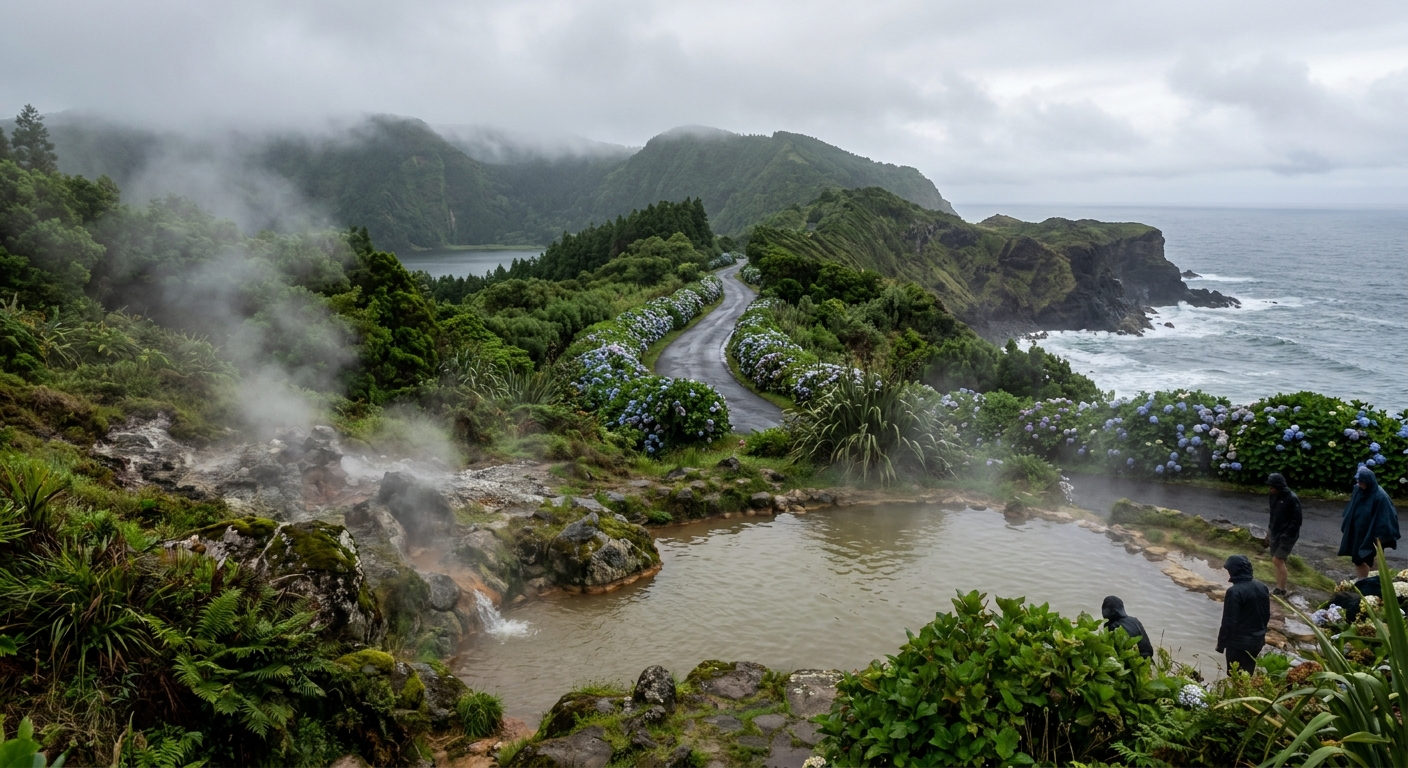
Terra Nostra Park at Furnas puts a thermal pool inside a botanical garden, and prices visitors and residents differently: around EUR 16 for a visiting adult against about EUR 12.80 for a resident, under-6s free. We could not read those figures at source, since the park’s visiting pages returned a 404 on September 8, 2026 and the regional tourism portal refused automated reading, so confirm the gate price and the closing time on arrival. Poça da Beija, clear water over ferrous mud, is the valley’s other named bathing spot, and the Caldeiras of Ribeira Grande set an 1811 thermal building among trees and fumaroles.
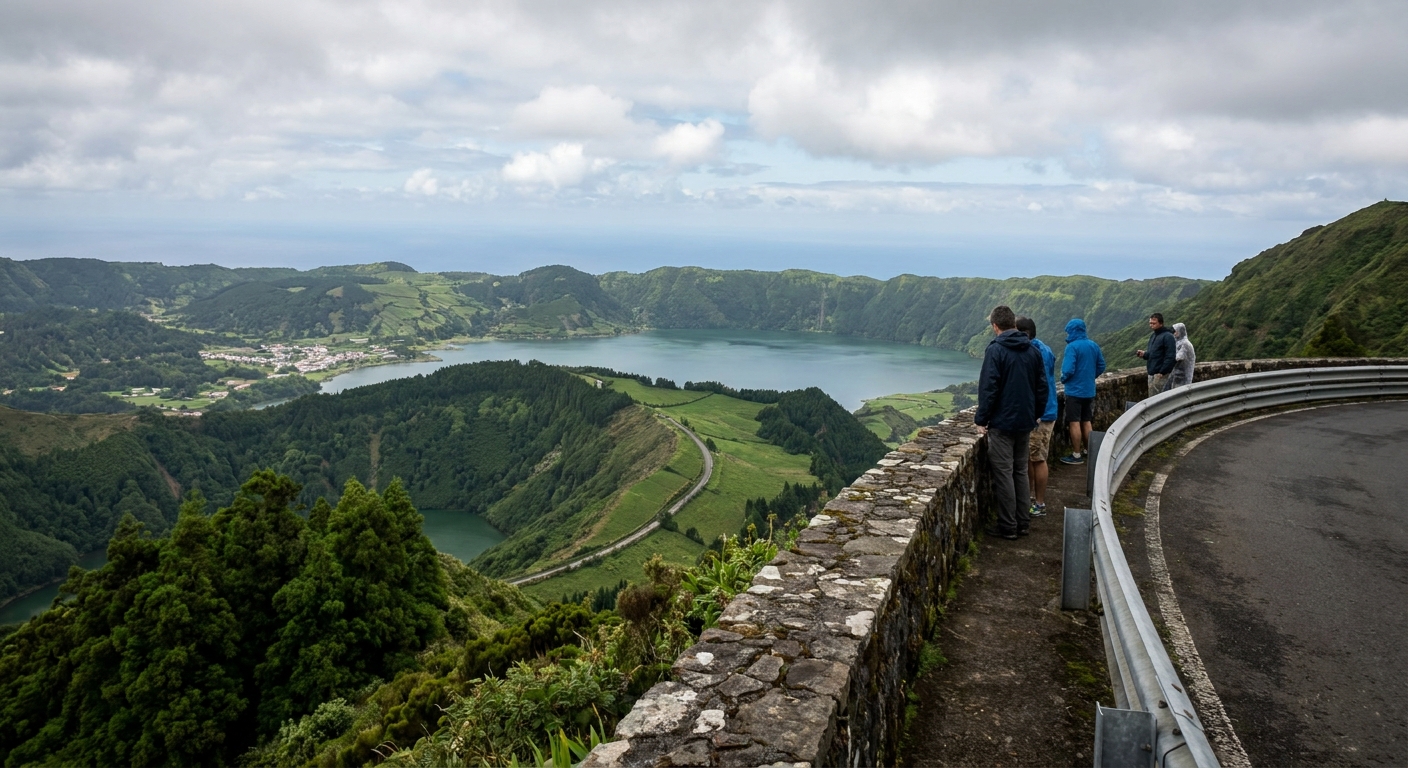
Free in November, and better for it, are the lookouts. Vista do Rei holds the twin Green and Blue lakes of Sete Cidades, Lagoa do Fogo sits higher and wilder, and both cost nothing but daylight. The Furnas valley’s fumaroles and carbonated springs run to dozens and charge no admission. Ponta Delgada, capital of the island since 1546, after the 1522 earthquake destroyed Vila Franca do Campo, is a town you can read on foot in an afternoon. Gorreana, growing tea since 1883 and Europe’s oldest plantation, we could not price: ask at the museum-factory door.
The Azores in November: a two-day São Miguel itinerary
Day one runs on the light. Leave Ponta Delgada by 7:45, minutes after a 7:22 sunrise, and stand at Vista do Rei above Sete Cidades before nine, while the crater is still legible. Down to the lakeshore by ten, coffee in the village, then cross east for a late lunch on the north coast. Give the afternoon to Gorreana’s tea factory and its museum, which works just as well under rain. Be back on the coast road by five, because the sun goes at 5:32.
Day two belongs to the water. A whale and dolphin trip lasts about three hours, and Visit Azores recommends a minimum age of five, a limit worth respecting: a sea an adult calls calm is hard work at three feet tall. Take the morning slot, then drive to Furnas for an afternoon where darkness stops mattering, with Poça da Beija or the Terra Nostra pool and the Caldeiras of Ribeira Grande on the way home. If the boat is canceled, Furnas becomes the whole day, and 2.9 days a month bring 0.39 inch of rain or more.
The Azores in November vs October and December
| Measure | October | November | December |
|---|---|---|---|
| Average high | 72.7°F | 67.8°F | 64.9°F |
| Average low | 62.8°F | 58.8°F | 56.1°F |
| Precipitation | 4.65 in | 3.75 in | 6.02 in |
| Days with 0.04 in (1 mm) or more | 13.7 | 11.8 | 15.0 |
| Sea surface | 72.3°F | 68.4°F | 65.4°F |
| What that buys | Warmest air and sea of the three | Least rain, fewest wet days | Coolest, wettest, 15.0 wet days |
All three columns come from the same station and the same 1991-2020 period, which makes the comparison clean. October beats November by 4.9°F on the daytime average and by 3.9°F in the water, then hands back 0.9 inch of extra rain and two more wet days. December goes the other way on every line at once: 64.9°F by day, 6.02 inches of rain, 15.0 wet days, and a sea at 65.4°F that ends the swimming argument.
Shifting four weeks earlier buys warmth and costs dry days. Shifting four weeks later costs both, and buys nothing on this table. The one thing December does add is the approach of the blue whales, which the tourist board places at the end of winter rather than in the fall, so a cetacean-led trip is either a summer trip or a February-March one, not a compromise in between.
Is November a good time to visit the Azores?
Yes, if the trip is built around water you sit in, roads you drive and lookouts you can reach inside ten hours of daylight. It is the driest of the three months around it, 3.75 inches against October’s 4.65 and December’s 6.02, with the fewest wet days as well. No, if you came for a beach week, for blue whales, which arrive at the end of winter, or for one boat date that cannot be moved.
If that lands on no, shift backward rather than forward. October holds the air at 72.7°F and the sea at 72.3°F, a genuine swimming temperature, and charges 13.7 wet days for it instead of 11.8. For sperm whales, sei whales and spotted dolphins, Visit Azores points at summer, not at either shoulder month, and summer is also when the boats are full and the rooms are priced accordingly.
Only November puts a 68.4°F sea and 3.75 inches of rain in the same four weeks: October is warmer and wetter, December is colder and wetter still.
The last word
So the decision is a small one: take the four weeks where the sea still lets you in and the rain still lets you out, book the boat for your first morning, and keep Furnas in reserve for whatever the weather ruins. One last number for the suitcase. The thermometer that gives you 67.8°F stands at 35 m on the south coast, while Pico da Vara, the island’s high point, reaches 1,105 m. Nothing in this month’s coastal normals describes what the top of that feels like in the wet.
Sources & data for this guide
- November normals: high 67.8°F, low 58.8°F, 3.75 in, 11.8 days at 0.04 in (1 mm) or more, 2.9 days at 0.39 in (10 mm) or more · IPMA climate normals 1991-2020, station 513 Ponta Delgada Observatório, 35.0 m · checked Sep 14, 2026
- October and December normals in the comparison table, same station and same 1991-2020 period · IPMA · checked Sep 14, 2026
- Sea surface 68.4°F (and 72.3°F / 65.4°F for the neighboring months), taken as the mean of daily maxima 2015-2024 · Open-Meteo Marine API · checked Sep 14, 2026
- Daylight of 10 h 11 min on November 15, sunrise 08:22 UTC and sunset 18:32 UTC, converted to Azores time · sunrise-sunset.org · checked Sep 14, 2026
- Cetacean seasons, resident dolphins, three-hour trips, minimum age five, sanctuary and 20+ species · Visit Azores, official regional tourist board · checked Sep 14, 2026
- São Miguel geography and Pico da Vara at 1,105 m, Furnas thermal springs, Poça da Beija, Caldeiras of Ribeira Grande (1811), crater-lake lookouts, Gorreana since 1883, Ponta Delgada capital since 1546 · Visit Azores · checked Sep 14, 2026
- Terra Nostra fees (about EUR 16 visiting adult, about EUR 12.80 resident, under-6s free) · unconfirmed: parqueterranostra.com returned 404 on its visiting pages and turismo.azores.gov.pt returned 403 · attempted Sept 8, 2026
- Ponta Delgada tourist tax · taxaturistica.cm-pontadelgada.pt read Sept 9, 2026: the platform exists, the rate leaflet is behind a login. EUR 2 per person per night from age 13, capped at 3 nights, relayed by Jornal de Notícias and Correio dos Açores · unconfirmed
- Tax caps in Porto (EUR 3 up to 7 nights) and Funchal (EUR 2 up to 7 nights) · municipal sources cross-checked Sep 14, 2026
- We hold no price index for Azores flights or hotels: the demand notes above are editorial direction, not quotes. Hours, fares and taxes change · confirm with operators when you book.