
SÃO MIGUEL · DAY TRIPS · FROM PONTA DELGADA
You are already on the island, which changes the question: not whether to come, but what fits between breakfast and the last of the light. Ponta Delgada has been the island’s capital since 1546, when it took the role from Vila Franca do Campo after the earthquake of 1522, and it still works as the base for almost everything. São Miguel is the largest island of the archipelago: 62.1 km long, 15.8 km at its widest, 744.7 square kilometers in all, with Pico da Vara topping out at 1,105 m.
The outings that genuinely fill a day from here are the crater lakes at Sete Cidades and Lagoa do Fogo, the thermal valley at Furnas, a boat out to the cetaceans, and the tea plantations on the north coast. One caveat before any of it: the official sources do not publish driving times between those places, and we are not going to invent them. Ask your rental desk or your hotel to time the route the evening before. On this island the variable that ruins plans is cloud, not distance.
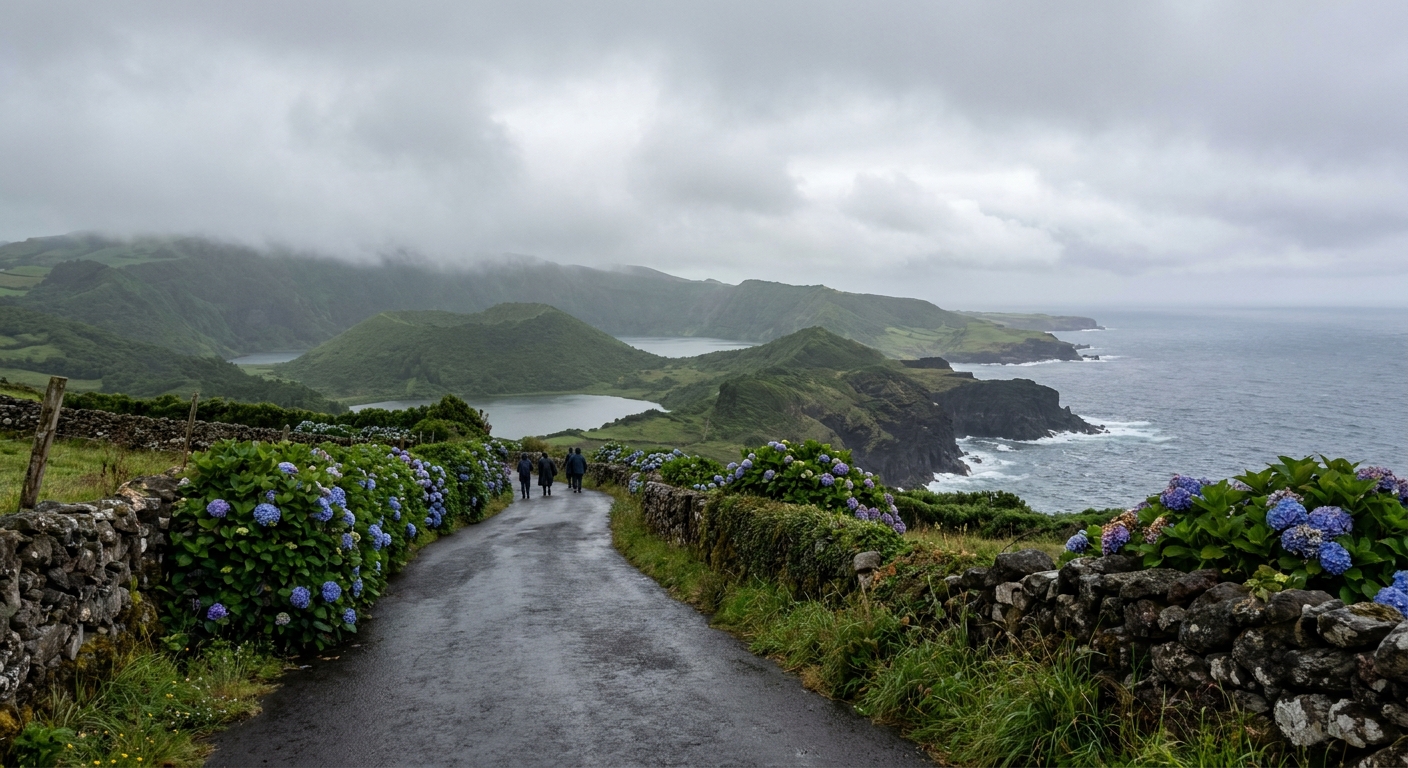
DAY TRIPS AT A GLANCE · SÃO MIGUEL
From Ponta Delgada the two crater lakes and Furnas each take a day, a whale trip runs about three hours, and the only number worth fighting for is your departure hour.
BASE: PONTA DELGADA · WHALE TRIP: ABOUT 3 HOURS · DRIVE TIMES: NOT IN OUR SOURCES
Go for: two crater lakes seen from named lookouts, a valley that cooks lunch in its own ground, tea rows that exist nowhere else in Europe, and water holding more than 20 cetacean species.
Think twice before: saving a lookout for the afternoon, or putting a child under five on a three-hour boat: a sea an adult calls calm is not calm for a small passenger.
Sites and season: Visit Azores · Normals: IPMA station 513, Ponta Delgada · full sources at the end
On this page
- The twin lakes from Vista do ReiSete Cidades
- Hot springs, a thermal pool and cozidoFurnas in a day
- A higher, wilder crater lakeLagoa do Fogo
- Whale watching season and cancellationsBoats from São Miguel
- Tea plantations open to visitorsGorreana and Porto Formoso
- A day trip to another Azores islandIsland hopping
Every figure here that concerns weather comes from one thermometer: IPMA station 513 at Ponta Delgada Observatório, 35.0 m above the sea on the south coast. January averages a high of 63.5°F and 4.02 inches of rain there, July a high of 76.5°F and 1.02 inches. The rims above Sete Cidades and Lagoa do Fogo stand far higher than that gauge, colder and considerably wetter, which is why a bright morning in town proves nothing about the lookout. For the shape of the year, the month-by-month verdict carries the rest.
Sete Cidades from Ponta Delgada: how to get there and when it is clear
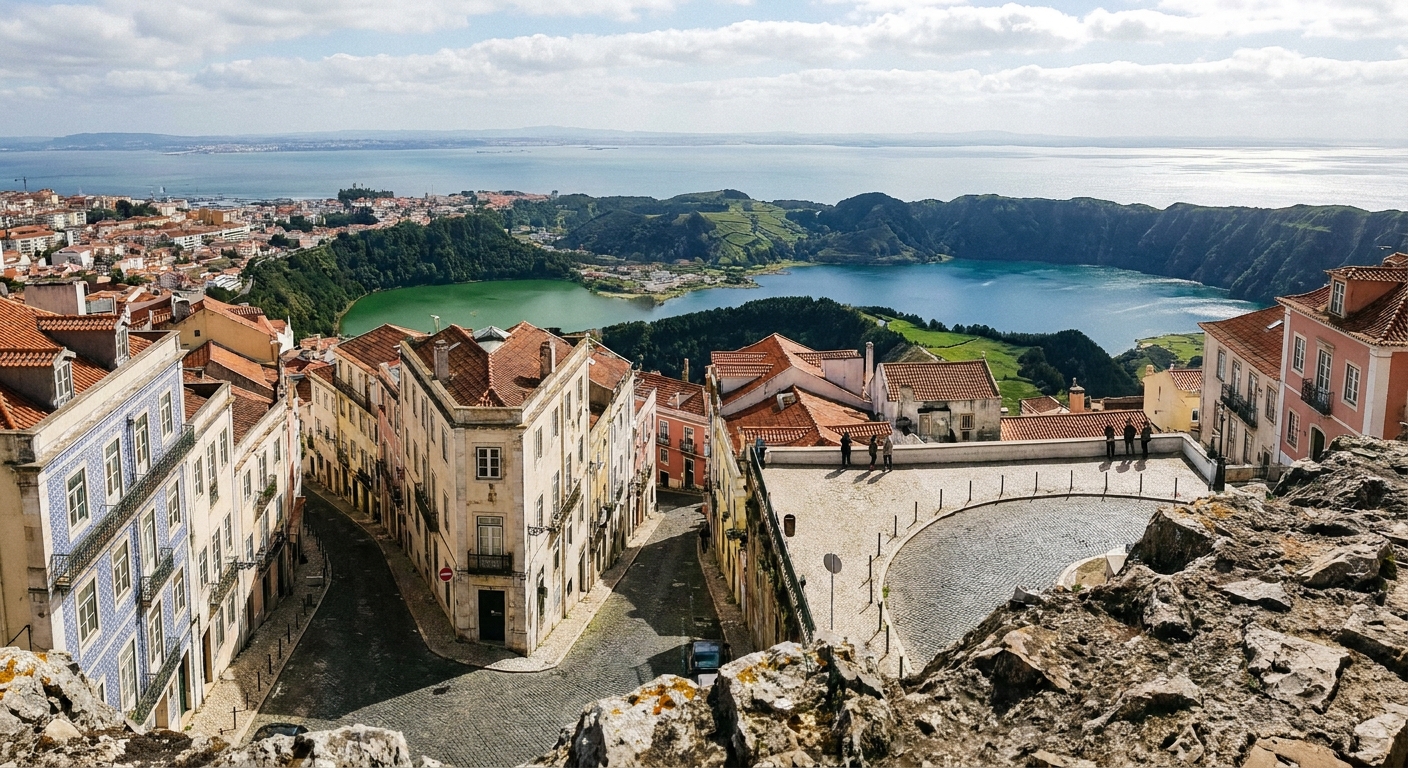
Vista do Rei is the lookout the postcards use, and the regional tourism board lists it as the island’s set-piece view. From it the twin lakes of Sete Cidades lie side by side inside one caldera, one green, one blue, with the village and its church on the strip of land between them. Walking a stretch of the rim above the lookout turns the visit into a half day; staying in the car turns it into twenty minutes and a photograph.
Go in the first clear hour after sunrise, and read the day from the sky over the ridge rather than from the harbor. Cloud parks on the caldera lip and, when it does, the lookout hands you a white wall no matter how blue the coast looked at breakfast. Keep a sea-level fallback: Furnas works in drizzle, and the tea factories are indoors. At the coastal station, 13.0 January days record at least 1 mm of rain against 4.8 in July, counted on the national service’s own 1 mm threshold, not the 0.10 inch used in US tables.
On the drive itself we have a reserve. No published time from Ponta Delgada to Vista do Rei was readable for us on the regional tourism portal, which refuses automated reading, so we will not put a figure on it. Ask at the rental counter when you collect the car, or at your accommodation the night before. Both quote it daily, and both know which road is closed. Our car guide handles the paperwork, and getting around Portugal covers what island roads ask of a driver.
Furnas in a day: hot springs, the lake and the cozido
The Furnas Valley is the island’s boiler room: dozens of thermal springs, fumaroles venting straight out of bare ground, and water that arrives at the surface naturally carbonated. The bathing spots have names worth writing down. Poça da Beija is a pool of clear water and ferrous mud. The Caldeiras of Ribeira Grande add a thermal building dating from 1811, standing among trees and steam.
Lunch in the valley is cooked underground. The pot of cozido goes into a hole where the fumaroles heat the soil, comes up hours later, and is served by restaurants in the village. What we could not read anywhere in our sources is how far ahead they need the order, or what a portion costs. Call the restaurant, ask what time the pot is lifted, and build the day around that hour instead of the reverse. That is a gap in our reading, not proof the information is unpublished.
Terra Nostra Park is why people stay past lunch: a wide thermal pool the color of strong tea, inside a botanical garden. Its pricing carries a warning. The figures in circulation put a visiting adult at around EUR 16 and a resident at about EUR 12.80, with under-6s free, but the park’s own site returned 404 on its visitor pages and the regional portal returned 403 when we tried on September 8, 2026. Treat both as an order of magnitude and confirm at the gate.
Then there is the smell. Over the caldeiras the air is rotten-egg sulfur, strongest on a windless day, and it travels home in your clothes. The iron in the water stains pale swimwear for good, so bring something you have already fallen out of love with, and leave silver jewelry at the hotel.
Lagoa do Fogo: when the crater is visible
Lagoa do Fogo is the wilder of the two lakes and sits higher, in a caldera with no village, no church and no road down to the water. The lookouts are on the pass that crosses the island’s spine, and the lake below is left entirely to itself, which is most of what makes it worth the morning. Reaching the shore at the bottom is a walk rather than a drive, and it eats a serious slice of the day.
The Sete Cidades rule applies twice over up here. Cloud builds on this crater earlier and lingers later, and the coastal thermometer at Ponta Delgada, 35.0 m above the sea, has nothing useful to say about it: the weather service’s own note is explicit that high ground on São Miguel runs colder and far wetter than that station. Drive up early. If the pass is in fog when you reach it, turn around, and give the day to Furnas or the tea coast instead.
Whale watching from São Miguel: season and cancellations
Whale and dolphin watching runs all year in the Azores, and the month decides the cast. Blue whales are easily spotted at the end of winter. Sperm whales, sei whales and other baleen whales are frequent in summer, along with spotted dolphins. Common dolphins and common bottlenose dolphins are resident, present in any month, and swimming with them is allowed. The archipelago is one of the largest whale sanctuaries in the world: more than 20 cetacean species pass through these waters, about a third of every species that exists.
A trip out lasts about three hours, and the sea decides whether it leaves the harbor at all. Winter swell can cancel several days in a row. On refunds and rebooking we have to stop short: the official tourism pages we read give the season and the trip length, not the operators’ cancellation terms. Get the refund policy in writing before you pay, and book your attempt early in the stay so a cancellation still leaves room for a second one.
The official recommendation is a minimum age of five, and it is not squeamishness. A sea an adult calls calm can be rough on a small child, and a boat three hours offshore has nowhere to put a passenger who wants out. Younger families get more from the coast and the thermal pools, which is the argument our Portugal with kids guide makes at length.
One thing we cannot give you is an approach distance. Whether a code of conduct sets a minimum gap between boat and animal, how many boats may work one whale, and what the penalty is: none of that was readable on the official pages we consulted on September 8, 2026, and we would rather leave the line blank than fill it. Ask the operator to state its own limits before you board, and ask the tourist office in Ponta Delgada for the current rules. A skipper who answers precisely is a good sign.
Tea plantations on São Miguel: Gorreana and Porto Formoso
Gorreana and Porto Formoso, both on the north coast, are tea plantations unique in Europe, and each runs a museum-factory open to visitors: rolling and sorting machines, the withering trays, and the hillside rows outside the window. Gorreana has grown tea since 1883 and calls itself the oldest plantation in Europe. Opening hours and admission were not in the sources we read, so check before driving over. As a rescue for a morning the cloud has taken, either one earns the detour more than a second attempt at a lookout.
Can you day-trip to another Azores island?
Not really, and it is worth saying flatly. Reaching another island from São Miguel means a flight or a ferry in each direction, plus the weather’s right of veto on both, and the archipelago is spread wide across the ocean: what reads as a hop on the map becomes a travel day with two terminals inside it. Two nights on the second island is the shortest version that still leaves you time to look at anything.
What we cannot quote is the schedule. Timetables, crossing times and fares for the inter-island flights and ferries were not readable in our sources, and rounding a number would be worse than admitting it. Ask SATA Azores Airlines about flights, Atlânticoline about ferries, and the tourist office on Ponta Delgada’s waterfront about what is actually running in your month. Build the São Miguel week first, using the three-day frame and the things-to-do list, and hold one clear morning back for Vista do Rei.
Sources & data for this guide
- Whale season by month, three-hour trip, minimum age five, sanctuary and 20-plus species · Visit Azores (official regional tourism board), Whale Watching page · checked Sep 13, 2026
- São Miguel dimensions, Pico da Vara at 1,105 m, crater lakes and named lookouts · Visit Azores, São Miguel page · checked Sep 13, 2026
- Ponta Delgada capital since 1546, Vila Franca do Campo and the 1522 earthquake · Visit Azores · checked Sep 13, 2026
- Furnas thermal springs, Poça da Beija, Caldeiras of Ribeira Grande and the 1811 building · Visit Azores · checked Sep 13, 2026
- Gorreana growing tea since 1883, Porto Formoso, museum-factories · Visit Azores and the Gorreana official site · checked Sep 13, 2026
- Terra Nostra Park pricing, unconfirmed · parqueterranostra.com returned 404 on its visitor pages, turismo.azores.gov.pt returned 403 · attempted Sept 8, 2026
- January and July normals, rain-day counts at the 1 mm and 10 mm thresholds · IPMA 1991-2020, station 513 Ponta Delgada Observatório, 35.0 m · checked Sep 13, 2026
- Not readable in the above sources, and therefore absent here: driving times, boat cancellation terms, cetacean approach distances, inter-island schedules, tea plantation hours · ask the operator, the rental desk or the Ponta Delgada tourist office
- The underground cooking of cozido and the sulfur smell are editorial description; hours and prices change · confirm when you book.