
SÃO MIGUEL · WHERE TO STAY · THE AZORES
You have already chosen the Azores. The remaining question is smaller and harder: which corner of the island keeps your suitcase for the week. On São Miguel the answer narrows to the capital on the south coast, the steaming valley at Furnas in the east, and the high ground above the crater lakes in the west. Each one hands you a different first hour of the day.
Each also takes something away, and the taking is the part booking sites skip. A city bed puts a drive between you and the rim light. A valley bed comes with sulfur in the air. The lake side buys you the caldera at dawn and gives back your dinner choices in exchange.
WHERE TO STAY · SÃO MIGUEL
Base in Ponta Delgada for the links and the late kitchens, move east to Furnas for the thermal water, and treat a second island as a separate trip rather than a day out.
ONE ISLAND FIRST · CAPITAL FOR LINKS · FURNAS FOR THE BATHS · TAX CAPPED AT 3 NIGHTS
Go for: thermal water within a walk of your bed, crater rims at first light, and more than 20 cetacean species in one of the largest whale sanctuaries on the planet.
Think twice before: booking two islands on a first trip, or sleeping in Furnas if a faint smell of struck matches in the room would spoil the week.
Island data and thermal sites: Visit Azores · tax: Câmara Municipal de Ponta Delgada platform · normals: IPMA station 513 · full sources at the end
On this page
- Where to stay in Ponta DelgadaThe capital base, its links and the municipal tax
- Hot springs you can walk toFurnas Valley, Poça da Beija and Terra Nostra
- Waking up by the crater lakesSete Cidades or the capital
- How many islands on a first tripSão Miguel’s size, and the schedule we could not read
- How much is the tourist taxEUR 2 a night, capped at three
- How many nights on São MiguelThe order of the bases
- Nightly ranges and daily budgetWhat a Portugal trip costs by tier
- The best month to comeThe Azores month by month
One caveat before any of it turns into a packing list: every figure here about weather, sea or daylight comes from a single thermometer, the national weather service station at Ponta Delgada Observatório, 35.0 m up on the south coast. High ground is colder and far wetter, and the far end of a coast keeps its own weather. Pico da Vara, at 1,105 m, is not measured by that station. The month-by-month readings sit in the seasonal guide and in the July and January pages.
Where to stay in Ponta Delgada
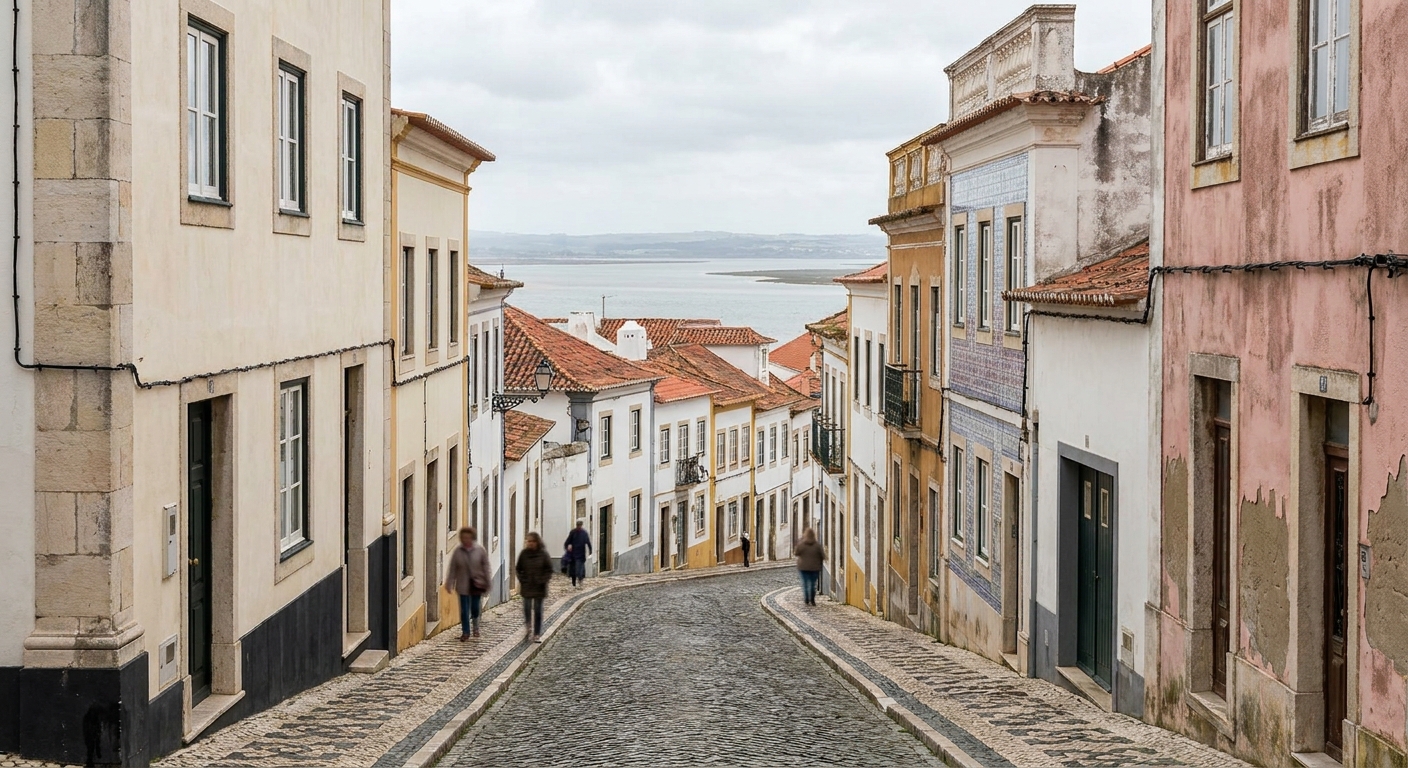
Ponta Delgada has been the island’s capital since 1546, when the role passed from Vila Franca do Campo after the earthquake of 1522 destroyed it. Nearly five centuries as the place where things happen still shows in the practical stuff: this is where the rental desks, the ferry quay and the kitchens that serve after nine are concentrated, on an island holding 137,856 people at the 2011 census, more than half of all Azoreans. A rained-out morning has an indoor answer here. Elsewhere it has a window.
The municipal tourist tax has applied in the city since January 2025. The Câmara Municipal runs a dedicated platform for it, which we read: the tax exists, and its rate leaflet sits behind a login. Press reports and host guides agree on EUR 2 per person per night for guests aged 13 and over, capped at three consecutive nights, so about EUR 6 a head. Under-13s, medical stays, disability of 60 percent or more and residents of the Azores are exempt. Ask the property to quote the amount in writing rather than discovering it at check-in.
What a city bed costs you is the first hour of the day. The lookouts sit at the other end of a climbing road, and you tend to arrive after the caldera has put its lid back on. The tea plantations are on the far coast: Gorreana, growing since 1883 and Europe’s oldest, and Porto Formoso, both with museum-factories open to visitors, are another drive again. Nature here is not out the door. It is out the door and up.
Furnas: hot springs and where to stay
Furnas is a valley with dozens of thermal springs, fumaroles and carbonated water, and it announces itself before you see it. Steam rises out of the ground at the roadside. Water hisses where there is no kettle. The air carries sulfur, sometimes faintly, sometimes not faintly at all, depending on the wind. Sleeping here means the water is a five-minute decision instead of a two-hour round trip, which changes how often you actually get in it.
The bathing spots have names. Poça da Beija is clear water over ferrous mud. The Caldeiras of Ribeira Grande keep a thermal building dating from 1811, standing among trees and fumaroles. Terra Nostra Park puts its thermal pool inside a botanical garden and prices visitors and residents differently: around EUR 16 for a visiting adult against about EUR 12.80 for a resident, with under-6s free. Take those two amounts as an order of magnitude. The park’s own visit pages returned an error to us on September 8, 2026, and the regional tourism portal refuses automated reading, so confirm at the gate.
Distance decides your evening. From a Furnas bed, a soak at dusk ends in a short walk and a shower. From the capital, the same soak ends with a cross-island drive in the dark: on January 15 the sun is down by 5:48 p.m. local, and even at midsummer it sets at 8:05 p.m. on July 15, with 14 hours 34 minutes of daylight before it. Anyone who has driven an unfamiliar volcanic road at night with wet asphalt will book the valley for the last two nights.
Straight talk on the smell: it does not stop at the door, and no amount of scenery negotiates with a sensitive nose. If a room that smells faintly of struck matches would sour the week, sleep in Ponta Delgada and come in for the day. The fumaroles do not mind being visited by people who leave.
Should you stay near Sete Cidades or in Ponta Delgada?
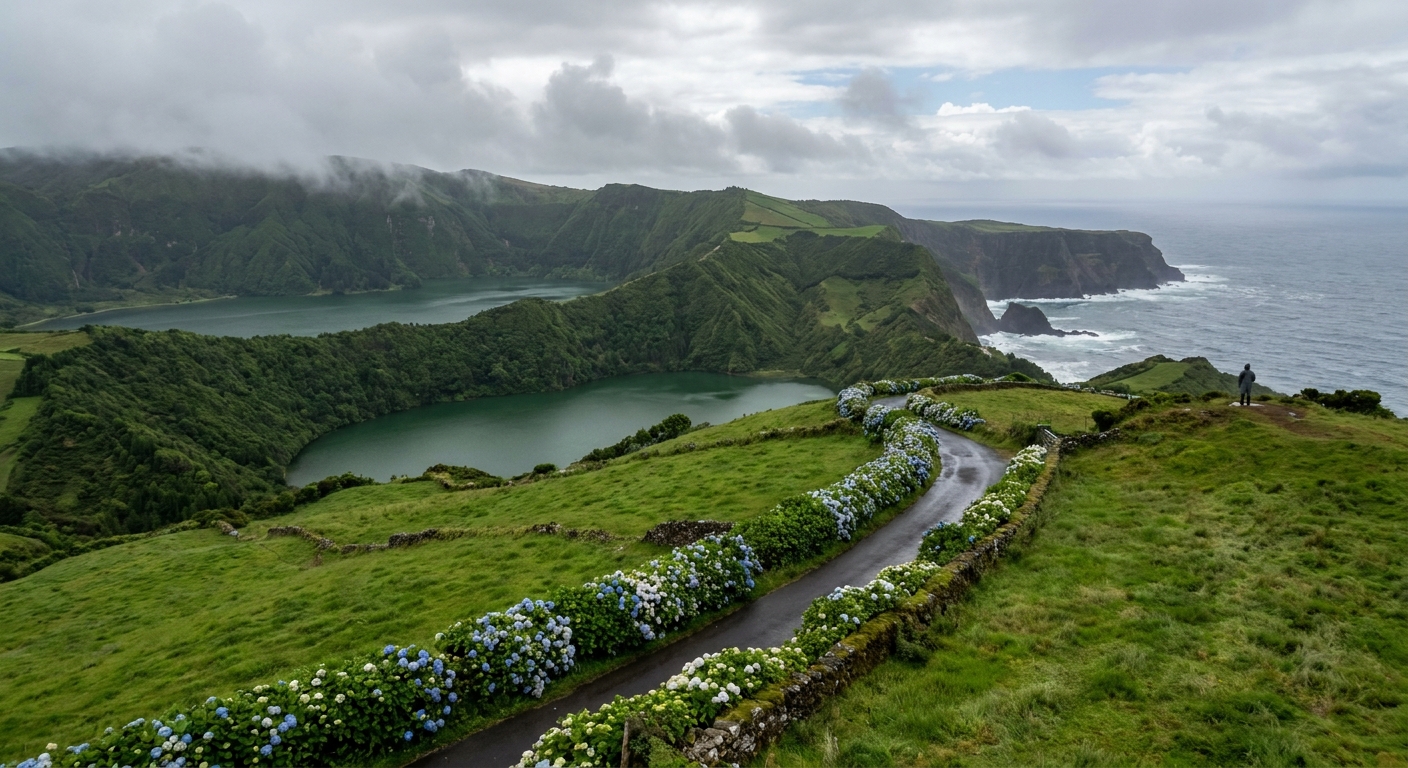
What a lake-side bed genuinely changes is access to the clear hour. Cloud builds on the rim through the morning, and being ten minutes away rather than a drive away means you can look outside, see the ridge exposed, and be at the viewpoint while it lasts. The trade is domestic: fewer places to eat, groceries planned a day ahead, and a walk back after dark with no streetlights doing you favors.
Use the named lookouts as your geography. Vista do Rei gives the set piece, the twin Green and Blue lakes of Sete Cidades in one frame. Lagoa do Fogo is wilder and higher, a different weather system from the coastal reading above, and it clears on its own schedule. Both are ranked with the rest of the island’s set pieces in things to do in the Azores.
How many Azores islands to visit on a first trip
São Miguel is larger than the mental map allows. It runs 62.1 km long and 15.8 km at its widest, covering 744.7 square kilometers, and it climbs to 1,105 m at Pico da Vara. It is the biggest island of the archipelago and carries most of its population. Distances read short on paper and drive long on roads that switchback up through cloud, which is why one island fills a week without apology.
There is no inter-island timetable in these paragraphs, and the reason is worth stating. On September 8, 2026 the regional tourism portal returned a refusal to our reading, so the ferry seasons and flight frequencies we would have quoted could not be checked against a primary source. Unread is not the same as nonexistent: the sailings and the flights are there, we simply will not print numbers we could not verify, because a page that guesses at a crossing you plan a day around does real damage.
The practical consequence lands before you book a bed. Decide the shape first: one island with two bases, or two islands with a transfer day at each end and a second round of check-ins and rental paperwork. A first trip that squeezes in a second island tends to spend its best weather in a terminal, and clear weather is the one thing on an archipelago you cannot buy back.
For the schedules themselves, go to the operators for your exact dates: the airline’s own booking page for the hops, the ferry company’s seasonal timetable for the crossings, and your host for what locals actually see happening that month. Our getting-around guide covers the mainland side of the same trip, and the month-by-month view tells you which weeks reward the gamble.
One argument for a coastal base outranks the rest. These waters form one of the largest whale sanctuaries in the world, with more than 20 cetacean species recorded, about a third of all species that exist. Blue whales show up at the end of winter. Sperm, sei and baleen whales are frequent in summer, along with spotted dolphins, while common and bottlenose dolphins are resident in any month and swimming with them is permitted. A trip out runs about three hours, with a recommended minimum age of five, and the water averages 73.1°F in July against 63.3°F in January.
How much is the tourist tax in the Azores?
For a long stay, the ceiling matters more than the rate. At EUR 2 per person per night with a cap of three consecutive nights, the charge stops accruing on your fourth evening: a ten-night stay and a three-night stay carry the same tax bill of roughly EUR 6 a head. Those figures come from press coverage and host guides rather than the municipal leaflet, which sits behind a login we could not pass, so treat them as a strong indication and have your property confirm the number.
Across Portugal it is the cap, not the nightly rate, that decides the total. Porto charges EUR 3 a night up to seven nights, which tops out at EUR 21. Funchal charges EUR 2 up to seven nights, or EUR 14. Ponta Delgada charges the same EUR 2 but stops at three. A fortnight in Porto and a fortnight on São Miguel do not produce the same line on the invoice, and the gap is bigger than most travelers assume.
Run the arithmetic on a week. Two adults in Ponta Delgada: EUR 2 each per night for three nights, about EUR 12 for the pair, with nights four through seven adding nothing. The same week in Porto, on that city’s published rate, is EUR 21 a head, EUR 42 for two. Remember it is a municipal tax, so a bed in a different municipality answers to a different town hall: ask what that one collects, in writing, at the time you book. Broader costs live on the trip-cost page.
How many nights on São Miguel
Three nights: keep them all in Ponta Delgada and drive out each morning, since the tax caps there anyway. Four to six: two in the capital, then move east and finish in Furnas, so the last bath does not end in a night drive. More than that, add the lake side for a rim at first light. Our three-day plan sets the driving order, and the national base guide slots the island into a longer Portugal trip.
Sources & data for this guide
- Island geography (62.1 km × 15.8 km, 744.7 km², Pico da Vara 1,105 m), 137,856 residents at the 2011 census, capital since 1546 · Visit Azores, official regional tourism board · checked Sep 10, 2026
- Furnas thermal springs, Poça da Beija, Caldeiras of Ribeira Grande and its 1811 thermal building · Visit Azores, São Miguel page · checked Sep 10, 2026
- Terra Nostra Park admission (about EUR 16 visiting adult, about EUR 12.80 resident, under-6s free) · RESERVE: parqueterranostra.com returned 404 on its visit pages and turismo.azores.gov.pt returned 403 to automated reading · attempted Sep 8, 2026, confirm at the gate
- Ponta Delgada municipal tourist tax in force since January 2025 · taxaturistica.cm-pontadelgada.pt read Sep 9, 2026: the platform is live, the rate leaflet is behind authentication · EUR 2 per person per night, ages 13 and over, three-night cap and exemptions relayed by Jornal de Notícias and Correio dos Açores, unconfirmed
- Porto (EUR 3 a night, seven-night cap) and Funchal (EUR 2, seven-night cap) for comparison · municipal primary sources · checked Sep 10, 2026
- January and July normals, rain-day counts, station 513 Ponta Delgada Observatório at 35.0 m · IPMA 1991-2020 · checked Sep 10, 2026
- Sea surface 63.3°F January and 73.1°F July, mean of daily maxima 2015-2024 · Open-Meteo Marine API · checked Sep 10, 2026
- Sunset at 5:48 p.m. on Jan 15 and 8:05 p.m. on Jul 15, converted to Atlantic/Azores, with 14 h 34 min of July daylight · sunrise-sunset.org · checked Sep 10, 2026
- Whale sanctuary, more than 20 species, seasonal presence, three-hour trips, recommended minimum age five, swimming with resident dolphins permitted · Visit Azores, Whale Watching · checked Sep 10, 2026
- Inter-island ferry and flight schedules: not verified, the regional portal returned 403 to automated reading on Sep 8, 2026 · confirm sailings and flights with the operators for your dates
- Zone descriptions are editorial; taxes, admissions and opening hours change · get the tourist tax quoted in writing when you book.