
THE AZORES · DECEMBER · 37.7° N
December on São Miguel runs mild and dark at the same time. The IPMA normal for Ponta Delgada puts the average high at 64.9°F and the average low at 56.1°F, warmer than most of mainland Portugal, and it drops 6.02 inches of rain across the month. The sea holds 65.4°F. On December 15 the sun clears the horizon at 7:49 a.m. and is gone by 5:26 p.m.
Those figures come from one thermometer, 35 meters above the water on the island’s south coast, and IPMA is blunt that high ground is colder and far wetter. Pico da Vara stands at 1,105 m, which is a different December from the harbor. For the question of whether Portugal as a whole rewards a winter trip, the 12-month verdict handles the country. This one is dated to December.
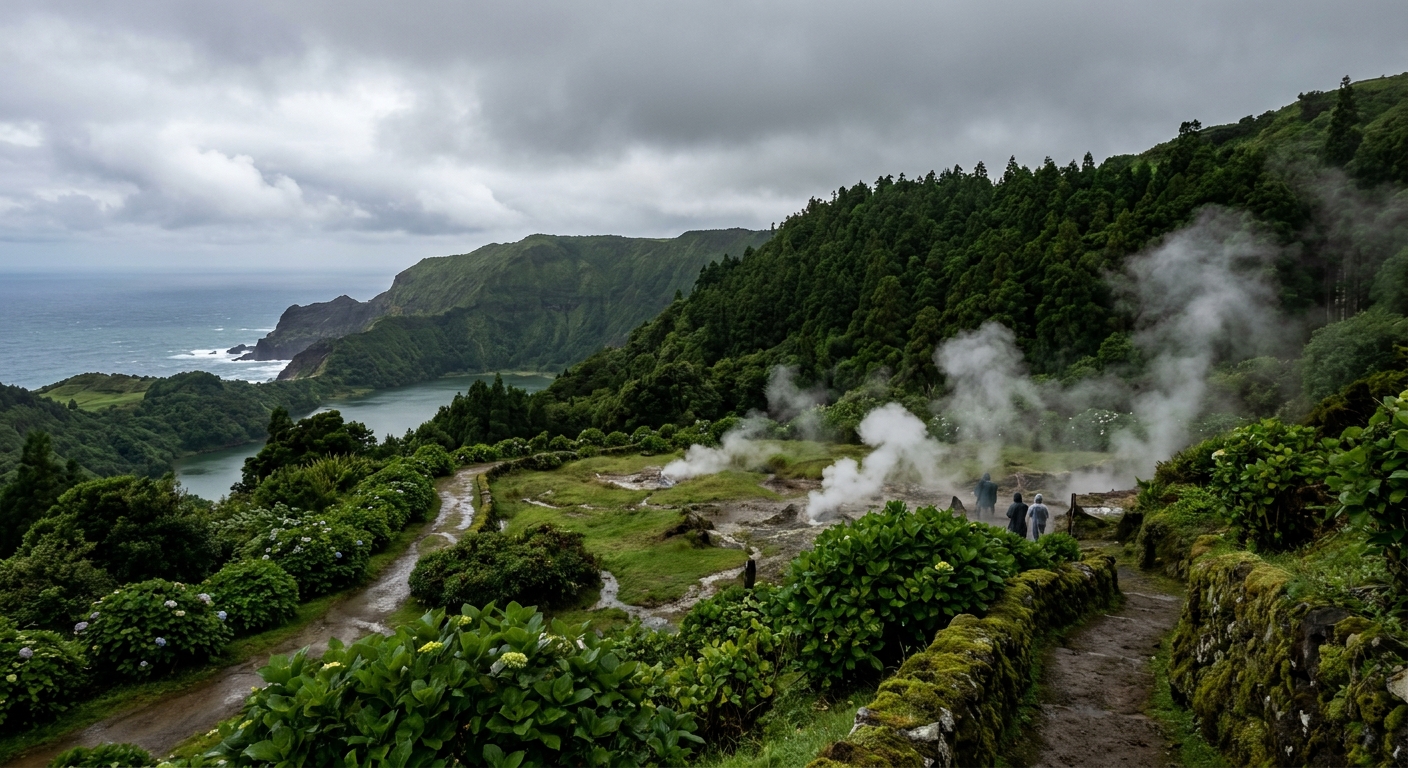
THE MONTH AT A GLANCE · AZORES · DECEMBER
December is mild, wet and short on daylight: 64.9°F days, 15 rain days and 9h 37m of light, with a 65.4°F sea that argues for neoprene or a thermal pool rather than a towel.
IPMA 1991-2020 · STATION 513, PONTA DELGADA · WETTEST OF THE THREE WINTER MONTHS
Go for: thermal bathing at Furnas, resident dolphins that turn up in any month of the year, and the Sete Cidades lookout with almost nobody parked at it.
Think twice before: booking a hiking week on these numbers. The 6.02 inches were measured at 35 m on the south coast, and the island climbs to 1,105 m.
Climate: IPMA station 513 · Sea: Open-Meteo Marine · Cetaceans: Visit Azores · full sources at the end
On this page
- Azores weather in December64.9°F highs, 6.02 inches, 15 rain days
- Can you swim in the Azores in December?A 65.4°F sea, measured as daily maxima
- Crowds, prices and the Ponta Delgada tourist taxWhat we can source, and what we can’t
- Things to do in the Azores in DecemberFurnas, Gorreana, and the three-hour whale boat
- A two-day plan for São MiguelTwo days built on 9h 37m of light
- December vs November and JanuaryThree months side by side, in figures
- Is December a good time to visit the Azores?Who should go, and who should shift to November
One caution before any of these numbers do work for you: every temperature below was recorded at Ponta Delgada Observatório, station 513, at 35 meters on the south coast of São Miguel. The island runs 62.1 km end to end and 15.8 km at its widest, and IPMA states plainly that high ground is colder and far wetter than the coastal record. Pack for the trailhead, not for the harbor front.
Azores weather in December: average highs, lows and rain days
| Measure | December | How it is measured |
|---|---|---|
| Average high | 64.9°F | IPMA normal 1991-2020, station 513 |
| Average low | 56.1°F | Same station, 35 m altitude |
| Precipitation | 6.02 in | Monthly total, same normal |
| Days with 0.04 in or more | 15.0 | IPMA 1 mm threshold |
| Days with 0.39 in or more | 4.5 | IPMA 10 mm threshold |
| Daylight, Dec 15 | 9h 37m | Sunrise 7:49 a.m., sunset 5:26 p.m. local |
The 1991-2020 normal published by IPMA, the Portuguese institute for the sea and the atmosphere, gives December at Ponta Delgada an average high of 64.9°F, an average low of 56.1°F and 6.02 inches of precipitation. Station 513 is an observatory with instruments at 35 meters, not a reanalysis grid cell, and the distinction is worth a sentence: a model square that averages open ocean with a 1,105 m mountain produces a number no traveler ever experiences.
Fifteen days in an average December record at least 0.04 inch, and 4.5 of those record 0.39 inch or more. Note the thresholds: those are IPMA’s 1 mm and 10 mm marks, not the 0.10 inch that American tables use, so the counts do not swap between sources. Read practically, that leaves roughly ten days of drizzle-to-shower, four or five days of rain you build the day around, and sixteen days that record nothing at all.
Between the average high and the average low there are only 8.8 degrees, which is a narrow spread by winter standards: one mid-weight layer covers both ends of the day. Water is the real packing problem. A hooded shell that survives horizontal rain, shoes with grip for wet basalt, a swimsuit within reach for the thermal pools, and a dry bag for the boat cover a São Miguel December. The packing guide handles the rest of the country.
Light is the tighter constraint. December 15 gives 9 hours 37 minutes between a 7:49 a.m. sunrise and a 5:26 p.m. sunset, local time. Crater lakes photograph badly in the last hour anyway, so the usable window is closer to eight hours, and it is not enough for two ends of the island in one drive. Plan one region per day and take the second coast tomorrow.
Can you swim in the Azores in December? Sea temperature at 65.4°F
Sea surface off the Azores averages 65.4°F in December, from Open-Meteo Marine across 2015-2024. Read the small print on that figure: it is the mean of daily maxima, the warmest reading of each day averaged over ten years, so it sits a shade above a true 24-hour mean. The same series gives 68.4°F in November and 63.3°F in January, which puts December on the downslope rather than at the bottom.
At 65°F the water is swimmable and unpleasant in roughly that order. Anyone conditioned by a New England summer will manage fifteen or twenty minutes and enjoy about twelve of them. Everyone else wants neoprene, or wants the geology instead: the Furnas valley’s bathing spots are the December alternative, with Poça da Beija and its ferrous mud and the thermal pool inside Terra Nostra Park doing what the Atlantic will not.
On wind and swell we have nothing dated we are willing to print, so no numbers here, only the operational fact: December boats sail or they don’t, and the decision is made that morning. A whale watching trip runs about three hours, and Visit Azores recommends a minimum age of five, on the reasoning that a sea an adult calls calm is hard going for a small child. Book the first morning of your stay and keep a second morning free.
How busy are the Azores in December? Crowds, prices and the tourist tax
December’s place in the Azorean price year is the one figure we cannot hand you: no monthly rate series for island hotels survived our checks, and a percentage we can’t source is worth less than nothing. What can be said without inventing anything is that the month splits in two. The first three weeks are the archipelago at its emptiest, and the stretch from about December 20 to New Year is the exception, when returning family fills rooms and flights (est.).
That split changes the booking calendar rather than the budget. For the holiday fortnight, treat four to six weeks ahead as the floor (est.), and check the transatlantic legs first, since the routing is the scarce part rather than the bed. Getting there from the US covers the connections. For the first three weeks, a few days of lead time on a room is usually enough, and the flexibility is worth keeping for weather.
Ponta Delgada has charged a municipal tourist tax since January 2025, and the city runs a dedicated platform for it. We read the platform; its rate leaflet sits behind a login. Press reports and host guides agree on EUR 2 per person per night for guests aged 13 and over, capped at three consecutive nights, so roughly EUR 6 a head, with exemptions for under-13s, medical stays, disability of 60 percent or more, and Azorean residents. Treat those figures as unconfirmed and ask the property to quote the tax in writing.
The cap is what decides the bill, and it varies across Portugal: Porto charges EUR 3 a night up to seven nights, EUR 21 in all, Funchal EUR 2 up to seven nights, EUR 14, against Ponta Delgada’s three-night stop. The one upgrade that changes the month is the car. On 15 rain days, a rental is what lets you leave a gray south coast for the north one, and December fleets are small, so book it before the room.
Things to do in the Azores in December: Furnas, Gorreana and the whale boats
Whale and dolphin watching runs all year in these waters, and the month decides the cast. December is not the blue whale window, which comes at the end of winter, and it is not the summer bill of sperm whales, sei whales and spotted dolphins either. What December delivers is the resident population: common dolphins and common bottlenose dolphins are present in any month, and swimming with them is permitted. The Azores are one of the largest whale sanctuaries on earth, with more than 20 species recorded, about a third of all the cetacean species that exist.
Named, with what we could verify: the boat trip is about three hours with a recommended minimum age of five. Terra Nostra Park at Furnas, thermal pool inside a botanical garden, prices visitors and residents differently, around EUR 16 for a visiting adult against about EUR 12.80 for a resident, under-6s free. We could not read those numbers on the park’s own site, which returned an error, nor on the regional tourism portal, which refuses automated reading, so confirm at the gate. Opening hours we will not guess at: call ahead.
What costs only fuel: the Vista do Rei lookout over the twin Green and Blue lakes of Sete Cidades, the higher and wilder Lagoa do Fogo, the fumaroles steaming beside the road through the Furnas valley, and the Caldeiras of Ribeira Grande, whose thermal building dates from 1811 and stands among trees and vents. Add the seafront at Ponta Delgada, capital of the island since 1546, for the hour when the rain settles in.
The Azores in December: a two-day plan for São Miguel
Day one, west then east. Breakfast in Ponta Delgada in the dark, on the road by 7:45 as the sun comes up behind you. Vista do Rei over Sete Cidades by 8:45, when the cloud on the crater rim is still deciding. Down to the lake and back out by 11. Lagoa do Fogo at midday, the one stop that punishes a late start. Furnas by 3, the fumaroles first, then Terra Nostra or Poça da Beija in the last hour of light before 5:26 p.m.
Day two, the north coast. The whale boat if it sails, three hours out of the harbor, first slot of the morning. Then the tea road: Gorreana, growing tea since 1883 and the oldest plantation in Europe, and Porto Formoso a few miles on, both running museum-factories. Finish at the 1811 caldeiras building in Ribeira Grande. If the rain arrives, and on 15 wet days in 31 it may, drive across the island rather than waiting it out: the south coast and the north coast run different weather most of the winter.
The Azores in December vs November and January
| Measure | November | December | January |
|---|---|---|---|
| Average high | 67.8°F | 64.9°F | 63.5°F |
| Average low | 58.8°F | 56.1°F | 54.9°F |
| Precipitation | 3.75 in | 6.02 in | 4.02 in |
| Days with 0.04 in or more | 11.8 | 15.0 | 13.0 |
| Sea (mean daily max) | 68.4°F | 65.4°F | 63.3°F |
All five rows come from the same station and the same normals period, so the comparison is clean. December is not the coldest of the three, January is, by 1.4 degrees on the daytime high. December is the wettest by a wide margin: 6.02 inches against 3.75 in November and 4.02 in January, which is 2.27 inches more than the month before it and 2.00 more than the month after. It also carries three more rain days than November.
Shift four weeks earlier and you gain 2.9 degrees on the daytime high, three fewer wet days and a sea 3.0 degrees warmer at 68.4°F, which is the difference between a swim and a dare. Shift four weeks later and you keep the quiet, lose 2.1 degrees of sea and gain two dry inches. Both are already written up: the Azores in November and the Azores in January.
Is December a good time to visit the Azores?
Yes for travelers who came for volcanic landscape, hot water and boats, and who accept that four or five days of the trip will be spent driving between showers. Yes, too, for anyone whose calendar is the constraint rather than the weather, since the first three weeks are as close to empty as São Miguel gets. No for swimmers without wetsuits, no for a fixed hiking itinerary at altitude, and no for a two-day stopover, because 6.02 inches has to fall somewhere.
If the answer lands on no, November is the month to move to rather than January. It is warmer in the air and by 3.0 degrees in the water, it is drier by 2.27 inches, and the daylight has not yet shrunk to its floor. Late winter is the other target, for a different reason entirely: blue whales are easily spotted at the end of winter, and no December sailing will find one.
What December alone hands you: a sea still holding 65.4°F, two degrees above January’s, on the shortest days of the year, with the Sete Cidades lookout to yourself at nine in the morning.
The last word
Two decisions carry a São Miguel December, and neither is the hotel. Book the whale boat for your first morning, since three hours at sea in winter is a weather lottery you want to enter twice. And get the tourist tax quoted in writing before you arrive, because EUR 2 a night capped at three is what the press reports say and what the city’s own leaflet keeps behind a login. Ponta Delgada has been the capital since 1546, when it took the title from Vila Franca do Campo, which an earthquake had flattened in 1522. The islands have been improvising around the weather for a while.
Sources & data for this guide
- December highs, lows and precipitation · IPMA, climatological normals 1991-2020, station 513 Ponta Delgada Observatório, 35.0 m · checked Sep 9, 2026
- Rain-day counts and their 1 mm / 10 mm thresholds · IPMA, same normals · checked Sep 9, 2026
- November and January normals used in the comparison table · IPMA, same station and same period, not estimates · checked Sep 9, 2026
- Sea surface 65.4°F, as the mean of daily maxima 2015-2024 · Open-Meteo Marine API · checked Sep 9, 2026
- Daylight 9h 37m, sunrise and sunset on December 15, converted to Azores local time · sunrise-sunset.org · checked Sep 9, 2026
- Whale watching seasons, resident dolphins, three-hour trips, minimum age five, sanctuary and species count · Visit Azores (official regional tourism) · checked Sep 9, 2026
- São Miguel dimensions, Pico da Vara at 1,105 m, Furnas thermal springs, Gorreana and Porto Formoso, Ponta Delgada capital since 1546 · Visit Azores · checked Sep 9, 2026
- Terra Nostra Park admission (about EUR 16 visitor / EUR 12.80 resident / under-6 free) · unconfirmed: parqueterranostra.com returned 404 on its visit pages, turismo.azores.gov.pt returned 403 · attempted Sep 8, 2026
- Ponta Delgada tourist tax · taxaturistica.cm-pontadelgada.pt read Sep 9, 2026, platform confirmed, rate leaflet behind a login; EUR 2 per night capped at 3 nights relayed by Jornal de Notícias and Correio dos Açores · unconfirmed
- Porto (EUR 3, 7-night cap) and Funchal (EUR 2, 7-night cap) tax caps · municipal primary sources · checked Sep 9, 2026
- We hold no monthly hotel-rate series and no verified wind or wave series for the Azores, so no price percentages and no swell figures appear above. Booking lead times are marked (est.). Opening hours change · confirm with operators when you book.