
AZORES · MARCH · 37.7° N
March is the month the Azores stop being winter without yet being spring. At Ponta Delgada the average afternoon reads 64.2°F and the average dawn 54.7°F, daylight has climbed back to a full twelve hours, and the official tourism board puts blue whales, the end-of-winter headliner, among the easy sightings off São Miguel.
What it takes back is dryness and warm water. An average March logs 11.7 days with measurable rain and 3.82 inches of it, and the sea sits at 61.9°F, the coldest of the late-winter run. That combination makes a superb hiking-and-whales week and a poor beach one.
MARCH AT A GLANCE · THE AZORES
March buys you 64.2°F afternoons, twelve hours of daylight and the end-of-winter blue whale window, at the price of 11.7 wet days and the year’s coldest sea.
AVG HIGH 64.2°F · 11.7 RAIN DAYS · SEA 61.9°F · BLUE WHALE WINDOW
Go for: whale trips at the end of the blue whale window, crater-lake lookouts with nobody on them, thermal water at Furnas, and a rental car that can outrun a shower across a 62 km island.
Think twice before: planning anything around swimming off a beach, or booking a boat on the last day of the trip: 11.7 wet days a month move sailings.
Normals: IPMA station 513, Ponta Delgada · Sea: Open-Meteo Marine · Whales: Visit Azores · full sources at the end
On this page
- Average highs, lows and rain daysMarch normals from IPMA station 513
- Sea temperature in March61.9°F, and what that means in the water
- Crowds, prices and the Ponta Delgada tourist taxWhat we can and cannot put a number on
- Things to do in the Azores in MarchWhales, Furnas and the tea plantations
- A two-day plan for São MiguelHour by hour, with a wet-day version
- March, February or April?Three months side by side, in figures
- Is March a good month, or should I wait for April?The verdict, with April’s figures next to it
Nine islands, and one thermometer doing most of the talking. IPMA’s station 513 at Ponta Delgada Observatório sits at 35 m on the south coast of São Miguel, and its 1991-2020 normals are what almost every March forecast for the Azores quotes. High ground is colder and far wetter, and the north coast runs its own weather. For the wider calendar, see the twelve-month verdict for Portugal. The neighboring months have their own pages: February and April.
Azores weather in March: average highs, lows and rain days
| Measure | March normal (1991-2020) |
|---|---|
| Average high | 64.2°F (17.9°C) |
| Average low | 54.7°F (12.6°C) |
| Precipitation | 3.82 in (97 mm) |
| Days with 0.04 in or more | 11.7 |
| Days with 0.39 in or more | 2.9 |
| Daylight, March 15 | 12h 00m · 6:51 a.m. to 6:51 p.m. |
| Sea surface (mean of daily maxima) | 61.9°F |
The 1991-2020 normals for March at Ponta Delgada Observatório, IPMA station 513, give an average high of 64.2°F, an average low of 54.7°F and 3.82 inches of rain across the month. That is a real thermometer standing 35 m above the sea, not a reanalysis grid cell averaged over open ocean, which is why it can disagree with the app on your phone. Read it as a coastal figure for the south side of one island. It does not describe the rim above Sete Cidades or the Fogo road, both higher and wetter.
An average March records 11.7 days with at least 1 mm, that is 0.04 inch. IPMA counts to its own threshold, not the 0.10 inch that American tables use, so the two numbers are not interchangeable and the Azorean one will always look grimmer than it lives. Only 2.9 days reach 10 mm (0.39 inch). Day to day that means something falls on roughly one day in three, most of it brief and gone by lunch, with a genuine washout arriving once or twice a week.
Between the afternoon and the dawn there are 9.5°F, a small gap that flatters the month. Wind and wet do the work the thermometer skips: 64°F on an exposed rim with rain crossing it feels closer to the low fifties. Pack a hard shell rather than a fleece alone, boots that shrug off mud, and one warm layer reserved for the boat, where three hours of open Atlantic is colder than three hours ashore. Our packing guide handles the rest of the bag.
On March 15 the sun rises at 6:51 a.m. and sets at 6:51 p.m. Azores time: twelve hours exactly, a few days ahead of the equinox itself. That buys a whole morning at sea and a whole afternoon inland with no headlamp involved. Light quality is the catch. Under 11.7 wet days, the useful window at a lookout can be twenty minutes wide, so drive to Vista do Rei when the cloud lifts rather than when the itinerary says to.
Can you swim in the Azores in March? Sea temperature at 61.9°F
Sea surface off the Azores averages 61.9°F in March in the Open-Meteo Marine record for 2015-2024. The small print matters: that figure is the mean of daily maxima, the warmest reading of each day, so a full 24-hour mean sits a shade below it. It is also the bottom of the late-winter curve. February comes in at 62.7°F and April at 63.0°F, both above March.
Sixty-two degrees is swimmable for roughly as long as it takes to regret it. Call it wetsuit water, not towel water, and move your bathing to the Furnas valley, where the temperature is geological rather than seasonal. There is one reason to get in off a boat instead. Visit Azores lists common dolphins and common bottlenose dolphins as resident, present in any month, and swimming with them as permitted.
Wind and swell are the part we cannot put a number on. Neither IPMA’s monthly normals nor the marine record we read publishes a March wave height or gust value for the islands, and we are not going to guess one. What the tourism board does state is operational: a trip out lasts about three hours, and the recommended minimum age is five, because a sea an adult calls calm can be hard on a small child. Treat every March sailing as weather-dependent and hold a spare day.
How busy are the Azores in March? Crowds, prices and the Ponta Delgada tourist tax
No monthly occupancy or price index for São Miguel survived our checks. IPMA publishes weather, not beds, and the regional tourism portal refuses automated reading, so we publish no price curve for the month. What is dated is the thing that drives demand. Visit Azores places sperm whales, sei whales, baleen whales and spotted dolphins in summer, and the island’s boats and beds are priced around that season, which puts March in front of the pull rather than inside it.
What runs short in March is not a room, it is a sailing. Boats operate all year, but a three-hour trip needs a workable sea, and 11.7 wet days a month push people into the next slot. Book the whale trip for your first full day rather than your last, and buy flexibility rather than the cheapest seat. The two mountain roads follow the same rule: Lagoa do Fogo and Sete Cidades reward the morning that opens, not the morning on the plan.
Ponta Delgada has levied a municipal tourist tax since January 2025. The city runs a dedicated platform for it, which we read and which confirms the tax exists, but the rate leaflet is behind a login. Treat the widely reported figures as unconfirmed: EUR 2 per person per night for guests aged 13 and over, capped at 3 consecutive nights, about EUR 6 a head, with under-13s, medical stays, disability of 60 percent or more and Azorean residents exempt. Ask the property to quote it in writing.
The one line worth overpaying is the car. São Miguel is 62.1 km long and 15.8 km at its widest, and in a month with 11.7 wet days the whole difference between a good day and a wasted one is being able to leave a shut-in south coast for whatever the north coast is doing. Our rental guide covers the Portuguese paperwork and the insurance trap. A guided minibus drives the same roads on somebody else’s schedule, which in March is the wrong schedule.
Things to do in the Azores in March: whales, Furnas and the tea plantations
March is the end of winter, and Visit Azores is specific about what that buys at sea: blue whales are easily spotted at this point in the year. The archipelago is one of the largest whale sanctuaries in the world, with more than 20 cetacean species recorded, about a third of all the species that exist. Summer swaps the cast for sperm whales, sei whales and spotted dolphins. If the blue whale is the reason for the flight, a July trip is the wrong ticket.
A trip out of Ponta Delgada runs about three hours, with a recommended minimum age of five. At Furnas, the thermal pool in the botanical garden of Terra Nostra Park prices a visiting adult near EUR 16 and a resident near EUR 12.80, with under-6s free, though the park’s own site returned a 404 and the regional portal a 403 when we tried to read them, so confirm the rate at the gate. Gorreana has grown tea since 1883 and calls itself Europe’s oldest plantation. Its museum-factory can be visited, and Porto Formoso runs one too.
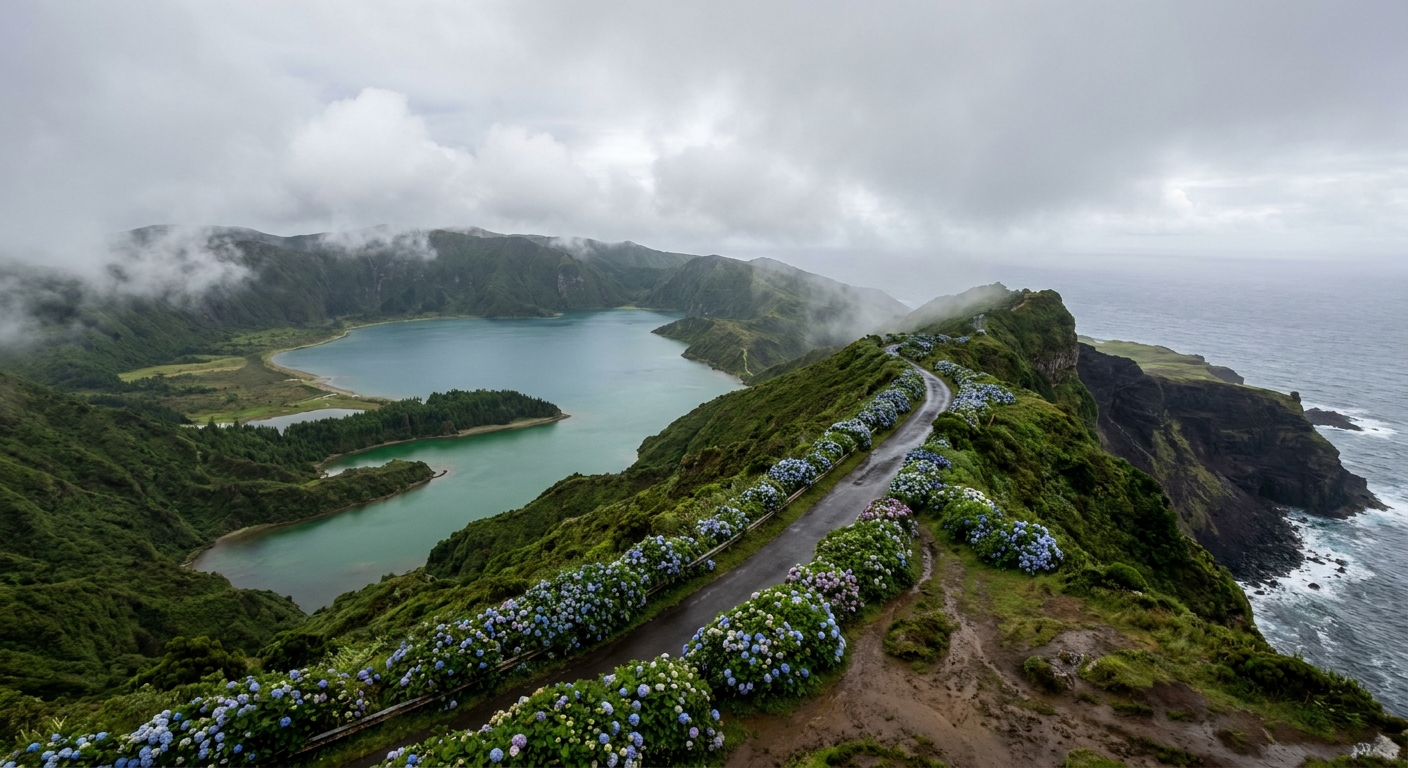
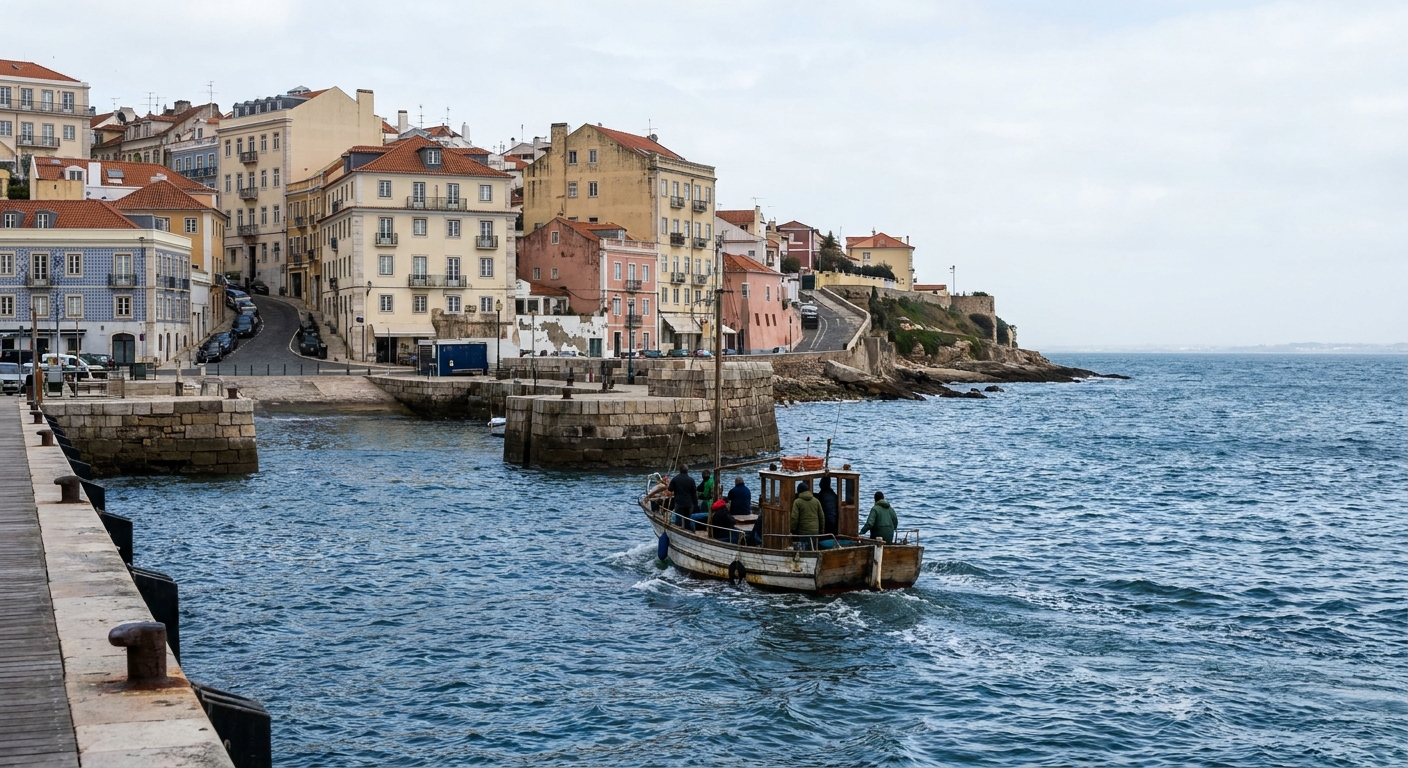
The lookouts cost nothing, and in March they are the day’s real currency: Vista do Rei over the Green and Blue lakes of Sete Cidades, and the higher, wilder Lagoa do Fogo. At Ribeira Grande the Caldeiras stand among trees and steam, the thermal building there dating from 1811, and the fumaroles ask nothing of you but a tolerance for sulfur. Ponta Delgada has been the island’s capital since 1546, when the role passed from Vila Franca do Campo after the earthquake of 1522, and its seafront fills a free hour when rain sets in.
The Azores in March: a two-day plan for São Miguel
Day one belongs to the sea. Sunrise at 6:51 a.m. means breakfast is not a race. Take a mid-morning boat out of Ponta Delgada, three hours, warm layer and hard shell in the bag, blue whales as the end-of-winter prize and the resident dolphins as the reliable fallback. Back ashore by early afternoon, drive west to Sete Cidades and take Vista do Rei on whatever cloud allows. Be at the rim by 4 p.m.: the light goes at 6:51 p.m., and the descent is slow in the wet.
Day two runs east to Furnas. Thermal pool first, when a 54.7°F dawn makes hot water look like wisdom, then home along the north coast with a stop at Gorreana for tea. This is the day that survives a change in the sky. Thermal water and a tea factory are indifferent to the 0.39 inch that falls on 2.9 days in an average March. Only the order moves: Lagoa do Fogo takes whichever morning clears, and the streets of Ponta Delgada take the afternoon that does not.
The Azores in March vs February and April: highs, rain days and sea
| Measure | February | March | April |
|---|---|---|---|
| Average high | 63.3°F | 64.2°F | 65.8°F |
| Average low | 53.8°F | 54.7°F | 55.9°F |
| Precipitation | 3.43 in | 3.82 in | 3.13 in |
| Days with 0.04 in or more | 10.8 | 11.7 | 10.2 |
| Sea (mean of daily maxima) | 62.7°F | 61.9°F | 63.0°F |
Across the three months the thermometer barely stirs: highs of 63.3°F, 64.2°F and 65.8°F, lows of 53.8, 54.7 and 55.9. Rain is where March loses the argument. It brings 3.82 inches over 11.7 wet days, against 3.43 inches over 10.8 in February and 3.13 inches over 10.2 in April, the driest of the three. The water runs against the air: 62.7°F in February, 61.9°F in March, 63.0°F in April.
Shift four weeks forward and April hands you 1.6°F more afternoon warmth, 0.69 inch less rain, one and a half fewer wet days and 1.1°F more sea. It takes away the end-of-winter weeks that Visit Azores ties to blue whales, and it walks you one month closer to the summer pricing built around sperm-whale season. Shifting back to February gains nothing in the water that 0.8°F can pay for. Both months are laid out in full on the February page and the April page.
Is March a good time to visit the Azores?
Yes for whale-watchers, hikers and anyone building a week around one animal. Blue whales at the end of winter, twelve hours of daylight and 64.2°F afternoons make a working outdoor week, with the crater lakes largely to yourself. No for a beach holiday: 61.9°F water and 11.7 wet days will not carry it. Families should also weigh the recommended minimum age of five on the boats, since the trip that justifies the month lasts three hours offshore.
If the answer came out no, April is the fix rather than June: 65.8°F, 3.13 inches, 10.2 wet days and 63.0°F water, still ahead of the crowd that summer’s sperm-whale season brings. If what you actually want is warm salt water, Madeira is the other Atlantic answer in Portuguese, and the mainland’s month-by-month case sits in the best-time guide.
One thing March holds alone: the end-of-winter weeks when the largest animal that has ever lived counts as an easy sighting off São Miguel, in daylight that already runs a full twelve hours.
The last word
Put the boat at the front of the trip and the Furnas pool at the back, and let the crater lakes take whichever morning clears. One last figure to keep the coastal numbers honest: IPMA’s thermometer stands 35 m above the sea, while Pico da Vara, the island’s high point, reaches 1,105 m. Nothing in that 64.2°F line describes the top of it, and any of the 137,856 people who live on São Miguel will say so if you ask on the way up.
Sources & data for this guide
- March, February and April normals 1991-2020 (highs, lows, precipitation, rain days) · IPMA, station 513 Ponta Delgada Observatório, altitude 35.0 m · checked Sep 9, 2026
- Scope warning: these are coastal readings for one island, not archipelago-wide values · IPMA station metadata · checked Sep 9, 2026
- Sea surface 61.9°F, given as the mean of daily maxima 2015-2024 · Open-Meteo Marine API · checked Sep 9, 2026
- Daylight 12h 00m on March 15, sunrise 07:51 UTC and sunset 19:51 UTC, converted to Azores time · sunrise-sunset.org · checked Sep 9, 2026
- Whale season, three-hour trips, recommended minimum age five, sanctuary and 20-plus species · Visit Azores (official regional tourism board), Whale Watching · checked Sep 9, 2026
- São Miguel geography, Ponta Delgada as capital since 1546, Furnas thermal sites, Sete Cidades and Lagoa do Fogo lookouts, Gorreana and Porto Formoso · Visit Azores, São Miguel · checked Sep 9, 2026
- Terra Nostra Park rates (EUR 16 / EUR 12.80 / under-6 free) are UNCONFIRMED: parqueterranostra.com returned 404 on its visitor pages and turismo.azores.gov.pt returned 403 · attempted Sep 8, 2026
- Ponta Delgada tourist tax: the municipal platform taxaturistica.cm-pontadelgada.pt confirms the tax, its rate leaflet is behind a login. EUR 2 per night, 13+, three-night cap relayed by Jornal de Notícias and Correio dos Açores · checked Sep 9, 2026
- Cap comparison (Porto EUR 3 up to 7 nights, Funchal EUR 2 up to 7 nights) · municipal sources for Porto and Funchal · checked Sep 9, 2026
- Itineraries, packing calls and crowd reasoning are editorial · boat schedules, park rates and opening hours change, confirm with operators when you book.