
AZORES · SÃO MIGUEL · THINGS TO DO
Whale watching here runs twelve months a year. The crater lakes are looked at from named railings on a crater rim. The bathing pools at Furnas work in the rain, and the tea factory at Gorreana has been picking leaves since 1883. Most of a first Azores trip happens on one island: São Miguel, 62.1 km end to end, with one capital, two tea plantations and dozens of thermal springs.
Prices are the awkward part. Terra Nostra’s own site returns an error on its visiting pages, the regional tourism portal blocks automated reading, and Ponta Delgada keeps its tourist-tax leaflet behind a login. Where a figure could not be read at source, it is flagged as an order of magnitude and the desk that can quote it is named.
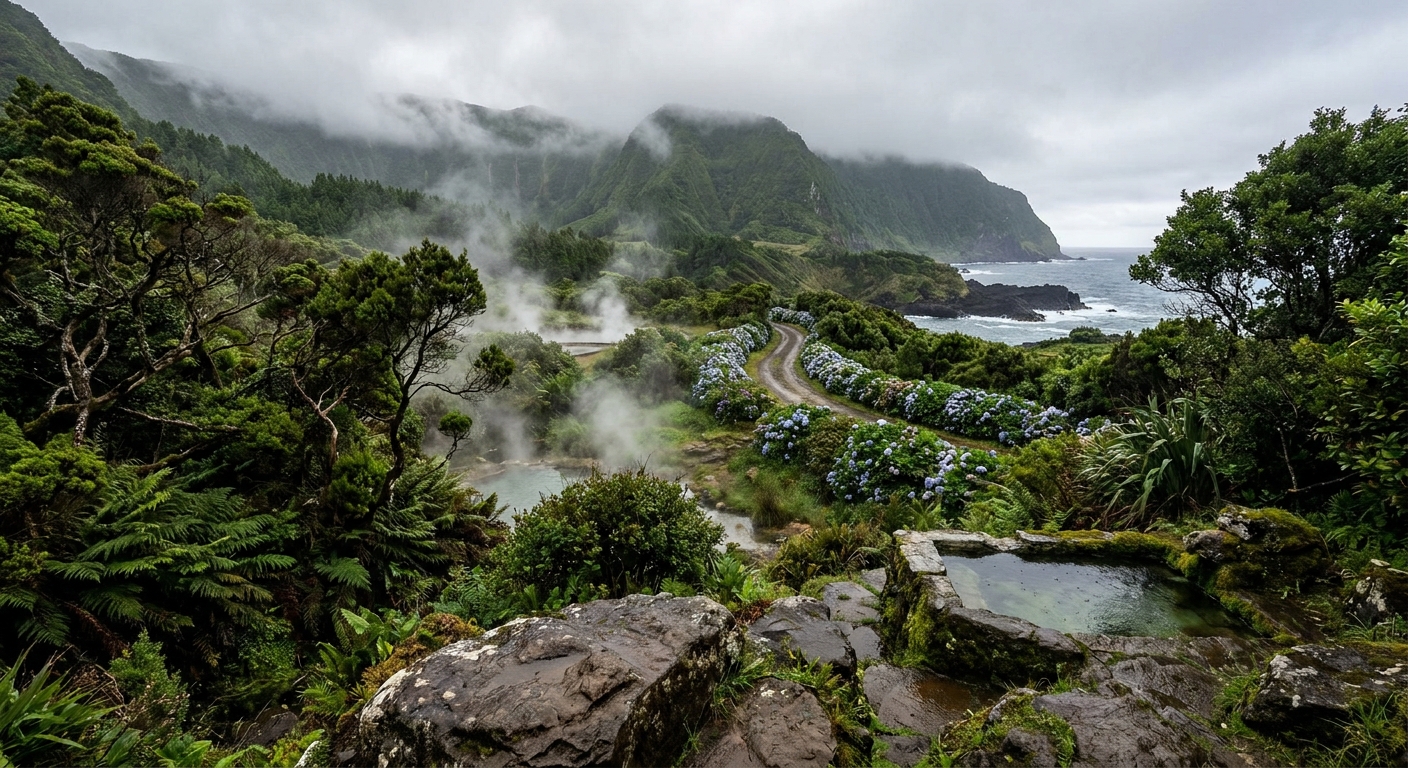
THE ISLAND AT A GLANCE · SÃO MIGUEL
Base on São Miguel, book the whale trip early in the stay, and keep two attempts in hand for the crater lakes: the sea works all year, the lookouts work when the cloud lifts.
WHALES ALL YEAR · 3-HOUR SAILINGS · MIN AGE 5 · TEA SINCE 1883
Go for: resident dolphins in any month, two crater-lake lookouts on one island, thermal bathing that ignores the weather, and Europe’s oldest tea plantation with its factory open to visitors.
Think twice before: taking a child under five on a three-hour sailing, or spending your only clear morning anywhere but a lookout.
Whales and island data: Visit Azores · Normals: IPMA station 513 · Tax: Câmara Municipal de Ponta Delgada · full sources at the end
On this page
- Whale watching by seasonWhich whales, which months
- Sete Cidades and Lagoa do FogoThe crater lakes and their lookouts
- Hot springs at FurnasPoça da Beija and the Caldeiras
- Europe’s oldest tea plantationGorreana and Porto Formoso
- A thermal pool in a botanical gardenTerra Nostra Park, price and reserve
- How big São Miguel is62.1 km by 15.8 km
- What to see in Ponta DelgadaThe capital since 1546
- Azores tourist taxEUR 2 a night, 3-night cap
- Best month for each activityMonth by month
- Where the weather figures are measuredStation 513, Ponta Delgada
All of it sits on São Miguel, the largest island of the archipelago, and most of it within a car radius of Ponta Delgada. For your own dates, the twelve Azores month pages and the best-time verdict hold the normals and rank them, and the Azores guide handles the orientation.
Whale watching in the Azores: which whales, which months
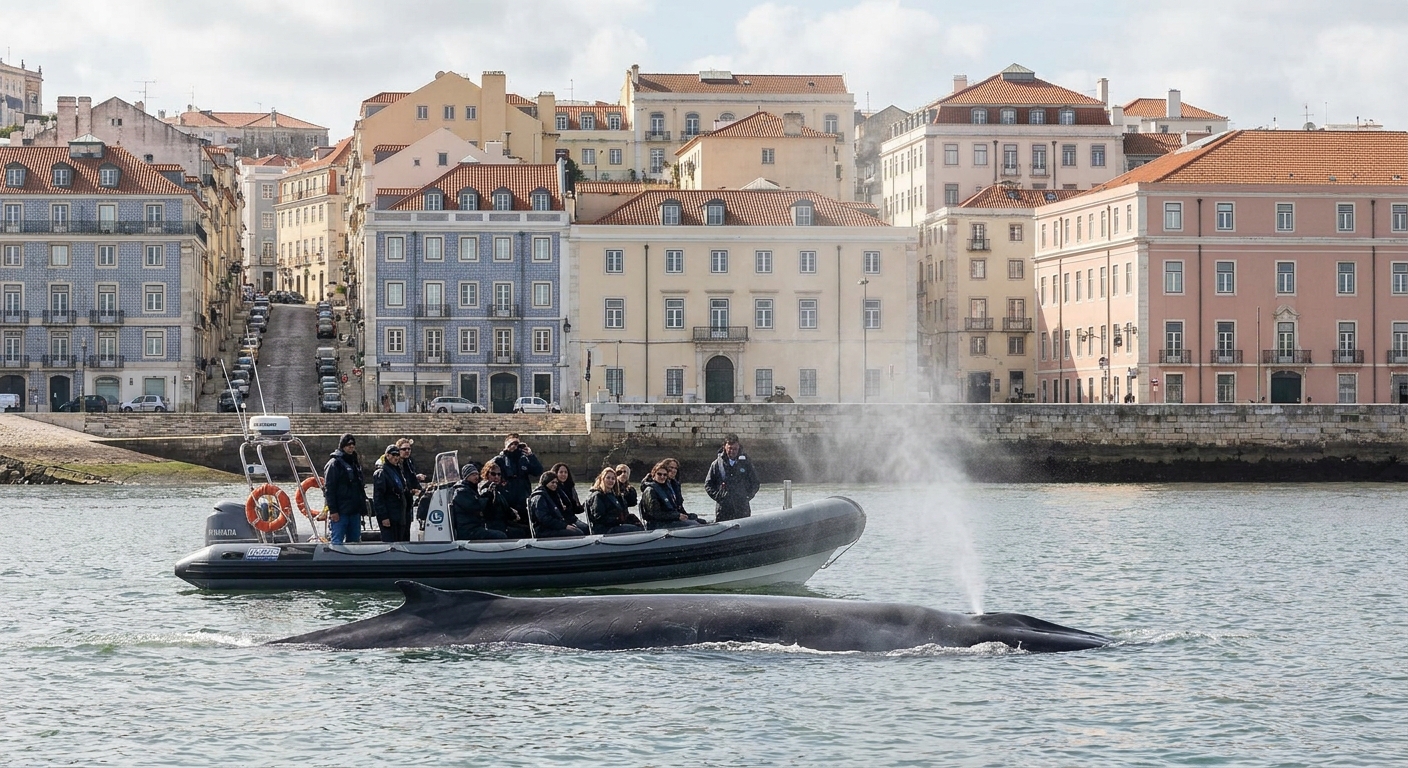
Blue whales are the late-winter sighting, and the regional tourism office puts the easy ones at the end of winter. Summer changes the cast: sperm whales, sei whales and other baleen whales become frequent, with spotted dolphins arriving alongside them. Two species never leave. Common dolphins and common bottlenose dolphins are resident, present in any month you book, and swimming with them is permitted here. That resident pair is why the season for going out at all is twelve months long, even when the headline animal changes.
A trip out lasts about three hours. The official recommendation sets a minimum age of five, and the wording deserves to be taken literally: a sea an adult calls calm can be hard on a small child. Nothing in the same guidance sets an upper age or a fitness rule, so the age-five line is the only threshold you have to plan around.
The archipelago is one of the largest whale sanctuaries in the world, with more than 20 cetacean species recorded in its waters, roughly a third of all the species that exist. Hold that number as a catalogue rather than a promise. Twenty-plus species across a year of sailings is not twenty species in one three-hour morning.
The figure we could not read is the price. No source available to us quotes a rate for an Azores whale-watching sailing, so we give none. Ask the operators on the Ponta Delgada waterfront, and get the price with the departure time attached, since the same boat may run more than one slot.
Sete Cidades and Lagoa do Fogo: best viewpoints and how to get there
Two craters carry the island’s set pieces. Sete Cidades holds the twin Green and Blue lakes, and the named viewpoint for them is Vista do Rei, on the rim above the village. Lagoa do Fogo is the other, a single lake in the middle of the island, higher and wilder, with no village at its edge at all.
The difference shows up on a cloudy day. Vista do Rei looks down into a crater from its lip, so a low ceiling takes the whole frame. Lagoa do Fogo sits higher again, and high ground in the Azores is colder and far wetter than the coastal readings suggest. Plan two attempts in a week rather than one, and spend the clear morning at a railing instead of at breakfast.
Furnas hot springs: which pools to visit and how to get in
Two bathing spots are named by the tourism office. Poça da Beija is a set of pools mixing clear water and ferrous mud, the kind that stains a pale swimsuit for good. The Caldeiras of Ribeira Grande are the other, a cluster of springs on the same thermal circuit, and the water there arrives with the smell that comes with it.
At the Caldeiras, the thermal building dates from 1811 and stands among trees and fumaroles rather than behind a spa lobby. Steam comes up through the ground beside the path. It is one of the few places on the island where the volcano is a neighbor and not a view.
The Furnas Valley goes well past its bathing pools: dozens of thermal springs, fumaroles venting in the open, and carbonated water you can taste from the springs themselves. Where a pool charges admission, the tariff is posted at the gate. No source we could read prints one, so carry cash and ask on arrival rather than turning up with a figure from a forum.
Azores tea plantations: Gorreana and Porto Formoso, hours and entry
Gorreana and Porto Formoso both grow tea on São Miguel, and both run museum-factories open to visitors: the rolling machines, the drying floors, the sorting. Gorreana has been growing tea since 1883 and calls itself the oldest tea plantation in Europe.
That claim rests on a simple scarcity. These are the only tea plantations in Europe, per the regional tourism office, which makes the walk between the rows a genuinely unrepeatable hour on this continent. The hillside above the north coast does the work: rain, mild air and volcanic soil.
You drink the estate’s own tea at the end of the visit, and you can carry packets home. What we cannot give you is a price list: no readable source quotes an entry fee, a tasting charge or a retail rate for either plantation. Both answer by phone and email, and both sell at the factory door.
Terra Nostra Park: the thermal pool and the botanical garden
Terra Nostra at Furnas is the one everybody has seen a photograph of: a large iron-rich thermal pool, the color of strong tea, set inside a botanical garden. The garden is the other half of the ticket, with mature planting and paths well beyond the pool deck.
On price, our cards on the table: the figure we have for a visiting adult is around EUR 16, and we could not verify it at source. The park’s own site returns a 404 on its visiting pages and the regional tourism portal returns a 403 to automated reading. Treat EUR 16 as an order of magnitude and confirm at the gate before you queue.
The same unverified set gives about EUR 12.80 for an Azores resident and free entry for under-6s. Two-tier pricing is ordinary in Portugal, where island attractions and ferries commonly separate residents from visitors. It also means a quoted price you find online may be the resident one.
For the exact number, ask the ticket desk at the park itself, or the reception of any hotel in Furnas, since they sell the day out constantly. Ask for the adult rate and the closing time in the same breath, and ask whether the towel is included or rented.
How big is São Miguel: length, width and highest point
São Miguel measures 62.1 km long, 15.8 km at its widest and 744.7 square kilometers, making it the largest island of the archipelago. It is still small enough that the tea plantations, both crater lakes and the thermal valley are all day trips from one bed. Book one base rather than three, and count half-days instead of kilometers, because the interior roads climb and turn.
Pico da Vara reaches 1,105 m at the eastern end, high enough to run its own weather. The island’s official normals come from a thermometer on the coast at 35.0 m, and high ground here is colder and considerably wetter than that. A crater rim can sit inside cloud on a morning the capital spends dry.
Ponta Delgada: what to see in the Azores capital
Ponta Delgada has been the island’s capital since 1546. It took the role from Vila Franca do Campo, further along the same south coast, after an earthquake destroyed that town in 1522. Vila Franca is still there, and visiting the two in one afternoon puts the whole transfer in front of you: the small first capital, then the harbor city that inherited it.
Population follows the same gravity. More than half of all Azoreans live on São Miguel, 137,856 of them at the 2011 census, the figure the tourism office still publishes. The consequence for a visitor is practical: this is where the marina desks, the airport and the late supermarket are.
The city is also where the archipelago’s temperature is measured. Average highs run 63.5°F in January with lows of 54.9°F, and 76.5°F in July with lows of 66.0°F, on 1991 to 2020 normals taken in Ponta Delgada itself. A shell jacket covers a January evening in town. See where those figures come from before packing for a mountain trail.
Azores trip cost: cost per day and for a week
| Item | Figure | Status |
|---|---|---|
| Ponta Delgada tourist tax | EUR 2 per person per night, age 13 and over | Unconfirmed · rate leaflet behind a login |
| Tax cap | 3 consecutive nights, about EUR 6 a head | Unconfirmed · press-relayed |
| Terra Nostra, visiting adult | around EUR 16 | Order of magnitude · park site returns 404 |
| Terra Nostra, resident adult | about EUR 12.80 | Order of magnitude · same reserve |
| Terra Nostra, under 6 | free | Order of magnitude · same reserve |
| Whale-watching sailing | no readable figure | Ask the operator at the marina |
| Porto, for comparison | EUR 3 a night up to 7 nights (EUR 21) | Verified · municipal source |
| Funchal, for comparison | EUR 2 a night up to 7 nights (EUR 14) | Verified · municipal source |
Ponta Delgada has charged a municipal tourist tax since January 2025. The city runs a dedicated platform for it, and that platform confirms the tax exists, but the rate leaflet sits behind a login. Press and host guides agree on EUR 2 per person per night for guests aged 13 and over, capped at 3 consecutive nights, so roughly EUR 6 a head however long you stay. Treat both figures as unconfirmed and ask the property to quote the tax in writing.
The cap is the part that decides the bill. Porto charges EUR 3 a night up to seven nights, so EUR 21. Funchal, on Madeira, charges EUR 2 up to seven nights, so EUR 14. Ponta Delgada charges the same EUR 2 and stops at three. A fortnight in Porto and a fortnight on São Miguel do not carry the same tax line.
Three things no readable source gave us: the price of a whale-watching sailing, a confirmed adult rate at Terra Nostra, and any entry figure for the two tea plantations. All three are quoted on site. Marina desks price per departure, the park prices at its own gate, and the plantations answer by phone or email.
The tax exemptions are worth naming when you check in: under-13s, medical stays, a disability of 60 percent or more, and residents of the Azores. If a booking platform folded a tax line into your total, the property is the only party that can itemize it for you.
No monthly price series exists for the Azores that we could read, so anyone ranking the cheapest month on São Miguel is guessing. Flights and cars are priced elsewhere: flights from the US, renting a car, and the national picture in what a Portugal trip costs.
Best time to visit the Azores: month by month
The month picks the animal more than the activity. Blue whales belong to the end of winter. Sperm whales, sei whales and other baleen whales are frequent in summer, spotted dolphins with them, while the resident dolphins ignore the calendar entirely. Furnas bathes in any weather, both tea factories are indoor visits, and the crater lakes are the only items here that a bad week can genuinely take from you, because a lookout needs the ceiling to lift.
For the numbers, the twelve month pages carry them one by one, from January and April to July and December, with the best-time verdict setting them side by side.
Which month to skip depends on what you came for. On January 15 the sun is up for about 9 hours 53 minutes, 07:55 to 17:48 local, and a two-lookout day quietly becomes a one-lookout day. Hikers and lake-chasers lose the most from that. Blue-whale hunters lose nothing at all, since late winter is their window.
July runs the other way: about 14 hours 34 minutes of daylight on the 15th, 06:31 to 21:05 local, and sea surface off the islands averaging 73.1°F against 63.3°F in January, both taken as means of daily maxima over 2015 to 2024. That gap is the difference between swimming with the resident dolphins and negotiating with a wetsuit.
Azores weather: temperatures and rainfall month by month
One thermometer supplies the archipelago’s official normals: IPMA station 513, Ponta Delgada Observatório, on the south coast of São Miguel at 35.0 m, over 1991 to 2020. It is a real instrument, not a model grid square. Its rainfall spread across the year is the headline: 4.02 inches in an average January against 1.02 inches in July.
A coastal station does not describe a mountainous island. Pico da Vara stands at 1,105 m at the eastern end, and high ground in the archipelago is colder and far wetter than a reading taken at 35.0 m. The rain counts need the same care: 13.0 January days record at least 1 mm and 3.2 days record 10 mm or more, thresholds set by the Portuguese service rather than the 0.10-inch line American tables use. The two counts are not interchangeable.
The last word
The decision that matters is the order. Put the sailing early in the stay so a blown-out sea still leaves you a second chance, and spend the first clear morning at Vista do Rei rather than over a second coffee. Everything else on São Miguel keeps in the rain, and July gives cover on that count too: only 0.6 days in an average month record 10 mm or more at the coastal station.
Sources & data for this guide
- Whale and dolphin seasons, three-hour sailings, minimum age five, 20-plus species · Visit Azores (official regional tourism office), Whale Watching · checked Sep 14, 2026
- São Miguel dimensions (62.1 × 15.8 km, 744.7 km²), Pico da Vara 1,105 m, 137,856 at the 2011 census, capital since 1546, Vila Franca do Campo and the 1522 earthquake · Visit Azores, São Miguel page · checked Sep 14, 2026
- Sete Cidades and Vista do Rei, Lagoa do Fogo, Furnas thermal springs, Poça da Beija, Caldeiras of Ribeira Grande and the 1811 thermal building · Visit Azores, São Miguel page · checked Sep 14, 2026
- Gorreana growing tea since 1883, Gorreana and Porto Formoso museum-factories · Plantações de Chá Gorreana, official site · checked Sep 14, 2026
- Terra Nostra Park rates (around EUR 16 visitor, about EUR 12.80 resident, under-6s free) · unread at source: parqueterranostra.com returns 404 on its visiting pages and turismo.azores.gov.pt returns 403 to automated reading · attempted Sep 8, 2026
- Ponta Delgada municipal tourist tax since January 2025 · taxaturistica.cm-pontadelgada.pt confirms the tax; the rate leaflet is behind a login. EUR 2 a night, 13 and over, 3-night cap and exemptions relayed by Jornal de Notícias and Correio dos Açores · checked Sep 14, 2026
- Porto (EUR 3, 7 nights) and Funchal (EUR 2, 7 nights) caps · municipal primary sources · checked Sep 14, 2026
- January and July normals, rainfall and rain-day counts · IPMA 1991-2020, station 513 Ponta Delgada Observatório, 35.0 m · checked Sep 14, 2026
- Sea surface 63.3°F January and 73.1°F July, means of daily maxima 2015-2024 · Open-Meteo Marine API · checked Sep 14, 2026
- Daylight, sunrise and sunset for the 15th · sunrise-sunset.org · checked Sep 14, 2026
- Gate prices, opening hours and sailing schedules change, and two of the figures above could not be verified at source · confirm with the operator or the property when you book.