
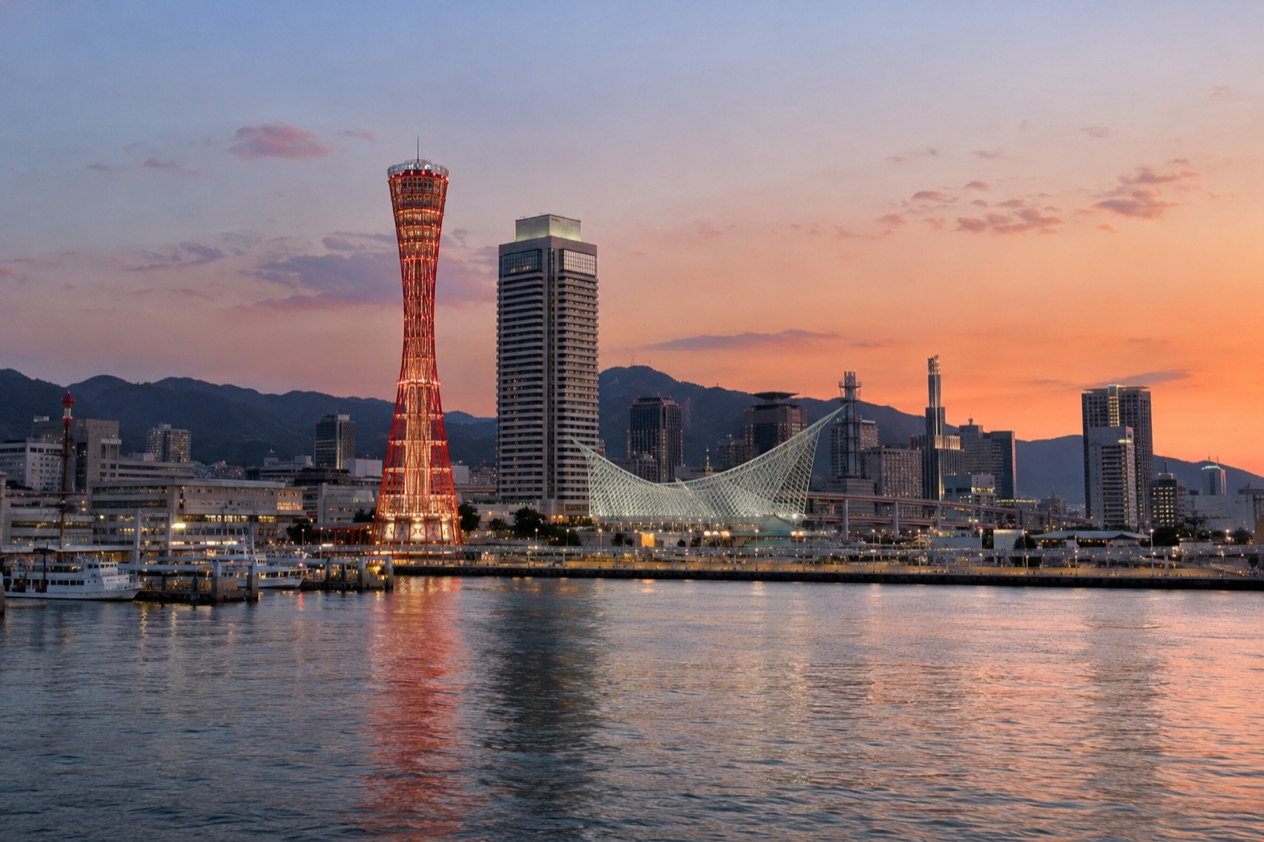
On a mid-November afternoon the maples on the slopes above Kobe turn rust and gold, the harbor lights come on early over the water, and the smell of grilled beef and fresh bread drifts out of the old foreign quarter. Spring and autumn are the seasons when people come, the early summer rains settle over the port, and July and August arrive hot and sticky. Kobe is a harbor city of hills, hot springs and serious appetite, and it rewards the months when the air is mild enough to walk from the waterfront up into the streets above.
When is the best time to visit Kobe?
The best time to visit Kobe is spring, from late March through May, and autumn, from October into early December, when the days are mild and the city’s parks and hillsides are in color. For travelers these two windows cover everything: sightseeing on foot, long lunches, hot-spring afternoons and evenings by the harbor.
For sightseeing, early April is hard to beat. The cherry trees usually open in late March and reach full bloom in the first days of April, and the days warm up without becoming sticky.
In autumn the maples color up later than travelers expect, usually around the start of December in the city itself, so the leaves and the harbor evenings come together late in the year. October and November are comfortable for walking, with the light shortening gently.
For food, the cooler months suit a city built on beef, sake and bakeries. Winter is the season for hot pots and for the sake breweries of the Nada district, while a cold beer after a hot August day has its own pull. Spring adds seasonal vegetables and sweets flavored with cherry blossom.
For nature, the hills behind the city and the hot-spring town of Arima are best with spring blossoms and autumn leaves, and a winter soak in an onsen on a cold day is a pleasure in its own right. Summer brings the strongest sunshine, but also heat and humidity that make long climbs tiring.
For quiet and a lighter schedule, winter after the New Year holiday is the calmest stretch, with cool air, fewer rain days and the city lit up in the evenings.
Kobe weather by month
Kobe has four distinct seasons, with a warm, wet early summer and a cool, fairly bright winter.
| Month | Average high (°F) | Average low (°F) | Precipitation (in) | Days with 1 mm or more of precipitation | Hours of sunshine | Daylight on the 15th |
|---|---|---|---|---|---|---|
| January | 48.9 | 37.6 | 1.51 | 4.7 | 146 | 10 h 04 min |
| February | 50.2 | 38.1 | 2.19 | 6.0 | 142 | 10 h 55 min |
| March | 56.3 | 43.3 | 3.71 | 8.9 | 176 | 11 h 55 min |
| April | 66.0 | 52.5 | 3.96 | 9.0 | 195 | 13 h 01 min |
| May | 74.5 | 61.7 | 5.30 | 9.1 | 203 | 13 h 57 min |
| June | 80.1 | 69.1 | 6.96 | 10.7 | 164 | 14 h 28 min |
| July | 86.7 | 76.5 | 7.40 | 10.0 | 189 | 14 h 17 min |
| August | 90.0 | 79.0 | 4.07 | 6.5 | 230 | 13 h 30 min |
| September | 83.8 | 72.7 | 6.19 | 9.3 | 164 | 12 h 27 min |
| October | 73.8 | 62.1 | 4.65 | 7.8 | 170 | 11 h 22 min |
| November | 63.5 | 51.6 | 2.46 | 5.6 | 152 | 10 h 23 min |
| December | 53.6 | 42.3 | 1.92 | 5.7 | 153 | 9 h 51 min |
The year runs from a cool, relatively dry winter to a wet June and July, then a hot, bright August and a second wet spell in September. In winter the rain comes in light, short spells, and on several days in January and February the precipitation falls as snow or sleet.
June and July bring the heaviest rain of the year, and the air gets heavy with humidity. August has fewer rainy days but the highest heat and the most sunshine.
In practice, a light jacket or sweater covers spring and autumn, with a thin extra layer for the evenings. Winter calls for a warm coat, a scarf and gloves for time outdoors. From June to September a compact umbrella and light, quick-drying clothes are the sensible kit. The daylight changes the shape of the day too: winter evenings fall dark before dinner, while in early summer the light lingers late over the harbor.
What is there to do in Kobe in each season?
Each season in Kobe has its own pace, from blossoms in the parks to hot springs in the cold, and the city’s food scene keeps going through all of them. The harbor, the hillside streets of the old foreign quarter, Chinatown at Nankinmachi and the onsen town of Arima are the pieces you can rearrange around the weather.
Spring: cherry blossoms and the first warm days
Spring is when Kobe is most inviting for walking. The cherry blossoms usually begin to open around March 27 and reach full bloom around April 5.
Hanami, the custom of sitting under the trees with a picnic, is the way people in Japan mark the season, and the city’s parks and riverbanks fill with blankets, bento boxes and small celebrations. By May the days turn properly warm, and the hill paths and hot springs are a pleasure again.
The rainy season and summer
June and July are the wettest months, and the better plan is to lean on indoor Kobe: covered shopping arcades, cafés and bakeries, museums in the old foreign-quarter houses, and a long onsen soak in Arima. The observation deck on the 24th floor of City Hall gives a view of the harbor and the hills even in gray weather.
| Site | Open |
|---|---|
| Kobe City Hall observation deck (24th floor) | Monday to Friday 08:15-22:00, Saturdays, Sundays and holidays 10:00-22:00 |
August is hot and bright, with the most sunshine of the year. Summer in Kobe is for the water’s edge in the evening, cold noodles at lunch, shaved ice, and festivals that bring lanterns and fireworks to the harbor. It is a season to schedule around the heat, with long breaks indoors.
Autumn leaves and winter
From mid-November to early December, the trees in Japan display colors that range from red to yellow and orange. In Kobe the maples change around December 1, which makes the city a late-autumn stop. October and early November are milder for walking, with fewer rainy days than summer.
Winter is cool, with snow or sleet on some days in the coldest months. It is the season for Kobe’s hot pots and sake, for the evening illuminations and for steaming onsen baths in Arima. Pack a warm coat and plan outdoor sights around the weather.
When is Kobe least crowded?
Kobe is quietest in the cool stretch between the New Year holiday and the first cherry blossoms, roughly mid-January through early March, and again in the weeks of June and July when the rain keeps some travelers away. Outside those windows the calendar of Japanese holidays shapes the city’s pace more than the weather does.
Golden Week, the string of national holidays around the end of April and the start of May, is a stretch when people in Japan travel. Obon, in mid-August, and the New Year holiday also send people home or on trips, so trains, hotels and the main sights can be busier than usual. The cherry blossom and autumn color weeks are the other moments when the city draws extra visitors, since the blooms and the leaves are what travelers plan around.
Winter outside the New Year holiday and the rainy weeks of early summer are the periods when a quiet visit is the most likely. You have more room at the table, more space on the hillside streets and a slower rhythm in the cafés. The trade-off is the weather: cold and some snow or sleet in January and February, or humid rain in June and July.
Kobe also sits across the bay from Osaka and is linked by Shinkansen to Tokyo, so it takes the overflow of the larger cities in busy weeks as well. Pairing it with a stay in another city is a way to spread a trip over several days rather than packing it into one.
Which months should you avoid in Kobe?
No month is off limits, but July and August are the hardest on the traveler, and June is the wettest stretch of the year. The humid heat of high summer wears down long days of sightseeing, and the early summer rains can turn a hillside walk into a soggy one.
June and July bring the most rain, with the heaviest totals of the year. August has fewer rainy days but the highest temperatures and the strongest sun, so it suits slow days, early starts and long breaks indoors. September is wet again, with more rain than August, so a September trip means keeping a flexible plan.
January and February are the coldest months, with snow or sleet on some days. It is not a reason to skip Kobe, but outdoor time is shorter and the hills are chillier. The days are short too, with daylight ending early in the evening.
The blooms and autumn colors move with the year. The cherry blossoms usually open around the end of March and peak in the first week of April, and the maples change around the start of December.
Festivals and events in Kobe through the year
Kobe’s calendar follows the Japanese year: New Year shrine visits in winter, blossoms and street parades in spring, lanterns and fireworks in summer, and leaves and illuminations in the cooler months. The dates move, so treat the months as a guide.
Winter: New Year, Chinese New Year and the lights
New Year is the biggest holiday in Japan. On January 1 and in the days that follow, people make hatsumode, the first shrine visit of the year, and Kobe’s central shrines such as Ikuta Shrine fill with visitors drawing fortunes and buying lucky charms.
Chinese New Year, usually in late January or February, brings lion dances and lanterns to Nankinmachi, the city’s Chinatown. In December, the Kobe Luminarie turns a district downtown into an avenue of lights, set up in remembrance of the great earthquake that struck the city. Warm sake and street snacks are part of a winter evening there.
Spring: blossoms and Kobe Matsuri
Spring begins with hanami, when the cherry trees open and the parks fill with picnics. Kobe Matsuri, the city’s big festival, is usually held in May and brings parades, music and dancers to the streets near the port. It reflects the city’s mix of Japanese and international influences.
Golden Week falls around the turn of April and May, and the weeks around it are festive across Japan, with banners, family outings and holiday menus. The warm days also bring out the hillside gardens and herb parks above the city.
Summer and autumn: fireworks, Obon and the leaves
Summer festivals in Japan are about evenings: yukata, the light cotton robes, paper lanterns, food stalls and fireworks. Kobe’s harbor is a natural stage for a summer fireworks display. In mid-August, Obon is the season when families remember their ancestors, and people travel home.
Autumn brings the leaves, with the maples changing from mid-November to early December in Japan and around December 1 in Kobe itself. Evenings are cool enough for the harbor promenade, and the hot springs of Arima are a pleasant counterpart to the colors on the hills. The year closes with the winter lights and then New Year again.
Sources
- Japan Meteorological Agency (JMA), Normal values 1991-2020, monthly (https://www.data.jma.go.jp/stats/etrn/view/nml_sfc_ym.php?prec_no=63&block_no=47770), station Kobe, elevation 5 m, checked October 11, 2026
- Computed from the date and the latitude of the place (sunrise equation, solar elevation -0.833 degrees), October 11, 2026
- Japan National Tourism Organization, Kobe (https://www.japan.travel/en/destinations/kansai/hyogo/kobe-and-around/), checked October 11, 2026
- Visit Kobe, the official travel guide (https://www.feel-kobe.jp/en/), checked October 11, 2026
- Wikipedia, Kobe (https://en.wikipedia.org/wiki/Kobe), checked October 11, 2026
- Wikivoyage, Kobe (https://en.wikivoyage.org/wiki/Kobe), checked October 11, 2026
- Japan National Tourism Organization, autumn in Japan (https://www.japan.travel/en/guide/autumn-guide/), checked October 11, 2026
- Japan National Tourism Organization, spring in Japan (https://www.japan.travel/en/guide/spring-guide/), checked October 11, 2026
- Japan Meteorological Agency, cherry blossom first-bloom dates 2021-2026 and 1991-2020 normal (https://www.data.jma.go.jp/sakura/data/sakura003_07.html), checked October 11, 2026
- Japan Meteorological Agency, cherry blossom full-bloom dates 2021-2026 and 1991-2020 normal (https://www.data.jma.go.jp/sakura/data/sakura004_07.html), checked October 11, 2026
- Japan Meteorological Agency, maple color-change dates 2025-2026 with difference from the 1991-2020 normal (https://www.data.jma.go.jp/sakura/data/phn_014.html), checked October 11, 2026
To plan your stay
- Things to Do in Kobe: Kobe Beef, Kitano's Foreign Houses, Arima Onsen and Harbor Night Views
- Where to Stay in Kobe: Shin-Kobe, the City Center, Harborland and Arima Onsen
- Kobe from Osaka: Trains, Two Stations, the Bus and a Day at the Harbor
- Kobe vs Osaka: Beef, Dotonbori Nights, Getting Around and Weather