
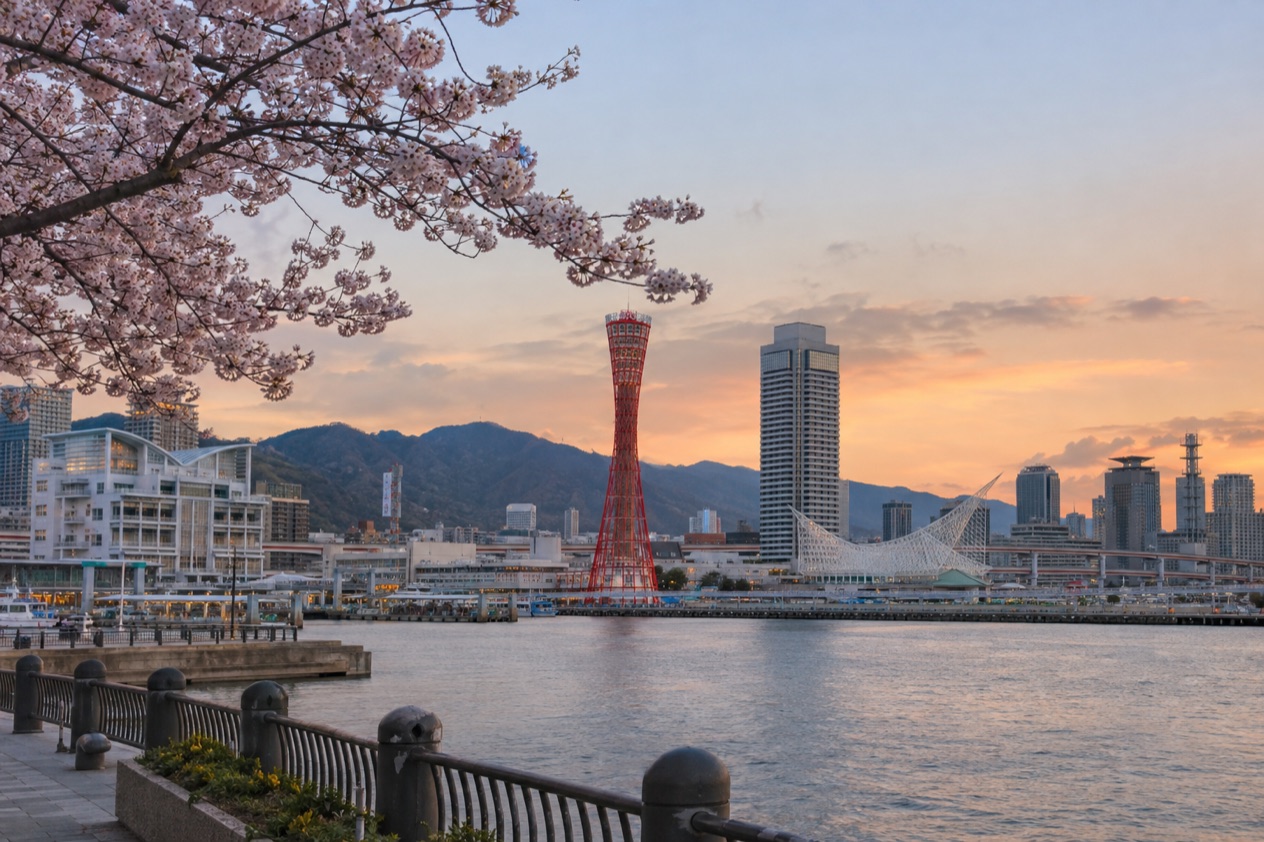
March in Kobe is the month when winter loosens its grip on the harbor. Coats still come out in the morning, but the light grows longer, the port city starts to feel looser and brighter, and the first cherry buds swell toward their opening. Between the Rokko mountains and the bay, with steak sizzling on teppanyaki plates and the first spring walks beginning, this is a month for a city that rewards slow wandering.
What is the weather like in Kobe in March?
March in Kobe is cool and changeable, a month of real spring light that still asks for a jacket, and it runs a good deal milder than February.
| Month | Average high (°F) | Average low (°F) | Precipitation (in) | Days with 1 mm or more of precipitation | Hours of sunshine | Daylight on the 15th |
|---|---|---|---|---|---|---|
| February | 50.2 | 38.1 | 2.19 | 6.0 | 142 | 10 h 55 min |
| March | 56.3 | 43.3 | 3.71 | 8.9 | 176 | 11 h 55 min |
| April | 66.0 | 52.5 | 3.96 | 9.0 | 195 | 13 h 01 min |
Afternoons reach the mid-50s, which is comfortable for walking if the sun is out, while mornings and evenings drop into the low 40s. That gap is the reason layers matter more than any single heavy coat: a sweater and a light jacket handle most of the day, and a scarf is welcome after dark.
Rain comes on roughly one day in three, and March is wetter than February. Some days bring a gray drizzle, others a clear stretch with bright sunshine, so a compact umbrella earns its place in the bag.
The days are nearly balanced between light and dark, with about twelve hours of daylight in the middle of the month. That means sightseeing can stretch into the early evening, and the harbor lights come on just as dinner plans begin.
What to do in Kobe in March
Kobe is a port city across the bay from Osaka, and March suits it well. The cold is easing, the streets are good for walking, and the cherry blossom season is just about to begin.
In recent years first bloom has fallen anywhere from late March to the first day of April, so the timing shifts from one spring to the next, and a March trip often catches buds rather than a full display.
The cooler air makes it a good month for the kind of outings that would feel sticky in summer: long walks between neighborhoods, hours indoors over a good meal, and time in the hills above the city. The city is also a pleasant place to simply wander, with the water on one side and mountains on the other.
Kobe beef, the meal of the stay
Kobe beef is the reason travelers come, and a cool March evening is exactly the moment for it. The beef comes from Japanese Black cattle, the breed behind the highly marbled wagyu that has made the name known around the world. It can be served as steak, sukiyaki, shabu-shabu, sashimi or teppanyaki, and each style gives a different texture and a different way of tasting the fat.
Teppanyaki is the version visitors picture, with a chef cooking on a hot iron plate in front of the counter. Sukiyaki and shabu-shabu, cooked in a simmering pot at the table, are well matched to a chilly night, when steam and broth feel right. Lunch sets of the same beef at a restaurant counter are another way to try it without turning the whole evening into the occasion.
Harbor, city hall and the view
The waterfront is where Kobe shows its port character, with the bay opening out and the hills rising behind the city. In March the air is clear enough on bright days that the sea and the mountains frame each other, and a stroll along the water feels pleasant with a jacket buttoned.
For a view over the whole city, the observation deck on the 24th floor of Kobe City Hall looks out across the harbor and the streets below. The hours are in the table, and the deck stays open into the evening, which suits a March day when the light fades around dinner time.
| Site | Open |
|---|---|
| Kobe City Hall observation deck (24th floor) | Monday to Friday 08:15-22:00, Saturdays, Sundays and holidays 10:00-22:00 |
The Rokko mountains behind the city
Mount Rokko is a range of mountains in southeastern Hyogo Prefecture, and it forms the green wall behind Kobe. In March the hills are a place to look up at from the streets, with the cooler air still holding on the slopes. The city rises toward them in layers, so you feel the change of scale as you move inland.
Because mountain weather can differ from the harbor, bring an extra layer if you plan to head into the hills.
Back in town, Kobe is part of the Keihanshin area with Kyoto and Osaka, so the neighboring cities are within reach if a rainy day needs a different plan. The Tokaido and Sanyo Shinkansen call at Shin-Kobe Station, which gives the city a direct line to Tokyo.
A two-day itinerary for Kobe in March
Day 1 begins with the harbor, since March mornings are crisp and the light over the bay is clear. Walk the waterfront while the air is cool, then move into the city streets for a late morning of wandering.
In the afternoon, head up to the Kobe City Hall observation deck on the 24th floor while the light is still good. With daylight lasting nearly twelve hours, you can then take a slow walk back through the center as the sky dims, and finish with a simmering sukiyaki or shabu-shabu pot, which suits the cool evening air.
Day 2 turns to the hills. Spend the morning toward the Rokko mountains, with a jacket and an extra layer, then come down for lunch in a small noodle or set-meal place in town. In the afternoon, take a bakery and coffee break and look at the city from a different angle.
If rain sets in, switch to indoor plans: a long lunch, a café stop, and a day trip by train to a neighboring city in the Keihanshin area. Teppanyaki makes a warm evening finish after a gray afternoon.
Is Kobe busy in March?
March is a building month in Kobe, with the cherry blossom season only just approaching. Kobe is a large city, with around 1.5 million people, and the third-largest port in Japan, so it has a steady daily pace whatever the month.
The first cherry blossoms usually open near the end of March, with full bloom normally in early April. That means the pull of the blossom is strongest at the very end of the month and into April, so a trip in the first half of March is likely to feel like a city between seasons, while the last days lean toward the spring crowds that cherry blossom brings across Japan.
In recent years, first bloom in Kobe has fallen anywhere from late March to the start of April, so the exact timing differs from one spring to the next. For a quieter pace and the city’s everyday rhythm, early March is the part of the month that sits furthest from the blossom.
What to pack for Kobe in March
Spring in Japan is a time when a light jacket or a simple sweater goes a long way, and Kobe’s cool mornings and evenings fit that pattern.
- A light jacket or sweater, for cool mornings and evenings by the harbor.
- A compact umbrella, since rain falls on a good share of March days.
- Comfortable walking shoes for long days through the city streets.
- An extra warm layer if you head up toward the Rokko hills.
- A scarf for the evenings, when the temperature drops into the low 40s.
Good to know before you go
March sits ahead of the rainy and typhoon seasons, but showers are frequent enough that a flexible plan helps. The weather can shift between a bright afternoon and a gray, drizzly one, so keep an indoor option, such as a long meal or a visit to the City Hall deck, ready for the wetter hours. Kobe City Hall’s observation deck opens later on weekends and holidays, so plan a weekend visit for after ten o’clock.
Kobe in March vs February and April
Moving the trip a month earlier puts you in February, which is colder, with a lower afternoon high and noticeably shorter days. Snow or sleet shows up on more days, and the light fades earlier, so the city feels more wintry and the evening plans start sooner.
Moving a month later lands in April, when the afternoons are clearly warmer, the sun shines longer and the days stretch past thirteen hours. April is also when the cherry blossom reaches its fullest in Kobe, so the city leans toward the spring display, with the rain still falling on a similar number of days as in March.
If you want the cherry blossom, April is the safer pick, and the end of March is a chance rather than a promise. If you prefer cooler air for walking and a city in its everyday rhythm, March is the middle ground, milder than February and before the full spring season.
Is March a good time to visit Kobe?
Yes, March is a good time to visit Kobe for travelers who like cool air, long walks and hearty food, and who are happy to treat the cherry blossom as a possible bonus rather than the goal.
It suits those who want to eat well, since Kobe beef is at home on a chilly evening, and those who like a port city with mountains behind it. It is less suited to anyone who wants a full cherry blossom display or warm, dry weather, since rain still falls on many days and the buds are only starting to open.
On arrival, start with the waterfront and the view from the City Hall deck to get your bearings between the sea and the hills. March in Kobe is a month of a city easing out of winter, with a hot plate of beef in the evening and the first buds on the trees.
Sources
- Japan Meteorological Agency (JMA), Normal values 1991-2020, monthly (https://www.data.jma.go.jp/stats/etrn/view/nml_sfc_ym.php?prec_no=63&block_no=47770), station Kobe, elevation 5 m, checked October 11, 2026
- Computed from the date and the latitude of the place (sunrise equation, solar elevation -0.833 degrees), October 11, 2026
- Japan Meteorological Agency, cherry blossom first-bloom dates 2021-2026 and 1991-2020 normal (https://www.data.jma.go.jp/sakura/data/sakura003_07.html), checked October 11, 2026
- Japan Meteorological Agency, cherry blossom full-bloom dates 2021-2026 and 1991-2020 normal (https://www.data.jma.go.jp/sakura/data/sakura004_07.html), checked October 11, 2026
- Japan Meteorological Agency, sakura2020.pdf (https://www.data.jma.go.jp/sakura/data/sakura2020.pdf), checked October 11, 2026
- Japan National Tourism Organization, flowers by season: cherry blossom, plum, wisteria, hydrangea, where and when (https://www.japan.travel/en/see-and-do/flowers/), checked October 11, 2026
- Wikipedia, Prunus mume (https://en.wikipedia.org/wiki/Prunus_mume), checked October 11, 2026
- Japan National Tourism Organization, spring in Japan (https://www.japan.travel/en/guide/spring-guide/), checked October 11, 2026
- Japan National Tourism Organization, autumn in Japan (https://www.japan.travel/en/guide/autumn-guide/), checked October 11, 2026
- Japan National Tourism Organization, summer in Japan (https://www.japan.travel/en/guide/summer-guide/), checked October 11, 2026
- Wikipedia, Kobe (https://en.wikipedia.org/wiki/Kobe), checked October 11, 2026
- Wikivoyage, Kobe (https://en.wikivoyage.org/wiki/Kobe), checked October 11, 2026
- Japan National Tourism Organization, Kobe (https://www.japan.travel/en/destinations/kansai/hyogo/kobe-and-around/), checked October 11, 2026
- Visit Kobe, the official travel guide (https://www.feel-kobe.jp/en/), checked October 11, 2026
- Wikipedia, Wagyu (https://en.wikipedia.org/wiki/Wagyu), checked October 11, 2026
- Wikipedia, Mount Rokkō (https://en.wikipedia.org/wiki/Mount_Rokk%C5%8D), checked October 11, 2026
To plan your stay
- Things to Do in Kobe: Kobe Beef, Kitano's Foreign Houses, Arima Onsen and Harbor Night Views
- Where to Stay in Kobe: Shin-Kobe, the City Center, Harborland and Arima Onsen
- Kobe from Osaka: Trains, Two Stations, the Bus and a Day at the Harbor
- Kobe vs Osaka: Beef, Dotonbori Nights, Getting Around and Weather