
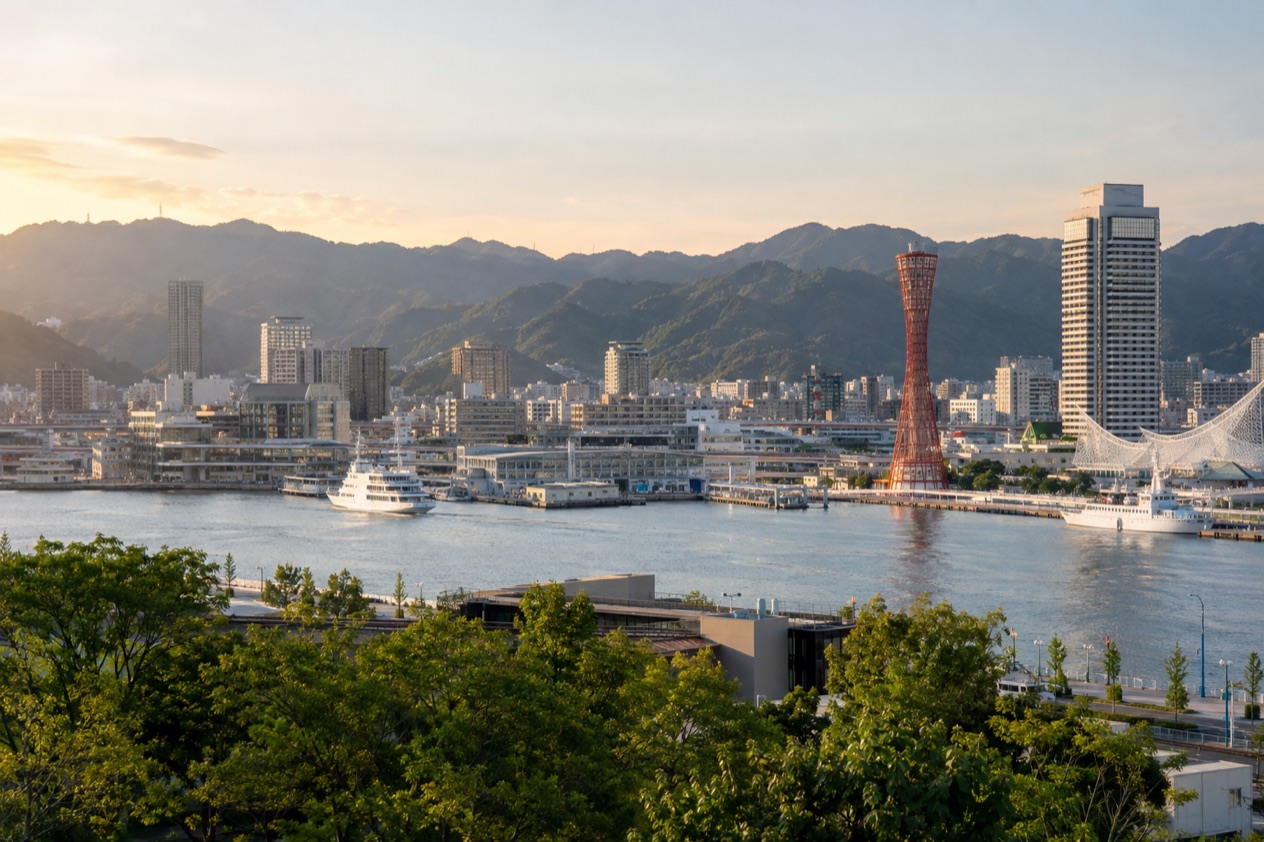
In August the cicadas start before the sun is properly up, and by afternoon the shaved-ice stands (kakigori, piled with syrup) are the place to be. Evenings in Kobe belong to the harbor, where the lights come on along the water and the hills behind the city turn into a dark backdrop dotted with windows. It is a hot, humid month for slow indoor-outdoor days, cold noodles, the port and the evening views, with the Obon holiday setting the mood.
What is the weather like in Kobe in August?
August in Kobe is hot, humid and mostly sunny, with fewer rainy days than July and September. Afternoons are the hot part of the day, nights barely cool off, and the sun is out for much of the month.
| Month | Average high (°F) | Average low (°F) | Precipitation (in) | Days with 1 mm or more of precipitation | Hours of sunshine | Daylight on the 15th |
|---|---|---|---|---|---|---|
| July | 86.7 | 76.5 | 7.40 | 10.0 | 189 | 14 h 17 min |
| August | 90.0 | 79.0 | 4.07 | 6.5 | 230 | 13 h 30 min |
| September | 83.8 | 72.7 | 6.19 | 9.3 | 164 | 12 h 27 min |
Highs reach the 90s and lows stay in the upper 70s, so evenings stay warm enough to eat outside and walk the waterfront in short sleeves. Humidity averages around 71 percent, which is the real weight of the month. Clothes that dry quickly and breathe will matter more than any layer, and a second shirt in the bag is a small comfort by late afternoon.
Rain comes less often than in July, but it still arrives as showers rather than a washout, so a compact umbrella is more useful than a heavy raincoat. A shower can also double as shade-time, a good excuse to step into a café, an arcade or a museum. The long summer light stretches the evening and gives you time for the harbor after dinner.
Indoors, air conditioning can be strong, so a thin cardigan or scarf helps on trains, in department stores and in restaurants. Outdoors, a hat and sunglasses do more work than sunscreen alone. Plan the day so that the stretch outside is broken by cool interiors.
What to do in Kobe in August
The month has a quiet backbone in Obon, the Buddhist custom of honoring the spirits of one’s ancestors. People return to family places and visit and clean the graves of their relatives, and the festival lasts three days. In a port city like Kobe that mostly means a change of rhythm, with some residents away and temples and shrines holding their own observances.
For the rest, August in Kobe is about the water and the evenings. The city sits between the mountains and the bay, and across the bay from Osaka, so the harbor is the natural place to spend the long, warm hours after sunset. Days are for shade, cold food and indoor pleasures, and the evenings are for the waterfront and the heights.
Summer eating suits Kobe well. Cold somen noodles, chilled soba, edamame and cold beer fill the izakaya (casual pubs) in the evening, while the cafés and bakeries that Kobe is known for turn to iced coffee and fruit sweets. Kobe beef, grilled or in a steak house, is the one indulgence worth planning a hot day around.
The harbor, Meriken Park and Harborland
The harbor is the center of summer evenings in Kobe. Meriken Park runs along the water with open lawns, the red Port Tower and a view across the bay, and the shopping and dining streets of Harborland sit next to it, with their lit-up promenades and the ferris wheel on the skyline. Kobe is the third-largest port city in Japan, and you feel it in the cranes and ships beyond the promenade.
This is a place for the late part of the day, when the heat of the stone eases and the lights come on across the water. You can drift between the park and the shopping streets, stop for a cold drink and watch the ships. Rainy spells are easy to handle here, because the shopping streets give you somewhere to wait it out.
Kitano and the old foreign houses
Above the center, the slopes of Kitano are lined with the ijinkan, Western-style houses from the days when foreign merchants settled in the port. Several are open to visitors, with period rooms, stained glass and gardens, and they give a cool and shaded break from the August sun in their interiors. Between houses you pass cafés and sweet shops in the same spirit.
The streets climb, so it is a part of town where the heat shows. Go slowly, move from house to house with a drink in hand and treat the interiors as your pauses. The district suits travelers who like architecture and gardens more than a checklist of sights.
Nankinmachi and a Kobe beef lunch
Nankinmachi, Kobe’s Chinatown, is a small grid of lanes with red gates, steamed buns, dumplings and stalls selling snacks you eat standing in the street. In August the cold drinks and shaved ice stands do the best business, and the lanes stay lively into the evening.
For a sit-down meal, Kobe beef is the city’s signature. Teppanyaki counters cook it in front of you in thin slices or thick cuts, and the air conditioning inside is a relief from the street. Pair it with a glass of sake from the nearby Nada breweries, which supply much of Japan’s sake.
The view from the City Hall deck
A free-standing pleasure for the evening is the observation deck on the 24th floor of Kobe City Hall, where the city, the port and the bay lie below. In summer, the late closing time lets you come after dinner and watch the lights across the harbor.
| Site | Open |
|---|---|
| Kobe City Hall observation deck (24th floor) | Monday to Friday 08:15-22:00, Saturdays, Sundays and holidays 10:00-22:00 |
Shops in urban areas of Japan are generally open from 10:00 a.m. to 8:00 p.m. every day, which fits a day of drifting through arcades, department stores and cafés between showers or in the hottest hours.
A two-day itinerary for Kobe in August
Day 1 is the harbor and the old town. Start in the morning at Meriken Park and the Port Tower while the heat is still gentle, then drift through Harborland for a first cold drink. Around midday move into Nankinmachi for dumplings and steamed buns, then settle into a teppanyaki counter or a cool café for a long, air-conditioned lunch.
In the afternoon, head up to Kitano and spend the hottest hours going from one ijinkan house to the next, with their rooms and gardens as pauses. Come down in the evening for a drink at an izakaya, then finish at the City Hall deck, which stays open into the night, for the lights over the port. If a storm arrives, stay in the houses and the covered shopping streets of Motomachi and Sannomiya.
Day 2 is the hills and the sake. Begin at Shin-Kobe, the bullet train station, and go up toward Nunobiki, with its waterfall and herb garden among the trees, in the morning. Then take the ropeway up Mount Rokko for the view over the bay, and stay for dinner, as the lights of the city and the port spread out below you after dark.
In the afternoon, step into the sake district of Nada, where breweries open their cellars and tasting rooms, a cool and indoor way to spend the hot hours. A rainy day suits this plan: the breweries, cafés and arcades hold up well in the wet, and the mountain view can wait for the next clear evening.
Is Kobe busy in August?
August in Kobe is shaped less by a visitor rush than by Obon, when many people return to their ancestral places and the city’s rhythm changes. The pace is that of a hot summer month, with long evenings out and slow afternoons.
Because Obon is a time of family visits and grave-cleaning, temples and shrines have their own ceremonies, and some local shops and eateries may keep their own holiday schedule. The urban shops that stay open generally run through the day and into the evening, so there is almost always somewhere to eat or cool off.
The heat does the sorting for you. Sights in the open feel best when you pace them, the interiors of houses, museums and cafés fill the middle of the day, and the harbor becomes the main stage after dark. With the long daylight and warm nights, the evening is when the city is most social.
What to pack for Kobe in August
Pack for heat, humidity and the occasional shower, with a little extra for the cool interiors.
- Lightweight, breathable clothes that dry quickly, because the air stays humid even at night.
- A compact umbrella for the showers that pass through.
- A hat and sunglasses for the hours on the harbor and the hill streets.
- A small towel or handkerchief for the heat on the Kitano slopes.
- A thin cardigan or scarf for strong air conditioning in trains, shops and restaurants.
- Comfortable shoes that handle the climb up toward Kitano and Nunobiki.
Good to know before you go
The summers of Honshu are very humid, hot and sultry, and August in Kobe fits that description, so pace the day around the heat. Obon falls in the middle of the month and, like other holidays, can change local opening patterns, though urban shops are generally open every day. If extreme weather ever threatens, the Japan Meteorological Agency issues Emergency Warnings for natural phenomena of extraordinary magnitude, and the Japan National Tourism Organization keeps a Japan Safe Travel Information page for travelers.
Kobe in August vs July and September
Moving the trip four weeks earlier brings July, which is rainier and a touch cooler, with longer daylight but grayer skies and fewer hours of sun. The harbor is still the evening stage, but you need the umbrella more often, and the indoor plan matters more than the outdoor one.
Moving four weeks later brings September, when the heat starts to ease and the nights cool slightly, though rain still falls on a good share of days and the sunshine thins. Days are shorter, so the harbor lights come on earlier, and walking the Kitano slopes becomes more comfortable.
Choose August if you want the sunniest weather, the longest warm evenings and the Obon season. Shift earlier only if you do not mind frequent rain, and later if the heat is your main worry and you prefer a gentler stroll through the hills.
Is August a good time to visit Kobe?
Yes, for travelers who like sunshine, warm nights and a port city best seen after dark, and less so for anyone who finds heavy humidity a burden. August suits those who enjoy cold noodles, long lunches in cool rooms and evenings by the water.
If you tire quickly in the heat, pick a cooler month, or at least plan most of the day indoors. On arrival, head straight for the harbor in the evening and then the City Hall deck, so that the first night gives you the shape of the city and its lights before you go up into the hills. What stays with you from August in Kobe is the contrast between the sultry, bright days and the glittering harbor that comes alive after dark, with the Obon tradition quietly running through the month.
Sources
- Japan Meteorological Agency (JMA), Normal values 1991-2020, monthly (https://www.data.jma.go.jp/stats/etrn/view/nml_sfc_ym.php?prec_no=63&block_no=47770), station Kobe, elevation 5 m, checked October 11, 2026
- Computed from the date and the latitude of the place (sunrise equation, solar elevation -0.833 degrees), October 11, 2026
- Japan National Tourism Organization, shop and attraction hours, national holidays (https://www.japan.travel/en/plan/business-hours-and-holidays/), checked October 11, 2026
- Wikipedia, Obon (https://en.wikipedia.org/wiki/Obon), checked October 11, 2026
- Wikipedia, Public holidays in Japan (https://en.wikipedia.org/wiki/Public_holidays_in_Japan), checked October 11, 2026
- Japan National Tourism Organization, summer in Japan (https://www.japan.travel/en/guide/summer-guide/), checked October 11, 2026
- Japan National Tourism Organization, festivals and events (https://www.japan.travel/en/see-and-do/festivals-and-events/), checked October 11, 2026
- Wikipedia, Hanabi (https://en.wikipedia.org/wiki/Hanabi), checked October 11, 2026
- Japan Meteorological Agency, Emergency Warnings (https://www.jma.go.jp/jma/en/Emergency_Warning/ew_index.html), checked October 11, 2026
- Japan National Tourism Organization, safety information (https://www.japan.travel/en/japan-safe-travel-information/), checked October 11, 2026
- Japan National Tourism Organization, weather and seasons in Japan (https://www.japan.travel/en/plan/weather/), checked October 11, 2026
- Wikipedia, Awa Odori (https://en.wikipedia.org/wiki/Awa_Odori), checked October 11, 2026
- Wikipedia, Climate of Japan (https://en.wikipedia.org/wiki/Climate_of_Japan), checked October 11, 2026
- Japan National Tourism Organization, Mount Fuji guide (https://www.japan.travel/en/fuji-guide/), checked October 11, 2026
- Official website for Mt. Fuji climbing, about the climb (https://www.fujisan-climb.jp/en/about/), checked October 11, 2026
- Wikipedia, Nebuta (https://en.wikipedia.org/wiki/Nebuta), checked October 11, 2026
- Wikivoyage, Kobe (https://en.wikivoyage.org/wiki/Kobe), checked October 11, 2026
- Japan National Tourism Organization, Kobe (https://www.japan.travel/en/destinations/kansai/hyogo/kobe-and-around/), checked October 11, 2026
- Visit Kobe, the official travel guide (https://www.feel-kobe.jp/en/), checked October 11, 2026
- Wikipedia, Kobe (https://en.wikipedia.org/wiki/Kobe), checked October 11, 2026
To plan your stay
- Things to Do in Kobe: Kobe Beef, Kitano's Foreign Houses, Arima Onsen and Harbor Night Views
- Where to Stay in Kobe: Shin-Kobe, the City Center, Harborland and Arima Onsen
- Kobe from Osaka: Trains, Two Stations, the Bus and a Day at the Harbor
- Kobe vs Osaka: Beef, Dotonbori Nights, Getting Around and Weather