
In December, Kobe’s waterfront fills with strings of lights, and the last maple leaves on the slopes above the city turn copper and red. Bakeries in the old foreign quarter sell stollen and strawberry cakes, and sake brewers start pouring the new season’s bottles. The port city is cold but rarely gray for long, which makes it a good month for lingering in cafés, soaking in hot springs and walking the lit-up streets at dusk.
What is the weather like in Kobe in December?
Kobe in December is cold and mostly dry, with crisp days that call for a proper coat and short, light rain spells rather than long wet stretches.
| Month | Average high (°F) | Average low (°F) | Precipitation (in) | Days with 1 mm or more of precipitation | Hours of sunshine | Daylight on the 15th |
|---|---|---|---|---|---|---|
| November | 63.5 | 51.6 | 2.46 | 5.6 | 152 | 10 h 23 min |
| December | 53.6 | 42.3 | 1.92 | 5.7 | 153 | 9 h 51 min |
| January | 48.9 | 37.6 | 1.51 | 4.7 | 146 | 10 h 04 min |
Afternoons sit in the low 50s, so a wool coat and a scarf are comfortable for sightseeing, and the sun gives a little warmth on the waterfront. Mornings and nights drop close to freezing, cold enough that you will want gloves when you stand outside to look at illuminations.
Rain comes in modest amounts, and this is also the month when snow or sleet can appear on about four days. In the city itself it is usually a passing dusting or a cold shower, and the hills behind the city are the places that look white. A compact umbrella and shoes with some grip are enough.
Daylight is short, with the sun setting early in the afternoon, so the lit-up evening is a real part of the day here. Plan indoor stops, such as museums, cafés and covered shopping streets, for the dark hours after the outdoor sightseeing.
What to do in Kobe in December
The big event of the month is the Kobe Luminarie, a long avenue of arches and lanterns made of thousands of colored lights, created in memory of the earthquake that struck the city. Visitors walk slowly beneath the glowing archways, often with a paper cup of something hot, and the mood is quiet and reflective rather than festive in the loud sense. Around it, the shopping streets of Sannomiya and Motomachi put up their own decorations, and the harbor lights add to the evening glow.
Christmas is not a national holiday in Japan, so December 25 is an ordinary working day, though gifts are sometimes exchanged. The season feels more like a couples’ evening out and a time for cake than a family holiday. Shops in urban areas are generally open from 10:00 a.m. to 8:00 p.m., which suits slow browsing among the decorations.
Kitano and the foreign houses
Kitano is the hillside district where Western merchants built their houses when Kobe opened as a port, and the ijinkan (foreign residences) still stand along its slopes. In December the winding lanes feel like a small European village with Japanese details, and many houses are decorated for the season. Cold weather makes it pleasant to duck inside the houses, with their wooden staircases, stained glass and period furniture.
The area also holds bakeries, tea rooms and sweet shops, so it fits a slow stop for coffee and cake between houses. Because it climbs, wear shoes that handle slopes, and expect that a wet day makes stone paths slippery. It suits couples, architecture lovers and anyone who likes browsing small shops.
Nankinmachi, Harborland and the waterfront
Nankinmachi, Kobe’s Chinatown, is a compact grid of lanterns and food stalls where steamed buns, dumplings and sesame sweets are sold, and a hot snack is welcome in December’s cold. The red gates and the smell of steaming dough make it the place to eat while standing and walking.
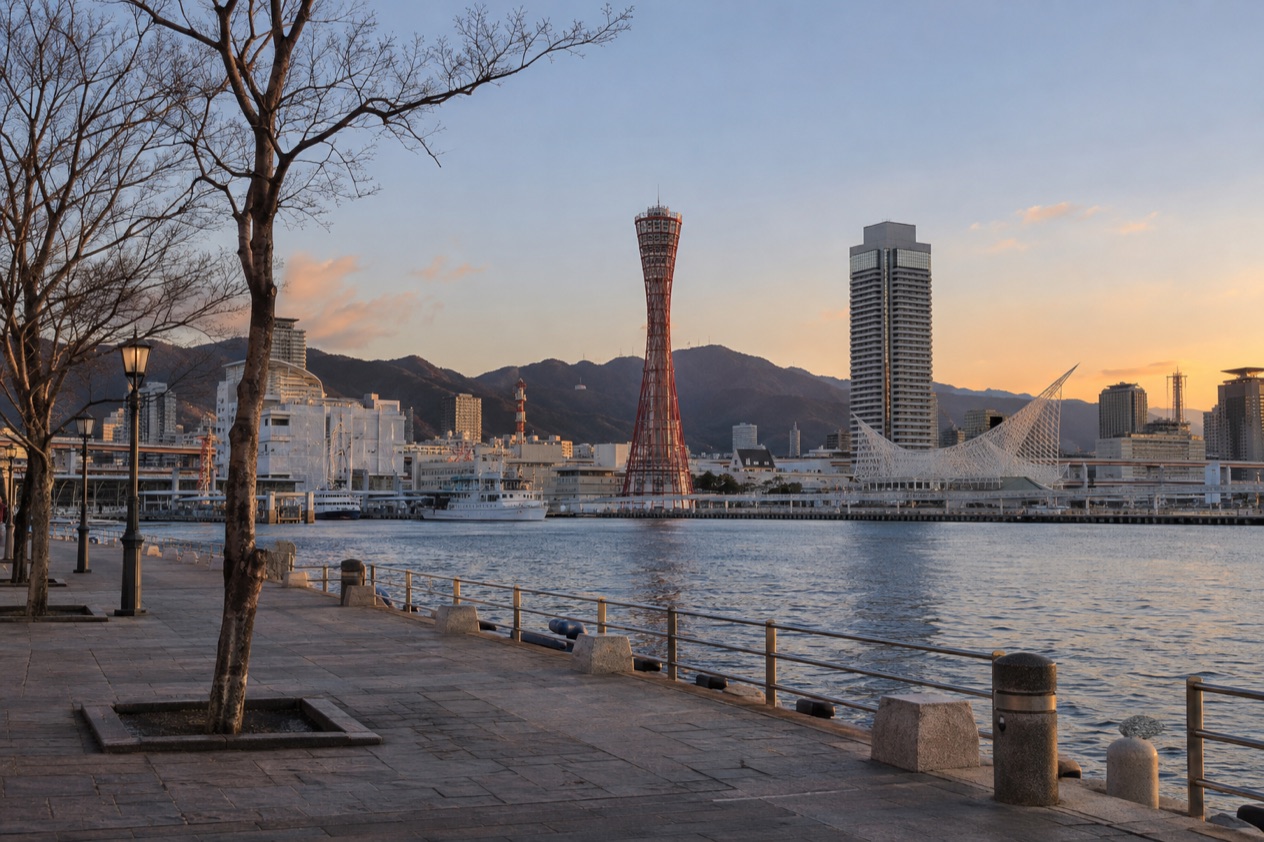
Down at the water, Meriken Park and the Harborland area frame the port with its red tower, ferris wheel and brick warehouses. In winter the air is sharp and clear and the lights on the water add to the mood. Shops and restaurants in the brick warehouses make a good warm-up between outdoor stretches, and the harbor suits a walk at dusk when the lights come on.
Arima Onsen and the hills
Arima Onsen, in the hills of Kobe, is a hot spring town, and soaking in an onsen on a cold December day is one of the great winter pleasures of Japan. The waters there are known for their reddish tint, and a bath of any kind is a good counterpoint to the cold air. Ryokan (traditional inns) in the hot spring towns serve multicourse kaiseki dinners built on seasonal ingredients.
Maple leaves around Kobe usually reach their color around the start of December, so the hills above the city can still carry red and gold at the beginning of the month. On a cold clear day, a walk on a hill path followed by a bath is a good way to spend the afternoon. Etiquette is to wash before entering the bath, and shoes come off at the entrance of an inn.
Food is a reason to come in itself. Kobe is a port city with a long history of Western influence, so its bakeries, sweet shops and cafés are a pleasure in winter, with warm bread, cakes and strong coffee. Kobe beef, sizzled on a teppanyaki grill, is a classic winter meal, and sake from the brewing district of Nada, poured warm or cold, goes well with hot pots and grilled fish.
For a view over the whole city, the observation deck of Kobe City Hall gives a free vantage over the port as the lights come on.
| Site | Open |
|---|---|
| Kobe City Hall observation deck (24th floor) | Monday to Friday 08:15-22:00. Saturdays, Sundays and holidays 10:00-22:00 |
A two-day itinerary for Kobe in December
Day 1 starts in the hills, because the short daylight rewards using the clear hours for outdoor sights. Begin in Kitano, wandering the sloped lanes and stepping inside one or two of the foreign houses, then stop at a bakery or tea room for a hot drink and pastry. Come down through Sannomiya for lunch, perhaps a teppanyaki counter with Kobe beef or a noodle shop.
In the afternoon, walk to Nankinmachi for a snack of steamed buns and then continue on to Meriken Park and Harborland for the waterfront. Daylight lasts under ten hours, so reach the water before the sun sets and let the lights come on around you. After dark, go to the Luminarie while it is on and then warm up with dinner in a restaurant near Motomachi.
Day 2 is for the hot spring and the cellars. Spend the morning and early afternoon in Arima Onsen, with a soak in an onsen bath, a walk among the town’s lanes and a lunch of seasonal dishes. Maples may still hold some color in the hills around the start of the month.
Return to the city for the late afternoon and go to the sake brewing district of Nada for a tasting of the new season’s sake, then finish with dinner at an izakaya (a casual pub) of grilled skewers and hot pot. If it rains, shift the day indoors, with the covered shopping arcades of Sannomiya and Motomachi, the interiors of the Kitano houses and the observation deck of City Hall once the weather clears.
Is Kobe busy in December?
December in Kobe is a season of winter lights and the tail of the maple color, with the city moving at a steady rather than a rushed pace.
The maple leaves around the city usually change color around the start of December, which gives the first days of the month an autumn feel in the hills. Once the color fades, the focus turns to the lights, with evenings devoted to strolling the illuminated streets and the harbor. Shops are generally open from 10:00 a.m. to 8:00 p.m., so there are plenty of evening hours for browsing and eating.
Christmas is not a national holiday, so schools and offices run on their normal days and the city does not shut down around December 25. The slowdown comes at the turn of the year, when many restaurants and attractions are closed for the New Year holidays. The official Japanese New Year falls on January 1, and families eat osechi, a selection of special dishes, during the celebration.
In practice, that means the first three weeks of December are a normal working season for the city’s restaurants and sights, and the last days of the month are when closures start to appear. If your trip runs into the new year, expect a quieter, shuttered feel in many places.
What to pack for Kobe in December
Pack for cold, mostly dry days, with layers you can peel off when you step into a warm museum, restaurant or bath house.
- A warm coat, for afternoons in the low 50s and nights near freezing.
- A scarf and gloves, for standing outside among the lights.
- A compact umbrella, because rain and sleet pass through in short spells.
- Shoes with grip, for the sloping lanes of Kitano and wet pavement.
- Thin layers or thermal underwear, for moving between cold streets and heated interiors.
- Easy-to-remove shoes and clean socks, for inns, onsen and houses where shoes come off.
Good to know before you go
Most major cities in Japan rarely see snow, while the mountains and the north get heavy falls, so Kobe’s cold feels sharp but its streets stay open.
The date to keep in mind is the turn of the year, when many restaurants and attractions close for the New Year holidays. Christmas Day itself is an ordinary working day.
Kobe in December vs November and January
Moving four weeks earlier brings you to November, which is noticeably milder, with afternoons in the low 60s and longer daylight. The maple leaves are in full color in the hills and you can sit outside more comfortably, but the Luminarie and the winter lights are not yet part of the scene. It suits walkers and photographers who care more about autumn color than winter atmosphere.
Moving four weeks later brings you to January, colder still, with highs in the upper 40s and a larger number of days with snow or sleet. Rain is lighter, but the New Year holidays close many restaurants and attractions at the start of the month. It suits travelers who want a quiet city and are happy to plan around closures.
December sits between the two, with the end of the maple season and the lights of the evenings together. Choose November for color and mild walks, December for lights and hot springs, and January for the stillest, coldest stretch of winter.
Is December a good time to visit Kobe?
Yes, December is a good time for travelers who like winter evenings, hot baths and a city that glows after dark, and less so for anyone who wants warm weather or long daylight.
It suits couples, food lovers and people who enjoy cold, clear days followed by a hot meal. If you arrive in the city, start with the harbor and the lit streets at dusk, then save the hills and the onsen for the next day.
What stays with you from Kobe in December is the sight of the Luminarie’s arches against the dark, a bag of hot steamed buns in Nankinmachi and the warmth of a mineral bath in Arima after a cold afternoon.
Sources
- Japan Meteorological Agency (JMA), Normal values 1991-2020, monthly (https://www.data.jma.go.jp/stats/etrn/view/nml_sfc_ym.php?prec_no=63&block_no=47770), station Kobe, elevation 5 m, checked October 11, 2026
- Computed from the date and the latitude of the place (sunrise equation, solar elevation -0.833 degrees), October 11, 2026
- Japan National Tourism Organization, winter in Japan (https://www.japan.travel/en/guide/winter-guide/), checked October 11, 2026
- Wikipedia, Christmas in Japan (https://en.wikipedia.org/wiki/Christmas_in_Japan), checked October 11, 2026
- Japan National Tourism Organization, shop and attraction hours, national holidays (https://www.japan.travel/en/plan/business-hours-and-holidays/), checked October 11, 2026
- Wikipedia, Japanese New Year (https://en.wikipedia.org/wiki/Japanese_New_Year), checked October 11, 2026
- Wikipedia, Public holidays in Japan (https://en.wikipedia.org/wiki/Public_holidays_in_Japan), checked October 11, 2026
- Japan National Tourism Organization, skiing guide (https://www.japan.travel/en/guide/skiing/), checked October 11, 2026
- Japan National Tourism Organization, skiing and snowboarding in Japan: regions, resorts, seasons (https://www.japan.travel/en/sports/snow/), checked October 11, 2026
- Wikipedia, List of ski areas and resorts in Japan (https://en.wikipedia.org/wiki/List_of_ski_areas_and_resorts_in_Japan), checked October 11, 2026
- Wikipedia, Climate of Japan (https://en.wikipedia.org/wiki/Climate_of_Japan), checked October 11, 2026
- Japan Meteorological Agency, maple color-change dates 2025-2026 with difference from the 1991-2020 normal (https://www.data.jma.go.jp/sakura/data/phn_014.html), checked October 11, 2026
- Wikivoyage, Kobe (https://en.wikivoyage.org/wiki/Kobe), checked October 11, 2026
- Japan National Tourism Organization, Kobe (https://www.japan.travel/en/destinations/kansai/hyogo/kobe-and-around/), checked October 11, 2026
- Visit Kobe, the official travel guide (https://www.feel-kobe.jp/en/), checked October 11, 2026
- Wikipedia, Kobe (https://en.wikipedia.org/wiki/Kobe), checked October 11, 2026
To plan your stay
- Things to Do in Kobe: Kobe Beef, Kitano's Foreign Houses, Arima Onsen and Harbor Night Views
- Where to Stay in Kobe: Shin-Kobe, the City Center, Harborland and Arima Onsen
- Kobe from Osaka: Trains, Two Stations, the Bus and a Day at the Harbor
- Kobe vs Osaka: Beef, Dotonbori Nights, Getting Around and Weather