
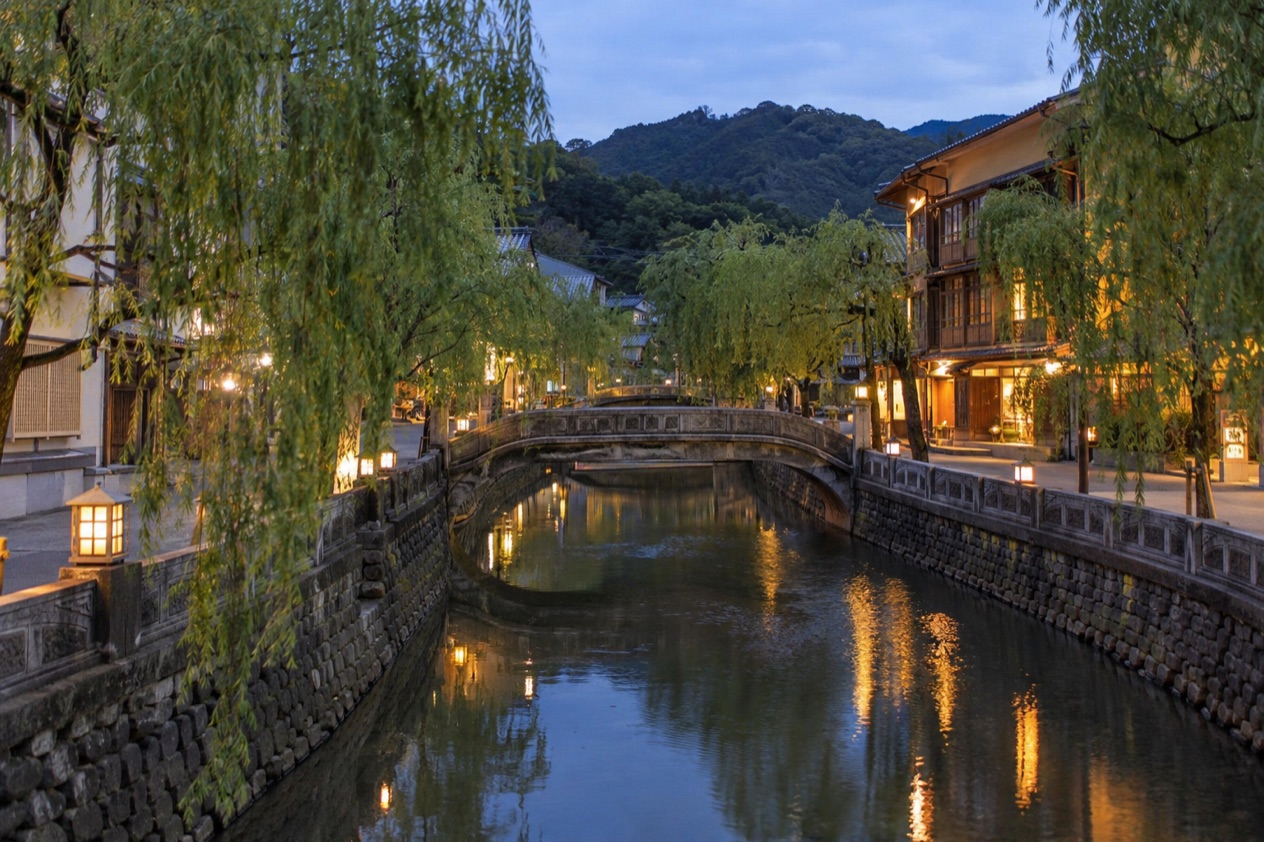
Evening in Kinosaki Onsen sounds like wooden sandals clicking along a street lined with willows, as guests in cotton yukata drift between bathhouses carrying small towels. Steam rises from the baths, ryokan lanterns come on, and nobody seems to be in a hurry. This is a hot spring town built for bathing on foot, a place for couples, friends and anyone who wants a trip that revolves around soaking, eating and strolling.
Where is Kinosaki Onsen and what is it like?
Kinosaki Onsen is a hot spring town in Hyogo Prefecture, in the Kansai region of Japan, within Toyooka City yet distinct from it, geographically and culturally. It is a resort area in the old sense: a small town that exists for its waters, with ryokan (traditional inns) and bathhouses at its center rather than shops or offices.
The history gives the town its tone. Its hot springs first came into use in the 8th century, which makes it one of the earliest onsen towns in Japan, and the town counts a history of 1,300 years. You feel that continuity in the way people use the place. Guests check into an inn, change into yukata (light cotton robes), and spend the day moving between baths instead of driving between sights.
What defines Kinosaki is a shared way of bathing. Guests of many ryokan receive a pass to all seven public bathhouses, so the whole town works like one large, spread-out spa. Everyone follows the same slow rhythm, which is a large part of the charm.
The town suits people who like the idea of doing little: a soak, a stroll, a long dinner, another soak. It is a good match for couples and for travelers who want a night or two in a ryokan after the big cities of Kansai.
It may suit less well someone who wants a packed sightseeing schedule, nightlife or shopping, since the town’s pleasures are the baths, the meals and the walk between them. Bathing in public, with other people, in the nude, is also part of the experience, so those uneasy with that may prefer a private bath at their inn.
What is there to do in Kinosaki Onsen?
The main thing to do is to bathe in the public baths, one after another, and everything else grows out of that. What sets Kinosaki apart from other hot spring towns is that the whole routine happens on foot, in yukata, along the same few streets.
Moving between the public baths
The town has seven public onsen bathhouses: Kouno-yu, Mandara-yu, Goshono-yu, Ichino-yu, Yanagi-yu, Jizou-yu and Satono-yu. Each has its own name and its own character, and bathers often choose them in a loose order, stopping for a drink or a snack between visits. Part of the pleasure is comparing them, from the tiled interiors to the way the water feels once you settle in.
Tourists staying in many of the ryokan in Kinosaki can receive a free pass to all of the public bathhouses. That turns the town into a kind of open-ended bathing circuit, where you can go back to a favorite in the evening or again before breakfast. A good plan is to take one or two baths before dinner and one more afterward, leaving the evening unhurried.
Walking the town in yukata
It is common for tourists staying in Kinosaki Onsen to walk around in yukata, which saves them from changing into their own clothes every time they use an onsen. Along the willow-lined river and the lanes around it, you will see guests in matching robes and wooden geta sandals, towel in hand, heading for the next bath. Joining in is half the fun, and it makes the town feel like one big inn.
This is a town for evening strolls with no particular destination. Lanterns glow on ryokan fronts, steam drifts from the bathhouses, and the sound of sandals on the pavement sets the pace. Stopping at a small shop or a stand for something to snack on is part of the routine, and so is simply sitting somewhere to cool down between soaks.
Eating in an onsen town
Dinner is a central event in a ryokan stay. Meals are often served as a multicourse kaiseki spread of small seasonal dishes, and a stay here is generally built around that evening table and a breakfast the next morning. Fish and local ingredients play a large role in the cooking of this part of Japan, and in the colder months crab dishes are a well-loved treat in the region.
Between baths, the habit is to pick up a light snack or a cold drink, then settle back into the evening. Plan the day so that you arrive hungry for dinner, since the meal is meant to be enjoyed slowly after a soak.
How many days do you need in Kinosaki Onsen?
One night is the minimum that does the town justice, and two nights lets you settle into its rhythm. The town is built around a stay at a ryokan, so a single night gives you an evening in the baths, a long dinner and a morning soak before you move on.
With two nights you can try the public baths at a gentler pace, returning to your favorites instead of rushing through them all. The evenings are for bathing and dinner.
Travelers use Kinosaki as a pause in a longer trip through Kansai, placing it between bigger destinations. It pairs naturally with a stay in a city on the same rail line, since the limited express trains are the way in. Staying longer than a couple of nights is a choice for those who truly want to do nothing, which is a perfectly good reason to come.
If you have more time, the rest of the surrounding Toyooka City area is there to explore, and the town’s separate character makes it easy to combine with other stops in Hyogo Prefecture or Kansai. Treat Kinosaki as the restful chapter of a trip rather than the one that carries the sightseeing.
Where to stay in Kinosaki Onsen
Tourists staying in many of the ryokan in Kinosaki can receive a free pass to all of the public bathhouses, so choosing an inn that offers it makes the whole stay more rewarding. Staying within the town also means you can walk to each bath in your yukata without ever changing.
A ryokan stay usually includes the things that define the experience: tatami rooms, futon bedding laid out in the evening, a multicourse dinner and a Japanese breakfast. Many guests dress in the inn’s yukata the moment they arrive and keep it on for most of their stay. The inn becomes both your base and your dining room, and the evening schedule revolves around it.
Staying near the station suits travelers who arrive by train and want to settle in right away, and it makes the bicycle rental at the SOZORO Tourist Information Center a short step away. Staying closer to the river and the bathhouses places you in the middle of the evening scene, with the clack of sandals outside your window. Either way, check whether your inn includes the bath pass, since it shapes how you spend your days.
Some inns have their own baths, which suits anyone who would rather soak in private for part of the stay. Others lean on the public bathhouses entirely and treat the town as an extension of the inn. Decide which style appeals to you, and match your lodging to it.
How do you get to Kinosaki Onsen and get around?
You reach Kinosaki Onsen by train, since Kinosaki Onsen station is on the JR San’in Main Line. Three limited express services stop there: Kinosaki, Hamakaze and Kounotori. Reservations are required for the limited express trains serving Kinosaki Onsen.
Once you arrive, the town is built for getting around on foot, in yukata and sandals, from your inn to the public baths and back. That is the point of the place, and you rarely need anything more than your own two feet. The bathhouses and the lanes around them make up the core of the visit.
Bicycles are rentable at the SOZORO Tourist Information Center near Kinosaki Onsen train station. That gives you another way to see the town and its surroundings in the daytime, before settling back into the bath routine in the evening.
Because the town is part of Toyooka City but distinct from it, think of your arrival at the station as the start of a different pace. Leave the schedule behind once you step off the train, and let the evening in the baths set the tone.
When is the best time to visit Kinosaki Onsen?
Kinosaki is a place for soaking in hot water, so any season can work, and each gives the town a different mood. The willows along the river change with the year, bright green in the warmer months and bare in winter, and the walk between baths feels different each time.
Winter suits the idea of an onsen town especially well. Stepping from a hot bath into cool evening air, then returning to a warm inn for dinner, is what people picture when they think of a hot spring trip. It is also the season when crab dishes are a well-loved treat in this part of Japan, and a ryokan dinner often reflects what is in season.
Summer is a time of lighter evenings, and some travelers enjoy the contrast of a hot soak at the end of a warm day. Whenever you come, the pattern is the same: bathe, walk, eat, repeat.
Good to know before you go
Kinosaki rewards a slow, unscheduled visit, so leave room in your plans. Public bathing has its own habits: you wash before entering the water, bring a small towel, and carry what you need between baths. Wearing yukata around town is common, and it is part of how the place works. Reserve your limited express seats before you travel, since reservations are required on the trains serving the station.
Sources
- Wikipedia, Kinosaki Onsen (https://en.wikipedia.org/wiki/Kinosaki_Onsen), checked October 11, 2026
- Wikivoyage, Kinosaki (https://en.wikivoyage.org/wiki/Kinosaki), checked October 11, 2026