
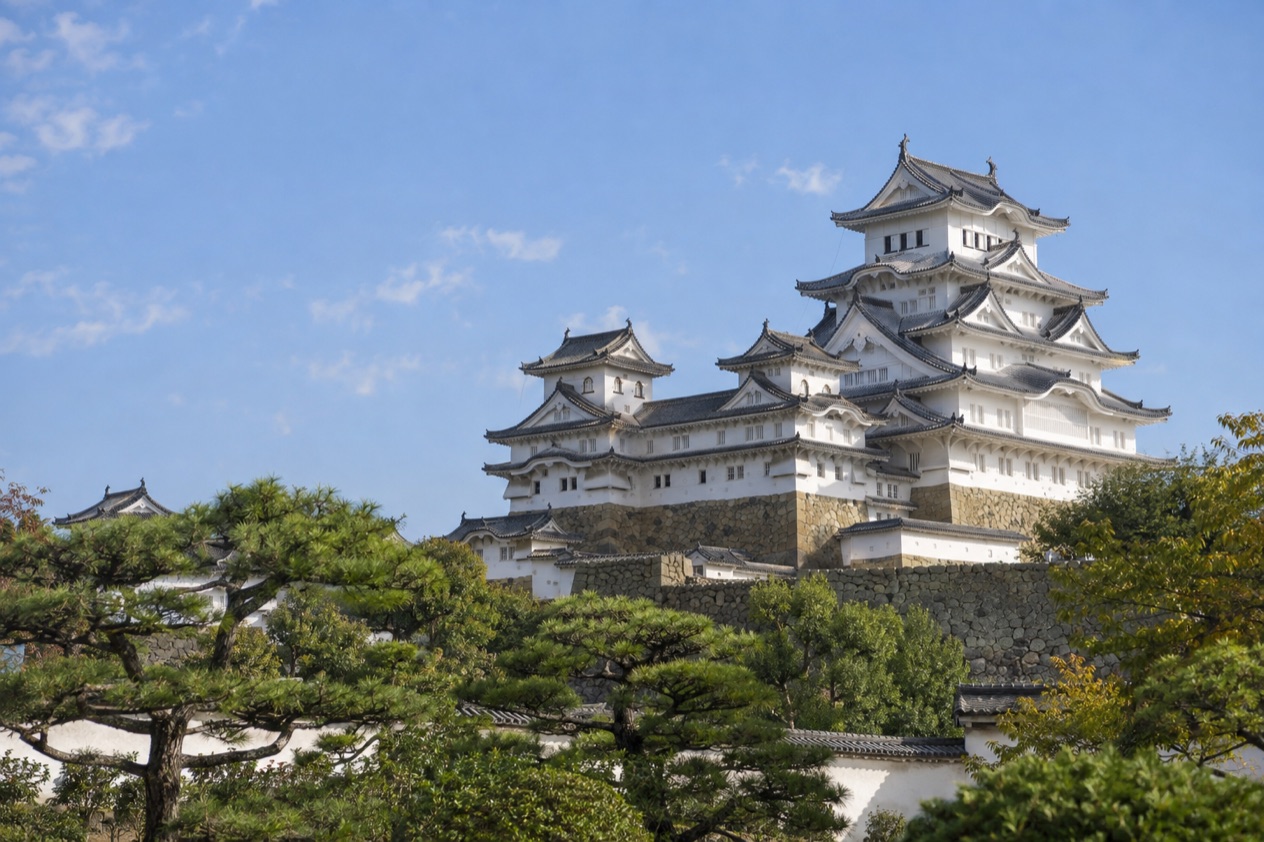
Coming out of Himeji Station, you see the castle before you have decided where to go. White plaster walls and layered gray roofs stand above the rooftops of the town, and the whole day seems to bend toward them.
Where is Himeji and what is it like?
Himeji sits in Hyogo Prefecture, in the Kansai region, west of Osaka along the San’yo Shinkansen line, with Kobe lying between the two on the way. It is a city rather than a village or a resort, and its streets carry office workers, students and shoppers as much as visitors, which gives the place a lived-in feel that a purely historic town would not have.
The city covers a wide stretch of land, a little over 206 square miles, so what you visit on a first trip is only the core around the station and the castle. That core has a clear shape.
The castle stands as the anchor, the station is the gateway, and the streets that connect them hold shops, cafés and small restaurants. You feel the rhythm of a regional city, with its own food habits and its own pride in the castle.
The castle gives Himeji its nickname of the White Heron Castle, a name that comes from the bright white plaster of its facades. Seen from across the moat, the roofs fold over one another like wings, and the name makes sense at once. This is the image that draws travelers, and it is a good reason to come.
Who will love it? Travelers who enjoy history, architecture and photography, and anyone who wants a day or two outside Osaka and Kyoto in a place with its own character. Who may be less taken?
Anyone hoping for a long list of nightlife districts, a mountain landscape or a beach, since Himeji is above all about one monument, its gardens and the town that grew around them. For visitors that focus is exactly the charm.
What is there to do in Himeji?
The castle is the main reason to come, and a second garden, a few temple-side excursions and the local table fill out the rest. What sets Himeji apart from the big Kansai cities is its focus: instead of choosing among dozens of neighborhoods, you give a day to one building and what surrounds it.
Himeji Castle
Himeji Castle is both a Japanese national treasure and a UNESCO World Heritage site, registered in 1993 as one of the first in Japan. It is also one of the 12 original castles in Japan, meaning its keep is the real thing rather than a later reconstruction.
It dates back more than 400 years, and it came through war, earthquakes and fires. It even came through the bombing of World War II and the 1995 Great Hanshin earthquake without collapse.
The grounds hold 83 buildings, so a visit is a walk through gates, turns, stone walls, storehouses and corridors before you reach the main keep. You pass the thick walls and narrow openings that were built with defense in mind, and the path winds in a way that makes you feel how the castle was meant to be approached. Inside the keep, you climb through wooden floors and steep stairs, and the view through the windows takes in the roofs and the town beyond.
Entry to the main keep is limited to the first 15,000 visitors each day. A free guided tour in English is included if a guide is available, though reservations are not possible. That tour is a good way to learn what you are looking at, especially if you want the stories behind the gates and walls.
Kokoen Garden
Kokoen is a garden next to the castle, built as a series of separate gardens with ponds, streams, pines, bridges and stone paths. Each section has its own character, and you move from one to the next as if turning the pages of a book. Koi drift in the ponds, and the castle’s white walls appear over the garden walls at certain angles, so the two visits fit together naturally.
Kokoen suits a slower hour after the castle, when you want to sit rather than climb. Japanese gardens reward patience, so give yourself time to stand at a pond edge and watch how the light shifts on the water. Seasonal color changes the mood from one visit to the next, with blossoms in spring and leaves in autumn, though no date can be promised.
| Site | Open |
|---|---|
| Himeji Castle | Daily 9:00 a.m. to 5:00 p.m., last admission 4:00 p.m. From May to August open until 6:00 p.m., last admission 5:00 p.m. Closed December 29-31 |
| Kokoen Garden | Daily from 9:00 a.m., closing at 5:00 or 6:00 p.m. depending on the time of year, last admission 4:30 or 5:30 p.m. |
Eating in Himeji
Himeji has a food identity that is easy to taste in a single afternoon. Himeji oden, a pot of simmered fish cakes, daikon and eggs, is traditionally served with a dipping sauce of soy and ginger, which gives it a sharper edge than the oden you may know from convenience stores. Anago, the sea eel of the Seto Inland Sea, appears grilled over rice or tucked into sushi.
Small restaurants and noodle shops fill the streets near the station, and a bowl of udon or a set meal makes a good break between the castle and the garden. Look for places with a short menu written on a board, and let the plates tell you what is in season.
How many days do you need in Himeji?
Most of what Himeji offers sits around the castle, so you do not need a long stay unless you want to use the city as a base for the wider region.
On a short visit, spend the morning at the castle, walking the approach, the gates and the keep, and let the guided tour fill in details if a guide is available. After lunch, move on to Kokoen, then wander the streets between the garden and the station for coffee, sweets and a look at the shops. If you stay the night, the castle walls seen again in the evening light give a different impression from the daytime view.
With two days, you can slow everything down. Himeji also works as a stop between Osaka and places farther west, since the Shinkansen stops here.
Day trips and add-ons
Kobe is the obvious partner for a longer stay in the region, with its harbor, its hillside streets and its beef restaurants. Osaka offers the food, the neon and the big museums, and travelers split their time between a Himeji night and an Osaka base. Okayama, with its celebrated garden, is another town you can reach on the same Shinkansen line.
Within the Himeji area, a temple excursion on Mount Shosha is a way to add a wooded, spiritual counterpart to the castle’s military history. These add-ons turn Himeji from a stop on the way into a small base of its own, and they show how much of western Hyogo lies beyond the castle walls.
Where to stay in Himeji
The area around Himeji Station is the base for visitors, because it puts the Shinkansen stop, the shops and a large choice of rooms within reach of one another. Staying here means you step out of your hotel into the same streets that lead toward the castle, and you can return easily at the end of a day of walking.
Staying nearer the castle suits travelers who want the evening view of the white walls and a quieter feel after the day visitors leave. Rooms near the castle give a different mood from the station area, more residential and more tied to the old town. If you like to wake up near the thing you came to see, this is the part of the city to consider.
A ryokan, the traditional inn with tatami rooms, futons and often a set dinner, is a way to add a Japanese touch to a stay if one is available in the area. Business hotels, with their compact rooms and straightforward service, are part of the lodging mix in a regional city like this one.
Another option is to base yourself in Osaka or Kobe and visit Himeji as a day trip. That choice suits travelers who want big-city restaurants and nightlife in the evening, and who are happy to spend part of the day on the train. Staying in Himeji itself rewards you with the evening castle view and a slower start the next morning.
How do you get to Himeji and get around?
Travelers arrive by train, and the San’yo Shinkansen stops at Himeji Station, which puts the city on the main line west from Osaka. From Osaka the ride runs about 1.5 hours, and the line continues to other cities farther along the route, so Himeji fits into a larger rail itinerary.
Two airports serve the area. Kobe Airport lies to the east of Himeji, and Kansai International Airport lies to the southeast, with Kansai offering a large number of international and domestic destinations. For travelers flying in from abroad, Kansai is the airport that most often appears in itineraries, and from there the rail network carries you onward.
Getting around the city
The castle area is built to be explored on foot, with long approaches, wide moat paths and gardens that invite walking. From the station you can move toward the castle on the city streets, passing shops and cafés on the way, and the white keep stays in view as you go.
For places beyond the center, such as the temple on Mount Shosha, local buses and taxis are the usual choices in a city of this kind. Rental cars exist for travelers who want to range farther across the region, though a stay focused on the castle and garden does not call for one.
When is the best time to visit Himeji?
Spring and autumn are the seasons that most reward a visit, because the castle and Kokoen change with the plants around them. Cherry blossoms frame the white walls in spring, and maples add red and gold to the garden in autumn. Dates shift from one year to the next, so treat these as seasons rather than fixed weeks.
Summer brings a practical change at the castle, since from May to August it stays open later in the day. That gives you more time in the grounds, which matters when you want to walk slowly through the gates and still have a window for the garden. The warm months also mean long days for strolling the moat paths, though you should plan your hours around the weather.
Winter has its own appeal, with bare branches that let the white plaster stand out more clearly against the sky. The castle closes for the last three days of December, so a year-end trip needs to take that closing into account. In every season, entry to the main keep is limited each day, which gives you a reason to start your visit with the castle rather than leave it for the end.
Good to know before you go
Himeji is a city where the main sights sit close together, so a day of walking is the norm and comfortable shoes matter more than any special gear. Shoes come off at some entrances inside the castle, so slip-on pairs are a help.
Typhoon season in Japan brings rain and wind to many regions in the warmer months, so keep an eye on the forecast if you travel then. Bring cash and a card as you would for any Japanese city, and follow the usual habits of quiet courtesy on trains and in temples.
Sources
- Japan National Tourism Organization, Himeji (https://www.japan.travel/en/destinations/kansai/hyogo/himeji-and-around/), checked October 11, 2026
- Wikipedia, Himeji (https://en.wikipedia.org/wiki/Himeji), checked October 11, 2026
- Wikivoyage, Himeji (https://en.wikivoyage.org/wiki/Himeji), checked October 11, 2026
All our pages
Things to do
- Himeji Castle: White Egret Keep, Opening Hours and How to Plan Your Visit
- Koko-en Garden in Himeji: Garden Rooms, Koi Ponds, Tea Houses and the Castle Next Door