
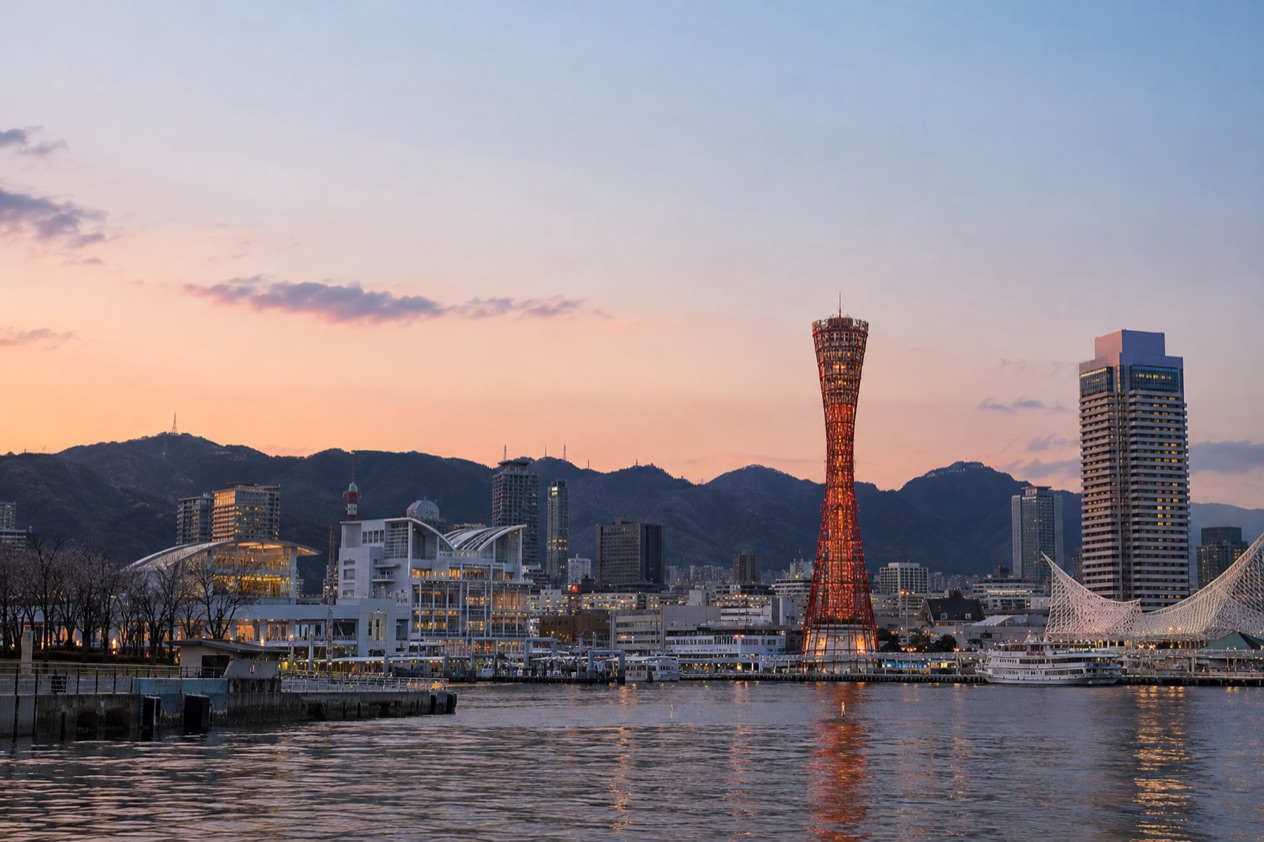
In January, the first shrine visits of the year are behind you and the osechi boxes of New Year’s are being replaced by hot bowls and grilled beef. In Kobe, the harbor air turns crisp, the hills behind the city stand clear on bright mornings, and the lights of the port glow a little longer into the evening. It is a month for warm interiors, long lunches and winter walks between the water and the mountain slopes.
What is the weather like in Kobe in January?
January in Kobe is cold but mostly dry, with bright stretches between a few gray days and the odd flurry of snow or sleet.
| Month | Average high (°F) | Average low (°F) | Precipitation (in) | Days with 1 mm or more of precipitation | Hours of sunshine | Daylight on the 15th |
|---|---|---|---|---|---|---|
| December | 53.6 | 42.3 | 1.92 | 5.7 | 153 | 9 h 51 min |
| January | 48.9 | 37.6 | 1.51 | 4.7 | 146 | 10 h 04 min |
| February | 50.2 | 38.1 | 2.19 | 6.0 | 142 | 10 h 55 min |
January is the coldest of the three months in the table, and it is also the driest. Afternoons stay cool rather than harsh, enough for a coat, a scarf and a walk along the waterfront. Mornings and evenings drop close to freezing, so the first step outside from a warm hotel feels sharp.
Rain comes on only a handful of days, and snow or sleet shows up on nearly nine days of the month, usually as a light dusting that melts rather than a real snowfall. Gray days feel damp, since the air stays fairly humid, so a waterproof layer is more useful than an umbrella that fights the wind off the bay.
Daylight is short, and the sun sets early enough that dinner plans begin under lit streets. On clear days the winter light is low and crisp over the harbor and the hills, which suits photographs of the port and the slopes of Mount Rokko.
What to do in Kobe in January
The month starts inside the New Year holidays, when many restaurants and attractions are closed, and the city only returns to its normal rhythm as the first days pass. Japan celebrates the New Year on January 1, and the osechi dishes served in lacquered boxes are a sign of those first days. After that, January in Kobe is about warming food, harbor views and the plum trees that begin to flower late in the month.
Plum blossoms (ume, Prunus mume) typically flower from January until late February in East Asia, so a few early branches may be in bloom in parks and gardens by the end of the month. They are a quiet, pale forerunner of the cherry blossoms that come later. Do not expect a full display, only the first hints of spring against bare winter trees.
Kobe beef on a winter table
Kobe beef is the dish the city is known for, and a cold January evening is a fine moment to sit down to it. It can be prepared as steak, sukiyaki, shabu-shabu, sashimi or teppanyaki, and the hot-pot styles suit the season best, with thin slices swirled through simmering broth or a sweet soy sauce.
The beef comes from Wagyu cattle, and the Japanese Black breed is the main source of that finely marbled meat. Teppanyaki counters, where the cook grills the beef in front of you, make a long dinner out of it. Pair it with rice, grilled vegetables and a glass of hot sake or tea, and let the meal fill the early dark.
The view from Kobe City Hall
The observation deck on the 24th floor of Kobe City Hall gives a wide look at the port, the city grid and the hills behind it. In winter the air is often clear enough for the outlines of the bay to stand out, and as dusk falls the city lights come on below you. It is a good first or last stop of a day, and it keeps you out of the wind.
| Site | Open |
|---|---|
| Kobe City Hall observation deck (24th floor) | Monday to Friday 08:15-22:00, Saturdays, Sundays and holidays 10:00-22:00 |
Harbor and hill walks
Kobe is a historic port city across the bay from Osaka, and the waterfront is the natural place for a winter stroll. Cold air makes the harbor lights look sharper, and cafés along the way give you a place to warm your hands with coffee or hot tea. Behind the city rises Mount Rokko, a range of mountains in southeastern Hyogo Prefecture, whose slopes frame the skyline.
Shops in urban areas are generally open from 10:00 a.m. to 8:00 p.m. every day, which makes browsing arcades and department stores a good plan for a cold afternoon. When a gray day settles in, museums, covered shopping streets and long restaurant lunches fill the hours without needing a plan.
Snow sports are a different trip. Japan’s ski season generally opens in December and runs to April, with January and February as the peak months in places like Hokkaido and the high mountains of Nagano. Kobe is a city base, and most major cities rarely see snow, so skiing means traveling elsewhere.
A two-day itinerary for Kobe in January
Day 1 begins with a late breakfast in the harbor area, once the morning chill has eased a little. Walk the waterfront in the middle of the day while the sun is up, then browse the covered shopping streets and department stores as the afternoon cools.
Go up to the Kobe City Hall observation deck before the light fades and watch the port lights come on. Dinner is the teppanyaki or shabu-shabu meal of Kobe beef. If rain or sleet sets in on the first day, keep to the indoor stops: the shopping arcades, a long lunch and an early visit to the observation deck, where the view stays open through the glass.
Day 2 turns toward the hills. Spend the morning looking for early plum blossoms in a park or garden, since the trees flower from January into late February, then lunch at a noodle shop or a hot-pot restaurant. In the afternoon, return to the city for museums and cafés, and keep the evening for an izakaya (a casual pub) with grilled skewers and warm sake as the temperature drops after dark.
Is Kobe busy in January?
January is a quieter, colder month in Kobe, though the first days belong to the New Year holidays, when many restaurants and attractions are closed.
Once the holiday days pass, the city goes back to ordinary winter life, with shops generally open from 10:00 a.m. to 8:00 p.m. in urban areas. The cherry blossoms and the autumn leaves are far from this month, so the draw is food, harbor views and early plum trees rather than a blooming season.
Public holidays can shift the rhythm of a week. When a national holiday falls on a Sunday, the next working day becomes a holiday, and a day between two holidays also becomes one, so some days may feel slower than a regular weekday. The deck at City Hall also opens later on Saturdays, Sundays and holidays.
What to pack for Kobe in January
Pack for cool, damp days and cold evenings, with layers that come off easily in heated shops and restaurants.
- A warm coat, for lows that sit close to freezing after dark.
- A sweater or fleece, to layer under it on harbor walks.
- A scarf and gloves, for the cold air off the bay.
- A waterproof jacket, for rain and the occasional sleet.
- Comfortable shoes with grip, for wet pavement and park paths.
Good to know before you go
The start of January falls inside the New Year holidays, so many restaurants and attractions are closed in the first days of the month. Plan the Kobe beef dinner and any special visits for later in the week or month. Shops in urban areas are generally open from 10:00 a.m. to 8:00 p.m. every day, but rural shops often close earlier, sometimes as early as 6:00 p.m.
Kobe is directly connected to Tokyo by the JR Tokaido/Sanyo Shinkansen, which reaches Shin-Kobe Station, and the journey takes between 2 hours 40 minutes and 3 hours 15 minutes.
Kobe in January vs December and February
Moving earlier to December brings slightly milder afternoons and a bit more sunshine, and the year-end season has its own atmosphere before the New Year closures begin. The ski season also opens in December, so winter sports are possible, though January and February are the peak months for snow in the mountain regions.
Moving later to February keeps the cold but brings more rain days and more snow or sleet days, and the plum blossoms are still in flower until late in the month. Daylight is noticeably longer, so there is more usable light for walking the harbor and the hills.
January suits travelers who want the driest of the three months and do not mind the cold, and who want to avoid the busy year-end. Choose December for milder afternoons, or February for longer light and the plum trees at fuller flower.
Is January a good time to visit Kobe?
Yes, for travelers who like crisp winter days, hot meals and a harbor city without a blooming season to chase.
It suits people who plan around food, view points and indoor stops, and who are happy to wear layers. It is less suited to anyone who wants warm weather, sea activities or snow sports, since the city itself rarely sees heavy snow and the slopes are elsewhere.
On arrival, start with the observation deck at City Hall to see the harbor and the hills laid out, then plan the beef dinner for an evening after the New Year closures. January in Kobe is a month of steam rising from a hot-pot, the first plum blossoms and city lights over a cold bay.
Sources
- Japan Meteorological Agency (JMA), Normal values 1991-2020, monthly (https://www.data.jma.go.jp/stats/etrn/view/nml_sfc_ym.php?prec_no=63&block_no=47770), station Kobe, elevation 5 m, checked October 11, 2026
- Computed from the date and the latitude of the place (sunrise equation, solar elevation -0.833 degrees), October 11, 2026
- Japan National Tourism Organization, shop and attraction hours, national holidays (https://www.japan.travel/en/plan/business-hours-and-holidays/), checked October 11, 2026
- Wikipedia, Japanese New Year (https://en.wikipedia.org/wiki/Japanese_New_Year), checked October 11, 2026
- Wikipedia, Public holidays in Japan (https://en.wikipedia.org/wiki/Public_holidays_in_Japan), checked October 11, 2026
- Japan National Tourism Organization, winter in Japan (https://www.japan.travel/en/guide/winter-guide/), checked October 11, 2026
- Japan National Tourism Organization, skiing and snowboarding in Japan: regions, resorts, seasons (https://www.japan.travel/en/sports/snow/), checked October 11, 2026
- Wikipedia, Climate of Japan (https://en.wikipedia.org/wiki/Climate_of_Japan), checked October 11, 2026
- Japan National Tourism Organization, weather and seasons in Japan (https://www.japan.travel/en/plan/weather/), checked October 11, 2026
- Japan National Tourism Organization, skiing guide (https://www.japan.travel/en/guide/skiing/), checked October 11, 2026
- Wikipedia, List of ski areas and resorts in Japan (https://en.wikipedia.org/wiki/List_of_ski_areas_and_resorts_in_Japan), checked October 11, 2026
- Japan National Tourism Organization, flowers by season: cherry blossom, plum, wisteria, hydrangea, where and when (https://www.japan.travel/en/see-and-do/flowers/), checked October 11, 2026
- Wikipedia, Prunus mume (https://en.wikipedia.org/wiki/Prunus_mume), checked October 11, 2026
- Japan National Tourism Organization, Kobe (https://www.japan.travel/en/destinations/kansai/hyogo/kobe-and-around/), checked October 11, 2026
- Visit Kobe, the official travel guide (https://www.feel-kobe.jp/en/), checked October 11, 2026
- Wikipedia, Kobe (https://en.wikipedia.org/wiki/Kobe), checked October 11, 2026
- Wikivoyage, Kobe (https://en.wikivoyage.org/wiki/Kobe), checked October 11, 2026
- Wikipedia, Wagyu (https://en.wikipedia.org/wiki/Wagyu), checked October 11, 2026
- Wikipedia, Mount Rokkō (https://en.wikipedia.org/wiki/Mount_Rokk%C5%8D), checked October 11, 2026
To plan your stay
- Things to Do in Kobe: Kobe Beef, Kitano's Foreign Houses, Arima Onsen and Harbor Night Views
- Where to Stay in Kobe: Shin-Kobe, the City Center, Harborland and Arima Onsen
- Kobe from Osaka: Trains, Two Stations, the Bus and a Day at the Harbor
- Kobe vs Osaka: Beef, Dotonbori Nights, Getting Around and Weather