
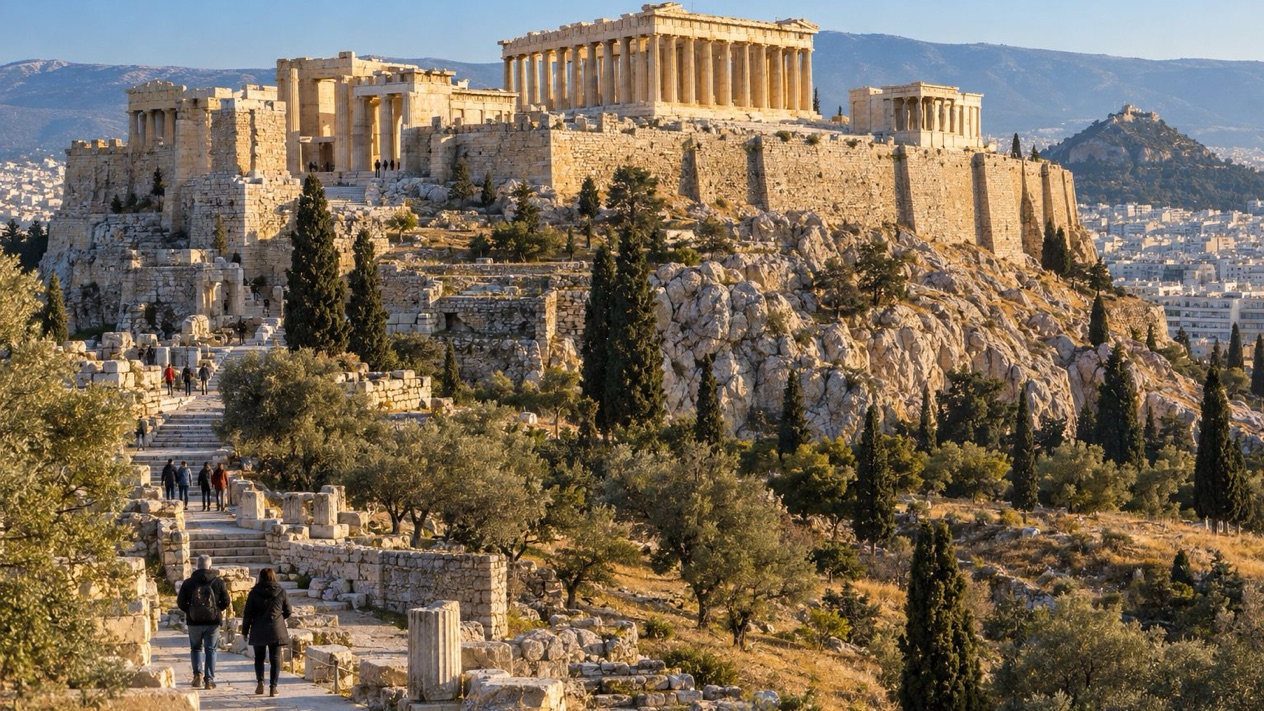
Athens is a sprawling, congested, layered city with a small, walkable heart. The Acropolis rises high above the city and is easy to spot from many corners of Athens. Rooftop bars look straight at the Parthenon, and some hotels and restaurants have glass floors over ruins thousands of years old. History lovers will feel right at home here, but anyone who likes to eat well and wander will find plenty to do. Many travelers treat Athens as a quick pass-through on the way to the islands. It deserves a few days of its own.
Where should you stay in Athens?
Central Athens is compact, and most of the sights sit within walking distance of one another. That makes the choice of neighborhood a question of mood. Pick the feel you want to wake up in. Then check how close you are to the metro, and to the airport or Piraeus port.
Plaka and Anafiotika
This is the classic first-timer base. Plaka lies at the foot of the Acropolis, between the hill and Syntagma Square. It has car-free streets, sunny squares, small churches, gelato shops and restaurants with outdoor tables. It's a very popular area with visitors, and you'll feel that during the day. Right beside it, Anafiotika climbs the hillside in whitewashed houses with blue doors and bougainvillea, a quiet slice of old Athens that many visitors miss. It looks like a Cycladic village because Cycladic builders made it. In the 19th century the king invited them to Athens to help build the Royal Palace and other landmarks. In exchange they got land for homes, and they named the neighborhood "Little Anafi" after their island. From here you can walk to the Acropolis, the Ancient Agora and the other major sights, so it's ideal for two or three nights. In Plaka, A77 Suites is a small luxury property, and Mona Athens has rooftop views of the Acropolis. The lanes are cobbled and climb the hill, so pack comfortable shoes.
Monastiraki and Psyrri
Monastiraki is the historic center, with the Roman Agora, the Ancient Agora and Hadrian's Library close by. Its main square has an impressive view of the Acropolis, and the flea market fills the streets around it. Psyrri, next door, looks sleepy by day. After dark it comes alive with cocktail bars, outdoor tables and a steady hum of talk. Both suit travelers who want to be in the middle of things and don't plan on early nights. Metro Line 3 stops at Monastiraki and runs straight to the airport.
Syntagma
Syntagma Square is the political and cultural hub of the country. The Parliament building, once the King's Palace, fills one side. It's also the easiest base for transport. The X95 airport bus runs here, Metro Line 3 connects the square directly to the airport, and trams leave for the coast and Piraeus. The boutique New Hotel is a few minutes' walk away. Syntagma is a practical pick for a short stay, especially if you land late or leave early.
Thissio
Thissio lies on the northwest side of the Acropolis, close to the Ancient Agora and Areopagus Hill. It has good food and drink, often with fine views of the Acropolis, and a calmer atmosphere than Plaka. Choose it if you want the big sights nearby without the crowds outside your door.
Kolonaki, Exarchia and Kypseli
For a different side of the city, Kolonaki has museums, antique shops and an aristocratic urban ambience, with relaxed brunch spots on quiet streets. Exarchia has a restless student spirit, bookstores and cafés, plus a Saturday farmers' market that ranks among the busiest in Athens. Kypseli has theatres and an intense multicultural life.
For a one-night stopover
If you're catching an early flight or ferry, sleep where you leave from. The Sofitel Athens Airport is connected to the terminal, so there's no transfer to worry about. The Mural Piraeus Hotel sits across the street from Piraeus port, which takes the stress out of a morning ferry.
The Athens Riviera
If you have extra days and want a different kind of vacation, the coast south of the city has become a destination in its own right. It has a glamorous streak and a cluster of five-star hotels by the sea. The beach section below covers what to do there and how to get there.
What are the best things to do in Athens?
Start with the Acropolis, because seeing it first helps the rest of the city fall into place. The Parthenon crowns the rock and towers over the city. Around it stand the Temple of Athena Nike, the Propylaea and the Erechtheion with its Caryatids, the columns carved as female figures. The ones on the hill are replicas, and the originals are in the Acropolis Museum. The ticket also covers the slopes, with the Theater of Dionysus and the Odeon of Herodes Atticus. The Odeon is a stone Roman theater that still welcomes concerts, and it serves as the main venue of the Athens Festival, held from May through October. Wander to the edges of the plateau for a bird's-eye view over the rooftops. Expect scaffolding somewhere, since restoration work is nearly constant. Allow 1.5 to 2 hours. The Cosmote Chronos app works as an interactive audio guide.
Full admission to the Acropolis and its slopes is €30, and reduced admission is €15. Tickets are sold at the site and online. The "Acropolis and Slopes" ticket is good for a single entry, so once you leave you can't get back into any site with it. Free admission days are March 6, April 18, May 18, the last weekend of September and October 28. The site is open from 8 a.m. to 5 p.m. in winter, with last entrance at 4:30, and until 8 p.m. in summer, with last entrance at 7:30. In the fall the closing time moves earlier in steps, so check the current hours before you go. The Acropolis is also closed on New Year's Day, Easter Sunday, Christmas Day and the day after, plus March 25 and May 1.
Timing matters more than anything else here. Many visitors like to arrive right at opening, when the site tends to be calmer. Late morning can be sheer madness, while a late-afternoon slot may leave the top nearly empty. In summer, buy a timed ticket in advance and arrive at least 15 minutes before your slot. For visitors with limited mobility, an elevator added in 2020 rises to the plateau, north of the Erechtheion. Accessible restrooms are at the Information Centre on Dionysiou Areopagitou Street, just east of the South Slope entrance.
The Acropolis Museum sits about ten minutes' walk below the hill. See it afterward. Many exhibits reference the layout of the ruins, so they make more sense once you've stood among them. Its top floor matches the dimensions of the Parthenon, which shows how massive the temple was. The nearest metro stop is Akropoli on Line 2.
Next comes the Ancient Agora, the social and commercial center of ancient Athens, where Socrates and Plato once argued. It has the well-preserved Temple of Hephaestus and an intimate museum. Admission is €20, or €10 reduced, and covers both. Its winter hours run until 4:30 p.m. and its summer hours until 7:30 p.m. Wheelchair access to the temple area is through the Thiseion Square entrance on Apostolou Pavlou Street. Call 210 3214824 ahead. From Monastiraki you can walk up to the Acropolis through the Agora.
The Roman Agora, with its wondrously intact Tower of the Winds, is a short stroll away. Tickets are €10, or €5 reduced, and it closes earlier in winter. It's a good extra ruin when you're short on time.
The Temple of Olympian Zeus was one of the largest temples in ancient Greece. Construction lasted more than 600 years, until the Roman emperor Hadrian finished it. Scaffolding on the southeast corner is part of conservation work, and construction work can close the area around Hadrian's Gate. Tickets are €20, or €10 reduced. If you plan to see several sites, a combined pass valid for five days from first use saves buying separate tickets.
The Panathenaic Stadium is a striking site built entirely of marble. It hosted the first modern Olympic Games in 1896, and the ticket includes a 30-minute audio guide. The National Archaeological Museum holds one of the world's great collections of ancient Greek art. Give it time if you love museums, and cut it if you don't.
For views without a ticket, climb Philopappos Hill, southwest of the Acropolis. Paths range from marble walkways to dirt tracks with uneven steps, so wear sturdy shoes and bring water. Go in the evening, when the climb is easier and you can stay for sunset. The best view of the Parthenon is a little above the main benches, near the Philopappos Monument. Lycabettus Hill, the city's highest point, looks over all of Athens to the sea and nearby islands. Take the metro to Syntagma or Panepistimio. From the foot of the hill it's a fairly easy 20-minute hike, or you can ride the cable car.
You can watch the changing of the guard at the Tomb of the Unknown Soldier, right by the Hellenic Parliament across from Syntagma Square. A short ceremony happens every hour and lasts about 15 minutes. The full version, with a band marching in, is on Sunday mornings. Arrive 15 minutes early for a good spot.
For shopping, pedestrian Ermou Street runs from Syntagma through Monastiraki to Thissio, lined with international chains. In Plaka, Andrianou Street and its neighbors sell handmade sandals, olive oil and ouzo.
Plan around holidays. All archaeological sites, monuments and museums close on Easter Sunday and May 1. Hours change on other public holidays, such as Good Friday and Holy Saturday, so check before you go.
How many days do you need in Athens?
Three days is the sweet spot. Two will work if you move fast. Three gives you the major sites without a sprint, plus time to eat well, which is half the point.
Day 1
Arrive and walk Plaka and Anafiotika. Let the side streets lead you, stop for gelato and keep wandering through Anafiotika for its island-like charm. End with dinner and drinks facing the Acropolis.
Day 2
Be at the Acropolis when it opens, then walk down to the Acropolis Museum. Spend the afternoon exploring Psiri. Make your way to Petralona for dinner once the sun has gone down, and end the night with loukoumades.
Day 3
Start with coffee near the Acropolis, then walk to Philopappos Hill. Add the Roman Agora if your energy holds. Choose a rooftop bar for sunset, then return to your favorite neighborhood for dinner.
With a fourth day, consider Delphi or Meteora. Both are full day trips. Delphi lies about 112 miles (180 km) northwest of the city and is known for its ancient sanctuary of Apollo. Meteora, a UNESCO World Heritage site of monasteries perched on towering rocks, is four to five hours away by bus, about four by car, or around five by train to nearby Kalambaka.
What should you eat in Athens?
Gyros and souvlaki are the cheap, fast, satisfying staples. Kostas, a tiny kiosk on Saint Irene Square, draws a steady line of locals for its takeaway souvlaki. Greeks aren't big on breakfast. Instead they often grab a pretzel from a stand as a mid-morning snack, and you'll find these all over the city. A well-known pretzel bakery in Psiri is open 24 hours a day. If you want a proper brunch, Philos Athens is a casual hideaway on a quiet street in Kolonaki.
Loukoumades are the classic sweet. These small puffs of fried dough, close to a doughnut, come with local honey and nuts. Gelato is everywhere, and the pistachio at Da Vinci, a stone's throw from the alleys of Anafiotika, is a favorite.
For sit-down meals, Manari Taverna serves excellent Greek food in a courtyard beside the city's oldest Byzantine church. Order the linguine for two and the pastitsio. Akra is Michelin-rated without being pretentious, with modern Greek dishes served inside the restaurant's actual kitchen. For something lively, the Mnisikleous Street Stairs in Plaka are a set of steps lined with restaurants and outdoor tables, busy with locals and visitors alike. Dessert Wise is a fun after-dinner stop that focuses on high-end dessert and wine pairings.
Dinner starts late by American standards, and the bar scene doesn't get going until after midnight. Coffee is as much about people-watching as the drink. Order a freddo, an iced coffee, and take your time. Takeaway cups are hard to find outside Starbucks. Little Tree Books & Coffee, a cozy café and bookshop near the Acropolis, is a good place to sit.
Rooftop bars are the signature of an Athens evening, and sunset is the hour to go. Couleur Locale feels like a secret. Enter an unassuming bar on a side street off Ermou and take the lift to the top. The Roof Garden at the five-star Electra Metropolis is chic, and its drinks are surprisingly affordable. The view from Monastiraki square is similar, so a drink at ground level works too. For a different kind of night out, try Cine Paris, an outdoor movie theater with Acropolis views.
Can you go to the beach from Athens?
Yes. The Athenian Riviera runs from Piraeus to Cape Sounion, past Glyfada, Vouliagmeni, Varkiza and Anavyssos. Locals head here to beat the heat, hit the beaches, stroll the promenade and dine at restaurants overlooking the water. The coast road has lovely views of the sea and the Saronic Gulf islands.
The tram runs from Syntagma to Voula. Cape Sounion sits at the far end of the coast, about 43 miles (69 km) from Athens. Intercity KTEL coaches leave from Aigyptou Square, near Victoria station, or you can rent a car and drive the coast road. A hop-on hop-off day pass that covers the Riviera saves you from sorting out transport. In summer, pack a hat.
How do you get to Athens and around the city?
Athens International Airport, Eleftherios Venizelos (ATH), is Greece's largest airport and its main international gateway. It lies about 20 miles (33 km) from the center. The ride takes about 35 to 40 minutes. Once you count getting to the station, buying a ticket and waiting, expect 40 to 50 minutes door to door by metro or taxi. The station is next to the terminal, reached by an elevated walkway. From there, Metro Line 3 runs to Syntagma and Monastiraki, and the Proastiakos suburban railway connects to Larissa, the central train station, and Piraeus. The X95 bus to Syntagma leaves from the arrivals level, between Exits 4 and 5. It's a good fit if your hotel is within a few blocks of the square. Taxis wait at the official rank outside Exit 3, and fares start at the airport. A private transfer is the easy option after a late arrival. Hertz, Avis and Enterprise have desks at the airport. To drive, you need your U.S. license and an international driving permit, even if the rental company doesn't ask for it. It's wise to keep passports, valuables and luggage out of a parked rental car, since thieves in Greece do break into them.
In the center, walk. Many streets are pedestrianized, though motorcycles still sneak through. Metro Line 2 serves Syntagma and Akropoli, and Line 3 serves Syntagma and Monastiraki. To reach the Acropolis, take the metro to Akropoli and walk along Dionysiou Areopagitou Street. Taxis are relatively cheap, and Uber or the FREENOW app is often easier than hailing one.
For ferries, take Metro Line 1 or a bus to Piraeus, Greece's largest port. The X80 express bus links Piraeus, the Acropolis and Syntagma, and a tram also runs from Syntagma to Piraeus. From Athens you can sail to the islands or fly to larger ones such as Mykonos, Naxos, Paros or Santorini.
When is the best time to visit Athens?
The shoulder seasons, spring and fall, are ideal. Days are pleasant, crowds are lighter and hotels cost less. In May the city fills with bougainvillea, jacaranda and jasmine. Summer is hot and dry. Start sightseeing early, take breaks and save evenings for rooftops and open-air concerts. Forest fires are common in the dry months and occasionally close roads. Winter is mild and quiet, with a more local feel, and some sites keep shorter hours. Many island businesses close for the season, though, so winter is a poor fit if Athens is only a stopover before the ferries.
What should Americans know before going to Athens?
U.S. citizens can visit Greece without a visa for up to 90 days for tourism or business. Your passport should have at least three months of validity beyond your planned departure date. A passport you've reported lost or stolen won't get you in, even if you find it. You may be asked for proof of sufficient funds and a return ticket. Carry your passport or a photo ID at all times.
Greece is generally safe, and central areas like Plaka, Kolonaki and Psyrri stay lively late into the night. Petty crime is common at busy sites, though. Pickpocketing and purse-snatching happen there and on public transportation, especially the metro. Strikes and demonstrations are common, can come with little notice and can disrupt traffic, taxis, seaports and airports, so check the news before travel days. Earth tremors also occur regularly.
Private hospitals in Greece usually require proof of adequate insurance or cash before admitting a patient, so travel insurance is worth having. The metro and airport are fully accessible with ramps and elevators. Buy the right ticket and validate it before you ride, since riders without a valid ticket can be fined up to 60 times the basic fare.
A friendly "kalimera" (good morning) is a nice way to start a conversation, and "efharisto" (thank you) and "parakalo" (please) are handy too. Carry some euros for taxis and small shops, and round up the bill or leave 5 to 10 percent at cafés and restaurants.
Sources
- finduslost.com (https://finduslost.com/athens-travel-guide-stay-eat-sleep/), checked October 18, 2026
- thetravelista.net (https://thetravelista.net/travel/ultimate-city-guide-athens/), checked October 18, 2026
- ricksteves.com (https://www.ricksteves.com/europe/greece/athens), checked October 18, 2026
- beantowntraveller.com (https://beantowntraveller.com/2025/06/03/athens-a-complete-guide-for-first-time-visitors/), checked October 18, 2026
- hudsonandemily.com (https://www.hudsonandemily.com/athens/), checked October 18, 2026
- U.S. Department of State (https://travel.state.gov/content/travel/en/international-travel/International-Travel-Country-Information-Pages/Greece.html), checked October 15, 2026
- Hellenic Ministry of Culture, Odysseus (http://odysseus.culture.gr/h/3/eh355.jsp?obj_id=2384), checked October 15, 2026
- Hellenic Ministry of Culture, Odysseus (http://odysseus.culture.gr/h/3/eh355.jsp?obj_id=2488), checked October 15, 2026
- Hellenic Ministry of Culture, Odysseus (http://odysseus.culture.gr/h/3/eh355.jsp?obj_id=2485), checked October 15, 2026
- Hellenic Ministry of Culture, Odysseus (http://odysseus.culture.gr/h/3/eh355.jsp?obj_id=2402), checked October 15, 2026
- ktelmessinias.gr (https://www.ktelmessinias.gr/en/routes/athens/), checked October 15, 2026
- Hellenic Ministry of Culture, Odysseus (http://odysseus.culture.gr/h/1/eh155.jsp?obj_id=2409), checked October 15, 2026
All our pages
When to go
- Best Time to Visit Athens: April to June and September to October
- Athens in January: Weather, Crowds and What to Do
- Athens in February: Weather, Crowds and What to Do
- Athens in March: Weather, Crowds and What to Do
- Athens in April: Weather, Crowds and What to Do
- Athens in May: Weather, Crowds and What to Do
- Athens in June: Weather, Crowds and What to Do
- Athens in July: Weather, Crowds and What to Do
- Athens in August: Weather, Crowds and What to Do
- Athens in September: Weather, Crowds and What to Do
- Athens in October: Weather, Crowds and What to Do
- Athens in November: Weather, Crowds and What to Do
- Athens in December: Weather, Crowds and What to Do
- The Athens to Thessaloniki Train: Hellenic Train, Ticket Changes and Thessaloniki's New Metro
Things to do
- Things to Do in Athens: The Best Sights, Ranked, and What to Skip
- Athens Day Trips: Temples, Theaters and Islands Within a Day's Reach
- Athens Itinerary: 3 Days, Plus Shorter and Longer Versions
- 7 Days in Greece: Itinerary for Athens, Santorini and the Aegean Crossing
- 10 Days in Greece: Itinerary Through Athens, Paros, Naxos, Mykonos and Santorini
- The Athens Central Market: Meat Hall, Fish Stalls, Produce and When to Go
- A day trip to Delphi vs an overnight at Delphi: Sights, Food, Weather and Getting There
- 5 Days in Greece: Itinerary Through Athens, Delphi and Meteora
- Athens Food: What to Eat, Where to Eat It, and How Meals Work
- Athens Metro: Lines, Tickets and Getting Around
- The National Garden of Athens: Ruins, Duck Pond, Hours and When to Go
- Athens Neighborhoods: Where to Stay and What Each One Feels Like
- The Athens Riviera: Sounion, Vouliagmeni, Glyfada and the Coast Road
- 7 Days in Greece: Itinerary for Athens, Santorini and the Caldera
- 10 Days in Greece: Itinerary for Athens, Mykonos and Santorini
- Street Art in Athens: Psiri, Exarhia, the Historic Center and When to Go
- The Athens Suburban Railway: Routes, Hours, Stations and Tickets
- Taxis and Ride-Hailing in Athens: Airport, Acropolis, Southern Beaches and Paying
Where to stay
- Athens Hotels: Where to Stay and Which Area Fits You
- Hotels near Athens Airport: Spata, the Terminals and Getting Into Athens
- Athens Hotels with Acropolis Views: Rooftops, Neighborhoods and Planning Your Visit
- Luxury Hotels in Athens: Neighborhood Choices, Airport and Metro Access, and the Seasons
- Where to Stay in Glyfada: The Marina, Ano Glyfada, the Tram Line and Hotel Types
- Where to Stay in Kolonaki: Lycabettus Slopes, Museum Row, Metro Access and Nearby Plaka and Koukaki
- Where to Stay in Koukaki: Acropolis Museum Streets, Syngrou–Fix and the Plaka Border
- Where to Stay in Monastiraki: Plaka, Koukaki and the Flea Market Streets
- Where to Stay in Piraeus: Central Harbor, Zea, Mikrolimano and Nearby Athens Neighborhoods
- Where to Stay in Plaka: Ano Plaka, Kato Plaka, Adrianou Street and Getting Around
- Where to Stay in Psyrri: Heroes Square, the Hero-Named Streets and Nearby Plaka and Koukaki
- Where to Stay in Syntagma: Syntagma Square, Plaka and Koukaki Compared
Getting there
- How to Get to Athens: Flights, Trains, Buses and Boats
- Athens Airport: Where It Is and How to Get Into Town
- Athens Airport Buses: Reaching the Terminal, Metro Line 3 and Tickets
- Athens Airport by Metro: Line 3, the Suburban Railway and Tickets
- Luggage Storage in Athens: Airport Terminals, the City Beyond Them and Beach Day Costs
- Athens Public Transport: Metro, Tram, Tickets and Getting Around
- Athens to Cape Sounion: Getting Out of the City, Driving Rules and Your Options
- Athens to Corinth: Driving With an IDP, Athens Transit and Corinth's Pedestrian Center
- Athens to Crete: Reaching Heraklion, Driving With an IDP and What to Eat on Arrival
- Delphi from Athens: How to Get There and Spend the Day
- Athens to Epidaurus: Driving, the Athens Metro and the Ancient Theatre
- Athens to Kalamata: Driving With an IDP, Athens Metro Hours and Kalamata's Olive Country
- Athens to Meteora: Kalabaka, Driving With an IDP and the Rock Monasteries
- Athens to Monemvasia: Driving, the Causeway and Moving Around Athens First
- Athens to Mycenae: Distance, Driving With a Permit, Athens Metro and Free Admission
- Athens to Mykonos: Airports, the Metro Ride to Athens International and the Island at the End
- Athens to Nafplio: Getting There by Car or Public Transport, the Driving Permit and Athens Metro Hours
- Athens to Olympia: Driving, the Katakolo Train and the Athens Metro
- Athens to Piraeus: Metro, Buses, Taxis and Getting to the Port
- Athens to Rhodes: Metro Hours, Island Options and Driving on Rhodes
- Athens to Santorini: Reaching the Airport, the Island Route and Driving on Santorini
- Athens to Thessaloniki: Getting Between the Two Cities, Driving with an IDP and the Egnatia Odos
- Athens Tram and Buses: Syntagma to Kalamaki, Voula to Piraeus, Tickets and Validation