
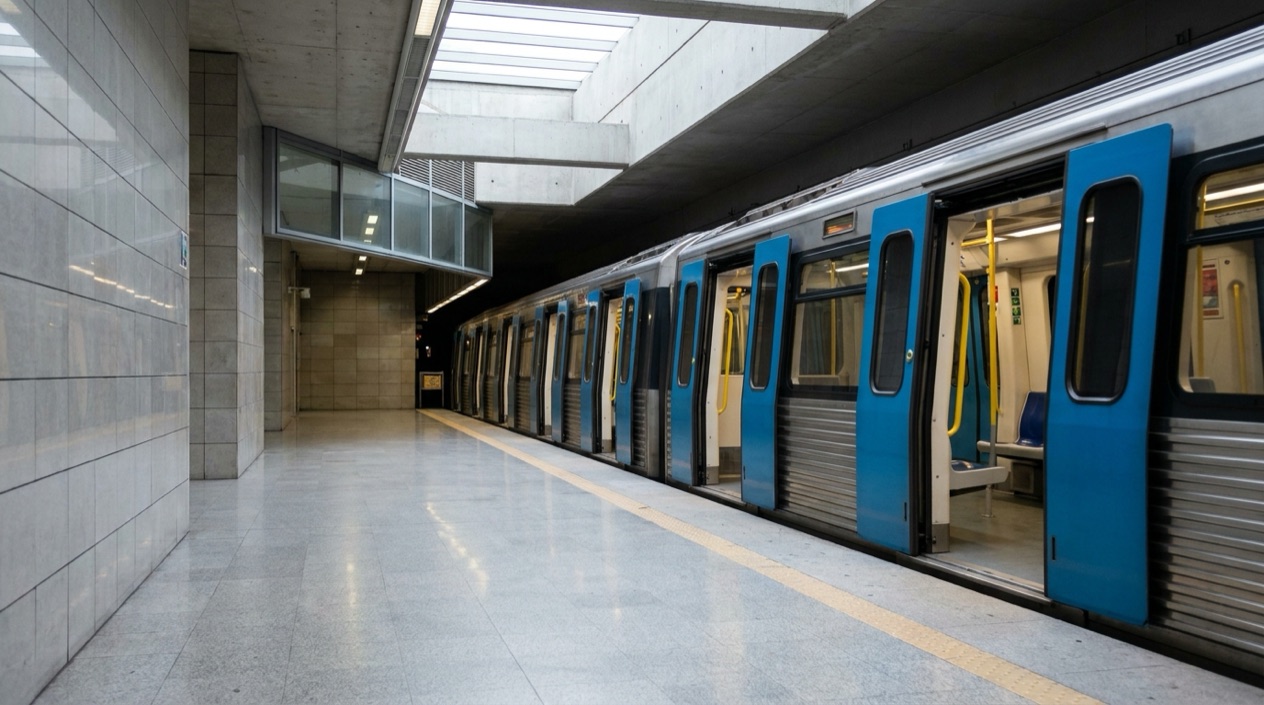
The metro is the fastest way around Athens. It has three color-coded lines, and it links up with the tram, city buses and the suburban railway. Line 3 (Blue) runs from the airport to Syntagma Square in about 40 minutes. Line 1 (Green) takes you down to the port of Piraeus. Line 2 (Red) stops at Akropoli, a short walk from the Acropolis.
How many metro lines does Athens have, and which ones matter?
Athens has three metro lines, and most people know them by their colors. You can change lines at Syntagma (Lines 2 and 3), Monastiraki (Lines 1 and 3), or Omonia and Attiki (Lines 1 and 2).
Line 1 (Green) is the oldest. This one is mostly an overground railway, linking the northern suburb of Kifissia with the port of Piraeus. It is a little slower than the underground lines, but you get to watch the city go by. Visitors use Monastiraki, Thissio and Omonia the most.
Line 2 (Red) runs underground from Anthoupoli in the west to Elliniko in the south. Akropoli is the stop for the Acropolis and the Acropolis Museum. Syntagma serves Constitution Square and the Greek Parliament. At Larissa Station you can walk through to the central railway station. For the beaches of the Athens Riviera, ride to Elliniko and continue by bus or taxi.
Line 3 (Blue) runs underground through the center and the northern suburbs, then out to the airport. It also reaches Piraeus. Its central stops include Syntagma, Monastiraki and Evangelismos. Megaro Moussikis serves the Megaron Music Hall, the city's main concert hall.
How do tickets work on the Athens metro?
One ticket system covers the metro, buses, trolleybuses and tram. A standard ticket lasts 90 minutes from the moment you first validate it, and you can change as often as you like. A day pass gives you 24 hours of unlimited rides, and a 5-day ticket suits a longer stay. The 3-day tourist ticket includes one round trip to the airport. You can buy it at the kiosks at the airport, Omonia, Syntagma, Thissio, Monastiraki, Akropoli and Piraeus stations.
Standard fares apply, including the airport fare, and your charges for the day stop at the price of a day pass. Try to use the same card or phone for the whole trip, transfers included, since inspectors can check the exact one you tapped in with.
Ath.ena paper tickets and cards are sold at metro and tram stations. Validate a paper ticket at the turnstiles before you head down to the platform. Inspections are frequent, especially on the airport line.
How do you get from the airport to the city by metro?
Take Line 3. From baggage claim, follow the "To Trains" signs. The station sits beside the terminal at the Departures level, reached by an elevated walkway, about a five-minute walk. Elevators help if your bags are heavy. Buy your airport ticket, or tap your card, before the barriers.
The ride takes about 40 minutes to Syntagma or Monastiraki. Both are central, so get off at whichever is closer to your hotel. As far as Doukissis Plakentias, the train runs above ground on the suburban railway tracks. Luggage space on board is tight, so keep big suitcases close.
Airport trains leave about every 30 minutes, so look up the last train if your flight lands late or leaves early. On the way back, more Line 3 trains end at Doukissis Plakentias than at the airport. Check the platform boards and the screen above the driver's cab for the final destination before you board.
How do you get from Piraeus port to central Athens?
The Line 1 terminus sits right across the street from the port, and signs lead you there. Ride Line 1 to Monastiraki, or get off at Thissio or Omonia if you are staying nearby. For the islands, take the same route in reverse.
From the airport, Line 3 runs straight to Piraeus in about an hour with no change of train.
What are the metro hours and how busy does it get?
The metro runs every day from early morning until around midnight. Timetables change with the season and the day of the week, so check the official metro website before a late trip.
At peak hours, trains come every 5 to 6 minutes, and every 7 to 10 minutes at quieter times. Platform screens show when the next train is due. If you have a big suitcase, travel outside those times.
Which metro stops are worth getting off at?
Building the metro uncovered more than 50,000 artifacts, and several central stations now display them, so a few stops are worth a look even before you go up to the street.
- Syntagma: one section of the excavation is left open, showing the city's layers from antiquity to today, along with a 4th-century BC tomb, mosaics and coins. One exit comes out on Amalias Avenue, in front of the Parliament and the Tomb of the Unknown Soldier, where you can watch the changing of the guard. The other opens onto the center of the square by its fountain.
- Akropoli: copies of the Parthenon frieze line the platforms. The exits come up on Makrigianni street by the Acropolis Museum. From there it is a few minutes' walk along Dionysiou Areopagitou street to the south entrance of the Acropolis.
- Monastiraki: the bed of the ancient Eridanos River runs beside the platforms. Upstairs are the flea market, Hadrian's Library and the Roman Forum. You can also walk up to the Acropolis through the Ancient Agora or Plaka.
- Thissio: a handy entrance to the Ancient Agora.
- Kerameikos: digging for the metro uncovered part of the ancient city's great cemetery here, including some 1,200 graves.
- Evangelismos: the stop for the War Museum, close to the Benaki Museum, the Cycladic Museum and the National Gardens.
How do you stay safe and comfortable on the metro?
The metro is generally considered safe, and stations have security staff and cameras. Pickpockets do work the tourist stations and crowded trains, so keep your bags zipped and in front of you. Stations have escalators, elevators and ramps. The trains are air-conditioned, which is a relief on hot summer days. Before you arrive, download a metro map to your phone, or pick up a paper one at a tourist information office.
Sources
- thisisathens.org (https://www.thisisathens.org/getting-around/public-transportation-metro-bus-tram), checked October 18, 2026
- greeka.com (https://www.greeka.com/attica/athens/transportations/athens-metro-system/), checked October 18, 2026
- visit-greece.info (https://www.visit-greece.info/en/athens/athens-metro/), checked October 18, 2026
- athens-international-airport.com (https://athens-international-airport.com/metro/), checked October 18, 2026
- greeking.me (https://greeking.me/blog/athens/athens-metro), checked October 18, 2026
- Hellenic Ministry of Culture, Odysseus (http://odysseus.culture.gr/h/3/eh355.jsp?obj_id=2384), checked October 15, 2026
- Hellenic Ministry of Culture, Odysseus (http://odysseus.culture.gr/h/3/eh355.jsp?obj_id=2488), checked October 15, 2026
- Hellenic Ministry of Culture, Odysseus (http://odysseus.culture.gr/h/3/eh355.jsp?obj_id=2485), checked October 15, 2026
- Hellenic Ministry of Culture, Odysseus (http://odysseus.culture.gr/h/3/eh355.jsp?obj_id=2402), checked October 15, 2026
- ktelmessinias.gr (https://www.ktelmessinias.gr/en/routes/athens/), checked October 15, 2026
- Hellenic Ministry of Culture, Odysseus (http://odysseus.culture.gr/h/1/eh155.jsp?obj_id=2409), checked October 15, 2026
- Visit Greece (GNTO) (https://www.visitgreece.gr/en/mainland/attica/athens), checked October 15, 2026