
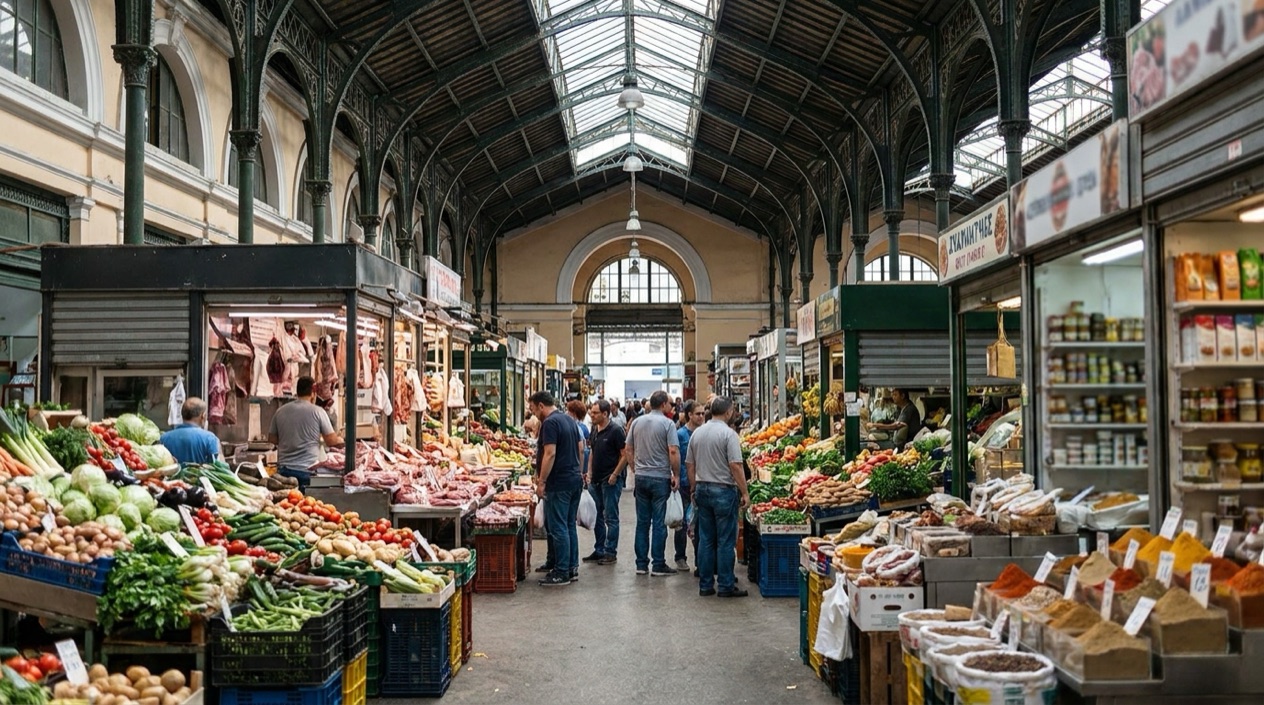
You hear Odos Athinas before you see the stalls: cleavers coming down on wooden blocks, fishmongers calling out the catch, shopkeepers arguing happily over a price. Then the smell arrives, a mix of crushed ice, raw meat, oregano and strong cheese. The Athens Central Market, Varvakios Agora, is where the city buys its food, and a visit here means walking through a working market rather than a showpiece.
Is visiting the Athens Central Market worth it?
Yes, if you like to see how a city really eats, and it suits food lovers, curious walkers and anyone who would rather watch a fishmonger at work than read a menu. Varvakios Agora is the largest non-covered municipality market in Athens, and it stands on Odos Athinas. It is a place of business first, so the pleasure comes from watching, smelling and tasting what Athenians cook with.
It also differs from the neighborhood markets you will meet elsewhere in the city. The laiki agora, the people’s markets, are weekly street markets that move through the neighborhoods, each on its own weekday, with farmers and professional sellers setting up along an ordinary street.
Varvakios is a distinct market with its own address on Athinas, and it is not one of those weekly street markets. That makes it the place for the great sweep of meat, fish, produce and pantry goods in one spot, rather than a single street lined with fruit and vegetables.
Come hungry and curious rather than with a shopping list. The market rewards slow walking, a few questions to a vendor and a willingness to be jostled a little by locals doing their weekly shopping. If you are not a fan of the sight of raw meat or the smell of fish, the meat and fish halls will be a lot to take in, and you can stay on the fruit, spice and cheese side.
What to see at the Athens Central Market
The meat hall
The meat section is the part people remember. Whole carcasses hang from hooks, butchers work at heavy wooden blocks, and trays hold every cut and organ that Greek cooking uses, from lamb and goat to offal for soups and grills. It is a full-on, unsentimental display, and it shows how much of the animal still goes into Greek home cooking.
Watch the rhythm of the stalls: regulars know their butcher by name, and orders are shouted, weighed and wrapped in paper within seconds. Stand back from the counters, keep your hands to yourself, and look at the way the displays are arranged, with prime cuts at the front and the more unusual pieces behind. Photographs are best taken with a smile and a nod to the seller first.
The fish stalls
The fish section is a bank of marble counters covered in ice, with silver sardines and anchovies, red mullet, sea bream, octopus, squid and shellfish laid out in rows. Vendors reshuffle the display constantly and call out to passersby. It is a good place to learn the Greek names of the fish you will later see on taverna menus.
Prices here move. In Greek markets, sellers change prices frequently within the same day, and fish is the item where this shows most clearly, with prices starting high and dropping as the hours pass. You do not need to buy anything to enjoy the scene, but watching a shopper bargain over a bag of sprats tells you a lot about how Athenians treat their seafood.
Produce, olives, cheese and spices
Across the street and in the surrounding lanes, the market turns to pantry goods. Barrels of olives in different sizes and colors stand beside wheels and blocks of feta, tangy graviera and other cheeses. Stalls and small shops sell dried oregano, mountain tea, nuts, dried figs, honey, pulses and bags of herbs that scent the whole lane.
This is where you can shop for edible souvenirs without a supermarket label: a jar of honey, a bag of oregano or a wedge of cheese is easy to carry and easy to explain later. Look at the cards or signs that sellers use to say where a product comes from. In Greek markets, foods usually state their place of origin on a card displayed with the product, which tells you whether the olives came from the Peloponnese or an island.
The tavernas and snack counters
Around the market hall are small eateries serving the workers and shoppers who keep the place running. The classic order here is a bowl of patsas, a tripe soup eaten with vinegar and garlic, along with simple grilled meat, bread and a glass of wine or ouzo. It is a food culture made for people at work, not for visitors with a camera, and that is the appeal.
If tripe soup is not for you, many counters offer plainer plates of grilled meat and salads, and bakeries nearby sell cheese pies and sesame bread rings to eat as you walk. A coffee at a kafenio, a traditional coffeehouse, is a calmer way to end the visit and let the noise settle.
Hours, tickets and rules
Walking into the Athens Central Market does not involve a ticket, and it is a place where you simply stroll in among the stalls. The market is a place of trade, so the sellers and the rules of the street matter more than any entry gate. The only hours the sources give belong to the neighborhood laiki agora, the people’s markets that move around the city, and they are set out here as a point of comparison.
| Site | Open |
|---|---|
| Laiki agora (neighborhood people’s markets) | 8:00 to 14:00, one weekday a week for each neighborhood |
Those weekly markets are run by the Division of people’s markets of the Attica Region. Every seller has to display a card with a name and a type, producer or professional, where shoppers can see it easily. Payment is almost universally done with cash in euros, and prices shift through the day. Mobile toilets are set up for sellers whenever a laiki agora is held in a neighborhood.
When to visit the Athens Central Market
Choose a month when you can walk outdoors in comfort, because the market spills into the streets. Spring and autumn give you the most pleasant walking, while July brings real heat to the city. The figures here describe the Athens coast, and what they change for you is how long you want to stay among the stalls and how much you want to carry.
| Month | Average high (°F) | Average low (°F) | Precipitation (in) | Days with rain |
|---|---|---|---|---|
| January | 56.3 | 44.4 | 2.17 | 7.5 |
| April | 68.4 | 53.2 | 1.10 | 5.5 |
| July | 91.8 | 74.1 | 0.28 | 1.6 |
| October | 75.2 | 61.0 | 1.09 | 3.9 |
January is cool and has the most rainy days of the four, so bring a rain jacket and expect to share narrow aisles with shoppers carrying umbrellas. It is also a month when hearty food feels right, and a bowl of hot soup at a counter fits the weather. April sits in a pleasant middle, with mild afternoons and fewer rainy days.
July is hot, and sun protection and water matter more than any other advice. A market of ice, meat and fish in high heat is a sharper experience for the nose, and you may prefer to stay on the spice and produce side. October is warm, with a few rainy days, and suits a long wander followed by lunch.
As for time of day, the sources only speak about the neighborhood markets, where sellers start high in the early morning, around 8 to 9, and lower their prices as the day goes on, with the lowest prices after midday and often less than half the starting price by the end. That tells you how a Greek market breathes through the day, even if it does not set the hours of Varvakios itself.
Tips for your visit
Wear closed, sturdy shoes, because wet floors and melting ice are part of the scene, and bring a small bag or tote for anything you buy. Cash in euros is what the street markets run on, so carry some small notes and coins. Only a very small number of sellers in higher-income neighborhoods take Visa or MasterCard, and a market stall is not the place to count on a card.
Go with an open mind and a bit of appetite. Ask a vendor the name of something you do not recognize, point to what you want and smile.
Most sellers are used to curious visitors, and a few words of Greek, such as kalimera for good morning and efharisto for thank you, go a long way. Read the origin cards on the products, because they are a quick lesson in Greek geography and in what is grown where.
If you are traveling with children, the stalls are a lively show: fish on ice, heaps of olives, hanging meat. Some young travelers will love it and some will find the smells strong, so it helps to keep the visit loose and leave the meat hall for last or skip it. People of all ages and incomes shop at the laiki agora in downtown Athens, so you will not be out of place at any age.
The Athens Metro runs from 5:30 a.m. to 00:30 a.m., and on Friday and Saturday nights lines 2 and 3 stay open later. On city buses, passengers cannot use the front door to get on or off. For another outing in the city, Plaka has picturesque streets, historic landmarks and lively shops but gets crowded, while Koukaki is a fashionable neighborhood where the Acropolis Museum and a pedestrian walkway link ancient monuments.
There are 44 separate laiki agora in downtown Athens alone, which means a neighborhood street market is likely to be set up near where you are staying on one weekday or another. It is a good way to compare the big central market with the everyday ones, and to taste seasonal fruit in the same morning.
Good to know before you go
Carry cash in euros, since street markets in Athens work almost entirely that way, and keep it in a pocket that is easy to reach when a seller names a price. Stalls are tightly packed and people move quickly, so walk with purpose and step aside when you stop to look.
In July the heat can be strong, so water and a hat are sensible. The market sits on Odos Athinas, and that street name is the one to give a taxi driver.
Sources
- Wikipedia, Laiki agora (https://en.wikipedia.org/wiki/Laiki_agora), checked October 12, 2026
- OASA, Athens urban transport (https://www.oasa.gr/en/), checked October 12, 2026
- Athens Transport, public transport guide (https://www.athenstransport.com/english/), checked October 12, 2026
- This is Athens, the official Athens tourism site (https://www.thisisathens.org/), checked October 12, 2026
- Hellenic National Meteorological Service (HNMS), climatological normals 1991-2020 for Elliniko station (https://www.emy.gr/climatic-data), monthly mean daily maximum and minimum; rain from the ECMWF ERA5 reanalysis, 1991-2020, grid cell of Athens (Open-Meteo), checked October 12, 2026
- ECMWF ERA5 reanalysis 1991-2020, grid cell of Athens (Open-Meteo), checked October 12, 2026