
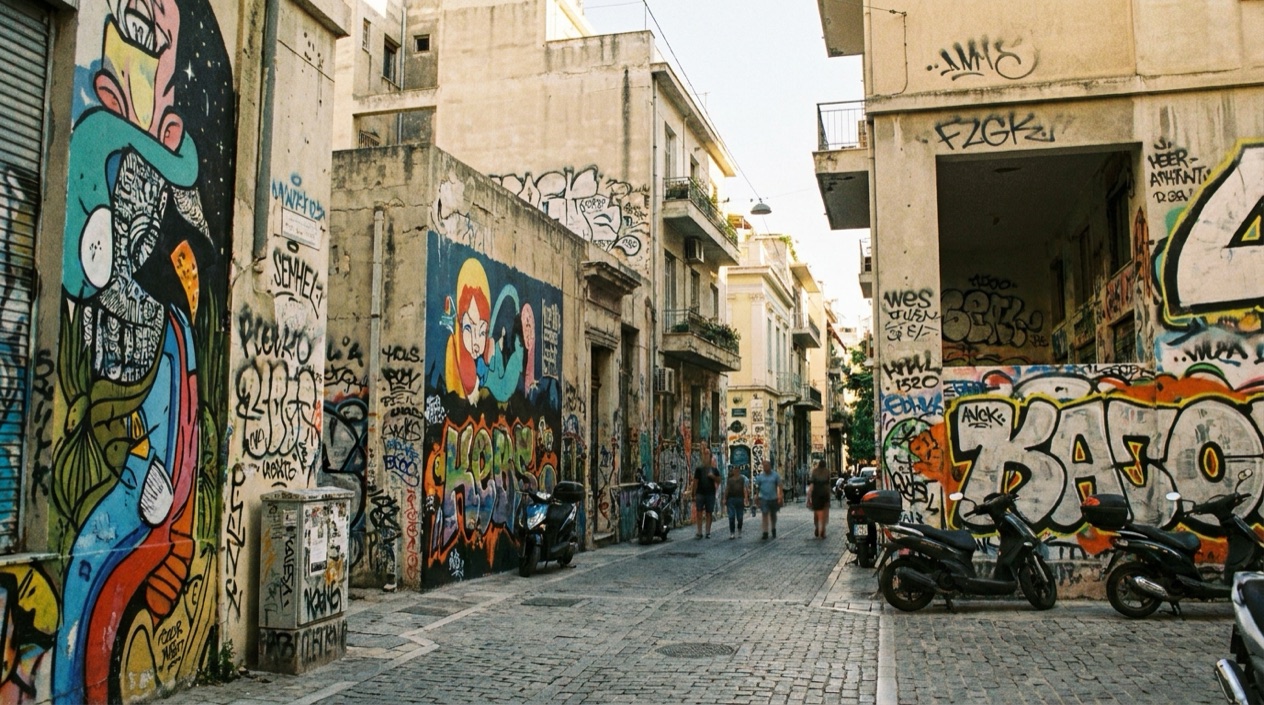
Turn a corner in Psiri and a whole wall stares back at you, painted over a shuttered doorway where a tavern sign hangs a few steps along. Athens wears its paint on shutters, stairwells and the flanks of apartment blocks, and the walls change as you walk. It is an open-air visit through a few neighborhoods, for anyone who likes to look up while they wander.
Is visiting street art in Athens worth it?
The paintings sit in streets you may well cross anyway, so the visit adds a second layer to an ordinary day in town rather than asking for a separate outing.
What makes it different from the other things you will do in Athens is the subject. The Acropolis and the Acropolis Museum speak of the ancient world, and the walls of Psiri and Exarhia speak of the present.
The street art scene in Athens gained momentum in the years leading up to Greece’s 2011 financial crisis, and many of the images carry that mood: sharp political humor, portraits, stenciled slogans and large painted figures. In Greece the scene has been active since the late 1980s, so what you see is the result of decades of layering, with new work covering old and a few pieces lasting longer than the rest.
Compared with the polished stone of the classical sites, this is a looser, rougher kind of sightseeing. Walls get repainted and pieces fade, so the exact works you see will differ from a friend’s photos from last year.
That changing quality is part of the pleasure. You come for the neighborhoods as much as for any single mural, and you can stop for coffee, a pastry or a plate of meze whenever the walking makes you hungry.
What to see at street art in Athens
Street art in Athens is found in the historic city center and in the Exarhia district, with the Psiri neighborhood a clear place to start.
Psiri
Psiri is where the artist Bleepsgr has work, painted in the spirit of artivism, the word for art made to carry a message about public life. The pieces here share the streets with tavernas, small bars and workshops, so a painted wall may sit right beside a café table spilling onto the pavement.
Look at the side streets as well as the main squares. Murals often climb the blind walls of buildings and wrap around shutters, and the smaller stencils and pasted posters are easy to miss if you only follow the busier lanes. Take your time and let your eyes drift upward. Psiri is a good place to end the afternoon, since the same streets that hold the paintings also hold places to sit and eat.
Exarhia
Exarhia is the other district named for its street art, and its walls feel more layered and more political than those of Psiri. Stenciled slogans, portraits, tags and large painted scenes overlap, and the visual noise tells you a good deal about the neighborhood’s character before you read a single word.
Walk slowly and look at how the pieces talk to each other: a bold figure may stand beside a handwritten phrase, and a faded older mural may peek out from under a newer one. Bookshops, cafés and small music places line the streets, which makes it easy to pause and let the walls sink in. It is a district for observing rather than rushing.
The historic center
Street art also turns up in the historic city center, where it sits close to the places every visitor comes to see. Plaka is a top attraction with picturesque streets, historic landmarks and lively shops, though it gets crowded, and the contrast between old facades and fresh paint is part of what you notice as you move between neighborhoods.
In Koukaki, the Acropolis Museum and a pedestrian walkway link ancient monuments, and the neighborhood has become fashionable. Pairing it with a street art walk gives you a day that runs from the ancient to the contemporary. Let the walls surprise you in between, because the center rewards a loose route more than a strict one.
When to visit street art in Athens
Because the work is outdoors on public walls, you can look at it whenever you are in the city, and the real question is which season makes walking pleasant. October is a good answer. The afternoons are warm enough for a long stroll, the evenings stay mild enough to sit outside afterward, and rain is possible but not frequent.
The table gives a picture of the year through four months, so you can see how the weather shapes a day of walking. Spring and autumn suit a day on foot, summer asks for patience in the heat, and winter brings cooler days with more frequent rain.
| Month | Average high (°F) | Average low (°F) | Precipitation (in) | Days with rain |
|---|---|---|---|---|
| January | 56.3 | 44.4 | 2.17 | 7.5 |
| April | 68.4 | 53.2 | 1.10 | 5.5 |
| July | 91.8 | 74.1 | 0.28 | 1.6 |
| October | 75.2 | 61.0 | 1.09 | 3.9 |
July is dry, but the highs are in the low 90s, which makes a long walk on pavement and past sunlit walls tiring. If you come in summer, bring sun protection and plan your stops around shade, drinks and a place to sit. January is cooler, with rain on a good share of days, so a rain jacket belongs in your bag.
April sits comfortably in the middle, with mild highs and fewer wet days than winter, and October is similar. Both months give you a pleasant range for walking between Psiri, the center and Exarhia without the pressure of midsummer heat. Plaka gets crowded, so expect more people there than on the side streets where many of the walls are found.
For the time of day, it is mostly a question of comfort. The Athens Metro runs from early morning until just after midnight, and on Friday and Saturday nights lines 2 and 3 stay open later, which gives you room to stay out for an evening meal after a walk among the walls.
Tips for your visit
Comfortable shoes matter most, since the visit is all walking, and a camera or phone with some battery left will serve you better than any guidebook. Bring water in the warmer months and sun protection from late spring through summer.
Getting around is simple to plan with the public transport the city offers. The Metro runs from 5:30 a.m. to 00:30 a.m., with later closing on Friday and Saturday nights on lines 2 and 3. The tramway returned to Syntagma on 19 November 2020. On buses, passengers cannot use the front door to get on or off, so use the other doors.
Pair the walls with the neighborhoods around them. Psiri has places to eat and drink within a few steps of its murals, Exarhia has its cafés and bookshops, and the historic center brings you to Plaka and the Koukaki walkway by the Acropolis Museum. A day can move from a coffee, to the walls, to a plate of souvlaki or a shared round of meze, and back to a taverna table in the evening.
For families and anyone with limited mobility, think about the pace rather than a fixed route. Street art can be viewed from the pavement and you can shorten or lengthen the walk as you like, stopping at a café whenever energy dips.
Because walls are repainted, treat any list of works as a loose guide, and enjoy what you find. The official tourism guide, This is Athens, is the city’s own site for planning the rest of your days.
Good to know before you go
There is no ticket for the walls themselves, since they stand on public streets, so money goes mostly to coffee, meals and transport. Keep a bottle of water with you in summer, when afternoons run hot. The Plaka area gets crowded, so give yourself room to move there, and carry your phone and camera in a way that leaves your hands free for walking.
Sources
- Wikipedia, Street art (https://en.wikipedia.org/wiki/Street_art), checked October 12, 2026
- OASA, Athens urban transport (https://www.oasa.gr/en/), checked October 12, 2026
- Athens Transport, public transport guide (https://www.athenstransport.com/english/), checked October 12, 2026
- This is Athens, the official Athens tourism site (https://www.thisisathens.org/), checked October 12, 2026
- Hellenic National Meteorological Service (HNMS), climatological normals 1991-2020 for Elliniko station (https://www.emy.gr/climatic-data), monthly mean daily maximum and minimum; rain from the ECMWF ERA5 reanalysis, 1991-2020, grid cell of Athens (Open-Meteo), checked October 12, 2026
- ECMWF ERA5 reanalysis 1991-2020, grid cell of Athens (Open-Meteo), checked October 12, 2026