
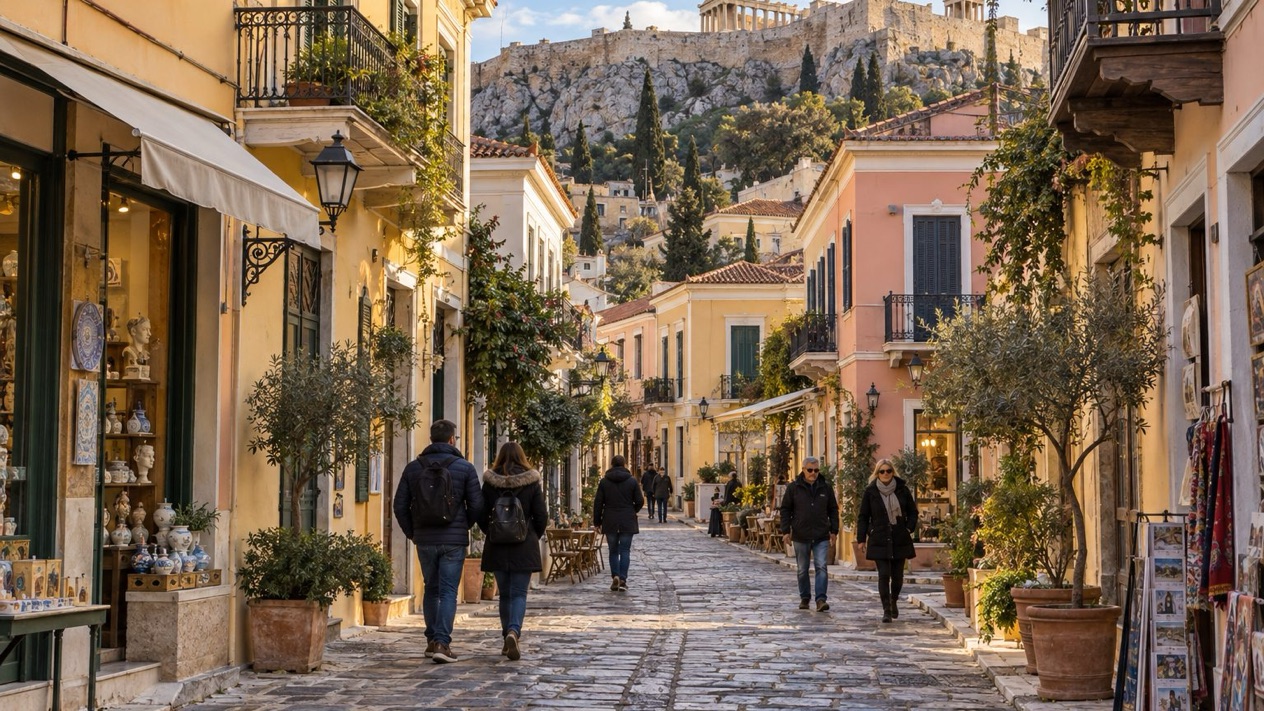
Three days is the sweet spot for a first visit to Athens. Book the Acropolis ticket before anything else, because entry is by time slot and the earliest slot beats the crowds by a wide margin.
How many days do you need in Athens?
The ruins sit inside the modern city, between apartment blocks and cafés, and you can see many of them from the sidewalk. The center is compact and walkable, so even a short stay covers a lot of ground.
With one day, do the Acropolis, a souvlaki lunch, Plaka and Anafiotika, and a rooftop drink at golden hour. With two, add the Acropolis Museum and two more ancient sites nearby. Three days lets the city breathe, and that's the version below. With four or more, spend a day out of town. Or head to the Temple of Poseidon at Cape Sounion for sunset, about 1.5 hours away by car or 2 hours by bus.
How much are Acropolis tickets, and when are the sites open?
The Acropolis draws big crowds, and the tickets you book online come with a time slot, so it helps to reserve ahead. Staff are strict about the end of the hour and turn latecomers away. In winter, same-day tickets are often available. Tickets are sold online and at the ticket offices on site. The old combination ticket has been discontinued, so you pay for each site separately.
2026 prices: the Acropolis and its slopes cost €30, or €15 reduced. The ticket is single-entry: once you exit either the Acropolis or the South Slope, it won't get you back into either one. The Ancient Agora and the Olympieion are €20 each, €10 reduced, and the Agora ticket covers its museum. The Roman Agora is €10, €5 reduced. All four sites are free on March 6, April 18, May 18, the last weekend of September and October 28.
The Acropolis is open 8:00 a.m. to 8:00 p.m. in summer (last entry 7:30 p.m.) and 8:00 a.m. to 5:00 p.m. in winter (last entry 4:30 p.m.). The Ancient Agora runs 8:00 a.m. to 7:30 p.m. in summer and 8:00 a.m. to 4:30 p.m. in winter. The Roman Agora and the Olympieion share a schedule: 8:00 a.m. to 8:00 p.m. in the warm months, with winter hours ending at 3:00 p.m. and last entry at 2:40 p.m. Closing times move earlier step by step through September and October.
The archaeological sites, monuments, and museums stay closed on Easter Sunday and May 1. The Acropolis, the Ancient Agora and the Olympieion also close on January 1, March 25, December 25 and December 26. On Good Friday, sites open from noon to 5:00 p.m., and on Holy Saturday from 8:30 a.m. to 3:30 p.m.
Where should you stay?
Monastiraki and Plaka put the bars, restaurants and ruins at your door, and nearly all of this itinerary is walkable from there. Anywhere inside the triangle formed by the Omonia, Syntagma and Acropoli metro stations works well too. The liveliest streets are loud at night, so ask about noise. A hotel a block or two off Monastiraki Square sleeps quieter than one right on it.
How do you get from the airport and around town?
Athens International Airport (Eleftherios Venizelos) is about 20.5 miles (33 km) from the center. Metro Line 3 (Blue) runs to Syntagma and Monastiraki in about 40 minutes. Its station is next to the terminal, reached by an elevated walkway. The X95 bus boards just outside the terminal and runs to Syntagma Square, which makes it a good fit if your hotel is within a few blocks of the square. Taxis queue at the official rank outside Exit 3 of Arrivals, and the ride takes about 35 to 40 minutes in normal traffic. Pre-booked private transfers take about 40 to 60 minutes and start around $37.
Once you're in, walk. Most of this itinerary is on foot. Still, ride the metro at least once, because the central stations double as small archaeological museums. For the Acropolis, get off at Acropoli and walk up Dionysiou Areopagitou Street. You can also start from Monastiraki and walk through the Ancient Agora or Plaka. Taxis are fairly cheap, and Uber or the FREENOW app is often easier than hailing one.
What should you do each day?
Day 1: Ancient Agora, Roman Agora and Plaka
Start at the Ancient Agora, where Athenians once shopped, gathered and debated. Head first to the Temple of Hephaestus, the best-preserved temple in Athens, with a view over the rooftops toward the Parthenon. Most of the rest is stumps and low walls, so bring your imagination. The Stoa of Attalos has been rebuilt and now serves as the site museum. The little Byzantine Church of the Holy Apostles, about a thousand years old, still stands.
Next comes the Kerameikos. Athens's famous painted vases were made in this old potters' quarter, which later became one of the city's most important cemeteries, and stretches of the ancient city wall survive here. Then lunch. Souvlaki and gyros make a quick, tasty lunch, and keeping it short leaves more time for the rest of the sights. Grilled pork in pita with tzatziki is the classic order.
The Roman Agora follows lunch. In winter it closes early in the afternoon, so slot it in before you eat. Its star is the Tower of the Winds, an octagonal marble tower that worked as a sundial, weathervane and water clock. It is often called the world's first weather station. Close by stands the gate of an old Ottoman madrasa. From here, wander up through Plaka and into Anafiotika, where whitewashed houses and narrow lanes feel like a Cycladic island. The 19th-century builders who settled here came from the islands, Anafi among them, and it shows. Plaka fills up in summer, and its side streets are the place to get lost.
For sunset, claim a seat at one of the rooftop bars around Ermou Street with Acropolis views. Plan to be there a couple of hours before sunset to find a good viewing spot, because the Acropolis glows once the sun has gone down. Then walk over to Psyrri for dinner at a courtyard taverna with zucchini balls, minty meatballs and tzatziki.
Day 2: The Acropolis, its museum and Syntagma
From spring through autumn, book the earliest slot at 8:00 a.m. A photo taken at opening and one taken half an hour later look like two different places. In winter you can book a later slot and have a sit-down breakfast first. For an 8 a.m. entry, pick up sesame koulouri from a Psyrri bakery and eat them before the gate. Many visitors bring bottled water along, and a vending machine near the exit sells it too. The bathrooms are outside the entrance. Arriving early also gives you time for the Areopagus, the rocky outcrop where the Apostle Paul preached. It sits just before the entrance and needs no ticket.
Paths on the rock are polished stone and get slick in rain or morning damp, so wear shoes with grip. On the way in, look down at the Odeon of Herodes Atticus, where rows of marble seats cascade toward a checkerboard stage floor. At the top come the Propylaea, the Temple of Athena Nike, the Parthenon and the Erechtheion with its Caryatid porch. Walk to the edges for city views, and count on about two hours at a steady pace. An audio tour helps. Download it before you go, because the Wi-Fi at the entrance fades once you're inside. Visitors with limited mobility can use the elevator, which sits about 1,150 feet (350 meters) from the main entrance and travels about 82 feet (25 meters) up to the plateau, in the area north of the Erechtheion. It rises to the plateau just north of the Erechtheion.
The Acropolis Museum is about 10 minutes away on foot. Seeing it after the ruins makes the displays easier to follow. The top floor wraps visitors in sculpture and frieze and is aligned with the Parthenon, which you can see through the floor-to-ceiling windows. Plan a couple of hours. Backpacks go in the cloakroom, and you'll need your own headphones for the audio guide.
Then head to Syntagma Square for the changing of the guard. It runs every hour on the hour and lasts about 15 minutes. Afterward, stroll the National Garden past its palm arcades and Roman mosaics. For dinner, pick a neighborhood. Exarchia has a restless student spirit, bookstores and good restaurants. Kolonaki has museums and an aristocratic feel, and in the evening its sidewalks fill with café and bar tables.
Day 3: Markets, Olympian Zeus and a hilltop sunset
Get to the Varvakios Central Market early, when it's far calmer than in the afternoon. Inside it's mostly seafood and meat. The shops around it sell olives, herbs, cheese and spices, all easy souvenirs to pack. Across Athinas Street, the flea market alley is lined with jumble shops spilling onto the sidewalk with icons, musical instruments and oddities.
Walk down to Monastiraki Square and its 18th-century mosque, then on to Hadrian's Library, once the largest library in Athens and now a handful of columns. From there, head to Hadrian's Gate and the huge temple beside it, entered from Vasilissis Olgas Avenue. Of the temple's original 104 columns, 15 still stand. The Acropolis framed by the arch of Hadrian's Gate is a classic photo, but check ahead. The area around the gate is due to close for roadworks, and scaffolding covers the temple's southeast corner for conservation. In winter, the site's early closing means getting here before lunch.
Walk back along Ermou Street, a buzzing shopping street with the Panagia Kapnikarea church at one end, to pedestrian Aiolou Street for lunch. Order fried calamari in a paper cone, then loukoumades, Greek donuts smothered in pistachio praline. Afterward, browse the Commercial Triangle between Syntagma, Monastiraki and Omonia. Its old linen shops, leather workshops and hand-painted signs reward slow walking, and the neon of the Merchants' Arcade is a highlight.
For the evening, choose one view. Philopappos Hill looks north-east to a clear view of the Parthenon and is lovely at golden hour. Go an hour before sunset and bring company, since the paths get very quiet. Lycabettus Hill rises 909 feet (277 meters) above sea level, the highest point in Athens, and looks out toward the Acropolis and the sea, though it tends to be busy even in winter. Arrive 60 to 90 minutes before sunset and ride the funicular up. Just before sunset, start walking down and claim a spot on the path, where there are fewer people. At the summit, a flag-lowering ceremony takes place in front of St. George's Church as the sun sets.
Which Athens sights can you skip or swap?
If time is short, skip the ticket for the big temple near Hadrian's Gate, which is thin on standing structure and partly under scaffolding. Aristotle's Lyceum is the least rewarding paid site, historically important but little more than rocks on the ground.
For a break from ruins, swap in the Panathenaic Stadium, the marble venue of the first modern Olympics in 1896. Behind it, the Mets neighborhood is full of tumbledown houses and photogenic lanes. On a scorching day the stadium is completely exposed, so trade it for the Benaki Museum, an indoor option on the edge of the National Garden. The National Archaeological Museum, with the richest collection of ancient Greek art anywhere, is another good choice when you want a roof overhead.
When should you go?
Winter tends to bring thinner crowds. Summer brings heat, scarce shade at the big ruins and a crush in Plaka. In any season, start early, carry water and wear sunscreen.
Sources
- wander-lush.org (https://wander-lush.org/3-days-in-athens-itinerary/), checked October 18, 2026
- neverendingfootsteps.com (https://www.neverendingfootsteps.com/athens-greece-itinerary/), checked October 18, 2026
- johnnyafrica.com (https://johnnyafrica.com/athens-itinerary/), checked October 18, 2026
- artoftheitinerary.com (https://artoftheitinerary.com/3-days-in-athens-a-detailed-itinerary/), checked October 18, 2026
- globetrotterkyle.com (https://globetrotterkyle.com/what-to-do-athens/), checked October 18, 2026
- Hellenic Ministry of Culture, Odysseus (http://odysseus.culture.gr/h/3/eh355.jsp?obj_id=2384), checked October 15, 2026
- Hellenic Ministry of Culture, Odysseus (http://odysseus.culture.gr/h/3/eh355.jsp?obj_id=2488), checked October 15, 2026
- Hellenic Ministry of Culture, Odysseus (http://odysseus.culture.gr/h/3/eh355.jsp?obj_id=2485), checked October 15, 2026
- Hellenic Ministry of Culture, Odysseus (http://odysseus.culture.gr/h/3/eh355.jsp?obj_id=2402), checked October 15, 2026
- ktelmessinias.gr (https://www.ktelmessinias.gr/en/routes/athens/), checked October 15, 2026
- Hellenic Ministry of Culture, Odysseus (http://odysseus.culture.gr/h/1/eh155.jsp?obj_id=2409), checked October 15, 2026
- Visit Greece (GNTO) (https://www.visitgreece.gr/en/mainland/attica/athens), checked October 15, 2026