
Halfway through the week you are standing on the rim of a flooded volcano, with a glass of assyrtiko, the island’s mineral white wine, and a plate of fava (a purée of yellow split peas) in front of you. Behind you lies Athens, with its marble hills and its souvlaki counters.
Ahead lie a few more days among black volcanic cliffs and tomato fields. This is a week in Greece built around two places, the capital and the island of Santorini, for travelers who want one city and one island rather than a dozen stops.
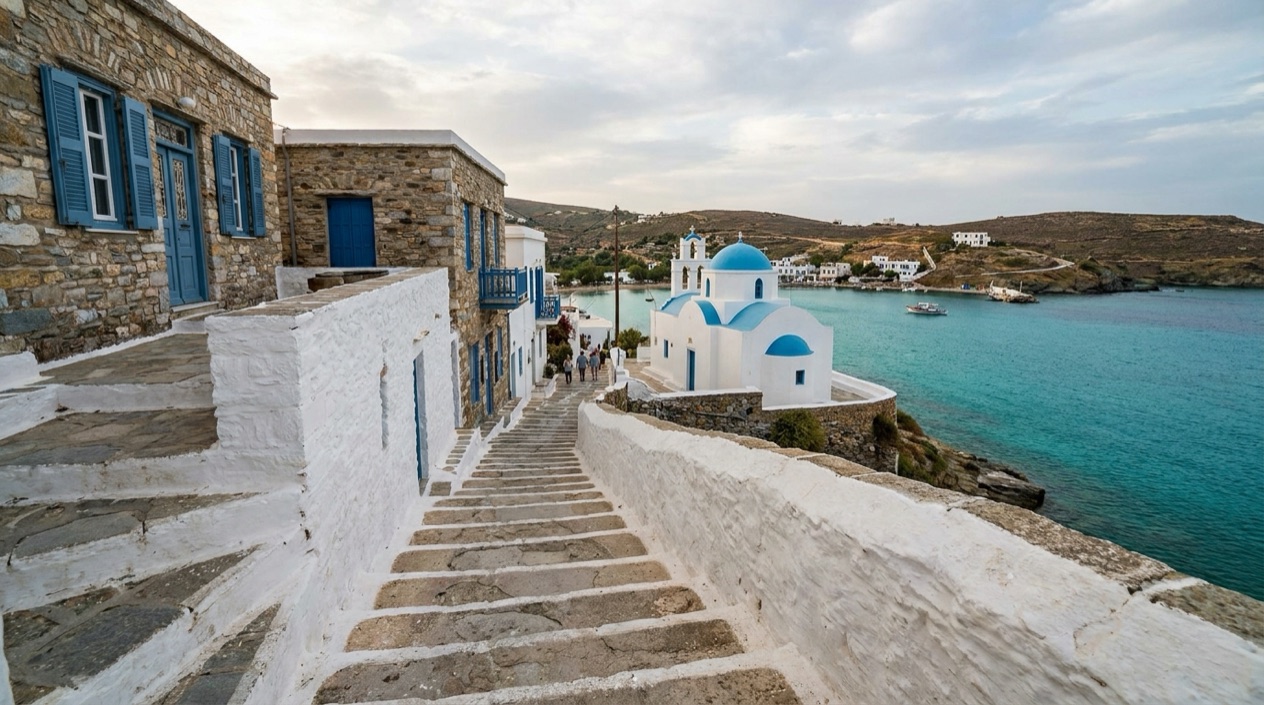
Is 7 Days enough for Greece?
A week is enough for a good first taste of Greece if you accept two places and leave the rest for another trip. This route gives you Athens and Santorini, one city built on layers of the ancient world and one island shaped by a volcano. It suits first-time visitors who want to see the great ruins and then spend time by the sea.
Athens carries the story of ancient Greece, a world that was never one country but a loose collection of culturally and linguistically related city-states and regions, centered on the northeastern Mediterranean. You feel that patchwork in the museums, where objects from many places sit side by side. The city is also a living capital, with neighborhoods, cafés and tavernas that have nothing to do with antiquity.
Santorini sits in the southernmost Cyclades, in the Aegean Sea, and is the largest island of a small, circular group formed by the caldera. The ancient Greeks knew it as Thera. It has an active volcano, and visitors can stay on the caldera rim, which is what gives the island its shape and its reputation. A week is long enough to see both without feeling that you spend the whole trip in transit.
What the route leaves out is a lot. Crete, the largest Greek island, is a trip of its own. So are Rhodes, Lesbos and Evia, which round out the four largest islands, and so is the mainland beyond Athens, with its monasteries and mountain villages.
The trade-off is simple. With three days in Athens you can take in the main ancient sites and a museum or two, and still wander the old streets. With the remaining days on Santorini you can slow down. If you prefer to see more places, the final section shows how to stretch or shrink the plan.
One more thing shapes the week. The move between Athens and Santorini crosses open water, and it takes up a stretch of one day. Plan that day as a travel day with a lunch at each end, not as a day of sightseeing, and the rest of the schedule falls into place.
The itinerary stage by stage
Days 1 to 3: Athens
Day 1 is for settling in and walking. Base yourself in or near Plaka, the old neighborhood under the Acropolis, with its picturesque lanes, historic landmarks and lively shops. It does get crowded, so treat it as a place to wander and to eat rather than to hurry through. Stop for a coffee at a kafenio, the traditional Greek café, and order a spoonful of something sweet on the side.
Day 2 belongs to the Acropolis and the Parthenon, the hill that defines the skyline, and to the museums and ancient sites around it. From there you can drift down toward Monastiraki and its flea-market streets, where souvlaki, gyros and sesame bread rings sell at every corner. Day 3 can go to the National Archaeological Museum, then to Syntagma Square and the neighborhoods you did not reach, such as Psyri, with its meze bars (small plates meant for sharing).
Getting around is simple on the public network. The metro runs late, and on Friday and Saturday nights lines 2 and 3 stay open even later, which suits a long taverna dinner. On buses, passengers cannot use the front door to get on or off. The tramway is another option, and it is back at Syntagma.
Days 4 to 7: the move to Santorini and the caldera
Day 4 is the crossing. Santorini lies southeast of the mainland, and you get there by sea or by air. Plan for little else that day beyond checking in, a first walk along the caldera edge, and dinner. Staying in the caldera towns puts you directly above the volcano’s flooded crater, and you sleep in a hillside village rather than a beach resort.
Days 5 and 6 are for the island itself. Take a boat toward the volcano, a wild natural wonder at the center of the group. You can also head to Akrotiri, the excavated ancient town buried by the eruption, and to the island’s wineries, where the volcanic soil gives the whites their character.
Day 7 is for the last swim, the last plate of cherry tomato fritters (tomatokeftedes) and the trip home. Order a Greek salad with a block of feta on top, a cold glass of white wine and a plate of grilled fish if you spot one on the menu. The route ends here on a concrete thing: a table by the water and the caldera in view.
Getting between stops
| Leg | Distance |
|---|---|
| Greek mainland to Santorini | About 120 miles, southeast of the mainland |
The one real leg of this trip is the crossing from the mainland to Santorini, which goes by sea or by air. On the sea side, several companies run passenger ships in Greek waters.
Blue Star Ferries links the Greek mainland with the Aegean Islands, and Golden Star Ferries operates from the mainland to the Cyclades, the island group Santorini belongs to. ANEK Lines focuses on the routes between Piraeus and Crete and on the Adriatic.
Within Athens you use the metro, buses and the tramway. The metro is the backbone for reaching the main neighborhoods, and it has late service on Friday and Saturday nights on lines 2 and 3. Taxis and walking fill the gaps in the old center, where the lanes of Plaka and Monastiraki are best covered on foot.
On Santorini, the places in this plan are the rim towns, the volcano and the excavated town of Akrotiri, and you move between them by road. A rental vehicle, buses or a taxi all appear in many island visits, but the plan itself does not depend on one choice. Settle on where you stay first, and the rest follows from the position of your hotel along the caldera.
Two practical thoughts keep the trip smooth. First, treat the sea or air crossing as the fixed point of the week, and arrange the rest of the days around it. Second, remember that the central stretch of Athens is a place for walking, so you rarely need to cross the city more than once a day.
What to book before your 7 Days in Greece
Three things settle the shape of the week. First comes the crossing to Santorini, by sea or by air, since the whole second half depends on it.
Second comes the place to sleep on the island, because staying in the caldera is part of what the island offers. Third come the ancient sites and museums of Athens, which fix the order of your first three days. Everything else, from tavernas to boat trips, can stay loose.
Adapting the route
| Month in Athens | Average high (°F) | Average low (°F) | Precipitation (in) | Days with rain |
|---|---|---|---|---|
| January | 56.3 | 44.4 | 2.17 | 7.5 |
| April | 68.4 | 53.2 | 1.10 | 5.5 |
| July | 91.8 | 74.1 | 0.28 | 1.6 |
| October | 75.2 | 61.0 | 1.09 | 3.9 |
In July the city is hot, so sun protection, a water bottle and a slower pace in the open ancient sites matter more than anything else.
In January the days are cool and wetter, and a rain jacket belongs in the bag. April and October sit between the two, with mild weather and fewer rainy days than in winter.
If you want a shorter trip, keep the structure and cut one Athens day. Days 1 and 2 are enough for Plaka, the Acropolis and a museum, and the saved time goes to the island. A shorter version still works as long as the crossing day is protected. The main loss is the neighborhoods, the cafés and the long walks, which depend on the extra day.
If you have more time, the natural extension of this plan is Crete, the largest Greek island. ANEK Lines focuses on the Piraeus and Crete routes, which gives a sense of how the island fits into Greek sea travel. Adding it means a second island, so the week stretches into ten days or more. Another option is to stay longer in the caldera and add a day to the volcano and wine side of Santorini.
For families, the plan holds, with more breathing room. In Athens, plan one big site a day and fill the rest with squares, ice cream and a taverna lunch where children can order grilled meat and fries. On Santorini, choose lodging that suits your group, since the caldera towns are built on a slope. Short plans for small travelers are better than full ones.
For a slower trip, drop the volcano boat or the second town and spend that day at one table. Greek meals are long by design, with plates of meze arriving in waves, so a single lunch can fill a block of the day. On a rainy day in Athens, the museums are the natural fallback, and on a hot one, they are cool places to retreat to.
The plan also bends around the seasons of the sea. Weather affects boat trips on the Aegean, so a flexible day is useful. If the volcano excursion does not happen on day 5, day 6 is there as a spare. Keep that buffer, and the week works whatever the sky does.
Good to know before you go
Greece uses the euro, and the figures in your plan are best treated as a rough frame until you have seen the actual rates on the day. In Athens, the late-running metro helps with evening plans.
In July the heat is the main thing to plan around, so keep the middle of the day for shade, a cold drink or a museum. Come with comfortable shoes, since the old center and the caldera towns are built on stone and slopes.
Sources
- Wikipedia, Ancient Greece (https://en.wikipedia.org/wiki/Ancient_Greece), checked October 12, 2026
- Wikipedia, ANEK Lines (https://en.wikipedia.org/wiki/ANEK_Lines), checked October 12, 2026
- Wikipedia, Blue Star Ferries (https://en.wikipedia.org/wiki/Blue_Star_Ferries), checked October 12, 2026
- Wikipedia, Fast Ferries (https://en.wikipedia.org/wiki/Fast_Ferries), checked October 12, 2026
- Wikipedia, Golden Star Ferries (https://en.wikipedia.org/wiki/Golden_Star_Ferries), checked October 12, 2026
- Wikipedia, Greek islands (https://en.wikipedia.org/wiki/Greek_islands), checked October 12, 2026
- OASA, Athens urban transport (https://www.oasa.gr/en/), checked October 12, 2026
- Athens Transport, public transport guide (https://www.athenstransport.com/english/), checked October 12, 2026
- This is Athens, the official Athens tourism site (https://www.thisisathens.org/), checked October 12, 2026
- Santorini official guide (https://www.santorini.gr/), checked October 12, 2026
- Visit Greece (GNTO), Santorini (https://www.visitgreece.gr/islands/cyclades/santorini/), checked October 12, 2026
- Wikipedia, Santorini (https://en.wikipedia.org/wiki/Santorini), checked October 12, 2026
- Hellenic National Meteorological Service (HNMS), climatological normals 1991-2020 for Elliniko station (https://www.emy.gr/climatic-data), monthly mean daily maximum and minimum; rain from the ECMWF ERA5 reanalysis, 1991-2020, grid cell of Athens (Open-Meteo), checked October 12, 2026
- ECMWF ERA5 reanalysis 1991-2020, grid cell of Athens (Open-Meteo), checked October 12, 2026
- Plan de the (duree choisie by the redaction)