
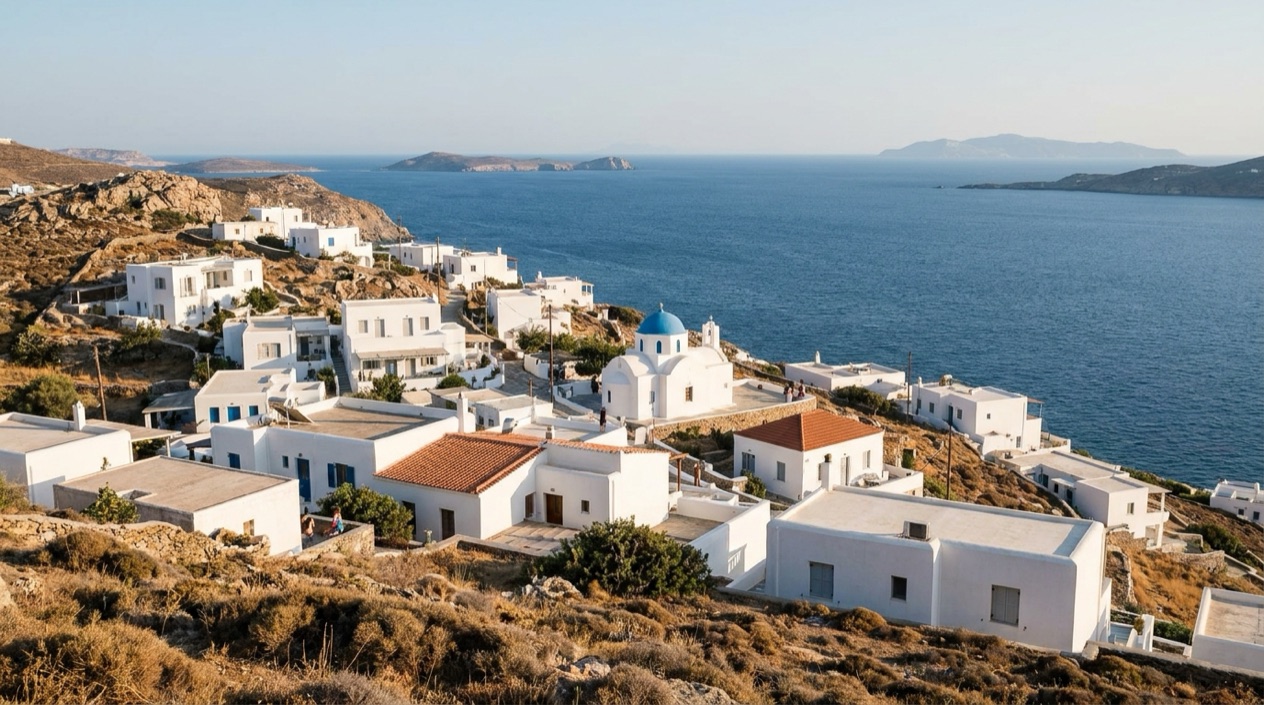
Somewhere over a late breakfast in Athens, with a map open beside the coffee, a traveler’s finger slides down the Peloponnese past the big names and stops at a small rock tied to the coast by a thread of road. That rock is Monemvasia, a Byzantine castle town that looks, from the mainland, like a ship moored to the shore.
How do you get from Athens to Monemvasia?
You get from Athens to Monemvasia by leaving the capital for the south-eastern Peloponnese and finishing on the one road that links the town to the mainland. The destination is what shapes the whole journey, because Monemvasia is a town in Laconia on a tied island off the east coast of the Peloponnese, surrounded by the Myrtoan Sea. Everything you do on the way is a means of arriving at that single approach.
The approach is a narrow causeway, and nothing else connects the town to the mainland. It is a sandy isthmus, a tombolo, about 1,300 feet long, and you cross it with the sea on both sides.
The name itself comes from this: Monemvasia derives from moni emvasi, the single approach. A traveler who knows this before setting out understands why the town has held its character, since there is only one way in and one way out.
What waits at the end of the causeway
The town was founded in the sixth century, which makes it one of the oldest continually inhabited fortified towns in Europe. That age shows in the stone. Walls climb the rock, lanes turn without warning, and doorways open onto courtyards that the street gives no hint of. Past the gate you find a lower town of old houses and small churches, and above it a ruined upper town on the crown of the rock.
What you do there is mostly walk, look and eat. You follow the lanes down toward the water, sit at a table where the stone wall ends and the sea begins, and order something simple: grilled fish, octopus, a plate of local greens, a glass of wine from the family of sweet malvasia wines that took their name from this place. Cats claim the steps, and a sweet malvasia… took their name from this place.
Starting in Athens
Your first stretch is inside Athens itself, and the city has a Metro, buses and a tramway to get you from where you sleep to where your journey begins. The tramway returned to Syntagma on 19 November 2020, which put it back at the square in front of Parliament. From the airport, the Metro’s line 3 is the rail link into the city.
Everything you do on the way is a means of arriving at that single approach.
Which options are there?
That applies to a rental car as much as to any other vehicle, and it is the first thing to sort out before you leave home. Everything else in the plan, from where you sleep in Athens to how you reach your car, is a matter of the city’s own transport.
Driving yourself
U.S. visitors driving in Greece must carry a valid U.S. driver’s license, and insurance companies may require an international driver’s permit. It is a small booklet, and it is worth treating as part of the trip’s paperwork rather than an optional extra. The U.S. Embassy in Greece does not issue these permits.
Travelers obtain the permit in the United States from the American Automobile Association or the American Automobile Touring Alliance. That means it is done before the flight, not on arrival in Athens. With the permit and the license in hand, a car gives you the freedom to cross the Peloponnese at your own rhythm and to arrive at the causeway on your own terms.
A car also suits the shape of Monemvasia. The town is joined to the mainland by one narrow road, so you reach it by driving out along the isthmus with the Myrtoan Sea around you. That approach is part of the visit, and the first sight of the rock rising ahead of the car is something many travelers remember longer than the town’s museums.
Using Athens transport at the start
Before the road south, there is the city. The Metro, buses and tramway of Athens are the tools you use to get yourself, and your luggage, to the place where the Peloponnese leg begins.
The tramway ends at Syntagma, so a stay near the square puts you beside Parliament, the National Garden and the streets of Plaka. The Metro covers the rest of the city, and its line 3 runs out to the airport. If your hotel sits on one of these lines, the first leg of the journey is already behind you before you turn a key in a car.
What should you know before you travel from Athens to Monemvasia?
Know three things before you go: the permit you need to drive, the rules of the Athens transport you use first, and the shape of the town you are heading for. The permit is a matter of paperwork done at home. The city rules are small habits that save a wasted morning. The town’s shape explains why the final approach feels like arriving somewhere apart.
The Athens Metro, bus and tram
The Athens Metro runs from early morning to just after midnight, and on Friday and Saturday nights lines 2 and 3 stay open later. On line 3 the stretch between the airport and Douk. Plakentias has trains at a slower rhythm than the rest of the line. That matters if you are heading to or from the airport at the edge of the schedule.
| Service | Hours or frequency |
|---|---|
| Athens Metro | 5:30 a.m. to 12:30 a.m. |
| Lines 2 and 3, Friday and Saturday nights | Open later than usual |
| Line 3, Airport to Douk. Plakentias | Trains every 30 minutes |
On buses in Athens, passengers cannot use the front door to get on or off. You board and leave by the other doors, which is a rule rather than a habit, and it is one that first-time riders discover when the driver’s door stays shut. The tramway, back at Syntagma since 19 November 2020, is the third rail-bound way to cross the center.
The driving permit, once more in practice
Carrying the permit is a rule for U.S. visitors who drive, and it applies even when a rental counter does not ask for it. Treat the license and the permit as a pair, kept together. The permit is obtained in the United States, so the time to think about it is while you are still planning the trip, long before you pack.
One more point on roads in Greece, so that names do not confuse you on the map. The motorway known as the Egnatia Odos, and the Roman road that shares the name, belong to northern Greece. They are not on the way to Monemvasia, so a sign or a search result that mentions them is pointing somewhere else.
What the town is like when you arrive
Monemvasia is a fortified town, and that decides how a visit feels. The causeway ends at a gate, the lanes beyond it are stone, and the upper town on top of the rock is a ruin that you reach on foot. The old houses of the lower town hold guesthouses, small restaurants, shops selling honey, preserves and sweets, and chapels that open onto tiny squares.
Food here follows the sea and the Peloponnese. Expect grilled fish, octopus, lamb, olives, olive oil, local cheeses and dishes of wild greens, with almond sweets and a glass of sweet wine to finish. The sea stays in view from most tables, since the town sits on its own rock with the Myrtoan Sea on every side except the causeway.
Good to know before you go
Greece uses the euro, and a trip like this one is best planned as a chain of small stages: the city first, then the road, then the causeway. What they do say is that the town stands on a tied island in the Myrtoan Sea, joined to the Peloponnese by the single approach that gave it its name.
Sources
- OASA, Athens urban transport (https://www.oasa.gr/en/), checked October 12, 2026
- Athens Transport, public transport guide (https://www.athenstransport.com/english/), checked October 12, 2026
- Visit Greece (GNTO), Monemvasia (https://www.visitgreece.gr/mainland/peloponnese/monemvasia/), checked October 12, 2026
- Wikipedia, Monemvasia (https://en.wikipedia.org/wiki/Monemvasia), checked October 12, 2026
- U.S. Department of State, Greece travel information, travel and transportation (https://travel.state.gov/content/travel/en/international-travel/International-Travel-Country-Information-Pages/Greece.html), checked October 12, 2026
- Hellenic Train (https://www.hellenictrain.gr/en), checked October 12, 2026
- Wikipedia, Egnatia Odos (https://en.wikipedia.org/wiki/Egnatia_Odos), checked October 12, 2026