
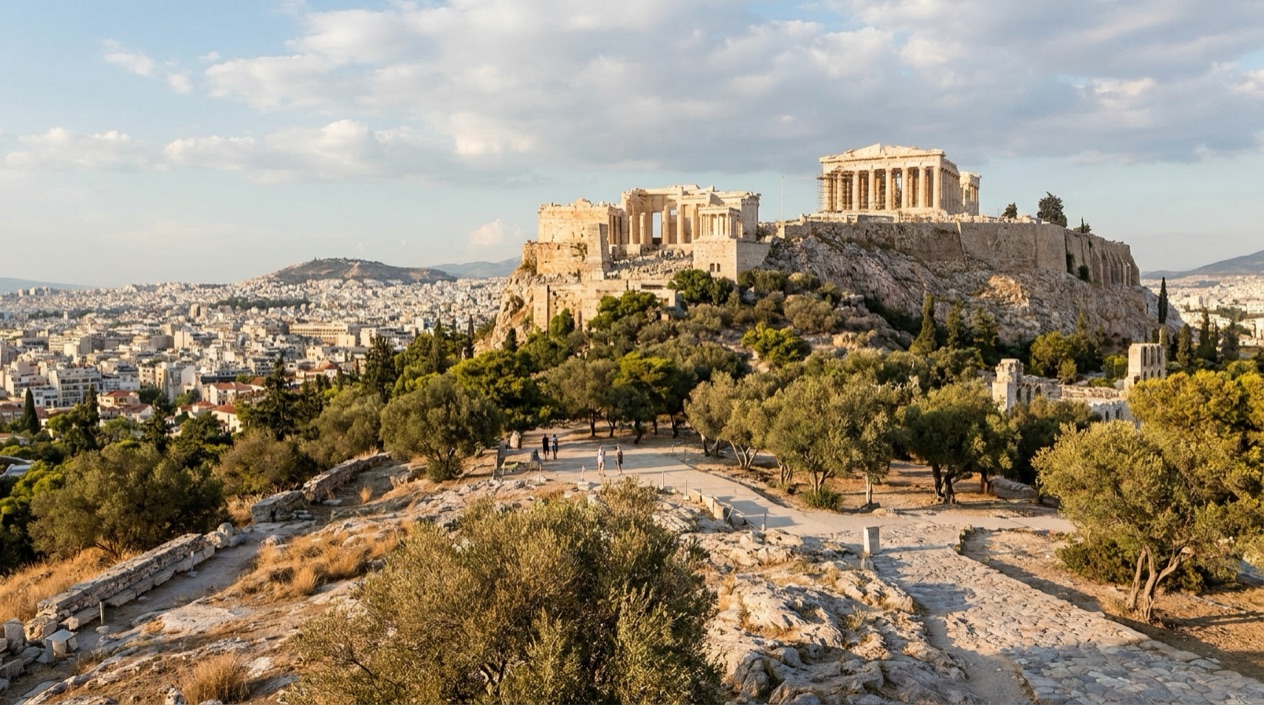
The Acropolis is the rocky hill in the middle of Athens that carries the Parthenon and the other great temples of ancient Greece. From the top, the city spreads out in a full 360° view. A good visit comes down to three things: a timed ticket booked online, an early start, and shoes with grip.
What is the Acropolis, exactly?
The Acropolis is the whole hill, and the Parthenon is the main temple standing on it. Visitors often use the two names as if they meant the same thing. The word Acropolis means "edge of the city." The rock rises about 525 feet (160 m), with steep sides on most of its perimeter, and its broad top is nearly flat.
The Parthenon, dedicated to Athena, the city's patron goddess, dominates the summit. You come in through the Propylaia, the grand entrance. Beside it stands the temple of Athena Nike, built for Athena as goddess of victory. Across the plateau is the Erechtheion, famous for its Caryatid columns. All four went up in the fifth century BC.
What is the history behind it?
People lived on this hill from very early times. A fortification wall went up around it, and the citadel became the center of a Mycenaean kingdom. By the 8th century BC it had become a sacred place, with the cult of Athena at its heart. In the mid-6th century BC the Panathenaia, the city's greatest religious festival, began here, and the first monumental temples rose on the summit.
In 480 BC the Persians pillaged the Acropolis and set its monuments on fire. The Athenians buried the surviving sculptures and offerings in hollows of the rock and fortified the hill again. The great architects and sculptors of the age, Iktinos, Kallikrates and Pheidias among them, worked on the project. What you see today is the golden age of Athens in stone.
The hill kept changing hands and roles. From the 6th century AD the temples served as Christian churches, and in the Middle Ages the Acropolis became the city's fortress. In 1687 a Venetian bombardment destroyed the Parthenon, then in use as a munitions store, and in 1801 and 1802 Lord Elgin stripped away much of its sculpture. Restoration began in 1975 and continues today. The new marble comes from Mount Penteli, the same mountain the ancient builders quarried.
How much does it cost, and when is it open?
2026 prices: full admission is €30 and reduced admission is €15. The ticket covers the Acropolis and its slopes, and you can buy it at the on-site ticket offices or online. The "Acropolis and Slopes" ticket is valid for a single use, so once you leave either part you cannot get back in. To see both, exit the summit through the Beulé Gate and follow the signs south, on your left, along the path to the South Exit and the South Slope entrance.
In summer the site is open from 8:00 a.m. to 8:00 p.m. In winter it closes at 5:00 p.m. Through September and October, closing time moves earlier in steps, from 7:30 p.m. at the start of September down to 6:00 p.m. by the end of October. Last entrance is 30 minutes before closing during the winter and summer seasons, so plan to arrive a little ahead of that.
Admission is free on March 6, April 18, May 18, the last weekend of September and October 28. The site is closed on January 1, March 25, May 1, Easter Sunday, December 25 and December 26. On Good Friday it opens from 12:00 p.m. to 5:00 p.m., and on Holy Saturday from 8:30 a.m. to 3:30 p.m. Ceremonies or maintenance occasionally close the site as well, so check the official schedule for your date.
When should you go?
Go early, and book ahead. Entry runs on timed tickets, and buying online through the official platform can spare you the lines at the gate.
The first slots of the morning and the late afternoon are the quietest and the coolest. Avoid midday in August, when the heat and the glare off the white marble can be punishing. During intense heatwaves the site sometimes closes for a few hours.
What should you wear and bring?
The paths are uneven and rocky, so wear comfortable shoes with grip. In winter, rain makes the ground slippery, so take extra care. Shade is scarce up on the hill, so pack plenty of water, sunscreen and a hat.
Is the Acropolis accessible for visitors with limited mobility?
An elevator for visitors with mobility difficulties and disabilities opened in 2020. It stands about 1,150 feet (350 m) from the main entrance, rises roughly 82 feet (25 m), and lets out on the plateau north of the Erechtheion. Accessible toilets are at the Information Centre, 18-20 Dionysiou Areopagitou Street, 164 feet (50 m) east of the South Slope entrance.
How do you get to the Acropolis?
The simplest route is Metro Line 2 to Acropolis station, then a walk along Dionysiou Areopagitou Street to the hill. For the South Slope, follow Dionysiou Areopagitou and then turn onto Thrasyllou Street. You can also take the metro to Monastiraki and walk up through the Ancient Agora site or the Plaka district.
From the airport, Metro Line 3 reaches Monastiraki and Syntagma Square in about 40 minutes. Taxis wait at the official rank just outside Exit 3 of the Arrivals level, and the ride into the center takes about 35 to 40 minutes, depending on traffic. Once in the historic center, walking is the best way around. Taxis are relatively cheap, and Uber or the FREENOW app often makes hailing one easier.
What else is nearby?
The Acropolis Museum, a short walk from the hill and near the same metro station, holds most of the original sculptures and architectural pieces from the monuments. Its exhibition builds to the third-floor Parthenon Gallery, which was designed specially for the Parthenon sculptures. The building also takes in the excavated ruins of an ancient neighborhood. The museum restaurant serves a seasonal menu of classic Greek dishes with a view of the lit-up Parthenon in the evening. Nearby Strofi has more views and traditional dishes made with local produce.
The neighborhoods around the hill have an island-like charm, so leave time to wander. The Ancient Agora makes a natural second stop: €20 full and €10 reduced, covering both the site and its museum. The Roman Agora, in Plaka, costs €10 full and €5 reduced. Both share the Acropolis free admission days.
Sources
- UNESCO World Heritage Centre (https://whc.unesco.org/en/list/404/), checked October 18, 2026
- theacropolismuseum.gr (https://www.theacropolismuseum.gr/en), checked October 18, 2026
- Hellenic Ministry of Culture, Odysseus (http://odysseus.culture.gr/h/3/eh351.jsp?obj_id=2384), checked October 18, 2026
- acropolisofathens.gr (https://www.acropolisofathens.gr/), checked October 18, 2026
- timeout.com (https://www.timeout.com/athens/things-to-do/acropolis-of-athens-visitor-guide), checked October 18, 2026
- Hellenic Ministry of Culture, Odysseus (http://odysseus.culture.gr/h/3/eh355.jsp?obj_id=2384), checked October 15, 2026
- Hellenic Ministry of Culture, Odysseus (http://odysseus.culture.gr/h/3/eh355.jsp?obj_id=2488), checked October 15, 2026
- Hellenic Ministry of Culture, Odysseus (http://odysseus.culture.gr/h/3/eh355.jsp?obj_id=2485), checked October 15, 2026
- Hellenic Ministry of Culture, Odysseus (http://odysseus.culture.gr/h/3/eh355.jsp?obj_id=2402), checked October 15, 2026
- ktelmessinias.gr (https://www.ktelmessinias.gr/en/routes/athens/), checked October 15, 2026
- Hellenic Ministry of Culture, Odysseus (http://odysseus.culture.gr/h/1/eh155.jsp?obj_id=2409), checked October 15, 2026
- Visit Greece (GNTO) (https://www.visitgreece.gr/en/mainland/attica/athens), checked October 15, 2026
To plan your stay
- Best Time to Visit Greece: September and Late May to Early June
- Arachova: Parnassus Mountain Town, Formaela Cheese, Ski Season and Saint George's Day
- American Airlines Flights to Greece: U.S. Cities, Athens Arrivals and Onward Island Flights
- Greece on a Budget: Cash Machines, Cards, Beaches and Ferries