
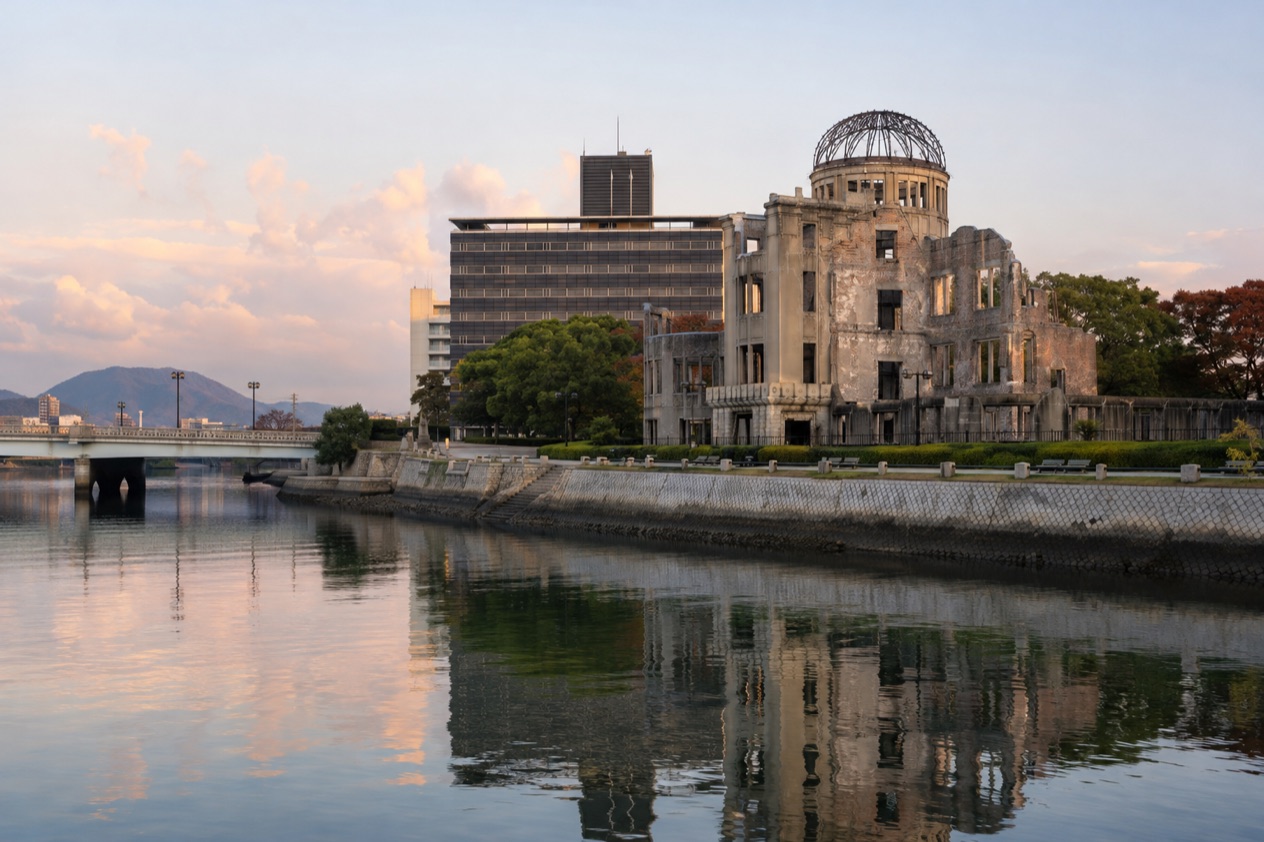
On a summer evening, paper lanterns drift down the river past the Atomic Bomb Dome, each one carrying a handwritten message, and the crowd on the banks falls quiet. Hiroshima is a city of wide boulevards, criss-crossing rivers and streetcars rattling past modern storefronts. It is a place for travelers who want to understand the past, eat very well and still have an island shrine and a stretch of inland sea within reach.
Where is Hiroshima and what is it like?
Hiroshima sits on the coast of the Seto Inland Sea in western Honshu, an industrial city laid out on a delta of rivers and wide boulevards. Wooded mountains rise behind it, and the islands of the inland sea lie in front, with Miyajima the best known of them. The setting matters here, because water shapes the whole feel of the place: you cross a bridge every few minutes, and the riverbanks are where people walk, sit and gather.
The city became the site of the world’s first atomic bomb attack on August 6, 1945, and that history is present without taking over every hour. Today Hiroshima feels like a working modern city with a deep sense of purpose around peace. Locals call survivors hibakusha, a word meaning people affected by the bomb, and their testimony is at the heart of how the city presents itself to visitors.
The pace is steady rather than frantic. Travelers who come for museums, memorials and food tend to love it. Those who want a lively nightlife scene or a long list of old temples may find the center more reflective than they expected, and may be happiest treating Hiroshima as a thoughtful stop in a longer Japan trip.
The prefecture around the city adds a different register: the Seto Inland Sea, wooded mountains and clear waters, along with shrines and museums. Hiking, cycling, ocean sports and even skiing are among the outdoor activities people pursue in the prefecture, so a stay can swing from solemn to active within a day or two.
What is there to do in Hiroshima?
Hiroshima’s appeal rests on a few big reasons to come: the memorials of the Peace Park, the island of Miyajima, the local food and the countryside of the prefecture. What sets it apart from its neighbors is the combination of a city whose story is known around the world with an island shrine and a regional cuisine that you can reach without leaving the area.
Peace Memorial Park and the Atomic Bomb Dome
The Peace Memorial Park lies in the center of the city, and it is where most visits begin. The Atomic Bomb Dome, also called the Genbaku Dome, stands within the park as the only structure still standing near the bomb’s hypocenter. Visitors cannot enter it, so you view it from the outside, walking around its skeletal frame and looking across the river.
The park holds many monuments, among them the Children’s Peace Monument and the Hiroshima National Peace Memorial Hall for the Atomic Bomb Victims. Both the Dome and the park are UNESCO World Cultural Heritage sites. Give yourself time to wander slowly, because the monuments are spread along paths shaded by trees and edged by water.
The Hiroshima Peace Memorial Museum, which opened in the park in 1955, carries the story further through belongings left by victims, A-bombed artifacts and survivor testimonies. It conveys the horrors of nuclear weapons and spreads the message of No More Hiroshimas. Visitors find it heavy, so it helps to plan something lighter for the rest of the day.
| Site | Open | Admission |
|---|---|---|
| Hiroshima Peace Memorial Museum (March to July) | 7:30am to 7:00pm | Adults ¥200; high school students ¥100; junior high school students and younger free |
Miyajima and Itsukushima Shrine
Miyajima is the excursion nearly everyone adds, an island known for its deer and its floating shrine. Itsukushima Shrine has a red torii gate standing in the sea, one of the most recognizable images in Japan, and the shrine was registered as a World Heritage Site in 1996.
On the island you can stroll among the deer, walk the shrine’s corridors and look back at the gate from different angles. It suits travelers who want a change of mood after the city, and it pairs well with a meal of the local specialties before heading back.
Okonomiyaki and Hiroshima’s table
Hiroshima is famous for its savory okonomiyaki crepes, and the city has over 2000 okonomiyaki restaurants. The local style is cooked on a noodle base and topped with pork and cabbage, then finished on the griddle with sauce. Watching the cook build it layer by layer in front of you is part of the pleasure.
Anago, saltwater eel, is another delicacy tied to the region, a reminder that the inland sea is close. Eating a griddled okonomiyaki at the counter and a plate of eel on another night gives you two very different tastes of the same place.
Countryside, rabbits and autumn leaves
Beyond the city, the prefecture has places that reward a longer stay. Okunoshima is known for its wild rabbits, and visitors must not chase or pick them up, and should provide appropriate food in a safe place. Sandankyo is famous for autumn leaves from late October to late November, and Nidandaki there can only be reached by taking the Sarutobi ferry boat.
These outings suit travelers who have more than a couple of days and want to see the green side of the region. Autumn color at Sandankyo is a good reason to time a trip for the later part of the year.
How many days do you need in Hiroshima?
Two days is a good fit for Hiroshima, and three lets you add Miyajima without rushing. A single day can cover the Peace Memorial Park, the Dome and the museum, but you would be moving quickly through a place that asks for time to absorb.
With two days, the park, the Dome and the museum fill a first day at an unhurried pace, leaving the evening for okonomiyaki. The second day can go to Miyajima, with its deer and its shrine standing in the sea, and a late meal back in the city. That is a full and satisfying short stay.
A third day gives you room for Hiroshima Castle in the city, or for a ride on the streetcar network just for the pleasure of watching the neighborhoods go by. Hiroden’s trams have been described as a moving streetcar museum, since they were built across Japan and Europe, so the ride itself is a small attraction.
With four days or more, the prefecture opens up. Okunoshima with its rabbits, the autumn leaves of Sandankyo in the right season, and outdoor days of hiking or cycling can all be added. If Hiroshima is one stop on a bigger rail trip, travelers pair it with Osaka, and two nights is a comfortable share of the schedule.
Where to stay in Hiroshima
The central part of the city, around the Peace Memorial Park and the rivers, suits travelers whose days revolve around the memorials and the museum. The park is in the center of Hiroshima, and the museum sits at Nakajima-cho in Naka-ku, so staying in this area puts the main sights close to your door and makes evening walks beside the water part of the routine.
Near Hiroshima Station, which is on the JR West Sanyo Shinkansen line, you are placed for arrivals and departures by rail and for onward day trips. It suits travelers who are passing through, who have an early train, or who want the transport links nearby. Streetcars from Hiroden run through the city and connect the station area with the center.
A third option is a night on Miyajima itself, for travelers who want the island after the day visitors have gone. It is a different experience from the city, with the shrine and its gate as the backdrop to your stay, and it suits those who value atmosphere over convenience.
In the end the choice is simple: the center for memorials and food, the station area for rail connections, and the island for a change of scene. Visitors to the city itself will be happiest close to the park and the streetcar lines, where the sights and the restaurants are within reach of each other.
How do you get to Hiroshima and get around?
Travelers arrive by shinkansen, the bullet train, which takes about four hours from Tokyo and 90 minutes from Osaka. Hiroshima Station is on the JR West Sanyo Shinkansen line, and Nozomi trains reach Shin-Osaka in 80 to 85 minutes.
By plane, the flight between Haneda Airport and Hiroshima Airport takes 90 minutes. That makes the air route an alternative for travelers coming from Tokyo who prefer to fly rather than ride the rails.
Within the city, the streetcar is the signature way to move. Hiroshima Electric Railway, known as Hiroden, operates the longest tram network in Japan, and its trams have earned the nickname The Moving Streetcar Museum because the rolling stock was built across Japan and Europe. The company also runs buses in and around the prefecture.
On payment, Hiroden accepted the PASPY smart card from January 2008, and in spring 2025 PASPY was replaced by the QR code based MOBIRY DAYS ticketing system. Beyond the city, reaching Miyajima is part of the usual excursion, and Nidandaki in Sandankyo can only be reached by taking the Sarutobi ferry boat. The Peace Park, the Dome and the museum sit close together in the center, so the memorial sights are readily visited on foot.
When is the best time to visit Hiroshima?
Spring and autumn are the best seasons, and April and October stand out. April brings highs in the upper 60s and lows around 50, with sunshine for much of the month and rain on some days. October is a touch warmer, with highs in the mid-70s and fewer wet days, which makes it comfortable for long days on foot between the park and the river.
Late October into late November is also the season of autumn leaves at Sandankyo, which gives a reason to come in the later part of the year. Winter is cold and gray rather than harsh in the city, with highs near 50 in January and snow or sleet on a number of days, though little accumulates.
July is the month to approach with care. Highs reach the upper 80s, lows stay in the mid-70s, humidity is high, and it is the wettest month of the four, with rain on about ten days.
Summer also holds the most meaningful date on the calendar: on August 6, the Peace Memorial Ceremony is held at the park, and thousands of people write peace messages on lanterns that are lit at sunset and floated along the river in front of the Atomic Bomb Dome. Travelers who come for that evening should expect the riverbanks to be filled with people.
Good to know before you go
The streetcar and bus system uses the QR code based MOBIRY DAYS ticketing, which replaced the older PASPY card, so payment on Hiroden follows that system. The Peace Memorial Museum has its own small admission, shown earlier, and the Atomic Bomb Dome is viewed from outside only.
Summer is humid and rainy, so a light rain layer helps from early summer on, while winter days call for a warm coat. At the memorial sites, visitors tend to keep voices low and treat the monuments with the respect they ask for, and around the wildlife on Miyajima and Okunoshima, keeping a polite distance from the animals is part of the visit.
Sources
- Japan National Tourism Organization, Hiroshima (https://www.japan.travel/en/destinations/chugoku/hiroshima/), checked October 11, 2026
- Visit Hiroshima, the official guide (https://visithiroshima.net/), checked October 11, 2026
- Hiroshima Peace Memorial Museum (https://hpmmuseum.jp/?lang=eng), checked October 11, 2026
- Wikipedia, Hiroden (https://en.wikipedia.org/wiki/Hiroden), checked October 11, 2026
- Wikipedia, Hiroshima (https://en.wikipedia.org/wiki/Hiroshima), checked October 11, 2026
- Wikivoyage, Hiroshima (https://en.wikivoyage.org/wiki/Hiroshima), checked October 11, 2026
- Wikipedia, Okonomiyaki (https://en.wikipedia.org/wiki/Okonomiyaki), checked October 11, 2026
- Japan Meteorological Agency (JMA), Normal values 1991-2020, monthly (https://www.data.jma.go.jp/stats/etrn/view/nml_sfc_ym.php?prec_no=67&block_no=47765), station Hiroshima, elevation 4 m, checked October 11, 2026
All our pages
When to go
- Best Time to Visit Hiroshima: Cherry Blossoms, Autumn Weather, Rainy Season and Festivals
- Hiroshima in January: Weather, New Year Traditions, Oysters and Miyajima
- Hiroshima in February: Weather, Setsubun, Winter Food and a Two-Day Plan
- Hiroshima in March: Cherry Blossom Season, Weather and What to Do
- Hiroshima in April: Cherry Blossoms, Peace Park, Miyajima and Weather
- Hiroshima in May: Weather, Golden Week and What to Do
- Hiroshima in June: Rainy Season Weather, Peace Park, Miyajima and Okonomiyaki
- Hiroshima in July: Weather, Peace Memorial Park and What to Do
- Hiroshima in August: Peace Lanterns, Summer Heat and What to Do
- Hiroshima in September: Weather, Peace Park, Miyajima and Okonomiyaki
- Hiroshima in October: Weather, Peace Park, Miyajima and a Two-Day Plan
- Hiroshima in November: Maple Color, Weather and Peace Park Walks
- Hiroshima in December: Weather, Miyajima, Peace Park and Okonomiyaki
Things to do
- Things to Do in Hiroshima: Peace Memorial Park, Miyajima, Okonomiyaki and Day Trips
- Day Trips from Hiroshima: Miyajima, Iwakuni, Kurashiki and Okayama
- 3 Days in Hiroshima: Peace Park, Miyajima, Okonomiyaki and a Rabbit Island Day
- Hiroshima Castle: The Rebuilt Keep, Wooden Gate, Bunker and When to Go
- Hiroshima Okonomiyaki: Layered Pancakes, Noodles, Okonomi-mura and the Best Seasons to Eat Them
- Hiroshima Peace Memorial Museum: Exhibits, Hours and Tickets, and When to Go
- Hiroshima Peace Memorial Park: A-Bomb Dome, Cranes, August 6 Ceremonies and How to Visit
Where to stay
Getting there
- Hiroshima from Osaka: Shinkansen, Local Trains and a Day at the Peace Park
- Hiroshima to Fukuoka: Sanyo Shinkansen, Local Trains and Arriving at Hakata Station
- Hiroshima to Miyajima: Tram, JR Train, Ferry and Itsukushima Shrine