
In early February, roasted soybeans rattle against doorways across Hiroshima as families shout “Oni wa soto! Fuku wa uchi!” to chase out the devils and let fortune in. Oyster shacks and okonomiyaki counters steam up their windows, and the wide boulevards and river banks have a clean winter light. February is the month to visit Hiroshima for its memorials, its Miyajima shrine and its winter table, before the cherry trees begin to bloom.
What is the weather like in Hiroshima in February?
February in Hiroshima is cold and fairly bright, with chilly afternoons, frosty nights and only a few wet days. Snow is a passing visitor and rarely settles.
| Month | Average high (°F) | Average low (°F) | Precipitation (in) | Days with 1 mm or more of precipitation | Hours of sunshine | Daylight on the 15th |
|---|---|---|---|---|---|---|
| January | 49.8 | 35.6 | 1.82 | 5.5 | 139 | 10 h 05 min |
| February | 51.6 | 36.3 | 2.52 | 6.9 | 140 | 10 h 56 min |
| March | 58.1 | 41.2 | 4.66 | 9.0 | 177 | 11 h 55 min |
What this means on the ground is a day in layers. Afternoons in the sun are mild enough to stand outside the Atomic Bomb Dome without feeling the cold bite, but once you step into shade or a river breeze you will want a proper coat. Nights drop close to freezing, so evenings call for a scarf and gloves.
Rain arrives in modest amounts, so a compact umbrella is plenty. Flurries or sleet can appear on about nine days, though the total that falls in the month is thin and the pavements of a city on the Seto Inland Sea are not buried the way northern Japan is.
The light is the quiet gift of the month. Days are longer than in January, and the sunshine hours let you plan most of a sightseeing day outdoors, with the museums and covered arcades held in reserve for the grayer hours.
What to do in Hiroshima in February
The calendar’s anchor is Setsubun, the day before the start of spring in the old reckoning, observed in early February. The main ritual is mamemaki. Roasted soybeans called fukumame are thrown out the front door, or at someone wearing an oni (devil) mask, to the cry of “Oni wa soto!
Fuku wa uchi!” Afterward people eat the beans, one for each year of their age plus one more for luck in the coming year. In Hiroshima it is a household custom, so you may meet it in shop displays, bags of beans in supermarkets and children’s masks, as much as in any single event.
Plum blossoms are the other seasonal note. Prunus mume flowers in East Asia from January until late February, so a garden or shrine with plum trees can show pale pink and white buds on bare branches while the cherry trees are still weeks from waking. Cherry blossom first bloom here usually arrives around the end of March, so February is for plum, not sakura.
Peace Memorial Park and the Atomic Bomb Dome
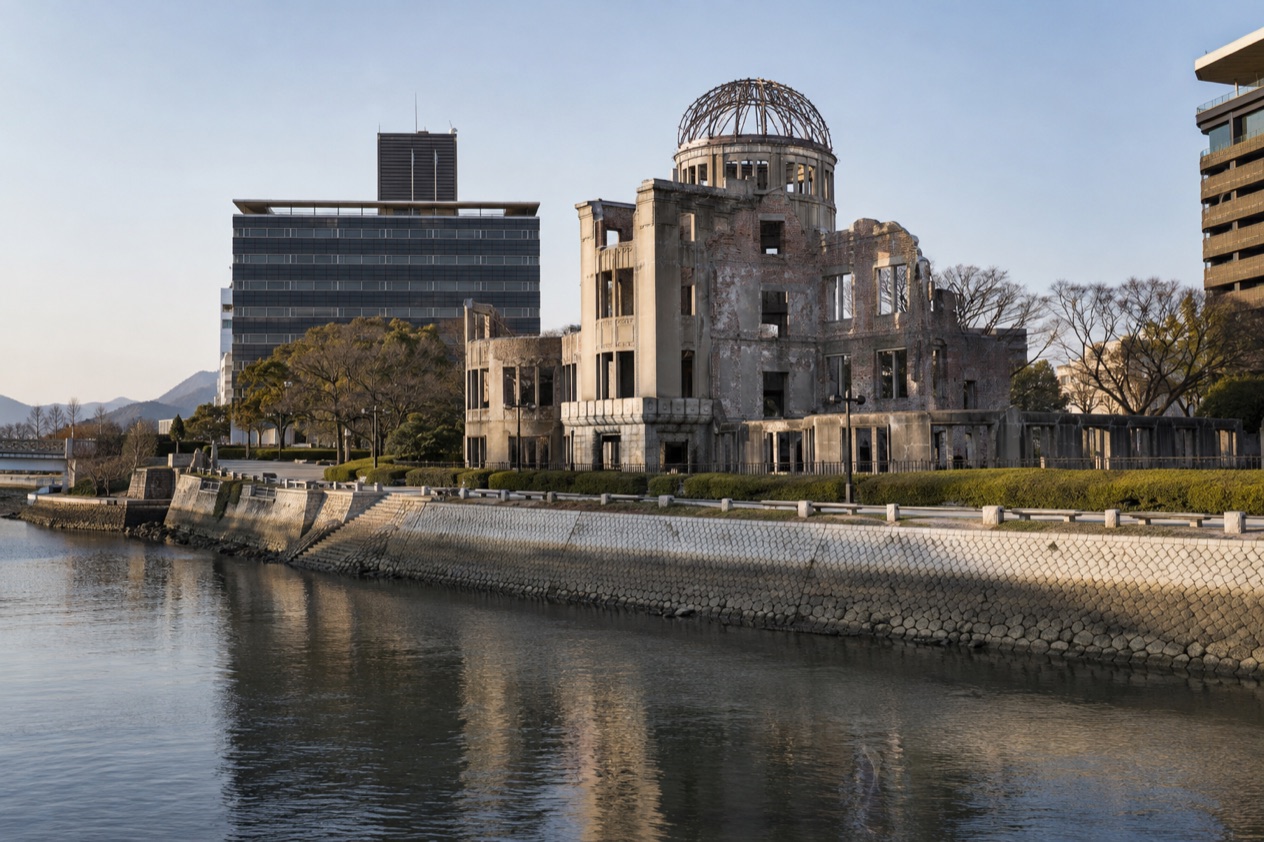
The park is where most visits to Hiroshima begin, and a winter day suits it. Hiroshima became the site of the first atomic bomb attack on August 6, 1945, and the park holds many monuments to that day, including the Children’s Peace Monument and the Hiroshima National Peace Memorial Hall for the Atomic Bomb Victims. The Atomic Bomb Dome, the only structure still standing near the hypocenter, is a UNESCO World Heritage Site and the heart of the grounds.
Visitors cannot go inside the Dome, so you view it from the outside, walking around it and along the river that passes in front. On a cold, clear February day the stillness of the open park and the bare trees give the place a plain, serious atmosphere. Walk without hurry, read the monuments and leave time to sit by the water. The cold keeps the visit contemplative, and a warm drink afterward is welcome.
Miyajima and Itsukushima Shrine
Miyajima Island is the excursion everyone pairs with the city. Itsukushima Shrine, registered as a World Heritage Site in 1996, is known for its red torii gate standing in the sea, and the island is also known for its deer. In February you see the shrine in winter light, with cool air off the water, and the colors of vermilion and dark wood stand out against gray-blue sky.
Dress more warmly than in the city, since the shoreline can feel colder than the streets. Wander the shrine’s walkways and the lanes of the village near it, where grilled oysters and momiji manju, maple-leaf cakes with sweet fillings, are the island’s treats. This is a good outing for a dry, bright day, with the city’s museums as your backup for rain.
Winter food: oysters and okonomiyaki
Hiroshima eats well in winter. Oysters from the Seto Inland Sea are a seasonal staple, served grilled in the shell, fried, or simmered in a miso hot pot, and cold evenings are the moment for them. Okonomiyaki, the local version of the savory pancake, is built in layers on a hot griddle with cabbage, noodles, egg and a sweet-savory sauce, and eating it at the counter while the cook works is part of the pleasure.
Warm dishes carry the month: noodle soups, hot pots, sake served warm. Small izakaya (casual pubs) fill in the evening with the smell of grilled skewers and steam from bowls. After a day in the cold, a bowl of anything hot tastes better than usual.
Rainy or snowy hours indoors
When sleet comes through, the city’s museums and the Peace Memorial Hall give you a place to spend a gray stretch of the day. Covered shopping arcades, department store food halls and coffee shops fill the gaps, and a long okonomiyaki lunch works as a rain plan on its own. The river-crossed layout of the city means you can step between indoor stops and the open park as the weather shifts.
A two-day itinerary for Hiroshima in February
Day 1 belongs to the city’s central memorial sites, taken in the order that the winter daylight allows. Start in Peace Memorial Park while the sun is out, circling the Atomic Bomb Dome and the river bank, then stop at the Children’s Peace Monument and the National Peace Memorial Hall for the Atomic Bomb Victims. The museum and memorial halls give the middle of the day an indoor, reflective rhythm, which suits the chill.
Lunch is okonomiyaki at a counter, built layer by layer on the griddle. In the afternoon, cross the river and let the streets carry you through shopping arcades and cafés, saving the energy for the evening.
For dinner, choose a restaurant with oysters in season, grilled or in a hot pot, and finish with something warm to drink. If sleet comes in, move the arcades and cafés earlier and keep the park for a clearer interval.
Day 2 is for Miyajima Island. Spend the morning at Itsukushima Shrine, with its red torii gate standing in the sea, then move through the village lanes and meet the island’s deer. Midday suits grilled oysters and a maple-leaf manju from a street stall. Bundle up against the wind off the water.
Return to the city for the afternoon and an unhurried last evening at a small izakaya, with skewers and a warm cup of sake. If the weather turns, trade the shrine walkways for a long meal in the village, then spend the afternoon at the museums and arcades back in the city.
Is Hiroshima busy in February?
February is a winter month here, outside the cherry blossom season that gives the spring calendar its pull. Cherry first bloom usually falls only at the end of March, with full bloom in early April, so the city’s big flowering draw is still to come.
What February offers is a different pace. The ski season in Japan is at its peak in January and February, but that belongs to Hokkaido and the high mountains of Nagano, which have the most frequent snowfall. Sapporo’s Snow Festival fills a week of February in the far north. Hiroshima’s own month is built around Setsubun in households, plum blossoms, hot food and the memorial sites.
For the traveler that means a season defined by the weather and the table rather than by a festival crowd. You plan around cold air and winter daylight, and you may find the rhythm of the city more about neighborhoods, restaurants and routines than about a headline event.
What to pack for Hiroshima in February
Pack for cold, bright days that dip below freezing at night, with a chance of sleet and light rain between sunny spells.
- A warm coat, for the open spaces of Peace Memorial Park and the wind on Miyajima.
- Layers such as a sweater and a light fleece, since museums and restaurants are heated while the streets are not.
- Gloves and a scarf for evenings and the walk to dinner.
- A compact umbrella for the rainy days and wet snow.
- Comfortable waterproof shoes for park paths and the shrine’s walkways.
- Sunglasses for the clear winter light.
Good to know before you go
February in Hiroshima sits in the cold season and falls ahead of the cherry blossoms, so the weather is the main thing to plan around. Closures of restaurants and attractions around the New Year holidays belong to the start of January, not to this month.
Setsubun in early February is celebrated at home and at shrines, which may show up as seasonal decorations and bean displays. Since the Atomic Bomb Dome can only be seen from the outside, a visit there is about the view and the surrounding park.
Hiroshima in February vs January and March
Going four weeks earlier means January, which is a little cooler and drier, with more days of snow or sleet falling on the city. Plum blossoms are already open then, and the first days of the year still carry the closures that come with the New Year holidays. The days are also the shortest of the three months.
Going four weeks later brings March, with a clear step up in warmth, longer days and more sunshine. Rain grows more frequent, and the cherry trees start to bloom around the last week of the month, with full bloom a little later. The plum season has finished by then, and the oyster-and-hot-pot mood of winter begins to give way to spring.
Choose February if you want winter food, Setsubun and cold bright days at the memorial sites. Shift to March if sakura is the point of the trip, or to January if you want the deepest winter feeling and the plum bloom.
Is February a good time to visit Hiroshima?
Yes, for travelers who like winter light, hot food and a city visit built around memorials, a shrine island and the table. It suits people who do not mind cold hands and who enjoy ducking into a warm restaurant between outings.
Anyone chasing cherry blossoms or warm days should choose a later month, and skiers should look to Hokkaido or Nagano. On arrival, begin with Peace Memorial Park while the light is good, so the rest of the days can bend around the weather. What February gives Hiroshima is a household tradition in the open, the call of “Fuku wa uchi!” through doorways, and a plate of oysters on a cold evening.
Sources
- Japan Meteorological Agency (JMA), Normal values 1991-2020, monthly (https://www.data.jma.go.jp/stats/etrn/view/nml_sfc_ym.php?prec_no=67&block_no=47765), station Hiroshima, elevation 4 m, checked October 11, 2026
- Computed from the date and the latitude of the place (sunrise equation, solar elevation -0.833 degrees), October 11, 2026
- Wikipedia, Setsubun (https://en.wikipedia.org/wiki/Setsubun), checked October 11, 2026
- Japan National Tourism Organization, festivals and events (https://www.japan.travel/en/see-and-do/festivals-and-events/), checked October 11, 2026
- Sapporo Snow Festival official website (https://www.snowfes.com/english/), checked October 11, 2026
- Wikipedia, Sapporo Snow Festival (https://en.wikipedia.org/wiki/Sapporo_Snow_Festival), checked October 11, 2026
- Japan National Tourism Organization, winter in Japan (https://www.japan.travel/en/guide/winter-guide/), checked October 11, 2026
- Japan National Tourism Organization, skiing and snowboarding in Japan: regions, resorts, seasons (https://www.japan.travel/en/sports/snow/), checked October 11, 2026
- Wikipedia, Climate of Japan (https://en.wikipedia.org/wiki/Climate_of_Japan), checked October 11, 2026
- Japan National Tourism Organization, flowers by season: cherry blossom, plum, wisteria, hydrangea, where and when (https://www.japan.travel/en/see-and-do/flowers/), checked October 11, 2026
- Wikipedia, Prunus mume (https://en.wikipedia.org/wiki/Prunus_mume), checked October 11, 2026
- Japan National Tourism Organization, skiing guide (https://www.japan.travel/en/guide/skiing/), checked October 11, 2026
- Wikipedia, List of ski areas and resorts in Japan (https://en.wikipedia.org/wiki/List_of_ski_areas_and_resorts_in_Japan), checked October 11, 2026
- Japan National Tourism Organization, weather and seasons in Japan (https://www.japan.travel/en/plan/weather/), checked October 11, 2026
- Japan Meteorological Agency, cherry blossom first-bloom dates 2021-2026 and 1991-2020 normal (https://www.data.jma.go.jp/sakura/data/sakura003_07.html), checked October 11, 2026
- Japan Meteorological Agency, cherry blossom full-bloom dates 2021-2026 and 1991-2020 normal (https://www.data.jma.go.jp/sakura/data/sakura004_07.html), checked October 11, 2026
- Wikipedia, Hiroshima (https://en.wikipedia.org/wiki/Hiroshima), checked October 11, 2026
- Wikivoyage, Hiroshima (https://en.wikivoyage.org/wiki/Hiroshima), checked October 11, 2026
- Japan National Tourism Organization, Hiroshima (https://www.japan.travel/en/destinations/chugoku/hiroshima/), checked October 11, 2026
- Visit Hiroshima, the official guide (https://visithiroshima.net/), checked October 11, 2026
To plan your stay
- Things to Do in Hiroshima: Peace Memorial Park, Miyajima, Okonomiyaki and Day Trips
- Where to Stay in Hiroshima: Peace Park, Station Area, Castle District and Miyajima Island
- Hiroshima from Osaka: Shinkansen, Local Trains and a Day at the Peace Park
- Know Before You Go to Hiroshima: Entry, Money, Getting Around and Local Etiquette