
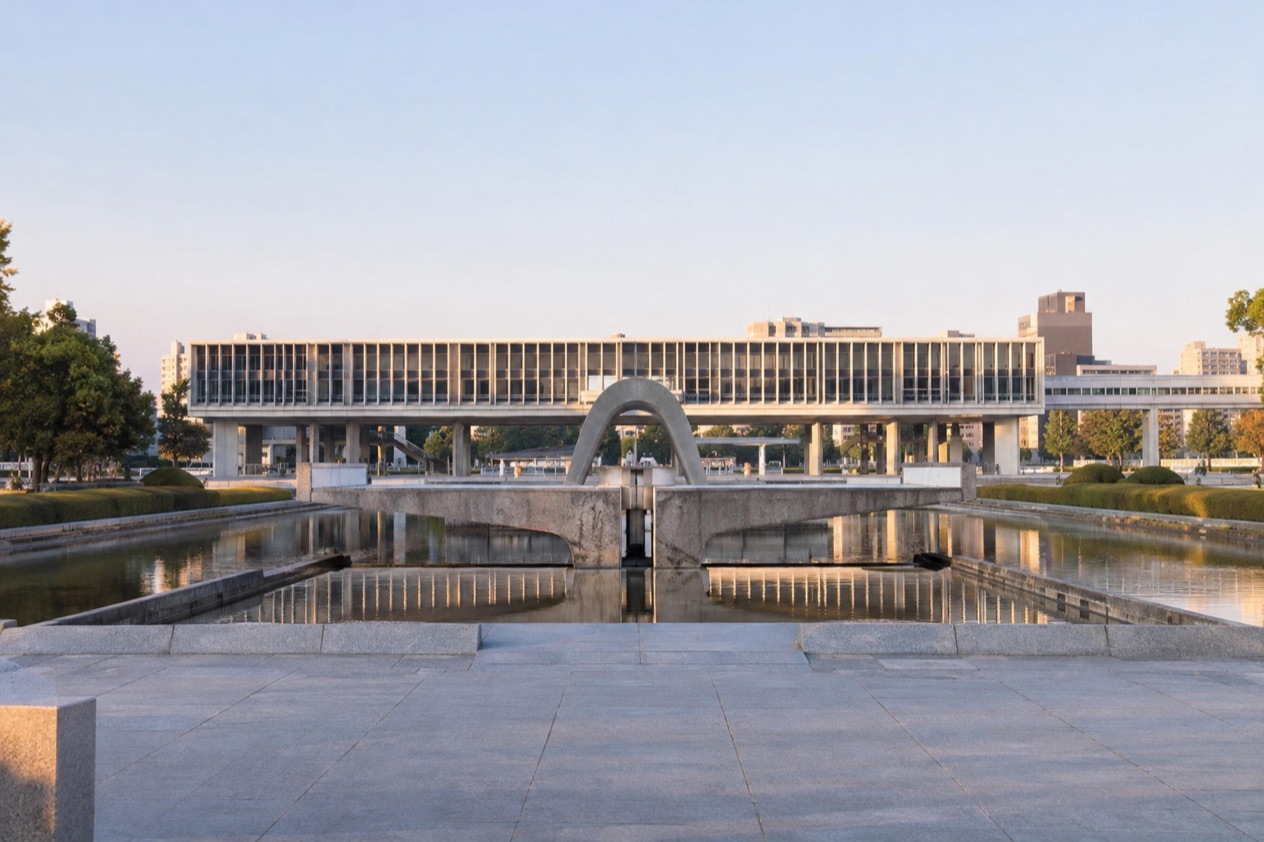
You come to the museum through the Peace Memorial Park, past the river and the lawns, and the first thing you meet is the long concrete building raised on pillars, the work of Kenzō Tange. Inside, the voices drop.
Schoolchildren file past glass cases, visitors read slowly, and the objects do most of the talking. It is a visit that asks for attention rather than speed, and it sits at the center of any trip to Hiroshima.
Is visiting the Hiroshima Peace Memorial Museum worth it?
Yes, for almost anyone who comes to Hiroshima, and especially for travelers who want to understand the city beyond its landmarks. The museum is the most visited of Hiroshima’s destinations, both for school field trips from all over Japan and for international visitors, and the reason shows as soon as you step inside.
What sets it apart from the other sites of the park is that it works through things rather than monuments. The Atomic Bomb Dome can only be seen from the outside, and the park is a place to walk and reflect.
The museum is where you stand close to belongings left by victims, artifacts from the bombed city and the testimonies of survivors. Its stated purpose is to convey the inhumanity of nuclear weapons and to spread the message of No More Hiroshimas, and it does so with plain, concrete evidence rather than slogans.
The museum opened in August 1955, and it has been rebuilt and reorganized more than once since. The East Wing now has interactive displays and a projection-mapped model of the city, so it speaks to younger visitors as well as to adults. It is not a light outing, and it does not pretend to be. Plan the rest of your day around it so that you have room to sit afterward in the park.
What to see at the Hiroshima Peace Memorial Museum
The exhibits are divided into four sections spread over the East Wing and the Main Building. Each has a different tone, and it helps to know what each one holds before you start.
The East Wing: the city, the decision and the nuclear age
The East Wing opens with an introductory exhibit and then tells the story that surrounds the bombing. You learn what Hiroshima was before the bomb, how the weapon was developed and how the decision to use it was made, and what daily life was like for the city’s residents during World War II and afterward.
It reopened in 2017 after renovation, and the old model of the city was replaced by a version that uses projection mapping to show the effects of the blast. Look for that model, since it lets you see the scale of the destruction across the streets you have just walked through. The wing also carries the sections on the dangers of nuclear weapons and on Hiroshima’s history, ending with efforts toward international peace.
The Main Building: the reality of the bombing
This is the heart of the visit and the hardest part. The section called Reality of the Atomic Bombing gathers the material witnesses: clothing, personal belongings and fragments of the city, each tied to a person or a place. The building was closed for seismic retrofitting until April 2019 and has since been shown in its current form.
The earlier West Wing was organized around the damage done by the heat rays, the blast and the radiation, and those themes still guide how the objects are read. Give this part the most time and let yourself stop at the small things, a lunchbox, a torn uniform, a watch. They tend to stay with visitors longer than any large display.
The building itself and the approach
Before you go in, look at the architecture. Kenzō Tange designed the main building, and its raised concrete form frames the view through the park toward the Atomic Bomb Dome. The museum stands at 1-2 Nakajima-chō in Naka-ku, inside the park, so the walk to it is part of the experience.
The Dome and the park are both UNESCO World Cultural Heritage sites. The Dome cannot be entered, only viewed from outside, which makes the museum the place where the story is told in full. Visitors walk past the Dome first and come to the museum afterward, or the other way round.
Hours, tickets and rules
The museum opens early, at 7:30am all year, and closing time moves with the seasons. It stays open latest in August, and the evenings of August 5 and 6 run later still for the memorial ceremony. Admission is low, and younger students enter free.
| Site | Open | Admission |
|---|---|---|
| Hiroshima Peace Memorial Museum, March to July | 7:30am to 7:00pm | Adults ¥200 (groups of 30 or more ¥160 each); high school students ¥100 (groups of 20 or more free); junior high and younger free |
| Hiroshima Peace Memorial Museum, August | 7:30am to 8:00pm (until 9:00pm on August 5 and 6) | Adults ¥200; high school students ¥100; junior high and younger free |
| Hiroshima Peace Memorial Museum, September to November | 7:30am to 7:00pm | Adults ¥200; high school students ¥100; junior high and younger free |
| Hiroshima Peace Memorial Museum, December to February | 7:30am to 6:00pm | Adults ¥200; high school students ¥100; junior high and younger free |
The museum is closed on December 30 and 31 and in the middle of February. The Atomic Bomb Dome cannot be entered and is viewed only from the outside. The official website of the museum is hpmmuseum.jp.
When to visit the Hiroshima Peace Memorial Museum
Any month works, since the exhibits are indoors, and the opening hour of 7:30am gives you the whole morning if you want to start early. In the colder months the museum closes earlier, at 6:00pm from December to February, so a winter visit fits best in the morning or the first half of the afternoon.
Highs sit in the mid-70s and lows near 59°F, with a modest number of rainy days. The park lawns and the river path are pleasant to walk before and after the galleries, and the museum closes at 7:00pm, which leaves a long day.
April is mild, with highs near 68°F, and rain comes on a handful of days. July is hot and humid, with highs near 88°F and the heaviest rain of the months in the table, so the air-conditioned galleries are a relief but the walk across the park can be sticky. January is cold, with highs near 50°F, and snow or sleet falls on some days.
| Month | Average high (°F) | Average low (°F) | Precipitation (in) | Rain days | Sunshine (hours) |
|---|---|---|---|---|---|
| January | 49.8 | 35.6 | 1.82 | 5.5 | 139 |
| April | 67.6 | 50.2 | 5.55 | 8.8 | 192 |
| July | 87.6 | 75.4 | 11.02 | 10.6 | 173 |
| October | 74.7 | 58.8 | 4.30 | 6.2 | 179 |
The most significant date is August 6. The museum stays open until 9:00pm on August 5 and 6, and on the evening of the 6th thousands of people write peace messages on lanterns, which are lit at sunset and floated along the river in front of the Atomic Bomb Dome. It is a ceremony as much as a sight, and the river is the place to watch it from.
Tips for your visit
Go in with an open morning. The galleries are best taken slowly, and the Main Building in particular rewards time. Wear comfortable shoes, since you will stand and walk through the wings and the park, and bring a light layer in the cooler months. In July, water and a hat help for the walk between the park and the entrance.
Reading the labels takes concentration, and visitors find they need a break between the Main Building and the East Wing. The park around the museum is the natural place for that pause, with benches and river views, and it is a place to stand quietly rather than hurry on. Families with children can take the younger ones in free up to junior high age, but the content is serious and heavy, so think about what your children are ready to see.
Combine the museum with the rest of the park, starting with the Atomic Bomb Dome, seen from the outside. Hiroshima has more to offer for the rest of the day or the next one.
Okonomiyaki, the local version of the savory griddle pancake, makes a good meal after a morning at the museum. Miyajima Island makes an excursion for its deer and the Itsukushima Shrine, whose red torii gate stands in the sea and was registered as a World Heritage Site in 1996.
Hiroshima is reached by shinkansen, about four hours from Tokyo and 90 minutes from Osaka, so the museum fits a day trip from Osaka as well as a longer stay in the city. If you want something lighter afterward, the prefecture also holds the Seto Inland Sea, wooded mountains and clear waters, and on Okunoshima visitors must not chase or pick up the wild rabbits.
Good to know before you go
Admission is paid in yen at the museum, and the amounts above are the ones to plan on. The galleries are a place for a low voice and unhurried steps, as the visitors around you will show.
Sources
- Hiroshima Peace Memorial Museum (https://hpmmuseum.jp/?lang=eng), checked October 11, 2026
- Japan National Tourism Organization, Hiroshima (https://www.japan.travel/en/destinations/chugoku/hiroshima/), checked October 11, 2026
- Visit Hiroshima, the official guide (https://visithiroshima.net/), checked October 11, 2026
- Japan Meteorological Agency (JMA), Normal values 1991-2020, monthly (https://www.data.jma.go.jp/stats/etrn/view/nml_sfc_ym.php?prec_no=67&block_no=47765), station Hiroshima, elevation 4 m, checked October 11, 2026
To plan your stay
- Best Time to Visit Hiroshima: Cherry Blossoms, Autumn Weather, Rainy Season and Festivals
- Where to Stay in Hiroshima: Peace Park, Station Area, Castle District and Miyajima Island
- Hiroshima from Osaka: Shinkansen, Local Trains and a Day at the Peace Park
- Know Before You Go to Hiroshima: Entry, Money, Getting Around and Local Etiquette