
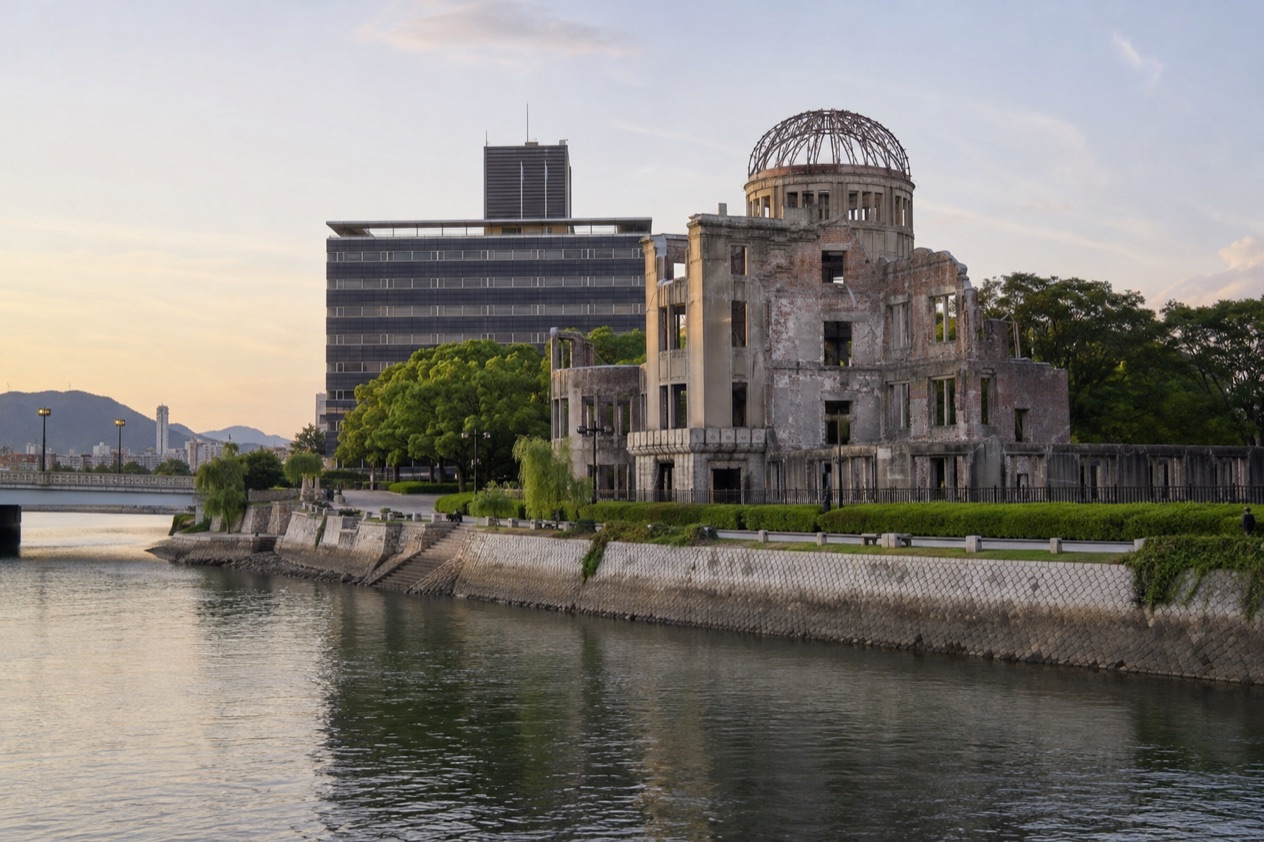
You step out of the station into Hiroshima and the first thing you notice is the streetcars, rolling past with a soft rattle along the wide avenues. A few minutes on, the river appears, and then the skeletal dome beside it, quiet and unmistakable.
A visit here is built around memory, a ferry to a shrine in the sea, and a plate of okonomiyaki. A handful of habits and practicalities make it all go more smoothly.
What should you know before visiting Hiroshima?
Four things matter most: the city is built around peace sites that call for a respectful pace, streetcars are a distinctive part of getting around Hiroshima, cards work widely but a little cash is still handy, and the weather changes a lot from one season to the next. Everything else is detail.
The heart of a visit is the Peace Memorial Park, the Atomic Bomb Dome and the Peace Memorial Museum. The Dome cannot be entered, so you see it from the outside, from the riverbank, and that is exactly how most people take it in. The museum shows belongings left by victims, artifacts from the bombing and survivor testimonies, and it carries the message of “No More Hiroshimas.” It is a heavy visit, and many people leave time afterward to sit by the river before doing anything else.
What surprises first-timers is how much more the prefecture holds. Hiroshima looks out on the Seto Inland Sea, with wooded mountains and clear waters behind it, and it has a food culture all its own.
Okonomiyaki here is layered on a thin crepe, and anago, saltwater eel, is another local delicacy. Many people also expect a somber city and find a lively one, with cafés, riverside walks and a streetcar line that doubles as a rolling museum of tram design.
Entry, customs and paperwork
According to the U.S. State Department, U.S. citizens visiting Japan for tourism or business on a visa-free stay of up to 90 days need a valid passport and should have proof of a return or onward ticket. The passport has to remain valid for the entire time you are in the country. Work on the local economy is not allowed during a visa-free stay.
Once you are in Japan, the State Department also notes that you must always carry your U.S. passport (or a Japanese Residence Card for residents). Without proof of identity and status, you may be questioned or detained, so keep the passport on you rather than leaving it in the hotel safe.
One more item from the State Department’s guidance on local laws: CBD products may be illegal in Japan depending on how much THC they contain. That is worth remembering before packing oils, gummies or creams from home.
Money, cards and tipping
Cards are accepted widely in Japan. According to the Japan National Tourism Organization, international credit, debit and prepaid cards are generally accepted throughout the country, and Hiroshima’s hotels, department stores and larger restaurants fit that picture.
Some shops do not display the logos of the cards they take. The JNTO advises asking the seller whether your card works, a small question that saves an awkward moment at the register.
Tipping is not part of the routine in Japan, and the habit is simply to pay the amount on the bill and say thank you. In practice, you leave the counter, the taxi or the restaurant with a nod and a word of thanks, and that is considered plenty. If you do try to leave money on a table, a server may well come running after you to return it. At the Peace Memorial Museum, admission is set by category, and the amounts below apply there.
| Visitor | Museum admission |
|---|---|
| Adult | ¥200 |
| Adult in a group of 30 or more | ¥160 per person |
| High school student | ¥100 |
| High school students in a group of 20 or more | Free |
| Junior high school student and younger | Free |
Getting around and staying connected
The streetcar is the signature way to move around town. Hiroshima Electric Railway, known as Hiroden, runs streetcars and buses in and around Hiroshima Prefecture, and it has been operating since 1910. Its fleet includes trams built across Japan and Europe, which is why it is nicknamed the Moving Streetcar Museum. Riding one is as much a part of the visit as any sight.
Ticketing has changed. Hiroden accepted the PASPY smart card from January 2008, and in spring 2025 PASPY was replaced by the QR code based MOBIRY DAYS ticketing system. If an older guidebook or a friend mentions PASPY, that is the reason it no longer matches what you find on the platform.
To reach the city, Hiroshima is accessible by shinkansen, about four hours from Tokyo and 90 minutes from Osaka. By air, the flight from Haneda Airport to Hiroshima Airport takes 90 minutes. Many people pair the city with Osaka or Kyoto on one rail itinerary and use Haneda for the faster hop from Tokyo.
Out on the water, Miyajima Island, home to the Itsukushima Shrine with its red torii gate standing in the sea, is the excursion most people add. Inland, Sandankyo is known for its autumn leaves from late October to late November, which makes it a natural idea for an autumn trip. Smaller outings include Okunoshima, where visitors must not chase or pick up the wild rabbits and should provide appropriate food in a safe place.
Health, water and the weather
Hiroshima’s weather swings noticeably across the year, and packing is easier once you know the pattern. January is cold, with highs near 50°F and lows around 36°F, and snow or sleet shows up on a number of days even though little accumulates. Gray days mix with fairly bright ones, so a warm coat and layers make sense.
April is mild and pleasant, with highs in the high 60s and lows around 50°F. Showers come on several days of the month, and sunshine is plentiful. October is similar in feel, with highs in the mid-70s and cooler evenings, and fewer wet days than in spring or summer. Sandankyo’s leaves start turning toward the end of the month.
July is hot and humid, with highs in the high 80s and lows in the mid-70s. It is also the wettest of the four months, with heavy rain and a damp, sticky air that makes long walks along the river tiring. Light clothing, a hat and a small umbrella are the practical choices.
| Month | Average high (°F) | Average low (°F) | Precipitation (inches) | Days with rain (1 mm or more) | Sunshine (hours) |
|---|---|---|---|---|---|
| January | 49.8 | 35.6 | 1.82 | 5.5 | 139 |
| April | 67.6 | 50.2 | 5.55 | 8.8 | 192 |
| July | 87.6 | 75.4 | 11.02 | 10.6 | 173 |
| October | 74.7 | 58.8 | 4.30 | 6.2 | 179 |
Local customs and etiquette
Shoes come off at the entrance of many buildings. It is customary to remove them at the door, step into indoor slippers, and leave the shoes in a shoe box or to the side. In a home or a ryokan, the slippers come off too when you step onto tatami mats, and a separate pair of toilet slippers is often waiting by the bathroom.
Around the Peace Memorial Park, the mood is hushed. People speak softly, photographs are taken with care, and the Atomic Bomb Dome is looked at from the riverbank rather than entered. On the evening of August 6, thousands of people write messages on lanterns that are lit at sunset and floated along the river in front of the Dome. Even on an ordinary day, visitors tend to pause for a moment by the cenotaph.
Everyday habits are gentle ones. On the streetcar, people keep their voices low and phone calls for later. Lines at stops form in an orderly way, and in restaurants a quiet thank-you to the cook as you leave is common. Trash cans can be scarce, so many people simply carry their wrappers until they find one, or take them back to the hotel.
Good to know before you go
The U.S. State Department rates Japan Level 1: Exercise Normal Precautions.
Summer in Hiroshima is wet and humid, and July shows it clearly, so carry rain gear and keep an indoor option for rainy periods. Keep your passport on you, and ask before paying if a shop does not display card logos. And if you are heading out to Miyajima, remember that the red torii gate stands in the sea itself, which makes the shrine one of the places you will want to see from the water’s edge.
Sources
- Japan National Tourism Organization, Hiroshima (https://www.japan.travel/en/destinations/chugoku/hiroshima/), checked October 11, 2026
- Visit Hiroshima, the official guide (https://visithiroshima.net/), checked October 11, 2026
- Hiroshima Peace Memorial Museum (https://hpmmuseum.jp/?lang=eng), checked October 11, 2026
- Wikipedia, Hiroden (https://en.wikipedia.org/wiki/Hiroden), checked October 11, 2026
- U.S. Department of State, Japan travel information, local laws and special circumstances (https://travel.state.gov/content/travel/en/international-travel/International-Travel-Country-Information-Pages/Japan.html), checked October 11, 2026
- Japan National Tourism Organization, manners, etiquette, shoes, bowing, chopsticks, public behavior (https://www.japan.travel/en/guide/understanding-and-mastering-japanese-manners-and-etiquette/), checked October 11, 2026
- Japan National Tourism Organization, credit cards and cash, where cards are accepted (https://www.japan.travel/en/plan/credit-cards/), checked October 11, 2026
- U.S. Department of State, Japan travel advisory (https://travel.state.gov/content/travel/en/international-travel/International-Travel-Country-Information-Pages/Japan.html), checked October 11, 2026
- U.S. Department of State, Japan travel information, entry and exit requirements (https://travel.state.gov/content/travel/en/international-travel/International-Travel-Country-Information-Pages/Japan.html), checked October 11, 2026
- Japan Meteorological Agency (JMA), Normal values 1991-2020, monthly (https://www.data.jma.go.jp/stats/etrn/view/nml_sfc_ym.php?prec_no=67&block_no=47765), station Hiroshima, elevation 4 m, checked October 11, 2026
To plan your stay
- Best Time to Visit Hiroshima: Cherry Blossoms, Autumn Weather, Rainy Season and Festivals
- Things to Do in Hiroshima: Peace Memorial Park, Miyajima, Okonomiyaki and Day Trips
- Where to Stay in Hiroshima: Peace Park, Station Area, Castle District and Miyajima Island
- Hiroshima from Osaka: Shinkansen, Local Trains and a Day at the Peace Park