
Along the riverbanks of Hiroshima, the cherry trees start to loosen their buds in March, and the wide boulevards fill with people walking in spring jackets. Streetcars rattle past the Peace Memorial Park while the first petals appear on the branches. This is a month for a city of rivers and memory just as winter lets go: sights to see on foot, griddled okonomiyaki for lunch, and a day out on Miyajima Island.
What is the weather like in Hiroshima in March?
March in Hiroshima is cool and turning mild, a month when winter coats can come off in the middle of the day but a sweater stays close at hand.
| Month | Average high (°F) | Average low (°F) | Precipitation (in) | Days with 1 mm or more of precipitation | Hours of sunshine | Daylight on the 15th |
|---|---|---|---|---|---|---|
| February | 51.6 | 36.3 | 2.52 | 6.9 | 140 | 10 h 56 min |
| March | 58.1 | 41.2 | 4.66 | 9.0 | 177 | 11 h 55 min |
| April | 67.6 | 50.2 | 5.55 | 8.8 | 192 | 13 h 01 min |
The numbers say that March sits between a cold, fairly dry February and a warmer, wetter April. Rain falls on roughly one day in three, so a folding umbrella earns its place in the bag.
Layers are the answer. The cool lows call for a warm jacket or a light coat, and the milder highs mean a sweater or a shirt beneath it is usually enough. Japan’s national tourism organization notes that in spring a light jacket or a simple sweater can see you through much of the country, and in Hiroshima in March you add a scarf and something waterproof.
The days are now close to twelve hours long, so the light stretches well into the evening, long enough for a stroll along the rivers after dinner. Sunshine is more generous than in February, which helps when you are outdoors at the memorial sites or waiting for the cherry blossoms to open.
What to do in Hiroshima in March
The big event of the month is the cherry blossom. In Hiroshima the first flowers usually open around the last week of March, and full bloom tends to arrive in the first days of April.
From one spring to the next, the dates shift, so you may find buds, a first scattering of blossoms or a tree in full white depending on your week. Along the rivers that cross the city, even buds make the walks pleasant.
March is also a month for the table. The Seto Inland Sea shapes the local menu, and oysters are a long-standing specialty of the region in the cooler months.
Hiroshima-style okonomiyaki, a griddled stack of cabbage, noodles, egg and sauce, suits the cool weather well. On a day with a light drizzle, the counter of an okonomiyaki shop, with the hot plate in front of you, is as good a place as any to wait it out.
Peace Memorial Park, the Atomic Bomb Dome and the Museum
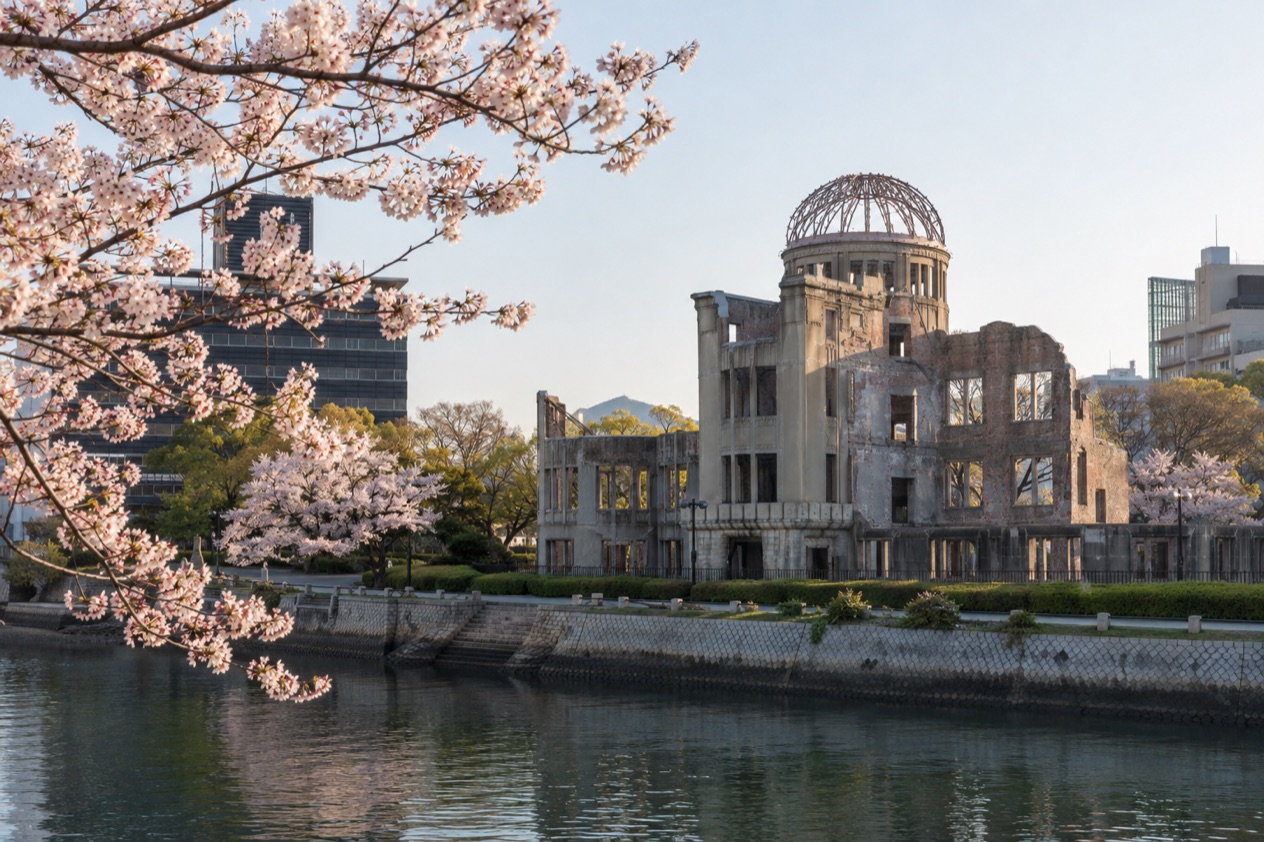
The park sits in the center of the city, on the ground where the first atomic bomb used in war fell on August 6, 1945. Its centerpiece is the Atomic Bomb Dome, the skeletal ruin that the UNESCO World Heritage listing protects as the only structure still standing near the hypocenter. In March, the bare steel ribs of the dome stand against a sky that is often pale, and the first cherry buds on the nearby trees give the place a quiet contrast between loss and renewal.
Beyond the dome, the park holds many monuments, among them the Children’s Peace Monument and the National Peace Memorial Hall for the Atomic Bomb Victims. The Peace Memorial Museum carries the message of ‘No More Hiroshimas’ through belongings left by victims, artifacts from the bombing and survivor testimonies. Visitors find the visit sobering, and it deserves unhurried time. The rooms are indoors, which makes the museum a natural choice when the rain comes.
| Visitor to the Peace Memorial Museum | Admission |
|---|---|
| Adult | ¥200 |
| Adult in a group of 30 or more | ¥160 per person |
| High school student | ¥100 |
| High school students in a group of 20 or more | Free |
Miyajima and the torii in the sea
Miyajima Island, in Hiroshima Prefecture, is home to Itsukushima Shrine, whose red torii gate stands in the sea. Wooden walkways, lanterns and the green hills behind the shrine give the island a setting that works in cool spring weather, when the walk between the shrine buildings and the town is pleasant in a jacket.
The island is also a place to eat. Maple-leaf-shaped momiji manju, little cakes with sweet fillings, are the local souvenir, and grilled seafood is on offer along the streets. Visit with the weather in mind: a gray day softens the colors of the shrine, while a bright one sharpens the vermilion against the water.
Riding the Hiroden streetcars
Hiroshima Electric Railway, known as Hiroden, has run streetcars and buses in and around the prefecture since its founding in 1910. Its fleet includes trams built in different parts of Japan and in Europe, which has earned it the nickname ‘The Moving Streetcar Museum’. Climbing aboard a vintage car is a small pleasure in itself.
In March, a tram seat is a dry place to watch the boulevards and river bridges roll past when a shower passes, and the streetcars give you a view of ordinary city life between the big sights. Hop off wherever a street looks interesting and a cluster of lanterns or food stalls catches your eye.
A two-day itinerary for Hiroshima in March
Day 1 belongs to the city center and its memorials. Start in the Peace Memorial Park while the light is clear, walking from the Atomic Bomb Dome to the Children’s Peace Monument and the memorial hall. Give the museum a generous block of the late morning, since the exhibits ask for attention and the rooms are indoors if the sky turns gray.
Lunch can be Hiroshima-style okonomiyaki, eaten at the counter where the cook flips your plate on the hot griddle. In the afternoon, board a Hiroden streetcar and ride through the boulevards, getting off wherever a river view or a street of small shops draws you.
With nearly twelve hours of daylight, there is time for a stroll along a river as the cherry buds swell. Dinner can be oysters or a casual izakaya, a pub serving small plates.
Day 2 is for Miyajima. Spend the morning at Itsukushima Shrine and its torii gate in the sea, then wander the island’s streets for momiji manju and grilled seafood.
If rain sets in, the covered corridors of the shrine and the food shops give you cover, and you can return to the city for the museum or a long meal if you did not take them on the first day. Evenings are cool, so keep a jacket handy for the trip back.
Is Hiroshima busy in March?
March brings the start of the cherry blossom season to Hiroshima, which gives the city its livelier spring mood, though the main bloom comes a little later.
The first flowers usually open in the last week of March and the full bloom comes in early April. Those dates move from one spring to the next, so the same week can look like winter in one year and like spring in another. If you want to see the trees in flower, the first days of April sit closer to the usual peak than the early weeks of March.
What you can count on is the character of the month. Cherry blossoms are a symbol of spring across Japan and a harbinger of the new season, and people start to look for them as soon as the weather turns. In Hiroshima that feeling mixes with the solemn tone of the memorial sites, which hold their own place in the city’s year regardless of the weather.
As the days lengthen and the sunshine grows, the riverbanks and parks start to draw people outdoors. Rooms and tables in the city are matters for your own planning, but the feel of March is of a city waking up, not yet in the full rush of April.
What to pack for Hiroshima in March
Pack for a month of changing layers, with rain likely on some days and spring warming the air only gradually.
- A warm jacket or light coat, for the cool lows that still feel like late winter.
- A sweater or long-sleeved shirt to layer under it, for the milder highs.
- A compact umbrella or rain jacket, since rain falls on a fair number of days.
- Comfortable walking shoes that handle damp pavement, for the park and the island paths.
- A scarf, for chilly evenings along the rivers and on the ride back from Miyajima.
Good to know before you go
The cherry blossom dates move from year to year, so treat the late-March opening as a pattern, not a promise.
The Peace Memorial Park and Museum are places of remembrance, and visitors tend to speak softly there. Among the voices you may hear are the hibakusha, a word meaning people affected by the bomb, which refers to the survivors of Hiroshima and Nagasaki.
Hiroshima in March vs February and April
Going four weeks earlier means a colder, drier city. February has fewer rainy days, but snow or sleet falls on many more days than in March, and the light is shorter at both ends of the day. The cherry trees are bare, and the blossom season that gives March its mood has not begun. The memorial sites look just as they do in March, but the walks between them are colder.
Going four weeks later brings the warmest of the three months, with more sunshine and the longest days. April is also the wettest of the three, in both rain and rainy days. The cherry trees are usually in full bloom in the first days of April, so a trip that starts there is more likely to catch them at their fullest than one that ends in mid-March.
If you want blossoms, aim for the turn of March into April. If you prefer cooler, drier days and do not mind bare branches, February works. March suits travelers who want the in-between: some rain, some sun, the first buds and a city that is warming up.
Is March a good time to visit Hiroshima?
Yes, March is a good time to visit Hiroshima for travelers who like a spring that is still arriving, with cool air, some rain and the first cherry blossoms.
It will suit those who come for the memorial sites, since the weather is comfortable for walking outdoors with layers, and for those who want to pair a thoughtful day in the park with an outing to Miyajima. Food lovers get okonomiyaki and Inland Sea oysters at a cool time of year. Travelers who want warm weather and trees in full bloom should look to April, and anyone who dislikes rain will find the month unpredictable.
On arrival, head first to the Peace Memorial Park and the Atomic Bomb Dome, the center of the city and the anchor of any visit. What makes March special here is the contrast of the season: a city rebuilt along its rivers, a place of remembrance, and the first cherry buds opening along the banks.
Sources
- Japan Meteorological Agency (JMA), Normal values 1991-2020, monthly (https://www.data.jma.go.jp/stats/etrn/view/nml_sfc_ym.php?prec_no=67&block_no=47765), station Hiroshima, elevation 4 m, checked October 11, 2026
- Computed from the date and the latitude of the place (sunrise equation, solar elevation -0.833 degrees), October 11, 2026
- Japan Meteorological Agency, cherry blossom first-bloom dates 2021-2026 and 1991-2020 normal (https://www.data.jma.go.jp/sakura/data/sakura003_07.html), checked October 11, 2026
- Japan Meteorological Agency, cherry blossom full-bloom dates 2021-2026 and 1991-2020 normal (https://www.data.jma.go.jp/sakura/data/sakura004_07.html), checked October 11, 2026
- Japan Meteorological Agency, sakura2020.pdf (https://www.data.jma.go.jp/sakura/data/sakura2020.pdf), checked October 11, 2026
- Japan National Tourism Organization, flowers by season: cherry blossom, plum, wisteria, hydrangea, where and when (https://www.japan.travel/en/see-and-do/flowers/), checked October 11, 2026
- Wikipedia, Prunus mume (https://en.wikipedia.org/wiki/Prunus_mume), checked October 11, 2026
- Japan National Tourism Organization, spring in Japan (https://www.japan.travel/en/guide/spring-guide/), checked October 11, 2026
- Japan National Tourism Organization, autumn in Japan (https://www.japan.travel/en/guide/autumn-guide/), checked October 11, 2026
- Japan National Tourism Organization, summer in Japan (https://www.japan.travel/en/guide/summer-guide/), checked October 11, 2026
- Hiroshima Peace Memorial Museum (https://hpmmuseum.jp/?lang=eng), checked October 11, 2026
- Wikipedia, Hiroden (https://en.wikipedia.org/wiki/Hiroden), checked October 11, 2026
- Wikipedia, Hiroshima (https://en.wikipedia.org/wiki/Hiroshima), checked October 11, 2026
- Wikivoyage, Hiroshima (https://en.wikivoyage.org/wiki/Hiroshima), checked October 11, 2026
- Japan National Tourism Organization, Hiroshima (https://www.japan.travel/en/destinations/chugoku/hiroshima/), checked October 11, 2026
To plan your stay
- Things to Do in Hiroshima: Peace Memorial Park, Miyajima, Okonomiyaki and Day Trips
- Where to Stay in Hiroshima: Peace Park, Station Area, Castle District and Miyajima Island
- Hiroshima from Osaka: Shinkansen, Local Trains and a Day at the Peace Park
- Know Before You Go to Hiroshima: Entry, Money, Getting Around and Local Etiquette