
A flat iron griddle hisses, a thin round of batter spreads out, and a mound of shredded cabbage goes on top before the cook presses it down with a spatula and flips the whole thing in one confident motion. That sound and smell fill the counters of Hiroshima’s okonomiyaki restaurants, where the pancake is built in layers rather than mixed in a bowl. It is a meal-sized visit, a seat at the counter watching your dinner take shape, and a way to taste the city beyond its memorials.
Is visiting Hiroshima okonomiyaki worth it?
Yes, if you like food you can watch being made, and it suits almost anyone who is curious about what people in Hiroshima actually eat. The dish is a savory pancake, and the local version is one of the places where Japan’s idea of comfort food is most clearly its own. The local version is even singled out among the notable things to experience in the city, next to the Peace Memorial Park and the trip to Miyajima Island.
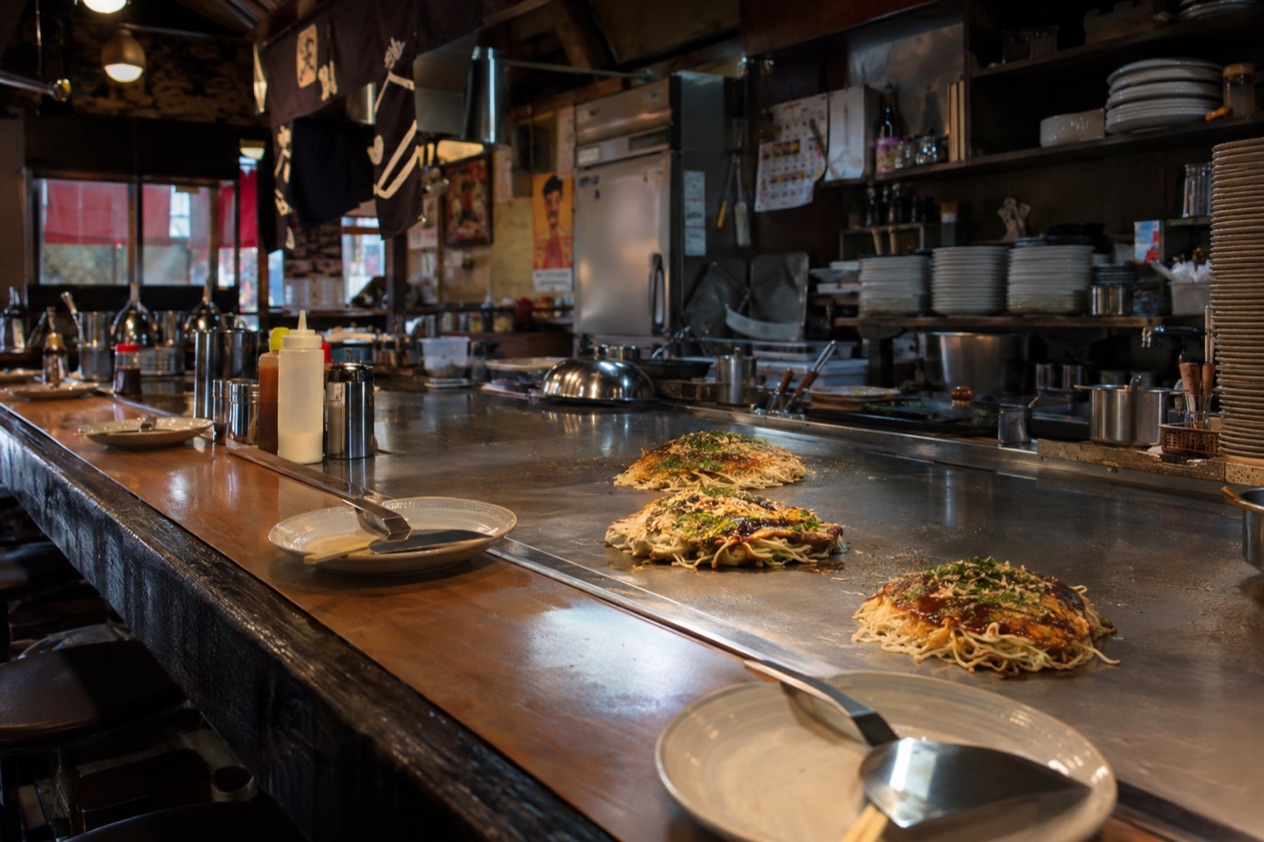
What sets Hiroshima apart from other okonomiyaki towns is the construction. Instead of stirring everything into one batter, as the Osaka style does, Hiroshima cooks keep the layers separate: a thin crepe-like base, a tall pile of cabbage, then other toppings, with noodles (yakisoba or udon), a fried egg and okonomiyaki sauce.
The cabbage alone runs to three or four times what goes into the Osaka version, so the pancake starts out towering and steams down as it cooks. The result is lighter and more vegetable-forward than the name “pancake” suggests, with soft cabbage, chewy noodles and a sweet, tangy sauce on top.
The city takes this seriously. Hiroshima has over 2000 okonomiyaki restaurants, and the prefecture has more of them per capita than anywhere else in Japan. You may also hear the dish called Hiroshima-yaki or Hiroshima-okonomi.
Nearby towns run their own variations, which is part of the fun for anyone who wants to keep eating their way around the region. Other places have their own styles too, such as the monjayaki of Tokyo’s Tsukishima district, but the layered Hiroshima pancake is a different dish, and it is the reason many travelers plan a meal here.
It also pairs naturally with a day of sightseeing. The city’s two UNESCO World Cultural Heritage sites, the Atomic Bomb Dome and the adjacent Peace Memorial Park, tend to leave visitors quiet and reflective, and a hot, busy counter meal afterward gives the day another rhythm. The trip out to Miyajima Island, with its deer and the red torii gate standing in the sea at Itsukushima Shrine, fits in just as well.
What to see at Hiroshima okonomiyaki
The layered pancake on the griddle
The main attraction is the cooking itself. At a counter seat you watch the batter spread thin, the cabbage heaped on, the toppings added, and then the noodles fried separately on the same griddle. The pancake is stacked on top of the noodles and finished with a fried egg, then brushed with okonomiyaki sauce. Everything happens within arm’s reach, so you can see each step.
Look for the noodle choice. Hiroshima-style okonomiyaki uses yakisoba or udon as a topping, and the two give quite different meals: yakisoba is thinner and a little crisp from the griddle, while udon is thick and soft. Many people eat it straight from the griddle with a small metal spatula, cutting wedges and lifting them to the mouth. It is a dish designed to be eaten hot.
Okonomi-mura in Naka-ku
Okonomi-mura is a building in Naka-ku given over to okonomiyaki, a food theme park where stalls sit side by side and each cook works at their own griddle. A poll in April 2004 named it the top food theme park destination for families in Japan. The appeal is the choice: you can walk past several counters, smell what is cooking and pick the one that suits your mood.
The atmosphere is that of a friendly food hall, with the sizzle of many griddles blending into one steady sound. Each counter has its own regulars and its own way of layering the pancake, so two plates can taste quite different even though they share the same name. It is a good place to try the dish for the first time, and a fine place to return if you want to compare cooks.
Otafuku museum and cooking studio
Otafuku, a popular okonomiyaki sauce brand based in Hiroshima, has an okonomiyaki museum and cooking studio in the city. If you wonder where that dark, sweet, fruity sauce on your plate comes from, this is where the story is told. The studio side lets you see how the dish is put together from a different angle than at a restaurant counter.
It suits travelers who enjoy food history, anyone traveling with curious children, and people who want to understand the dish rather than only eat it. A visit pairs well with a meal at a counter afterward, so that what you saw explained at the museum is in front of you on a plate.
Regional variations around Hiroshima
Beyond the city, nearby towns have their own spins. Fuchuyaki, from Fuchu in Hiroshima, is made with ground meat instead of pork belly. In Hinase, Okayama, kaki-oko mixes oysters into the pancake. On Innoshima island, the okonomiyaki includes udon, bonito flakes, Worcestershire sauce and vegetables fried with uncooked batter.
These local versions show how a single idea turns into a regional habit, and they give a reason to follow the dish beyond the city limits. Elsewhere in Japan, Kyoto has an old-style version called betayaki, served in layers of thin batter, shredded cabbage and meat with a fried egg and noodles, and in Tokyo the Tsukishima district is known for okonomiyaki and monjayaki along its Monja Street.
When to visit Hiroshima okonomiyaki
A hot griddle meal suits nearly any month, but the season changes how it feels. The pancake is a dish of warmth and steam, and in the cooler months a counter seat next to the griddle is a pleasure in itself. In summer you eat it with the heat of the city in the background, which is a different kind of meal but still a good one.
October is mild, with afternoons in the mid-70s and evenings that cool toward the high 50s, and it is a comfortable month to walk between sights and sit down for dinner. Rain falls on a handful of days, and there are plenty of sunny hours.
April is similar in feel, with highs in the upper 60s and lows around 50, though more rain days. Both months make easy company for a day that mixes the memorial sites with a long lunch.
Winter has its own charm for this dish. January afternoons reach only the high 40s, and nights drop to just above freezing, with some snow or sleet on a number of days. A steaming plate of okonomiyaki is a natural answer to that kind of weather. In July the city turns hot and humid, with highs in the high 80s, lows in the mid-70s and the wettest weather of the four months here, so it is a month for a meal indoors and a cold drink alongside.
| Month | Avg high (°F) | Avg low (°F) | Precipitation (in) | Days with rain (1 mm+) | Sunshine (hours) |
|---|---|---|---|---|---|
| January | 49.8 | 35.6 | 1.82 | 5.5 | 139 |
| April | 67.6 | 50.2 | 5.55 | 8.8 | 192 |
| July | 87.6 | 75.4 | 11.02 | 10.6 | 173 |
| October | 74.7 | 58.8 | 4.30 | 6.2 | 179 |
One date stands out in the city’s calendar. On August 6, during the ceremony in Hiroshima, thousands of people write peace messages on lanterns that are lit at sunset and floated along the river passing in front of the Atomic Bomb Dome. It is a solemn evening, and a visit that includes it is shaped more by the ceremony than by food, though a meal before or after fits naturally into the day.
Tips for your visit
Plan a meal, not a snack. Okonomiyaki is hearty, with a tall pile of cabbage, noodles and egg, so one plate is a full dinner or lunch. If you are curious about more than one version, share plates with a companion so that you can try different noodle styles or toppings without overeating.
Sit at the counter if you can. Watching the cook is half the experience, and you can see how the layers go together. Bring an appetite and some patience for the cooking itself, since each pancake is made to order on the griddle. The sauce is sweet and tangy, and many people add more as they go.
Combine the meal with the city’s other sights. The Atomic Bomb Dome can only be viewed from the outside, since visitors cannot enter it, and it sits next to the Peace Memorial Park, so a walk there makes a natural companion to a long lunch.
For a second outing, Miyajima Island offers its deer and the floating torii gate of Itsukushima Shrine, which was registered as a World Heritage Site in 1996. Hiroshima Prefecture also features the Seto Inland Sea, wooded mountains and clear waters, if you want to stretch your stay.
If you are arriving from elsewhere in Japan, Hiroshima is accessible by shinkansen, taking about four hours from Tokyo and 90 minutes from Osaka. That makes the city workable as a stop on a longer rail trip, with a meal built into the day. Families with children may enjoy Okonomi-mura for its lively counters, and the Otafuku museum for the chance to see how the dish is made.
Keep a few habits in mind at the counter. Eating the pancake with the small spatula is common, and food is served hot straight from the griddle, so give it a moment before the first bite. If you want to explore the surrounding region, the regional versions in Fuchu, Hinase and Innoshima give a reason to go further afield and compare what each place does with the same idea.
Good to know before you go
Okonomiyaki is a dish for the griddle, so a seat near the cook is the right place to enjoy it. Payment habits, menus and prices vary from counter to counter, so it helps to bring some yen along for a meal.
The rainy months bring heavier showers to the city, with July the wettest of the months here, so a restaurant meal is also a good answer to a wet afternoon. Hiroshima is an easy city to pair with a quieter, more reflective day, and the okonomiyaki counter is a good place to end it.
Sources
- Wikipedia, Okonomiyaki (https://en.wikipedia.org/wiki/Okonomiyaki), checked October 11, 2026
- Japan National Tourism Organization, Hiroshima (https://www.japan.travel/en/destinations/chugoku/hiroshima/), checked October 11, 2026
- Visit Hiroshima, the official guide (https://visithiroshima.net/), checked October 11, 2026
- Japan Meteorological Agency (JMA), Normal values 1991-2020, monthly (https://www.data.jma.go.jp/stats/etrn/view/nml_sfc_ym.php?prec_no=67&block_no=47765), station Hiroshima, elevation 4 m, checked October 11, 2026
To plan your stay
- Best Time to Visit Hiroshima: Cherry Blossoms, Autumn Weather, Rainy Season and Festivals
- Where to Stay in Hiroshima: Peace Park, Station Area, Castle District and Miyajima Island
- Hiroshima from Osaka: Shinkansen, Local Trains and a Day at the Peace Park
- Know Before You Go to Hiroshima: Entry, Money, Getting Around and Local Etiquette