
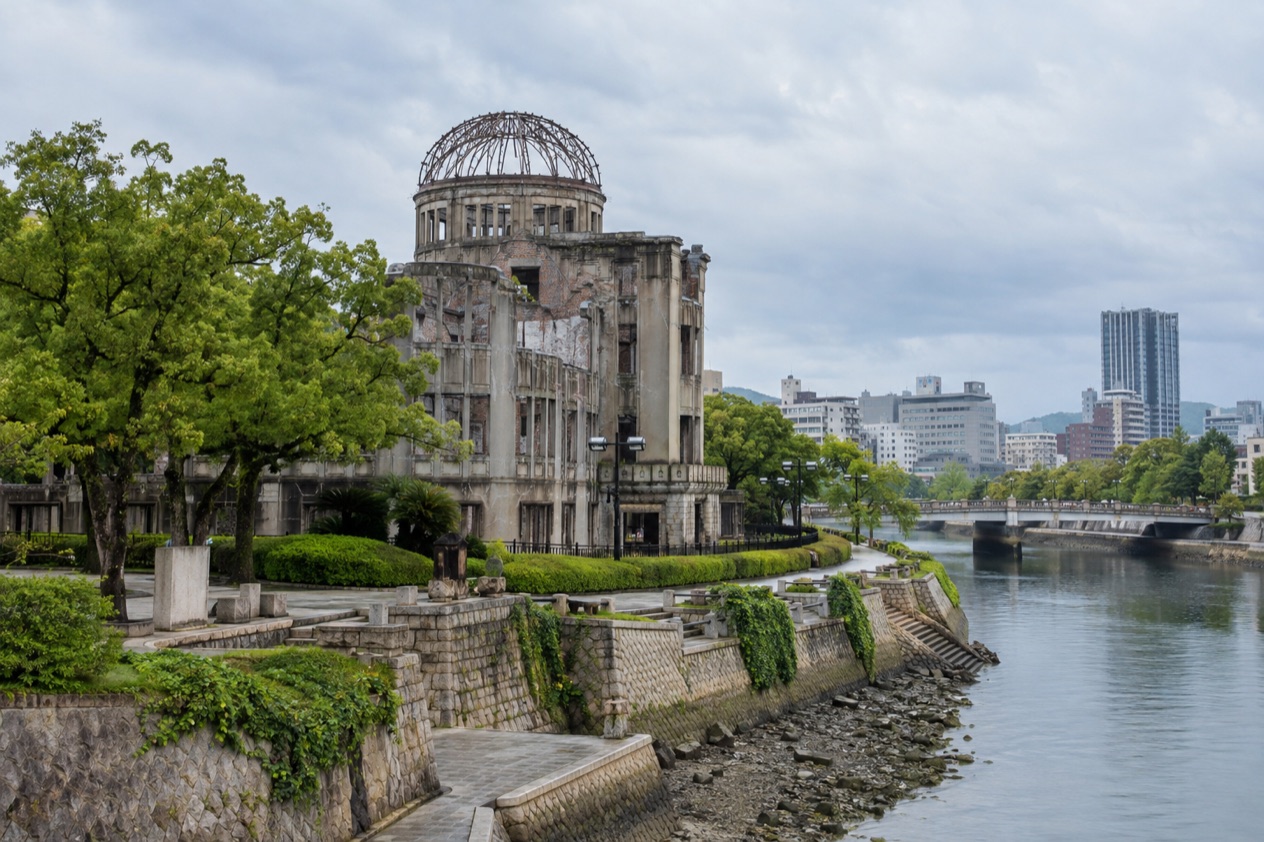
In June, Hiroshima’s wide boulevards shine after a shower, and the rivers that split the city into delta islands run full and green under a soft gray sky. Streetcars rattle past umbrellas, and the griddles in the okonomiyaki restaurants are hissing by lunchtime. It is the month of the rainy season, a time for museums, shrines and long meals, with the warm light of summer arriving between the clouds.
What is the weather like in Hiroshima in June?
June in Hiroshima is warm, humid and noticeably wetter than May, with the rainy season settling over the city and the first real taste of summer heat arriving in between the showers.
| Month | Average high (°F) | Average low (°F) | Precipitation (in) | Days with 1 mm or more of precipitation | Hours of sunshine | Daylight on the 15th |
|---|---|---|---|---|---|---|
| May | 75.9 | 59.2 | 6.69 | 8.6 | 211 | 13 h 56 min |
| June | 81.0 | 67.6 | 8.92 | 10.7 | 155 | 14 h 26 min |
| July | 87.6 | 75.4 | 11.02 | 10.6 | 173 | 14 h 15 min |
Afternoons are warm enough for short sleeves, and the humidity, which sits above 70 percent, makes walking feel heavier than the thermometer suggests. Evenings stay mild, so you can eat outside or stroll along the riverbanks without a jacket. A light layer is only useful inside, where air conditioning runs strong in trains, museums and shopping arcades.
Rain in June tends to come as a run of gray, damp days with some heavier downpours rather than one long storm, and the month still has plenty of sunshine in between. A compact umbrella or a light rain jacket earns its place in the bag every day. Shoes that dry quickly help, since the wide pavements of the city center turn into shallow puddles in a heavy shower.
The light is long. Daylight stretches well into the evening, which leaves time for a late visit to the Peace Memorial Park or a slow dinner after the clouds have cleared. The city sits on the coast of the Seto Inland Sea, and the moist air off the water is part of why the month feels so sultry.
What to do in Hiroshima in June
June is the month of hydrangeas in Japan, and the rainy season suits them: the flowers look their best in wet weather, with blue, violet and pink heads glistening along temple paths and in parks. Hydrangea species are native to Japan, and the leaves of one of them, Hydrangea serrata, are used to make ama-cha, a sweet herbal tea. Rain does not cancel the city, it slows it down, and Hiroshima has plenty of places that reward a slow pace.
The city is a place of wide boulevards and criss-crossing rivers, and on a damp day the water gives every view a silvery edge. Streetcars run through the center, and the local company, known as Hiroden, has earned the nickname The Moving Streetcar Museum for its mix of trams built across Japan and Europe. Riding one is a sightseeing activity in itself, with the rain tapping on the windows.
Peace Memorial Park and the Atomic Bomb Dome
The park is the emotional center of any visit. On August 6, 1945, at 8:15 a.m., the first atomic bomb used in war fell on Hiroshima, and the Genbaku Dome, the only structure still standing near the hypocenter, remains as it was left. The Dome and the adjacent park are two UNESCO World Cultural Heritage sites in Hiroshima.
Inside the park you find many monuments, among them the Children’s Peace Monument and the Hiroshima National Peace Memorial Hall for the Atomic Bomb Victims. The word hibakusha, meaning people affected by the bomb, appears throughout, and the testimonies give the place its weight. In June, the damp air and the green of the trees along the river make the walk quiet in spirit, whatever the weather does.
Allow a slow morning or afternoon for it, and plan the museum for the wettest part of the day. The park is open ground, so an umbrella is more useful than a poncho when you move between monuments. The long June evenings leave time to return to the riverbank when the rain stops.
Miyajima and the floating torii
An excursion to Miyajima Island is the classic outing from Hiroshima, and it is on the list of notable places for the city for its deer and its floating shrine. At Itsukushima Shrine, a red torii gate stands in the sea, and the shrine’s walkways and halls look especially atmospheric under low cloud or a light drizzle.
On the island, the deer wander among visitors, and the wooded mountains behind the shrine turn deep green in the rainy season. Expect to spend most of a day, with time for the shrine, the lanes of the village and a snack as you walk. Bring a rain layer, since the shoreline offers little cover between sights.
Okonomiyaki, the local way
Hiroshima’s version of okonomiyaki is the dish to eat here: a savory pancake built in layers on a hot griddle, with cabbage, noodles, egg and a sweet-savory sauce. Watching it cooked at the counter is part of the pleasure, and the warmth of the griddle suits a gray, wet June afternoon.
Plan it for a lunch or an early dinner after a morning of museums. Pair it with cold barley tea or a beer, and finish with something light, since the dish is filling. In humid weather, a hot meal at a counter, with the steam from the griddle, is a very local way to spend a rainy hour.
The prefecture also offers the Seto Inland Sea, wooded mountains and clear waters, in addition to shrines and museums, so even a rainy day has indoor and outdoor choices. Come in June for the green, the hydrangeas and the unhurried feel of a city in the rainy season.
A two-day itinerary for Hiroshima in June
Day 1 belongs to the city. Start in the morning at the Peace Memorial Park, walking past the Atomic Bomb Dome and the Children’s Peace Monument while the air is still fresher. Spend the late morning in the museum and the memorial hall, which keeps you dry if the clouds open.
At midday, head to an okonomiyaki counter for lunch. In the afternoon, ride a Hiroden streetcar along the boulevards and cross the rivers, stopping wherever a riverside path looks inviting. Come back to the river at the end of the day, since daylight lasts well past dinner time at this point in the year.
Day 2 is for Miyajima. Go in the morning to see the red torii gate standing in the sea and walk through Itsukushima Shrine, then wander the village and meet the deer. Eat something simple on the island at midday and use the afternoon for the wooded paths or the shops.
If the rain turns heavy, the shrine’s covered corridors and the village’s indoor stalls are the places to wait it out. Return to Hiroshima in the evening for a relaxed dinner at an izakaya, the casual pub where small plates arrive one after another.
Is Hiroshima busy in June?
June is the rainy season, and that sets the pace of the city, with fewer people lingering outdoors and more of the day spent in museums and restaurants. The heavy flow of visitors that comes with cherry blossoms in spring and with the August 6 ceremony in summer is not what defines this month.
Even so, the Peace Memorial Park and Miyajima remain the places everyone wants to see, so they have visitors in every month. What changes in June is the mood: umbrellas replace sunhats, and the rivers and the park feel hushed. Hotels and tables are as available as they are in any other month, and the city runs on its usual rhythm.
The long light helps spread the day. You can see the park in the morning, eat late, and still have time for a riverside walk at the end. Showers make people duck indoors in waves, and the sights empty and fill as the clouds come and go.
What to pack for Hiroshima in June
Pack for warm, damp days and an hour or two of rain, with clothes that dry quickly and layers for cool interiors.
- A compact umbrella, for showers along the park paths and the boulevards.
- A light rain jacket, for the ferry-side walkways and shrine grounds on Miyajima.
- Breathable short-sleeved shirts, because humidity makes the warm afternoons feel heavy.
- Shoes that dry quickly, for wet pavements and puddles.
- A thin cardigan, for air-conditioned museums and trains.
- A small towel, for wiping off after a downpour.
Good to know before you go
June falls in the rainy season, and the humidity climbs along with the temperature. Keep one indoor option ready for each day, whether the museum, a covered arcade or a counter lunch. Honshu summers are described as very humid, hot and sultry, and June is the first taste of that, with heat that builds through July.
The long June days give a cushion for rearranging plans, so a shower in the morning does not have to ruin the afternoon. Miyajima is the one outing where weather matters most, since the shrine and the torii are best seen when you can stand outside and look.
Hiroshima in June vs May and July
Moving the trip four weeks earlier to May brings drier, sunnier days, with far more hours of sun and noticeably less rain. If you want to trade humidity for brightness, May is the move.
Moving four weeks later to July brings more heat, more rain and heavier air, with highs well into the upper 80s and nights that stay warm. The sky opens up a little more than in June, but the city feels hotter and stickier. July suits travelers who accept summer’s weight and want to be in town as August approaches.
Choose May if you want sunshine and comfortable walking, July if you are drawn to a hotter, greener summer, and stay with June if the hydrangeas, the rain-washed boulevards and a slower city are the point of the trip.
Is June a good time to visit Hiroshima?
Yes, for travelers who like a green, damp, unhurried city and who plan around the rain rather than against it. June suits museum-goers, food lovers and people drawn to hydrangeas and soft light, and it works for anyone who sees a rainy afternoon as a good excuse for okonomiyaki.
It is a weaker fit for people who want long, dry days outdoors or who dislike humidity. They should look at May instead. On arrival, start with the Peace Memorial Park, since it anchors the rest of the visit, and keep the Miyajima day for the best-looking sky of your stay. What stays with you from June in Hiroshima is the river city under a wet sky, the Atomic Bomb Dome framed in green, and a hot griddle at lunchtime while the rain taps on the window.
Sources
- Japan Meteorological Agency (JMA), Normal values 1991-2020, monthly (https://www.data.jma.go.jp/stats/etrn/view/nml_sfc_ym.php?prec_no=67&block_no=47765), station Hiroshima, elevation 4 m, checked October 11, 2026
- Computed from the date and the latitude of the place (sunrise equation, solar elevation -0.833 degrees), October 11, 2026
- Japan National Tourism Organization, weather and seasons in Japan (https://www.japan.travel/en/plan/weather/), checked October 11, 2026
- Wikipedia, Climate of Japan (https://en.wikipedia.org/wiki/Climate_of_Japan), checked October 11, 2026
- Japan National Tourism Organization, flowers by season: cherry blossom, plum, wisteria, hydrangea, where and when (https://www.japan.travel/en/see-and-do/flowers/), checked October 11, 2026
- Wikipedia, Hydrangea (https://en.wikipedia.org/wiki/Hydrangea), checked October 11, 2026
- Japan National Tourism Organization, summer in Japan (https://www.japan.travel/en/guide/summer-guide/), checked October 11, 2026
- Wikipedia, Hiroden (https://en.wikipedia.org/wiki/Hiroden), checked October 11, 2026
- Wikipedia, Hiroshima (https://en.wikipedia.org/wiki/Hiroshima), checked October 11, 2026
- Wikivoyage, Hiroshima (https://en.wikivoyage.org/wiki/Hiroshima), checked October 11, 2026
- Japan National Tourism Organization, Hiroshima (https://www.japan.travel/en/destinations/chugoku/hiroshima/), checked October 11, 2026
To plan your stay
- Things to Do in Hiroshima: Peace Memorial Park, Miyajima, Okonomiyaki and Day Trips
- Where to Stay in Hiroshima: Peace Park, Station Area, Castle District and Miyajima Island
- Hiroshima from Osaka: Shinkansen, Local Trains and a Day at the Peace Park
- Know Before You Go to Hiroshima: Entry, Money, Getting Around and Local Etiquette