
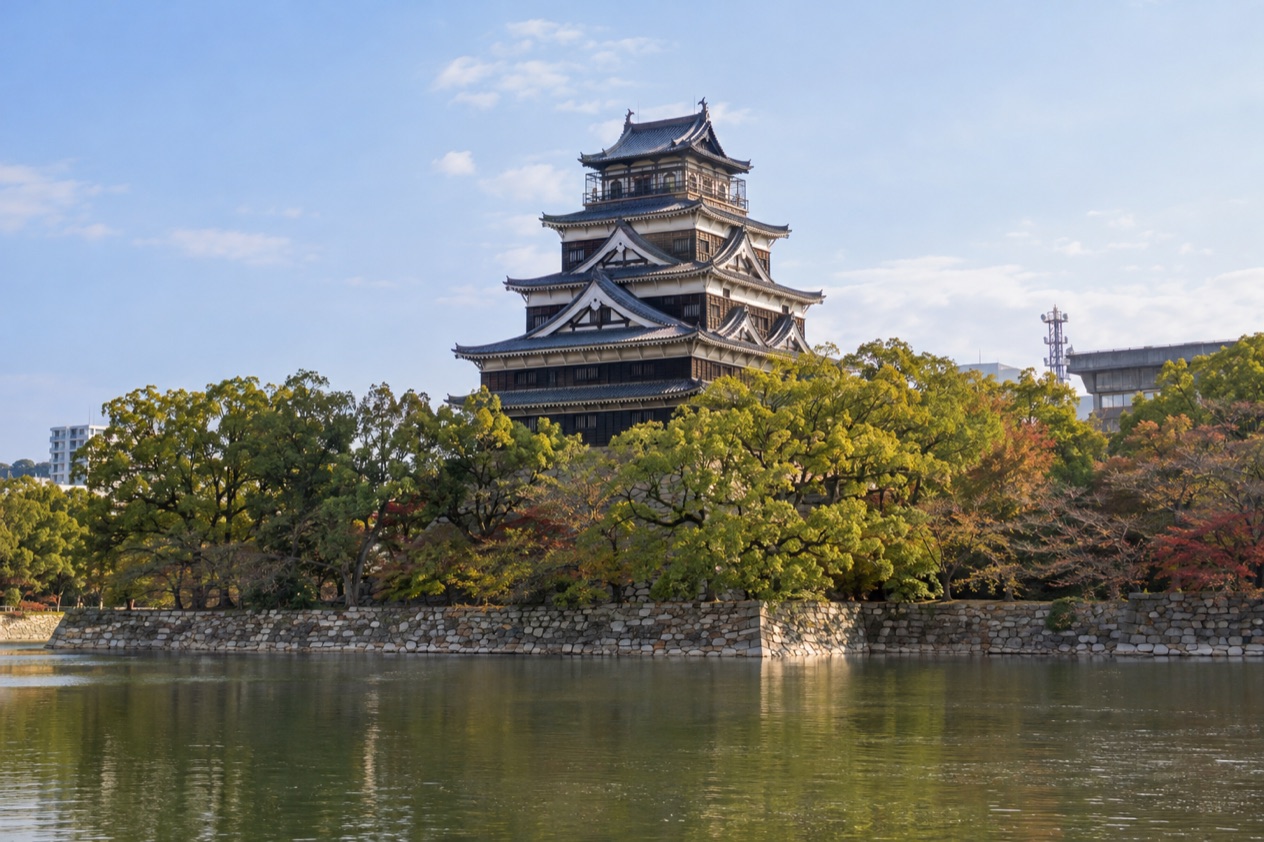
A dark five-story keep rises behind a wide moat, its white walls and dark upper levels reflected in the still water, with old trees leaning over the stone base. Walking in across the bridge, you pass through a wooden gate and the quiet of the grounds takes over from the city traffic outside. This is a visit built around history: a castle that was lost in 1945 and rebuilt, set in the middle of modern Hiroshima.
Is visiting Hiroshima Castle worth it?
Yes, for anyone who wants to understand Hiroshima before and after the atomic bombing, and who likes castle grounds with a story more than a long list of sights. It suits history-minded travelers, families who enjoy a museum inside a keep, and anyone building a day in the city around the Peace Memorial Park and the Atomic Bomb Dome.
What makes it different from other castles you may visit in Japan is that the keep you see is a replica, and the story of why is the heart of the visit. The original was built between 1589 and 1599 by Mōri Terumoto, and it was destroyed by the atomic bombing on August 6, 1945.
The keep that stands today was rebuilt in 1958, and it now serves as a museum of Hiroshima’s history before World War II. So the castle gives you the other half of the city’s story: not only the day everything changed, but the city that existed before it.
The castle is sometimes called Carp Castle, or Rijō, a nickname that gives the place a friendlier face than its history might suggest. Its official website is rijo-castle.jp, and it is the source for anything you want to confirm before you go.
Other places in Hiroshima will fill your day with more weight, notably the Atomic Bomb Dome and the Peace Memorial Park, both UNESCO World Cultural Heritage sites. The castle sits comfortably alongside them.
It gives you a pause among trees and water, and a way to see the same city from an earlier century. If you are heading out to Miyajima Island for its deer and its shrine with a red torii gate standing in the sea, the castle also pairs well with a day in the city itself.
If you only have time for the memorial sites, you will still understand Hiroshima. With the castle added, you understand what the city lost and what its people chose to rebuild, which is a different and fuller picture.
What to see at Hiroshima Castle
The grounds are laid out around moats, stone walls and a few reconstructed buildings, and each part tells a piece of the same story of loss and rebuilding.
The reconstructed main keep
The keep is the image everyone comes for: five stories tall, standing 26.6 meters above a stone base that is itself 12.4 meters high. It was rebuilt in 1958 as a replica of the original, after the atomic bombing destroyed the first one on August 6, 1945. From outside, look at how the white walls and darker upper levels stack above the heavy stone, and at the way the moat doubles the whole shape in the water.
Inside, the keep works as a museum of Hiroshima’s history before World War II. That framing matters: the displays are about the city that existed before the bomb, so you walk through the castle town’s past rather than through the events of 1945. It is a good complement to the memorial museums elsewhere in the city, which tell the other part of the story.
The wooden gate and yagura of the ninomaru
In 1994, a gate and three yagura (turret-like defensive buildings) in the ninomaru, the outer enclosure, were reconstructed out of wood using original methods. They are a quieter contrast to the concrete-built keep, and they reward a slower look. Notice the timber, the joinery, the plaster walls and the way the roofs sit against the sky.
Walking through the gate is also a good way to feel the scale of the old castle. The ninomaru was part of a defensive layering of moats and walls, and standing inside the reconstructed buildings gives you a sense of how a visitor, or an attacker, would have moved through the site.
The concrete bunker in the Honmaru
Inside the Honmaru, the inner enclosure, stands a concrete bunker with a particular place in the city’s story: it is where the first radio broadcast out of Hiroshima after the atomic bombing was made. It is a plain structure, and that plainness is the point. It shows how quickly the castle ground, a symbol of the old city, became a place of emergency communication.
Visitors walk past it without noticing. Give it a few minutes, read what is posted nearby, and consider how it sits against the reconstructed keep a short distance away: one structure from 1945, one from 1958, both on the same ground.
Hiroshima Gokoku Jinja
Within the innermost moat is Hiroshima Gokoku Jinja, a Shinto shrine that was moved there after 1945. The shrine adds a different mood to the grounds: a place of quiet ritual among the castle walls, with the usual shrine features such as a torii gate and a purification basin at the entrance.
If you have not visited a Shinto shrine before, this is a gentle introduction. Pause at the gate, look at the offering area, and watch how local visitors approach it. It also gives the castle grounds a living side, since the shrine is still a place of worship rather than a display.
When to visit Hiroshima Castle
The grounds are an outdoor visit, so the season shapes the experience more than anything else.
| Month | Average high (°F) | Average low (°F) | Precipitation (inches) | Days with rain or more (1 mm) | Sunshine (hours) |
|---|---|---|---|---|---|
| January | 49.8 | 35.6 | 1.82 | 5.5 | 139 |
| April | 67.6 | 50.2 | 5.55 | 8.8 | 192 |
| July | 87.6 | 75.4 | 11.02 | 10.6 | 173 |
| October | 74.7 | 58.8 | 4.30 | 6.2 | 179 |
October is a comfortable month for walking the moat and the grounds: afternoons in the mid-70s, cooler evenings, and a fair number of sunny hours. Rain comes on a handful of days, usually in showers rather than a whole gray week, so a light layer is enough.
April brings mild days in the upper 60s with cool mornings. It is also wetter than October, with rain on most weeks, so a small umbrella is a sensible companion. The castle grounds have trees along the moat, and spring is a pleasant season to be among them.
July is hot and humid, with highs in the upper 80s and the heaviest rainfall of the four months shown. A visit then is best planned around the weather: bring water, take your time in the shade of the trees, and let the museum inside the keep be your break from the heat.
January is cold, with highs near 50 and lows just above freezing, and snow or sleet falls on some days. The grounds are open to the sky, so dress warmly. The reward is a calmer, cooler walk around the moat with the keep standing out against winter light.
One date stands apart in the city: August 6. The peace ceremony that day is centered on the memorial sites, where thousands of people write messages on lanterns that are lit at sunset and floated along the river in front of the Atomic Bomb Dome. If you visit the castle around then, it is a natural part of a day that is, for the city, a day of remembrance.
Tips for your visit
The grounds, the keep museum, the reconstructed gate and yagura, the bunker and the shrine make for a satisfying outing, and they link easily in your mind with the memorial sites elsewhere in the city.
- Wear comfortable shoes for the grounds, which include stone paths and steps around the walls and the keep.
- Bring a light rain layer in spring and early fall, water in summer and a warm coat in winter, since much of the visit is outdoors.
- Pair the castle with the Atomic Bomb Dome, which can only be viewed from the outside, and the adjacent Peace Memorial Park.
- Keep an eye on the weather if you plan a day on Miyajima Island, where the red torii gate of Itsukushima Shrine stands in the sea.
- Check the official website, rijo-castle.jp, for hours and admission before you set out.
A sensible order is to begin with the keep museum to learn about the city before 1945, then walk the grounds to see the wooden gate and yagura, the bunker and the shrine. Finish at the moat for a last look at the keep. Visiting the memorial sites afterward gives the day a natural arc from the old city to the rebuilt one.
Food is part of the day too. Hiroshima has its own version of okonomiyaki, a griddled savory pancake, which makes a good meal after a morning of history. Trains make Hiroshima reachable from other cities: by shinkansen it takes about four hours from Tokyo and 90 minutes from Osaka, so some travelers fit the castle into a longer rail itinerary.
For families, the keep as a museum and the open grounds give children room to move, and the story of a castle destroyed and rebuilt is something they can follow. For travelers who want a slower pace, the moat and the shrine are good places to sit and take in the setting.
Good to know before you go
Hiroshima Prefecture offers the Seto Inland Sea, wooded mountains and clear waters alongside its peace-related sites, shrines and museums, so the castle fits into a wider trip. Treat the grounds with the respect due to a place tied to the events of 1945, keep voices low near the shrine and the bunker, and plan for the weather of your season, since July brings the heaviest rain and the greatest humidity of the months covered here.
Sources
- Wikipedia, Hiroshima Castle (https://en.wikipedia.org/wiki/Hiroshima_Castle), checked October 11, 2026
- Japan National Tourism Organization, Hiroshima (https://www.japan.travel/en/destinations/chugoku/hiroshima/), checked October 11, 2026
- Visit Hiroshima, the official guide (https://visithiroshima.net/), checked October 11, 2026
- Japan Meteorological Agency (JMA), Normal values 1991-2020, monthly (https://www.data.jma.go.jp/stats/etrn/view/nml_sfc_ym.php?prec_no=67&block_no=47765), station Hiroshima, elevation 4 m, checked October 11, 2026
To plan your stay
- Best Time to Visit Hiroshima: Cherry Blossoms, Autumn Weather, Rainy Season and Festivals
- Where to Stay in Hiroshima: Peace Park, Station Area, Castle District and Miyajima Island
- Hiroshima from Osaka: Shinkansen, Local Trains and a Day at the Peace Park
- Know Before You Go to Hiroshima: Entry, Money, Getting Around and Local Etiquette