
PORTO AND THE NORTH · PORTUGAL’S GRANITE NORTHWEST · THE MINHO · TRÁS-OS-MONTES · THE COAST
Portugal’s north is the country’s other half: granite instead of limestone, terraced vines instead of dune grass, and an Atlantic that stays cold in August. Rain made it what it is. The Minho’s hills are green the way Ireland is green, the churches are heavy with baroque gold, the cooking leans inland and rich, and the whole region is stitched with stone bridges and roadside chapels. It is the Portugal often skipped by first-time itineraries heading for the sun, which is a good part of the reason to go.
Porto is the door. The Ribeira stacks its houses over the river, the Dom Luís I bridge carries walkers on two decks, and Vila Nova de Gaia holds the port cellars on the opposite bank. Two or three days (est.) covers the city itself: the airport sits on the metro line, the train from Lisbon arrives downtown, and every road worth driving inland starts at the ring. Which of the two big cities suits you is argued out in our Lisbon vs Porto comparison. Everything past this paragraph goes beyond the city limits.
THE REGION AT A GLANCE · PORTO AND THE NORTH
Summer is the north’s best window, the opposite of the Algarve’s calendar, and Porto works as the base for most of a first visit.
BEST: JUNE TO SEPTEMBER · GATEWAY: PORTO (OPO) · GREEN, GRANITE, ATLANTIC
Go for: port cellars in Gaia, the Bom Jesus stairway above Braga, the medieval core of Guimarães, cold-water surf beaches, and vinho verde drunk where it grows.
Think twice if: the trip needs guaranteed dry beach days. The northwest takes real Atlantic weather outside high summer, and the sea is cold in every month.
Region character: Turismo de Portugal · rail: CP · climate figures delegated to our month pages · full sources at the end
Northern Portugal, region by region: the Minho, Trás-os-Montes and the Atlantic coast
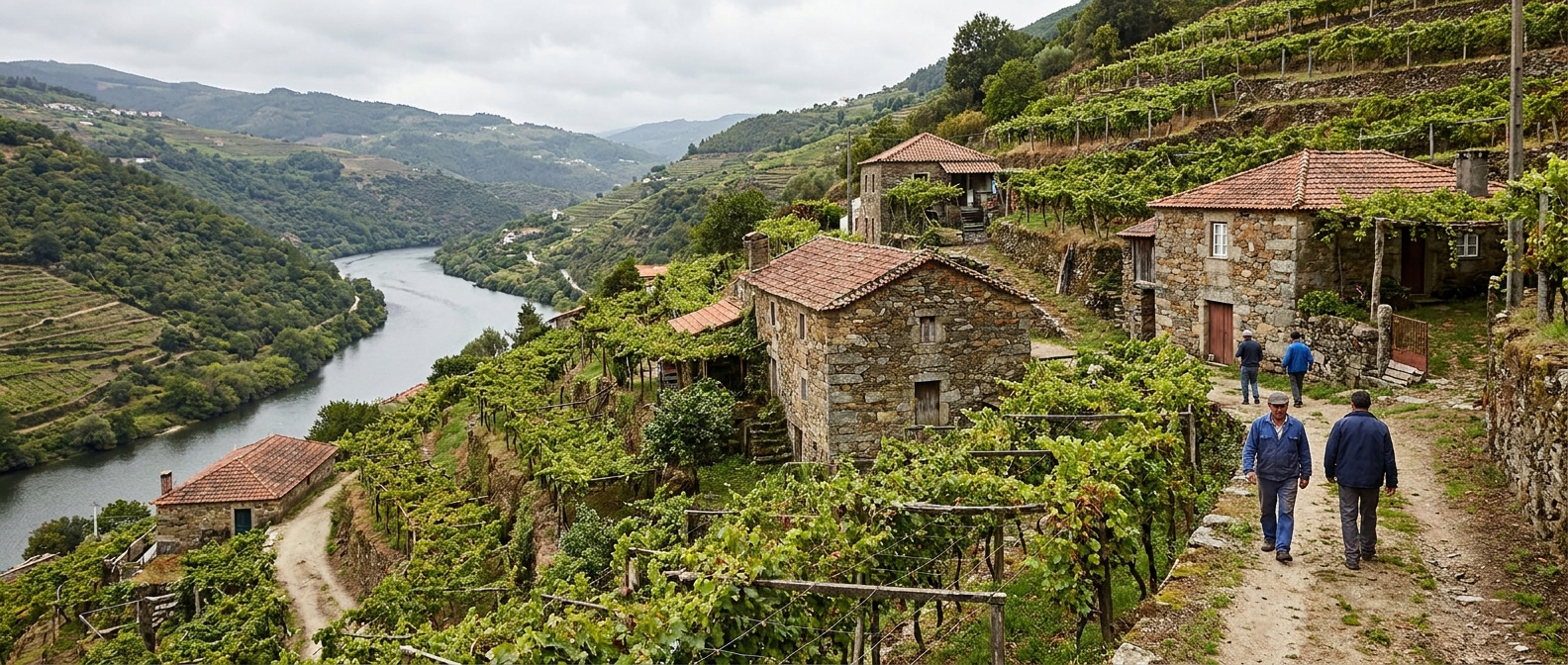
The Minho, between Porto and the Spanish border. This is the green one: granite villages, stone bridges, cornfields edged with vines trained high on wires so the fruit stays clear of the damp.
Braga and Guimarães anchor it inland and both sit on the train map. Above them, the Peneda-Gerês national park puts stone peaks, wild ponies and Roman road markers from the old Braga to Astorga route within a morning’s drive of the ocean.
Trás-os-Montes, literally behind the mountains. The plateau east of the Douro feels like the emptiest corner of mainland Portugal: schist and granite hamlets, smoked sausage and cured ham, almond and olive terraces, summers that bake and winters that bite. It costs driving hours and pays them back in roads with nothing on them. Chaves and Bragança are the practical stops, and the whole plateau pairs naturally with the upper stretch of the Douro Valley.
The coast and the Douro Litoral. North of the city the Atlantic runs open and straight: Matosinhos for fish grilled outside the door, Vila do Conde and Póvoa de Varzim for beach towns with a working past, Viana do Castelo where the Lima meets the sea under a hilltop basilica. Water is cold, wind is a permanent factor, and the surf schools treat both as features. Inland from the river mouth, the Douro Litoral hands you off to vineyard country.
Where to stay in Porto and the North
| Base | What it gives you | Best for | The catch | Nights (est.) |
|---|---|---|---|---|
| Porto | River city, trains and metro, cellars one bridge away | Everyone · first and last nights | Steep streets, and the Ribeira packs tight in summer | 3 |
| Vila Nova de Gaia | Port lodges at the door, the full Porto skyline across the water | Wine tasting, quieter evenings | You cross the bridge for most dinners | 2 |
| Braga | Baroque churches, a student city that lives year-round, Bom Jesus above town | History-first travelers, Holy Week | No beach, and rain is part of the deal | 1–2 |
| Guimarães | Medieval core, castle ridge, ducal palace, all walkable | One slow night in the country’s founding town | Small enough to exhaust in a day | 1 |
| Viana do Castelo | River-mouth beaches, hilltop basilica, Minho folk tradition | Coast days, surf, families | Atlantic wind and cold water | 2 |
The shape that works: Porto for the first stretch, one night inland at Guimarães or Braga, one coast night at Viana if the forecast cooperates. Five nights covers that comfortably as an editorial call, seven if you add the Douro Valley upstream, which is a different landscape and a separate guide. Our seven-day route and ten-day route both fold the north in without a rental car for the first half.
Things to do in Porto and the North: port cellars, the Bom Jesus stairway, Guimarães and the surf coast
The port cellars of Vila Nova de Gaia. The wine is grown and pressed upriver in the Douro, then aged on the cool south bank facing Porto, which is why the tasting happens in Gaia rather than in the vineyards. Many lodges offer tours and flights of tawny and vintage, the best-known names stand within a few streets of one another, and two visits fit into one afternoon. Walk the upper deck of the Dom Luís I bridge for the approach.
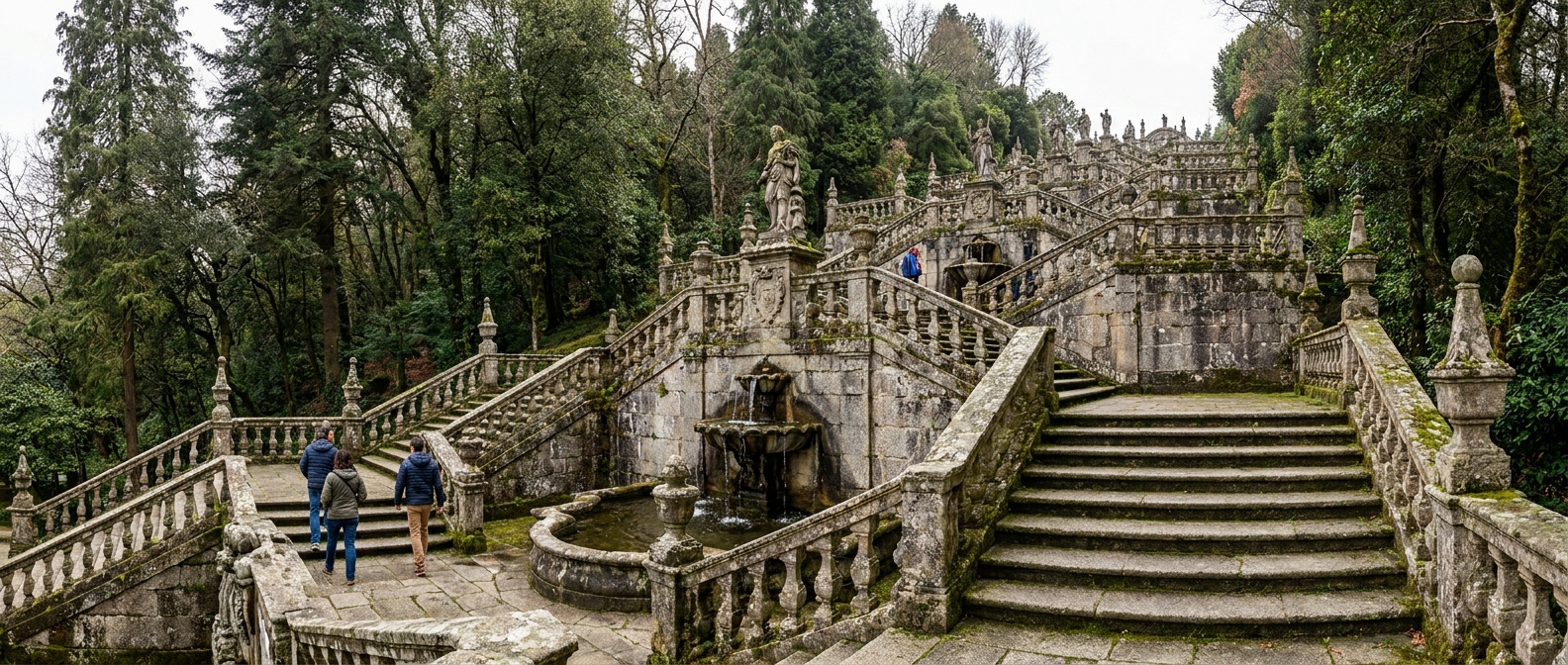
Bom Jesus do Monte, above Braga. A baroque stairway zigzags up a wooded hillside in landings, each one themed, with fountains running the whole climb. A funicular counterweighted by water carries anyone who would rather ride, and the ride is an attraction in itself. Down in town, Braga’s cathedral is among the oldest in the country, and its Holy Week processions fill the old streets each spring.
Guimarães rewards a slow half-day on foot. The UNESCO-listed old town runs on arcades, wooden balconies and small squares that empty out once the day-trippers head back to Porto. The castle on the ridge is traditionally held to be the birthplace of Portugal’s first king, and the ducal palace below it fills the rest of the morning. The tiled cafés on Largo da Oliveira handle the afternoon.
The coast asks for a wetsuit. Surf schools cluster at Matosinhos, at Esposende and at Cabedelo across the river from Viana do Castelo, which also draws windsurfers and kitesurfers. Water here runs colder than anything down south, so neoprene is standard gear rather than a precaution. Families tend to do better on the sheltered river-mouth sand than on the open beaches, a calculation our Portugal with kids guide works through.
Vinho verde, and what belongs beside it. The Minho’s young white is faintly spritzy and served cold, poured by the jug in village tascas within sight of the vines it came from. Around it: Porto’s francesinha, salt cod in its many treatments, caldo verde, and the smoked meats of the plateau. Come at harvest and the valleys turn into a worksite, a season covered in our Douro harvest guide.
On this page
- Port tasting without leaving the cityVila Nova de Gaia, across the bridge
- Baroque churches and a stairway climbBraga and Bom Jesus
- Medieval streets, castle, ducal palaceGuimarães
- Cold-water surf and river-mouth beachesViana do Castelo and the coast
- Granite peaks, stone villages, Roman markersThe Minho and Peneda-Gerês
- Terraced vineyards one valley upstreamThe Douro Valley
- Just hand me the routeSeven days, day by day
Not for: a guaranteed beach week. The northern Atlantic stays cold and moody in every month, and the dependable sun sits at the other end of the country, in the Algarve.
What a trip to Porto and the North costs
Think in three tiers rather than figures. Lean means a guesthouse in Braga or Guimarães, lunch at the counter, trains between towns. Middle buys a boutique room near the Porto riverfront, one serious dinner a day and a car for the Minho leg. High is the design hotel in Gaia or a wine estate upstream. How the north lines up against Lisbon and the southern coast is priced out, with sources and dates, in our Portugal trip cost guide.
Two levers move a northern total more than any booking trick. The calendar comes first, because summer is when everyone wants this region and the coast towns know it.
Where you sleep comes second: an inland night at Guimarães or Braga sits in a different market from a river-view room in Porto. (Tiers here are relative signals, not quotes.)
Northern Portugal by month: best time to visit
| Months | What the north is doing | Sourced numbers |
|---|---|---|
| Jan–Feb | Wet and green, cellars and churches do the work | February |
| Mar–Apr | Bright spells between fronts, camellias, Holy Week in Braga | April |
| May | Hills at their greenest, terraces and river cafés open up | May |
| Jun | Midsummer festival season, long light on the Ribeira | June |
| Jul–Aug | Driest and warmest stretch, coast towns at their busiest | August |
| Sep | Harvest in the valleys, sea at its least cold | September |
| Oct | Vine leaves turning, Atlantic fronts back in the forecast | October |
| Nov–Dec | Short days, wet granite, lit streets, low season indoors | December |
That table is qualitative on purpose. Temperatures, rain days and the crowd curve for the north live on the month pages and in our month-by-month guide, where every figure carries a source and a date. Reading them beside the southern columns is the fastest way to see how differently the two ends of the country behave.
The northern calendar runs against the southern one. In the Algarve the trick is dodging high summer, while up here summer is the payoff: dry granite, long evenings, festivals in the squares, hillsides you can actually walk.
The shoulder months that flatter the south send Atlantic fronts across the Minho instead. Winter visitors still get a real trip, built on cellars, cathedrals, soup and quiet streets, just not a beach one.
Getting to Porto and around the north: the Lisbon train, the airport metro and car rental
Porto’s airport (OPO) links to several major European hubs and carries transatlantic service in season, and the metro runs from the terminal into the city, so arrival needs no car at all. From the capital, the fast train is the civilized move, station to station, with no airport security in the middle of a short country. Services, ticket types and timings sit in Getting Around Portugal, and the open-jaw trick (in through Lisbon, home from Porto) is laid out in our country guide.
Rail reaches the towns most visitors want first: Braga, Guimarães and Viana do Castelo all sit on lines out of Porto. A car earns its keep elsewhere, in the rural Minho, in Peneda-Gerês and across Trás-os-Montes, where the villages are the point and bus timetables are theoretical. Automatics, boothless tolls and mountain-road habits are covered in Renting a Car in Portugal. Collect the keys on the morning you leave Porto, not on the day you land.
The last word
Travelers who never head south trade warm water for something less photogenic and more layered: a countryside of wet granite, cloudy wine poured cold, and churches built to impress a region rather than a court. Stand on the upper deck of the Dom Luís I bridge at dusk, lodge signs coming on across the water in Gaia, and the case makes itself.
Then go inland the next morning. The Bom Jesus stairway climbs into fog about as often as into sunlight, and the arcades of Guimarães hold up perfectly well in rain. Pack the jacket, keep one afternoon unplanned for a Minho market, and take the north on its own terms.
Sources & data for this guide
- Region character, towns and itineraries · visitportugal.com (Turismo de Portugal) · checked Sep 14, 2026
- Historic centers of Porto and Guimarães, World Heritage listings · UNESCO World Heritage List · checked Sep 14, 2026
- Rail service to Braga, Guimarães and Viana do Castelo, and Lisbon to Porto fast trains · CP Comboios de Portugal · checked Sep 14, 2026
- Airport connections and the metro link into the city · ANA / Porto Airport · checked Sep 14, 2026
- Peneda-Gerês national park, trails and Roman road markers · ICNF (Portuguese nature and forest institute) · checked Sep 14, 2026
- Editorial note: this page carries no temperature, rainfall or price figures on purpose. Those numbers live on the month-by-month guide, the individual month pages and the trip cost page, where they are sourced and dated. Night counts here are editorial recommendations marked (est.), not measurements.