
PORTO AND THE NORTH · FEBRUARY · 41.2° N
February in Porto is a coat month with an ocean attached. The average afternoon reaches 59.0°F, rain falls on ten days out of twenty-eight, and by the middle of the month the sun is up for 10 hours 41 minutes. The granite darkens with every shower and dries pale by three, the Douro runs full under the bridges, and the cellars across the water are the warmest rooms you will stand in all week.
Against January, the deal is drier: 3.85 inches of rain instead of 5.94, and nearly three fewer wet days. Against March, February gives up 3.6°F of afternoon warmth for almost nothing in return on the rain. If you are still choosing between months for the whole country, our best-time guide runs all twelve; what follows the calendar here is one date and what it costs you.
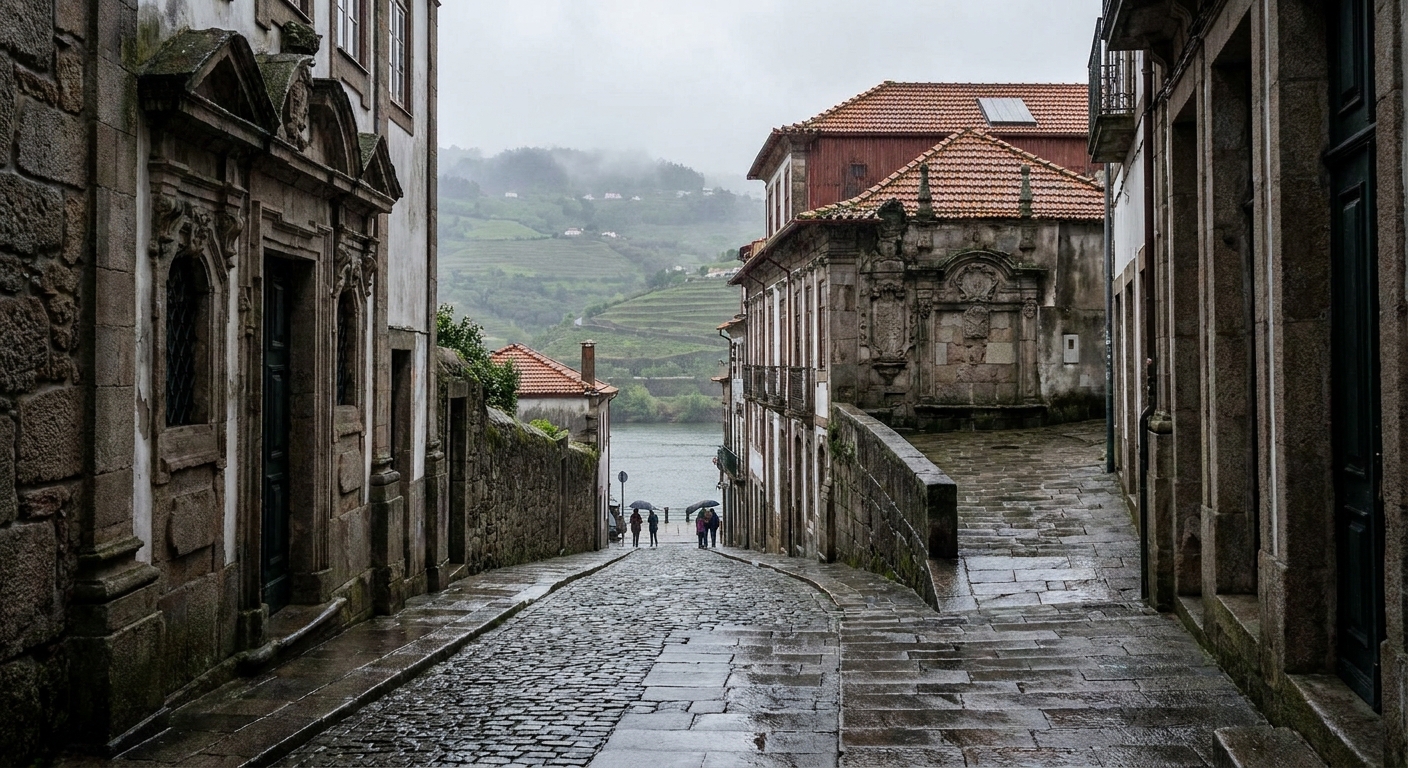
THE MONTH AT A GLANCE · PORTO AND THE NORTH
February gives Porto 59°F afternoons, 3.85 inches of rain spread over ten days and 10h41m of light by mid-month, which is enough for a city trip built on cellars, museums and one bright walk a day.
AVERAGE HIGH 59.0°F · 10.0 RAIN DAYS · 10H41M OF DAYLIGHT ON FEB 15
Go for: the port lodges of Vila Nova de Gaia, Porto’s indoor hours in the city itself, and inland days at Braga and Guimarães.
Think twice before: booking a walking week in the Douro or the uplands on these figures. They are measured at the coastal airport, and high ground runs colder and far wetter.
Normals: IPMA station 545, Porto Pedras Rubras · Daylight: sunrise-sunset.org · full sources at the end
On this page
- Porto weather in February59.0°F days, 3.85 inches of rain
- How cold the nights getAn average low of 44.2°F
- Crowds, prices and the city taxWhere February sits in the year
- What to do when it rainsGaia’s cellars, Braga, Guimarães
- A two-day plan for 10h41m of daylightThe February itinerary
- February vs January and MarchHow the three months compare
- Should I shift to March?Our verdict on February
One warning before the numbers start. Every figure here is measured at Porto Pedras Rubras, the airport station on the coast, 67.7 m above sea level. The north is not one climate: the upper Douro and the high ground toward the Spanish border run colder in winter and a great deal wetter. For the city and its river, this is the right thermometer. For a mountain trail, treat it as a starting point and pack colder.
Porto and the North weather in February: average highs, lows and rain days
| February at Porto Pedras Rubras | Normal, 1991-2020 |
|---|---|
| Average high | 59.0°F (15.0°C) |
| Average low | 44.2°F (6.8°C) |
| Precipitation | 3.85 in |
| Days with 0.04 in or more | 10.0 |
| Days with 0.39 in or more | 3.3 |
| Daylight on Feb 15 | 10h 41m (7:28 am to 6:09 pm) |
These come from IPMA, Portugal’s national weather service, and specifically from its 1991-2020 normals for station 545 at Porto Pedras Rubras: a real thermometer at 67.7 m by the coast rather than a model grid cell averaged over miles of landscape. February’s average high is 59.0°F (15.0°C), its average low 44.2°F (6.8°C), and its precipitation normal 3.85 inches.
Ten days in an average February record at least 0.04 inch of rain, and 3.3 of those reach 0.39 inch or more. Those are IPMA’s own thresholds, lower than the 0.10 inch that American tables use, so the counts do not swap across borders. Translated into a week on the ground: something wet on roughly one day in three, one genuine soaking a week, and a good many days when a hood settles the matter.
Between the 44.2°F night and the 59.0°F afternoon there are 14.8 degrees, a gap one mid-weight layer handles at both ends of the day. Water is the part clothing has to solve. A shell with a hood beats an umbrella on a riverfront where the wind comes straight off the Atlantic, and a second pair of shoes matters more in February than any other thing in the bag. We lay out the rest in our packing guide.
On February 15 the sun rises at 7:28 am and sets at 6:09 pm local time, Portugal staying on UTC through the winter. That makes 10 hours 41 minutes of daylight: breakfast happens in a half-lit city, and the light has gone before dinner anywhere in the north. Put the outdoor half of the day before 4 pm and keep the museum, the cellar or the long lunch for after it.
How cold does Porto and the North get in February?
February sits between 44.2°F and 59.0°F, both figures averaged across the whole month at the airport station. That afternoon number is 1.8°F above January’s 57.2°F and 3.6°F below March’s 62.6°F, so the month is one step up a slow slope rather than a change of season. Individual days swing either side of the average, and the Atlantic keeps the swings smaller on the coast than inland.
In practice you dress for the morning and carry what you shed. At 8 am on the river a mid-44°F chill with damp air asks for gloves in the first hour. By 3 pm on a clear day, 59°F in direct sun on the Gaia bank is sweater weather and nothing more. Hotel rooms and cellars sit at opposite ends of that experience, and the coat spends half the afternoon over an arm.
The IPMA monthly normals we read carry no count of frost nights, so we give none. The average low of 44.2°F sits about 12 degrees above freezing at a coastal station, while the upper Douro and the uplands get colder nights than that. We also found no sea-surface temperature series for this stretch of coast, so we publish no water figure. Where one is quoted elsewhere, check whether it is an average of daily maxima, which runs a touch warmer than a 24-hour mean.
How busy is Porto and the North in February? Crowds, prices and the city tax
February falls in the middle of the low season, after the New Year traffic and before the Easter build-up. That is a calendar fact, not a price reading. We found no occupancy series and no monthly hotel-rate series for Porto or the north, so we crown no month cheapest and quote no nightly average. What we can say about money is limited to what somebody publishes.
Without a rate series, booking advice stays structural. Confirm with the property that heating is included and actually running in February, read the cancellation terms before the photographs, and keep one night flexible if you plan to add the Douro, since the valley and the coast can want different jackets on the same day. For what a week in the country costs across three tiers, our trip-cost guide does that arithmetic.
We could not verify whether Porto or the northern municipalities are charging a tourist tax this year, nor at what rate, so no percentage and no per-night amount comes from us. Ask the property to state any city tax in writing when you book, per person and per night, and to say whether it is already inside the quoted price or collected separately.
One budget line changes February more than any other, and it is the address. A room in the Baixa or just above the Ribeira means a squall costs you a block of walking and the indoor fallback is minutes away in any direction. The same money spent on a bigger room further out buys you a wet tram ride twice a day. Our where-to-stay guide takes the areas one by one.
Things to do in Porto and the North in February: port lodges, Braga and Guimarães
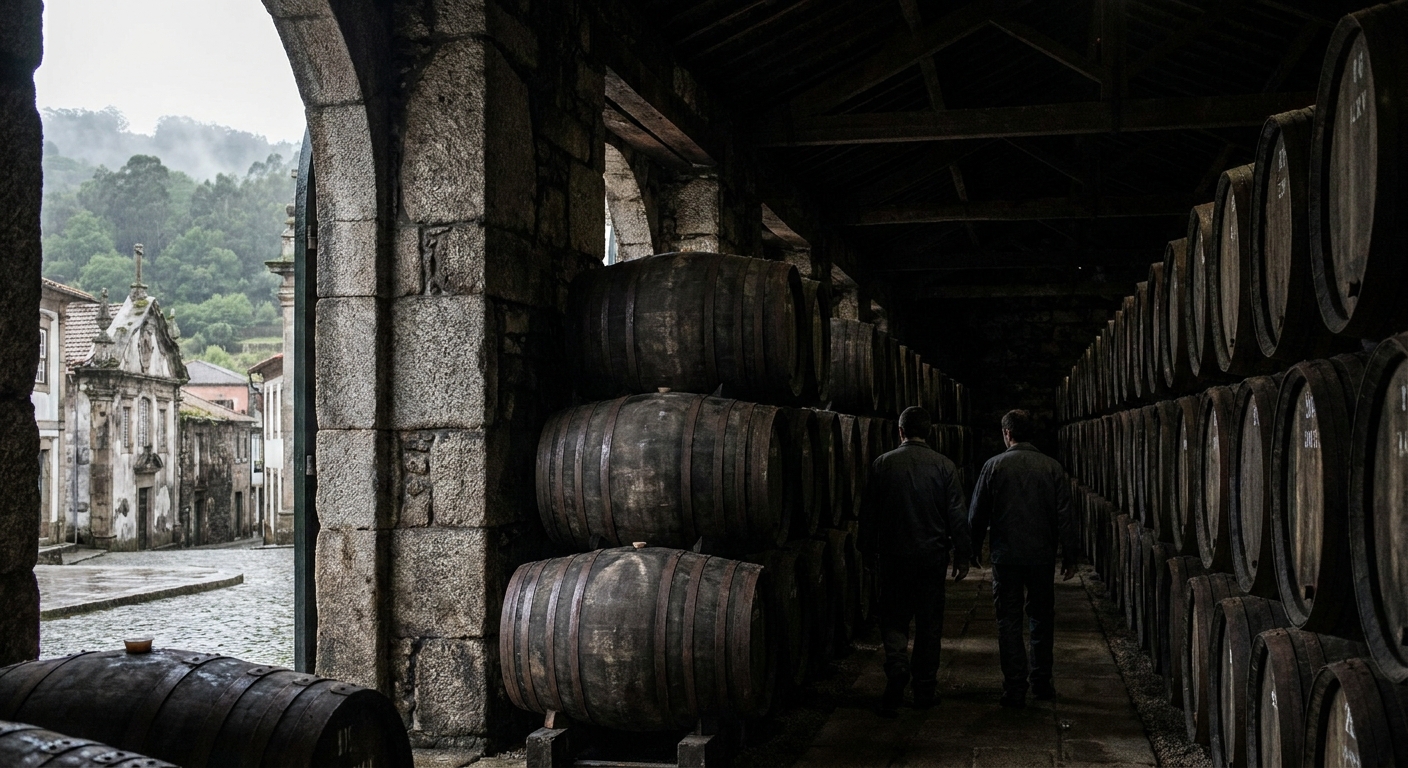
February lets the interiors lead without wasting the outdoors. At 59.0°F you can walk the city all day in a coat, which is not true of the high ground behind it, and with ten wet days on the calendar an indoor spine plus one bright walk is a plan rather than a compromise. The low sun also sits where photographers want it for most of the short afternoon.
The indoor anchors are easy to name. Across the Dom Luís I bridge, the port lodges of Vila Nova de Gaia run tours and tastings in their cellars. In the city, Livraria Lello, the Bolsa Palace, the Soares dos Reis museum and Serralves fill a rainy afternoon apiece. Inland, Braga has its cathedral and the Bom Jesus staircase, Guimarães its castle and ducal palace. Check February hours and admission for each directly before you go.
What the month changes is not the cellars, it is the air outside them. A Gaia lodge holds the same cool, still temperature in August as in February. The difference is the 44.2°F morning you walk in from and the 59.0°F you step back into, which is why a winter tasting feels warm and a summer one feels like relief. The same logic applies to a granite church: the season is in the doorway, not the nave.
We could not verify which museums in Porto, Braga or Guimarães run free admission hours this February, so we name none. Free in any month, and at their best under a low winter sun: the walk across the upper deck of the Dom Luís I bridge, the Jardim do Morro viewpoint on the Gaia side, and the Ribeira quay itself. Two of the three take ten minutes and cost nothing but a wet hem.
Porto and the North in February: a two-day itinerary
Day one stays by the river. Out at 8:30, with the light barely an hour old, cross to Gaia while the bridge is quiet and take a lodge tour in the late morning. Lunch long, because the middle of a February day is the part worth sitting through. Back over the upper deck around 2 pm for the Ribeira, the Bolsa Palace and the streets around Clérigos, and be done with the walking by 6:09 pm, when the light goes.
Day two heads inland early, to Guimarães for the castle and the ducal palace, or to Braga for the cathedral and Bom Jesus if you would rather have one town properly than two in a hurry. Our getting-around guide handles the connections. If the sky turns, keep the same day in Porto with Serralves or Soares dos Reis and push the cellar visit to the afternoon, when a tasting room is the driest room in the north.
Porto and the North in February vs January and March
| January | February | March | |
|---|---|---|---|
| Average high | 57.2°F | 59.0°F | 62.6°F |
| Average low | 43.5°F | 44.2°F | 47.8°F |
| Precipitation | 5.94 in | 3.85 in | 3.98 in |
| Days with 0.04 in or more | 12.8 | 10.0 | 9.9 |
Lined up by the same IPMA station, the three months separate cleanly. January brings 57.2°F afternoons and 5.94 inches over 12.8 wet days. February brings 59.0°F and 3.85 inches over 10.0. March brings 62.6°F and 3.98 inches over 9.9. February’s advantage over January is the water, not the warmth: 2.09 inches less rain for a gain of only 1.8°F. March’s advantage over February is warmth, 3.6°F of it, for 0.13 inch more rain in slightly fewer episodes. We have no sea temperature to add to any of the three.
Move four weeks earlier and you take on 2.09 extra inches and nearly three more wet days in a city that otherwise looks identical, which is the trade the January page sets out. Move four weeks later and you buy 3.6°F, longer evenings and a fraction more rain, plus the first stirrings of the spring calendar. Between those two, February is the version with the biggest single drop in rainfall and none of the March warmth.
Is February a good time to visit Porto and the North?
Yes for a city trip, no for a mountain one. If your Porto is granite lanes, cellars, museums, long lunches and a river you walk beside, February delivers all of it at 59.0°F with rain on about a third of the days and the low-season calendar in your favor. If your north means upland trails or three consecutive dry days on the Douro terraces, this is the wrong month, and the coastal normals flatter what the high ground will actually do to you.
If the answer came out no, March is the month to prefer: 62.6°F afternoons, 9.9 wet days, and evenings that last noticeably longer than 6:09 pm. The rain total barely moves, at 3.98 inches against 3.85, so what you are buying with the four-week delay is warmth and light rather than dryness. Our best-time guide places the rest of the year around it, and the Lisbon comparison helps if the city itself is still open to debate.
What February holds that neither neighbor does is the year’s sharpest improvement in rainfall, 2.09 inches off January, arriving while the afternoons have already reached 59.0°F.
The last word
Book the room within a block of a cellar, a museum or a covered market and February stops being a gamble on the sky. One number we have kept back to close on: divide each month’s rain by the days it falls on, and January’s wet days average 0.46 inch apiece against February’s 0.39, so January’s rain is both more frequent and heavier when it comes. February 15 hands you 10 hours 41 minutes of light for all of it. Spend the first half outside.
Sources & data for this guide
- February normals (high 59.0°F, low 44.2°F, 3.85 in) and the January and March figures · IPMA, Instituto Português do Mar e da Atmosfera, 1991-2020 normals, station 545 Porto Pedras Rubras, 67.7 m · checked Sep 24, 2026
- Rain-day counts (10.0 days at 0.04 in or more, 3.3 days at 0.39 in or more), on IPMA’s thresholds, which differ from the 0.10-inch threshold of US tables · IPMA · checked Sep 24, 2026
- Daylight on February 15, sunrise 07:28 and sunset 18:09 UTC, converted to local time · sunrise-sunset.org · checked Sep 24, 2026
- Scope: the station stands at Porto’s coastal airport; inland and upland northern Portugal is colder in winter and considerably wetter · IPMA · checked Sep 24, 2026
- We found no sea-surface temperature series for this coast, so no water temperature comes from us.
- We could not verify a municipal tourist tax rate, nor any occupancy or hotel-rate series, so we give no percentage and name no cheapest month.
- Opening hours and admission at the Gaia lodges and at sites in Porto, Braga and Guimarães are unverified by us · confirm with each operator before you go.
To plan your stay
- Things to Do in Porto and the North: Port Lodges, Bom Jesus, Guimarães, Surf and Peneda-Gerês
- Best Time to Visit Porto and the North: Weather, Rain Days and the Quiet Months
- Porto and the North in January: Weather, Rain Days and Winter Daylight
- Porto And The North in March: Weather, Rain Days, Daylight and What Changes by April