
A plate of miso katsu arrives with the pork cutlet still crackling under a dark, sweet sauce of red miso, and the table next to you is working through a bowl of hitsumabushi, grilled eel eaten three ways. Outside, the golden dolphins on the castle roof catch the light above the trees. Nagoya is a big working city of industry, shrines and its own distinct cooking, and it suits travelers who like to eat well and see Japan beyond the usual circuit.
Where is Nagoya and what is it like?
Nagoya sits on the Pacific coast in central Honshu, in the Chubu region, and it is the capital of Aichi Prefecture. It is also the largest city of Aichi and the fourth-largest in Japan, after Tokyo, Yokohama and Osaka. Around it spreads the Chukyo metropolitan area, home to about 10 million people.
The character of the place is that of a manufacturing capital with old roots. The Toyota Commemorative Museum of Industry and Technology stands in Nishi-ku and tells the story of the industry that shaped the region, while Nagoya Castle and Atsuta Shrine carry the city’s older history. You move between a modern downtown of department stores and office towers and the green grounds of a shrine within the same day.
Nagoya does not hand you one single postcard view, and that is part of its appeal. It rewards people who enjoy a city for its neighborhoods, its museums and above all its table. Nagoya-meshi, the local cooking, is a reason in itself: miso katsu, hitsumabushi, kishimen (flat, wide noodles in broth), tebasaki (peppery fried chicken wings) and ankake spaghetti in a thick, peppery sauce.
Travelers who want a single dramatic landscape or a town made of old wooden lanes may find Nagoya more matter-of-fact than they expected. Those who like to dig into a place, taste regional dishes and go to a museum devoted to how things are made will feel at home. It also works as a base for a longer trip across the Chubu and Kansai regions.
What is there to do in Nagoya?
Nagoya is known for four landmarks: Atsuta Shrine, Nagoya Castle, Higashiyama Zoo and Botanical Gardens, and the Port of Nagoya Public Aquarium. Around them sit a museum of industrial history, a Legoland and a food scene with its own vocabulary. What sets the city apart from its neighbors is how much of it is built around ordinary working life and regional appetite rather than a single historic district.
Nagoya Castle
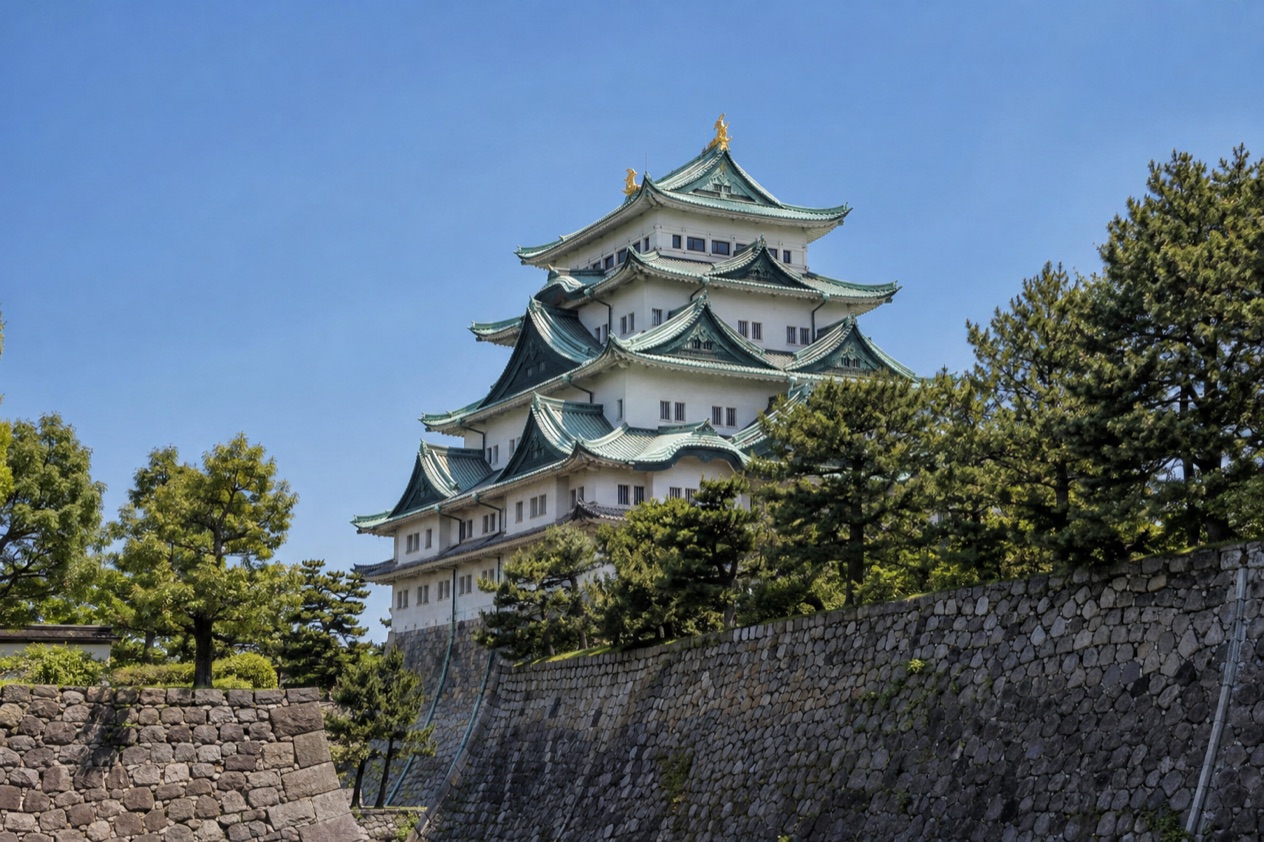
Tokugawa Ieyasu built Nagoya Castle in 1612, and a large part of it burned down during the Pacific War. The castle was restored in 1959. What you see today is a reconstruction on the old stone base, with the golden shachi, the dolphin-like roof ornaments, as its signature detail.
Take your time with the grounds as well as the keep, because the castle sits in a large green enclosure and the Honmaru Palace is part of the visit. It suits history lovers and anyone who likes castle architecture, and it makes a good first stop to get your bearings in the city.
Atsuta Shrine
Atsuta Shrine dates back to around 100 AD and houses the sacred sword Kusanagi, one of the three Imperial Regalia of Japan. The sword is never shown to the public, so the visit is about the setting: the approach beneath tall trees, the main hall, the sound of gravel underfoot and the small offerings left by local worshippers.
The shrine stands in Atsuta-ku and works as a counterweight to the city’s industrial image. People often pair a visit with a bowl of hitsumabushi, since the dish is closely associated with Nagoya and Atsuta-area eel restaurants.
Toyota Commemorative Museum of Industry and Technology
Also known as the Toyota Tecno Museum, this technology museum stands in Nishi-ku. It looks at how Nagoya became an industrial center, from textile machinery to automobiles, and it is the clearest window onto the working city that surrounds the shrines and the castle.
It suits travelers curious about how things are made and anyone who has wondered what lies behind the name on so many cars. A visit gives context to the whole region, and it fits well on a day when the weather is not good for outdoor sights.
The harbor, the zoo and the park side of town
The harbor area holds the Port of Nagoya Public Aquarium and Legoland Japan Resort, which is located in Minato-ku. Higashiyama Zoo and Botanical Gardens is the green counterpart, and Chubu Electric Power MIRAI TOWER is another landmark among the city’s attractions.
The NAGOYA Sightseeing Pass is described as a great-value way to enjoy the major attractions, including the castle, the MIRAI TOWER, the aquarium and the zoo and botanical gardens. Anime fans can add Ghibli Park, which opened on November 1, 2022, to a Nagoya-area trip.
How many days do you need in Nagoya?
Two full days is a good length for Nagoya itself, and three lets the city breathe. In two days you can see the castle and its palace grounds, spend a morning at Atsuta Shrine, eat your way through the main local dishes and visit one museum, either the Toyota Tecno Museum or the aquarium.
A first day might begin at the castle, continue with a lunch of miso katsu or kishimen, and end in the shopping and dining districts around Sakae and Nagoya Station. A second day could go to Atsuta Shrine in the morning, with eel for lunch, then the Toyota museum in Nishi-ku in the afternoon. That already covers the city’s layers: its history, its faith, its industry and its food.
With a third day, add the harbor side: the aquarium, Legoland in Minato-ku and the MIRAI TOWER. Another day can go to Higashiyama Zoo and Botanical Gardens, which makes a gentler day if you have been indoors at museums. Families with children will probably want that extra time at the zoo and the harbor.
If you have more time, treat Nagoya as a base. Chubu Centrair International Airport, Japan’s third major international gateway, sits on its own island, which makes the city a practical start or finish to a trip across central Honshu.
Where to stay in Nagoya
The best base depends on what you want to see first. Nagoya is a large city with several distinct centers, and the places you will visit are spread among them: Atsuta-ku for the shrine, Nishi-ku for the Toyota museum, Minato-ku for the aquarium and Legoland, and the central districts for the castle and the shops.
Staying in the central districts around Nagoya Station and Sakae suits first-time visitors and food lovers, since restaurants serving Nagoya-meshi, department stores and nightlife gather there. It is a base for people who want to step out of the hotel into a busy commercial downtown and have the whole city within reach.
Near the castle, you trade some of that bustle for a stay close to the green grounds and the history of the city. It appeals to travelers who put the castle at the center of their trip and prefer to start the day with a walk under the old stone walls.
The harbor side in Minato-ku makes sense for families bound for the aquarium and Legoland, and for travelers who want to be close to the water. Atsuta-ku suits those who want to begin mornings at the shrine. Near Chubu Centrair International Airport, a stay can simplify an early or late flight. Prices and specific hotels vary widely, so choose the area first and the room second.
How do you get to Nagoya and get around?
Most international visitors arrive at Chubu Centrair International Airport, Japan’s third major international gateway. It is built on an artificial island 30 minutes south of central Nagoya, which puts the airport and the city in the same trip rather than in two separate journeys.
Once in the city, the attractions are spread out across several wards, from Atsuta-ku and Nishi-ku to Minato-ku, so a day usually means moving between a few distinct places rather than staying in one neighborhood. The NAGOYA Sightseeing Pass is aimed at exactly that kind of day, bundling the major attractions, including the castle, MIRAI TOWER, the aquarium and the zoo and botanical gardens.
Beyond that, the details of routes, fares and timetables are best taken from the operators themselves. What matters for planning is the layout: a central core of shopping and dining, the castle in its own green enclosure, the shrine in Atsuta-ku, the museum in Nishi-ku and the harbor attractions in Minato-ku. Group stops by ward and you will spend less of your day crossing the city.
When is the best time to visit Nagoya?
April and October are the best months for a visit. In April, highs reach the upper 60s and lows stay near 50, which suits long days outside at the castle and the shrine, with about nine days of rain through the month. October is similar, with highs in the low 70s, lows in the upper 50s and about nine rainy days.
October is also the month of the Nagoya Castle Autumn Festival. During the festival, admission to the Honmaru Palace ends 1 hour before the gates close. October is also among the wetter months in Nagoya, with more than six inches of rain on average, so pack for showers even if the days are mild.
July is the month to approach with care. Highs average in the upper 80s, lows stay in the mid-70s, and the air is humid, with a rain day roughly every other day.
It makes more sense for museums, the aquarium and air-conditioned shopping than for long walks around the castle grounds. January is cold, with highs in the upper 40s and lows around freezing. Snow or sleet falls on several days, though the total stays small, and the skies are often bright.
Good to know before you go
Money in Nagoya is the Japanese yen. Rain is the main thing to plan around: an umbrella earns its place in October and especially in July, when the air is humid and showers come often. A folding umbrella or a light rain jacket costs little room in a bag.
Shrines have their own habits worth following. At Atsuta Shrine, visitors bow at the gate and quiet down as they walk toward the main hall. Keep the sword in mind too: it is never shown, so a visit is about the grounds and the atmosphere rather than the relic itself.
Sources
- Visit Nagoya, the Nagoya city guide (https://www.nagoya-info.jp/en/), checked October 11, 2026
- Wikipedia, Nagoya (https://en.wikipedia.org/wiki/Nagoya), checked October 11, 2026
- Wikivoyage, Nagoya (https://en.wikivoyage.org/wiki/Nagoya), checked October 11, 2026
- Wikipedia, Atsuta Shrine (https://en.wikipedia.org/wiki/Atsuta_Shrine), checked October 11, 2026
- Japan National Tourism Organization, anime and manga (https://www.japan.travel/en/guide/japanese-anime-and-comics/), checked October 11, 2026
- Wikipedia, Ghibli Park (https://en.wikipedia.org/wiki/Ghibli_Park), checked October 11, 2026
- Wikipedia, Studio Ghibli (https://en.wikipedia.org/wiki/Studio_Ghibli), checked October 11, 2026
- Wikipedia, Legoland Japan Resort (https://en.wikipedia.org/wiki/Legoland_Japan_Resort), checked October 11, 2026
- Wikipedia, Toyota Commemorative Museum of Industry and Technology (https://en.wikipedia.org/wiki/Toyota_Commemorative_Museum_of_Industry_and_Technology), checked October 11, 2026
- Japan Meteorological Agency (JMA), Normal values 1991-2020, monthly (https://www.data.jma.go.jp/stats/etrn/view/nml_sfc_ym.php?prec_no=51&block_no=47636), station Nagoya, elevation 51 m, checked October 11, 2026
All our pages
When to go
- Best Time to Visit Nagoya: Cherry Blossoms, Autumn Leaves, Weather and Festivals
- Nagoya in January: Weather, New Year Traditions and What to Do
- Nagoya in February: Setsubun, Plum Blossoms, Winter Weather and What to Do
- Nagoya in March: Cherry Blossom Start, Weather and What to Do
- Nagoya in April: Fading Cherry Blossoms, Weather, Food and Things to Do
- Nagoya in May: Golden Week, Weather and What to Do
- Nagoya in June: Rainy Season Weather, Hydrangeas, Hitsumabushi and What to Do
- Nagoya in July: Humid Heat, Nagoya Basho Sumo, Eel Rice and a Two-Day Plan
- Nagoya in August: Heat, Obon, Weather and What to Do
- Nagoya in September: Weather, Castle and Shrine Days, and Local Food
- Nagoya in October: Weather, Autumn Food and Castle Days
- Nagoya in November: Autumn Leaves, Castle Festival, Nagoya Meshi and Weather
- Nagoya in December: Cold Bright Days, Castle and Shrine Visits and Winter Food
Things to do
- Things to Do in Nagoya: Castle, Atsuta Shrine, Nagoya-meshi and Day Trips
- Day Trips from Nagoya: Takayama, Ise Grand Shrine and Kyoto
- 3 Days in Nagoya: Castle, Atsuta Shrine, Toyota Museum and a Third Day Out
- Nagoya Castle: Honmaru Palace, Gardens, Autumn Festival and When to Go
Where to stay
Getting there
- Nagoya from Tokyo: Shinkansen Services, Local Trains, Centrair Airport and a Day in the City
- Chubu Centrair Airport to Nagoya: Bus, Taxi, Ferry and What to Expect on Arrival
- Nagoya to Kyoto: Shinkansen Services, Rail Options and What to Know