
In July, Nagoya smells of grilled eel and sweet soy as the lunch lines form outside the restaurants that serve hitsumabushi, the city’s eel on rice. Umbrellas swing in and out of the subway stairs, and the air has the heavy, sticky warmth of a Honshu summer. This is the Nagoya of sumo season, cold noodles and long indoor afternoons, for travelers who want a big Japanese city at its most summery.
What is the weather like in Nagoya in July?
July in Nagoya is hot, humid and often wet, a month when the summer settles in for good and the nights barely cool down.
| Month | Average high (°F) | Average low (°F) | Precipitation (in) | Days with 1 mm or more of precipitation | Hours of sunshine | Daylight on the 15th |
|---|---|---|---|---|---|---|
| June | 81.7 | 66.9 | 7.34 | 11.6 | 152 | 14 h 31 min |
| July | 88.5 | 74.3 | 8.32 | 12.0 | 166 | 14 h 19 min |
| August | 91.8 | 76.5 | 5.49 | 8.5 | 201 | 13 h 31 min |
July is the wettest of the three months, and the rain can come as a gray, drizzly day or as a heavy downpour that empties the sidewalks. Honshu summers are described as very humid, hot and sultry, and that fits the city well.
Lows stay in the mid-70s, which means the evenings feel warm rather than relieving. Light, quick-drying clothes work better than anything with weight. Cotton and linen suit the weather, and a compact umbrella earns its place in a daypack. Shops, department stores, museums and trains are generally air-conditioned, so a thin layer can be welcome indoors.
Days are long, with more than fourteen hours of daylight in mid-July, so there is room to split the day into a morning outing, an indoor break and an evening out. Sunshine grows through the month toward the brighter weeks of August, and between showers the light turns white and hazy.
What to do in Nagoya in July
The calendar highlight is the Nagoya Basho, the grand sumo tournament that the city hosts every July at the Aichi Prefectural Gymnasium. Wrestlers in silk belts arrive at the venue, banners flutter on the street, and sumo fans fill nearby cafés and restaurants. The exact days change from year to year, so a trip planned around it starts with the tournament schedule.
Nagoya is the capital of Aichi Prefecture and sits on the Pacific coast of central Honshu. It is Japan’s fourth-largest city, and July is a good month to see it through its food, its indoor attractions and its shrine and castle grounds.
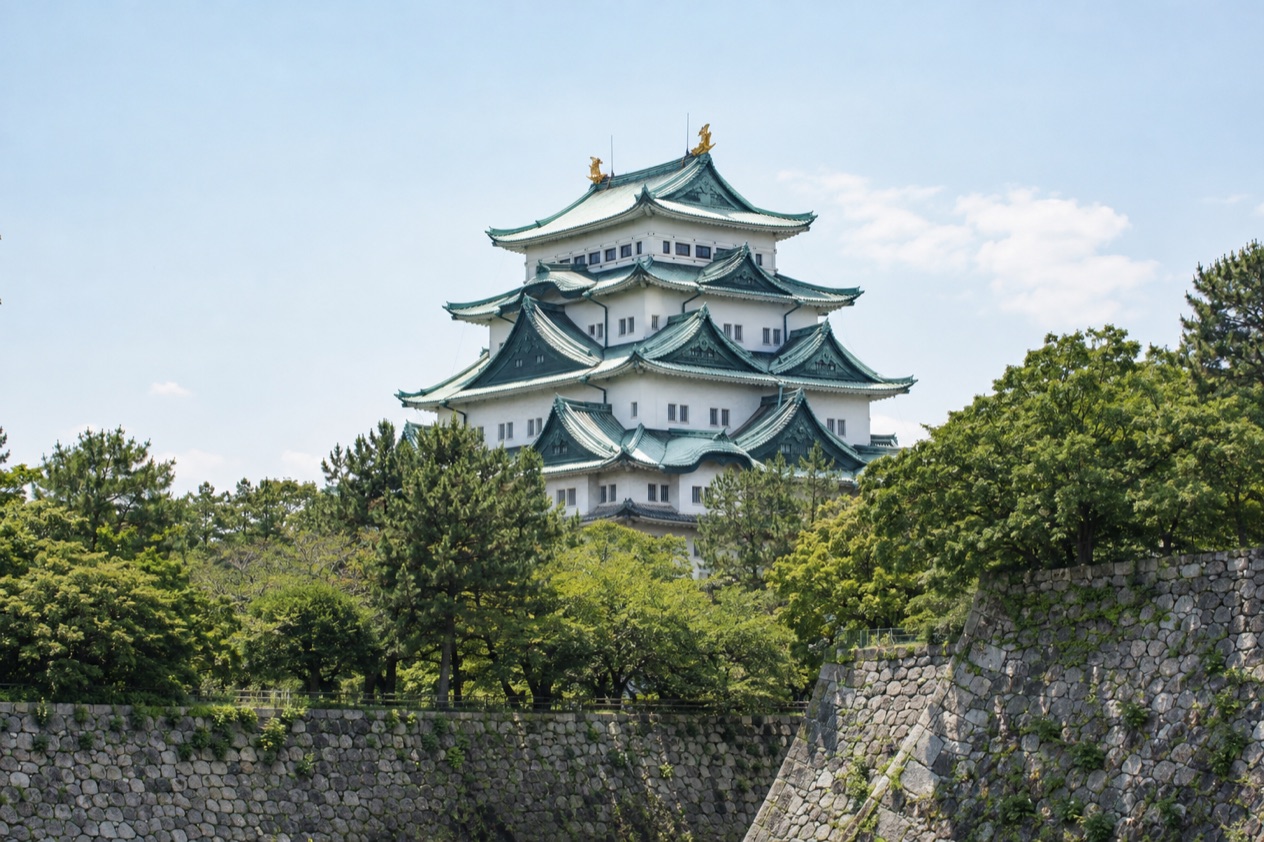
Nagoya Castle and Atsuta Shrine
The Honmaru Palace is part of the visit, with painted interiors that reward a slow look. The site holds seasonal events through the year, including an autumn festival, and in July the grounds are a summer walk through stone walls and green lawns.
Atsuta Shrine stands in Atsuta Ward and is one of the city’s great Shinto sites. Tall trees line the approach, and you pass under a torii gate, the entrance marker of a shrine, before reaching the main hall. In humid weather, the leafy grounds make a pleasant place to stroll between showers. Pair the shrine with a meal of hitsumabushi, since eel restaurants are part of the city’s food identity.
Rainy-day Nagoya: the aquarium, the zoo and the tower
A wet July afternoon suits the city’s indoor and covered attractions. The Port of Nagoya Public Aquarium sits by the harbor, with tanks and shows that keep children and adults occupied while rain drums outside. The Higashiyama Zoo and Botanical Gardens is the outdoor counterpart, with animal houses and garden paths for the breaks between showers.
Chubu Electric Power MIRAI TOWER rises in the city center and gives a view over the rooftops when the sky clears.
What to eat in Nagoya in July
Nagoya cooks with a strong hand, and the local dishes carry the name nagoya meshi. Hitsumabushi is the summer favorite: grilled eel over rice, eaten first as it comes, then with condiments, then as a soup with dashi poured over. It is a dish with a ritual, and July’s heat is its traditional moment.
Miso katsu, a fried pork cutlet under a dark, sweet miso sauce, is the other signature. Tebasaki, crisp chicken wings with pepper and sesame, goes well with a cold beer.
Kishimen, flat wheat noodles in broth, comes hot or cold, and the cold bowl is a good fit for a sticky afternoon. Ankake spaghetti, thick noodles in a peppery sauce, is a heavy but loved local oddity. Kakigori, shaved ice with syrup, is a way to cool down between sights.
The streets in July have a summer rhythm. Convenience stores sell cold tea, shaved-ice treats and sports drinks, vending machines glow on every corner, and handheld fans appear in many hands. Evenings are a good time for an izakaya, the Japanese pub where small plates arrive one after another.
A two-day itinerary for Nagoya in July
Day 1 begins at Nagoya Castle, because the grounds are open to the sky and the walk is better before the day’s warmth builds. Spend the morning on the stone walls, the lawns and the Honmaru Palace, then head into the city for lunch. A bowl of hitsumabushi suits the middle of the day, and the dish takes its time.
In the afternoon, go to the Port of Nagoya Public Aquarium, which keeps you indoors during the heat. With long July daylight, you can then walk along the harbor before dinner. Spend the evening in a district of izakaya, with tebasaki and a cold drink, and see the city after dark.
If rain turns the day, the aquarium moves to the morning and the castle to a break in the weather. Department stores and underground shopping streets are good places to pass a downpour.
Day 2 starts at Atsuta Shrine, where the tree-lined approach makes a gentle opening. Walk the grounds, pass under the torii, and visit the main hall. Midday is for kishimen or miso katsu in a local restaurant, a good break before moving on.
Spend the afternoon at the Higashiyama Zoo and Botanical Gardens, where animal houses give shelter and gardens offer space between showers. Finish with a visit to Chubu Electric Power MIRAI TOWER for the view as the long summer light fades. If a sumo tournament is under way, the evening is also a chance to find the sumo crowd in the restaurants nearby.
Is Nagoya busy in July?
July in Nagoya is a working summer month for a large city, with the sumo tournament as its main event and a steady flow of people through the city’s attractions.
Nagoya is the center of a metropolitan area of about 10 million people, surpassed only by Osaka and Tokyo, so the streets are never empty. The city’s pace is that of a big commercial place, with commuters, shoppers and families in the main stations and department stores. The humid weather moves people indoors, so shopping streets and attractions with a roof are where the movement concentrates.
The Nagoya Basho gives the month a particular energy around the sumo venue, with fans and wrestlers in the neighborhood. Elsewhere, July is simply a regular summer month, with the eel restaurants busy at lunch and the izakaya lively in the evening.
A summer trip here works best with a flexible plan, because rain can rearrange a day. With indoor options such as the aquarium, the tower and the shopping streets, the schedule bends without breaking.
What to pack for Nagoya in July
Pack for heat, damp and the occasional downpour, with clothes that dry quickly and shoes that cope with wet pavement.
- A compact umbrella, for the frequent rain and for shade on bright days.
- Light, breathable shirts in cotton or linen, because humidity makes heavy fabric uncomfortable.
- Comfortable walking shoes that tolerate wet streets for castle grounds and shrine paths.
- A hat and sunscreen for the open grounds of the castle and the zoo.
- A small towel or handkerchief to wipe off sweat between stops.
- A thin layer for air-conditioned trains, museums and restaurants.
Good to know before you go
July in Nagoya means a sticky summer with frequent rain, so it helps to keep a rain plan for every outdoor visit. The grounds of Nagoya Castle and Atsuta Shrine are better in a dry spell, while the aquarium, the tower and the shopping streets cover the wet hours. The Nagoya Basho is the main event of the month, and a stay around it follows the tournament schedule. Chubu Centrair International Airport sits on an artificial island south of the city center, which is worth remembering when matching flights to a sumo day.
Nagoya in July vs June and August
Moving the trip to June brings a little less heat and a bit more daylight, and the mornings and evenings feel less heavy. The rain days are about as frequent as in July, so June is still a wet month, just a cooler one. The sumo tournament is a July event, so June has no match for it.
August is hotter, brighter and drier, with fewer rainy days and more sun. The days are a little shorter, and the heat is stronger in the middle of the day. It suits travelers who prefer a clear sky to a gray one and who can handle the high temperatures. Outdoor sights like the castle grounds and the zoo are harder in August’s heat.
Choose July for the sumo tournament and for the rhythm of an eel-on-rice summer. Choose June for slightly gentler warmth, and August for more sunshine and fewer showers. Travelers who dislike humidity should consider another season altogether.
Is July a good time to visit Nagoya?
Yes, for travelers who like food, sumo and indoor attractions and who can take a humid summer in stride. It is a poor fit for anyone who wants to walk long distances outside in comfortable weather.
July suits those who plan around the weather, with mornings at the castle and shrine, afternoons in the aquarium or a shopping street, and evenings over tebasaki or kishimen. Sumo fans have a clear reason to come, since the grand tournament is held in the city this month.
On arrival, start with a bowl of hitsumabushi, then set the outdoor sights for the first dry spell you see. What is special about July here is the combination of a city that cooks with confidence, a sumo tournament in town and a summer that sends everyone to the table.
Sources
- Japan Meteorological Agency (JMA), Normal values 1991-2020, monthly (https://www.data.jma.go.jp/stats/etrn/view/nml_sfc_ym.php?prec_no=51&block_no=47636), station Nagoya, elevation 51 m, checked October 11, 2026
- Computed from the date and the latitude of the place (sunrise equation, solar elevation -0.833 degrees), October 11, 2026
- Japan National Tourism Organization, weather and seasons in Japan (https://www.japan.travel/en/plan/weather/), checked October 11, 2026
- Wikipedia, Climate of Japan (https://en.wikipedia.org/wiki/Climate_of_Japan), checked October 11, 2026
- Japan National Tourism Organization, summer in Japan (https://www.japan.travel/en/guide/summer-guide/), checked October 11, 2026
- Japan National Tourism Organization, festivals and events (https://www.japan.travel/en/see-and-do/festivals-and-events/), checked October 11, 2026
- Wikipedia, Hanabi (https://en.wikipedia.org/wiki/Hanabi), checked October 11, 2026
- Wikipedia, Gion Matsuri (https://en.wikipedia.org/wiki/Gion_Matsuri), checked October 11, 2026
- Japan National Tourism Organization, Mount Fuji guide (https://www.japan.travel/en/fuji-guide/), checked October 11, 2026
- Official website for Mt. Fuji climbing, about the climb (https://www.fujisan-climb.jp/en/about/), checked October 11, 2026
- Wikipedia, Tanabata (https://en.wikipedia.org/wiki/Tanabata), checked October 11, 2026
- Visit Nagoya, the Nagoya city guide (https://www.nagoya-info.jp/en/), checked October 11, 2026
- Wikipedia, Nagoya (https://en.wikipedia.org/wiki/Nagoya), checked October 11, 2026
- Wikivoyage, Nagoya (https://en.wikivoyage.org/wiki/Nagoya), checked October 11, 2026
- Wikipedia, Atsuta Shrine (https://en.wikipedia.org/wiki/Atsuta_Shrine), checked October 11, 2026
- Japan National Tourism Organization, anime and manga (https://www.japan.travel/en/guide/japanese-anime-and-comics/), checked October 11, 2026
- Wikipedia, Ghibli Park (https://en.wikipedia.org/wiki/Ghibli_Park), checked October 11, 2026
- Wikipedia, Studio Ghibli (https://en.wikipedia.org/wiki/Studio_Ghibli), checked October 11, 2026
To plan your stay
- Things to Do in Nagoya: Castle, Atsuta Shrine, Nagoya-meshi and Day Trips
- Where to Stay in Nagoya: Nagoya Station, Sakae, Osu and the Castle Area
- Nagoya from Tokyo: Shinkansen Services, Local Trains, Centrair Airport and a Day in the City
- Know Before You Go to Nagoya: Entry, Money, Getting Around and Local Etiquette