
In March, Nagoya is a city of steaming bowls of miso-simmered noodles and tables set with eel over rice, while the trees in the castle grounds begin to swell with buds. Winter coats are still on the racks, but sweaters and light jackets start to come out. The month is the hinge between the cold season and the cherry blossoms, and it suits travelers who want the great castle, the shrine and the table of central Honshu just as spring starts to arrive.
What is the weather like in Nagoya in March?
March in Nagoya is cool, turning mild, with a few gray, wet days and plenty of bright ones in between. It sits between a still-wintry February and a clearly warm April.
| Month | Average high (°F) | Average low (°F) | Precipitation (in) | Days with 1 mm or more of precipitation | Hours of sunshine | Daylight on the 15th |
|---|---|---|---|---|---|---|
| February | 50.9 | 34.5 | 2.55 | 6.2 | 176 | 10 h 54 min |
| March | 58.1 | 40.3 | 4.57 | 8.8 | 200 | 11 h 54 min |
| April | 68.2 | 49.5 | 5.02 | 9.4 | 200 | 13 h 02 min |
Afternoons reach a temperature where a sweater under a light jacket is plenty, and the nights stay a few degrees above freezing, so a scarf still earns its place in the bag. They are flurries, not a snowy season, and they come and go.
Rain falls on a bit under one day in three, usually as a gray, drizzly spell that makes a city of covered arcades and underground malls useful. Plan one indoor stop per day and leave the rest loose. Sunshine is generous, around the same as April, so the days between showers are bright and good for gardens and castle grounds.
Daylight is now close to twelve hours, so dinner no longer begins in the dark the way it does in midwinter. Nagoya sits on the Pacific coast of central Honshu, but this is a city trip, not a beach one, and the sea does not figure in the plan. Layers that go on and off are the best answer to the month.
What to do in Nagoya in March
The story of March here is the approach of the cherry blossoms. The Japan Meteorological Agency records the first flowers on the sample tree in Nagoya usually around March 24, and full bloom usually around April 2.
From one spring to the next the dates move by days, so a trip in the second half of the month may meet the first open blossoms, or only swollen buds. Plum blossoms, which typically flower from January until late February, are mostly done, so the pink of March belongs to the cherries.
Aichi Prefecture has its own signal of spring. In Toyota, in Aichi, peach trees announce the season, with a long stretch of weeping peach trees in white, red and pink. It is worth knowing about if your plans reach beyond the city and you like flowers, though it is a trip of its own, separate from the cherry dates above.
The table is where Nagoya shines in any weather. Travelers start with a morning set at a neighborhood kissaten (coffee shop), where thick toast comes with red bean paste and butter, a local habit known as ogura toast.
Later come the dishes the city is known for: miso katsu, a pork cutlet under dark, sweet miso sauce, and kishimen, flat wheat noodles in a light broth. The warm bowls are a good match for a March day with a breeze.
Sightseeing is easy to organize around a few anchors. The city is known for Nagoya Castle, Atsuta Shrine, the Higashiyama Zoo and Botanical Gardens, and the Port of Nagoya Public Aquarium. The Chubu Electric Power MIRAI TOWER rises among the city’s streets, and a NAGOYA Sightseeing Pass exists that bundles the major attractions, including the castle, the tower, the aquarium and the zoo and gardens.
Nagoya Castle and its grounds
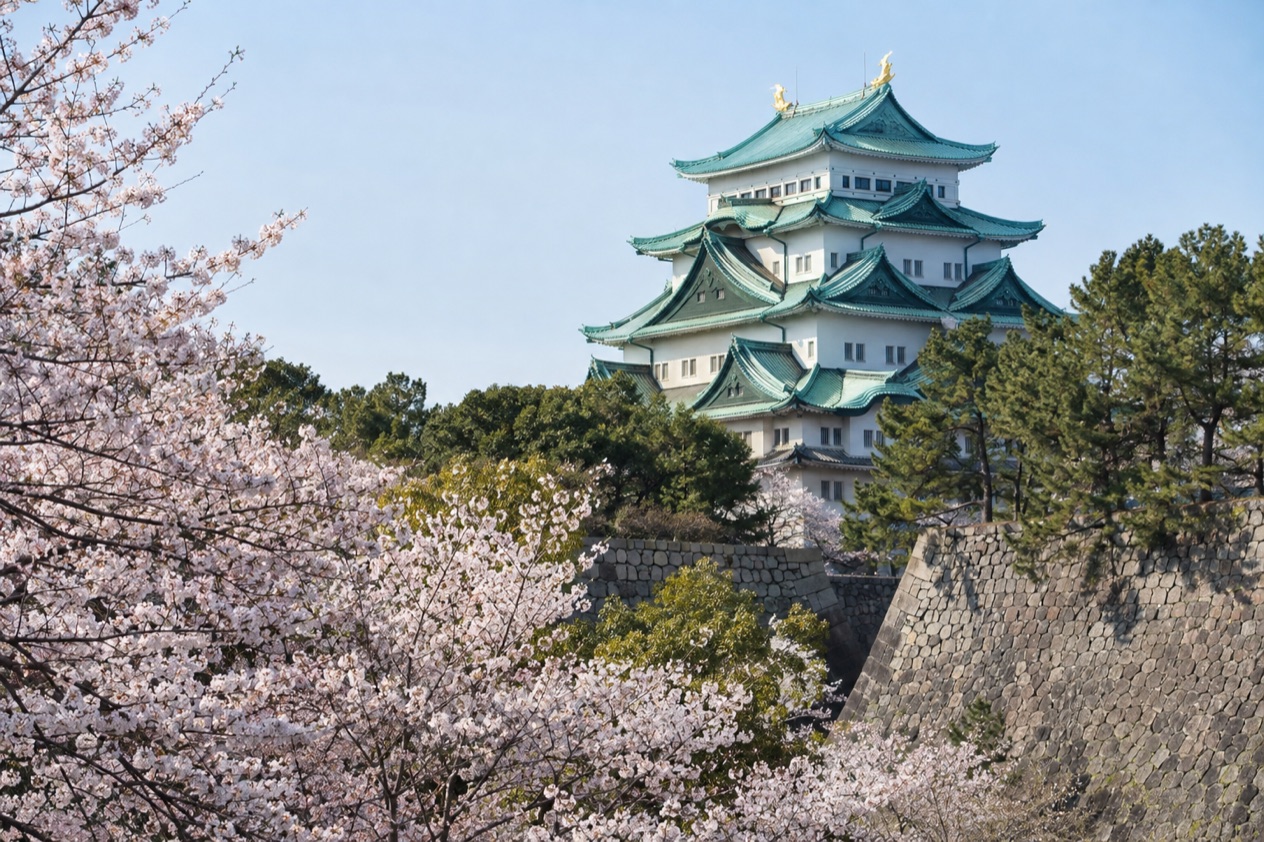
Nagoya Castle is where the month’s changes show most clearly. The grounds are wide, with old trees whose branches fill in over the weeks, and the castle itself rises above them with its famous golden roof ornaments. If you reach the end of March, you may catch the first flowers opening around the moats and paths.
Bring a light jacket, because stone walls and open grounds make for a cooler walk than the city streets. The castle is the place to spend the best weather of your stay. On a bright day you can circle the walls slowly, stop beneath the trees and take in the way the building sits in the landscape.
Atsuta Shrine and its wooded grounds
Atsuta Shrine sits in the Atsuta ward of the city, in a wooded precinct where paths run beneath tall trees. In March the evergreens give the grounds a green backdrop while the rest of the city is still bare, and the gravel underfoot and the sound of wooden sandals and prayer bells set the mood.
Visitors follow the usual shrine gestures. They bow at the gate, rinse their hands at the water basin, and toss a coin before a short prayer. The area around the shrine is also where hitsumabushi, grilled eel over rice eaten in three stages, is a local dish, so the visit pairs naturally with a meal.
Higashiyama Zoo and Botanical Gardens and the harbor
The Higashiyama Zoo and Botanical Gardens suit a day when the sun is out. The garden side gives a seasonal view of what is waking up, and the animals give children and adults a reason to stay outdoors. The Port of Nagoya Public Aquarium is the indoor alternative on a day of rain, and the MIRAI TOWER gives you a view over the city when the air is clear.
Mixing the two keeps March flexible. Choose the zoo and gardens when the sky is bright, the aquarium when it drizzles, and save the tower for a day when you can see far.
A two-day itinerary for Nagoya in March
Day 1 starts with a kissaten breakfast of toast with red bean paste and a cup of coffee, then goes straight to Nagoya Castle while you have energy for the wide grounds. Take your time among the trees and walls, because in late March the first cherry blossoms may be opening here. By midday you will want a hot lunch, and miso katsu or a bowl of kishimen noodles fits the cool air.
In the afternoon turn to Atsuta Shrine and its wooded paths. The trees keep the grounds green while the city is still waiting for spring, and a loop through the precinct is a calm way to spend a few hours.
For the evening, look for hitsumabushi, grilled eel over rice that is served in a local style, or an izakaya (a casual pub) with Nagoya specialties such as chicken wings. If rain arrives, linger over the meals and use the city’s covered arcades.
Day 2 belongs to the Higashiyama Zoo and Botanical Gardens, which suits a bright morning. Wander the garden paths to see what March is bringing out, and take time with the animals before a lunch of noodles or a bento (a boxed meal). If the weather turns wet, swap this day for the Port of Nagoya Public Aquarium, an indoor day that keeps you dry.
Finish at the Chubu Electric Power MIRAI TOWER in the city center, where the view shows how the streets spread out. A last dinner of miso katsu or a plate of tebasaki chicken wings with a glass of beer wraps the day. In bad weather, the tower can wait for another evening and the arcades can fill the time.
Is Nagoya busy in March?
March in Nagoya is a month of anticipation more than of peak activity, because the cherry blossoms reach the city only at the very end of it. The city is Japan’s fourth-largest, with a metropolitan area of about 10 million people, so it keeps its own busy pace whatever the month.
What changes in March is the mood. Toward the end of the month, the first blossoms can pull people out to the castle grounds and the parks, and the city seems to wake up with spring. Earlier in the month, the streets feel more like winter’s tail end, and the weather decides how much time people spend outdoors.
Because Nagoya is a big city of business and industry as well as sightseeing, daily life keeps going whatever the season. Restaurants, shops and the covered arcades run on their normal rhythm. The thing that tips the balance in March is the weather, not a rush of visitors, and a sunny weekend near the end of the month is the time when the parks and castle will feel most like an event.
What to pack for Nagoya in March
Spring in Japan suits a light jacket or a simple sweater, and Nagoya in March asks for a bit more than that at the start of the month. Pack for layers and a few wet hours.
- A light jacket or warm sweater, since afternoons are mild but not warm.
- A scarf and a thin warm layer for the cooler nights.
- A compact umbrella or rain jacket for the drizzly days.
- Comfortable shoes with grip for castle grounds and shrine gravel.
- A small day bag for layers you take off as the day warms.
- A camera, in case the first cherry blossoms are open.
Good to know before you go
March in Nagoya is changeable. A handful of days with snow or sleet can still show up, and rain falls on a good share of days, so a plan with an indoor option each day works better than a rigid one.
The cherry blossom dates are usual ones, not promises, and a cool spring can push them later while a warm one pulls them earlier. For the wider range of attractions, the NAGOYA Sightseeing Pass is a way to cover the castle, the MIRAI TOWER, the aquarium and the zoo and gardens in a single package.
Nagoya in March vs February and April
Moving four weeks earlier puts you in February, which is colder, drier and often wintry. Snow or sleet shows up on more days, and daylight is short, so the castle grounds and shrine paths are bare. The plum blossoms typically flower until late February, so an earlier trip can catch the last of them, while the cherries are still far off.
Moving four weeks later puts you in April, which is clearly warmer, wetter and longer in daylight. The cherry blossoms are usually in full bloom around the start of the month, so April is the time when the castle grounds and parks wear their spring color. It rains on a few more days than in March, but the air is mild enough for a lighter wardrobe.
Choose February if you prefer winter air and the last plum flowers, and April if the cherry blossoms are the point of the trip. March suits travelers who like the in-between: cool air, buds and a few early flowers, with the best chance of enjoying the sights without needing to time the bloom exactly.
Is March a good time to visit Nagoya?
Yes, March is a good time for travelers who enjoy sightseeing in cool, changing weather and want to see the city as spring approaches. It suits those who like castles, shrines, gardens and a serious meal, and who are happy to keep an umbrella in the bag. It is less suited to those who want to be sure of full cherry blossoms, since the peak usually falls just after the month ends.
Keep the aquarium and the covered streets for the wet hours, and put a bowl of miso-simmered noodles on the list for the first cool evening.
What is special about March in Nagoya is the waiting. The trees around the castle are close to flowering, the shrine paths are green against bare branches, and the city serves its richest, darkest dishes just as the first pink appears.
Sources
- Japan Meteorological Agency (JMA), Normal values 1991-2020, monthly (https://www.data.jma.go.jp/stats/etrn/view/nml_sfc_ym.php?prec_no=51&block_no=47636), station Nagoya, elevation 51 m, checked October 11, 2026
- Computed from the date and the latitude of the place (sunrise equation, solar elevation -0.833 degrees), October 11, 2026
- Japan Meteorological Agency, cherry blossom first-bloom dates 2021-2026 and 1991-2020 normal (https://www.data.jma.go.jp/sakura/data/sakura003_07.html), checked October 11, 2026
- Japan Meteorological Agency, cherry blossom full-bloom dates 2021-2026 and 1991-2020 normal (https://www.data.jma.go.jp/sakura/data/sakura004_07.html), checked October 11, 2026
- Japan Meteorological Agency, sakura2020.pdf (https://www.data.jma.go.jp/sakura/data/sakura2020.pdf), checked October 11, 2026
- Japan National Tourism Organization, flowers by season: cherry blossom, plum, wisteria, hydrangea, where and when (https://www.japan.travel/en/see-and-do/flowers/), checked October 11, 2026
- Wikipedia, Prunus mume (https://en.wikipedia.org/wiki/Prunus_mume), checked October 11, 2026
- Japan National Tourism Organization, spring in Japan (https://www.japan.travel/en/guide/spring-guide/), checked October 11, 2026
- Japan National Tourism Organization, autumn in Japan (https://www.japan.travel/en/guide/autumn-guide/), checked October 11, 2026
- Japan National Tourism Organization, summer in Japan (https://www.japan.travel/en/guide/summer-guide/), checked October 11, 2026
- Wikipedia, Nagoya (https://en.wikipedia.org/wiki/Nagoya), checked October 11, 2026
- Wikivoyage, Nagoya (https://en.wikivoyage.org/wiki/Nagoya), checked October 11, 2026
- Visit Nagoya, the Nagoya city guide (https://www.nagoya-info.jp/en/), checked October 11, 2026
- Wikipedia, Atsuta Shrine (https://en.wikipedia.org/wiki/Atsuta_Shrine), checked October 11, 2026
- Japan National Tourism Organization, anime and manga (https://www.japan.travel/en/guide/japanese-anime-and-comics/), checked October 11, 2026
- Wikipedia, Ghibli Park (https://en.wikipedia.org/wiki/Ghibli_Park), checked October 11, 2026
- Wikipedia, Studio Ghibli (https://en.wikipedia.org/wiki/Studio_Ghibli), checked October 11, 2026
To plan your stay
- Things to Do in Nagoya: Castle, Atsuta Shrine, Nagoya-meshi and Day Trips
- Where to Stay in Nagoya: Nagoya Station, Sakae, Osu and the Castle Area
- Nagoya from Tokyo: Shinkansen Services, Local Trains, Centrair Airport and a Day in the City
- Know Before You Go to Nagoya: Entry, Money, Getting Around and Local Etiquette