
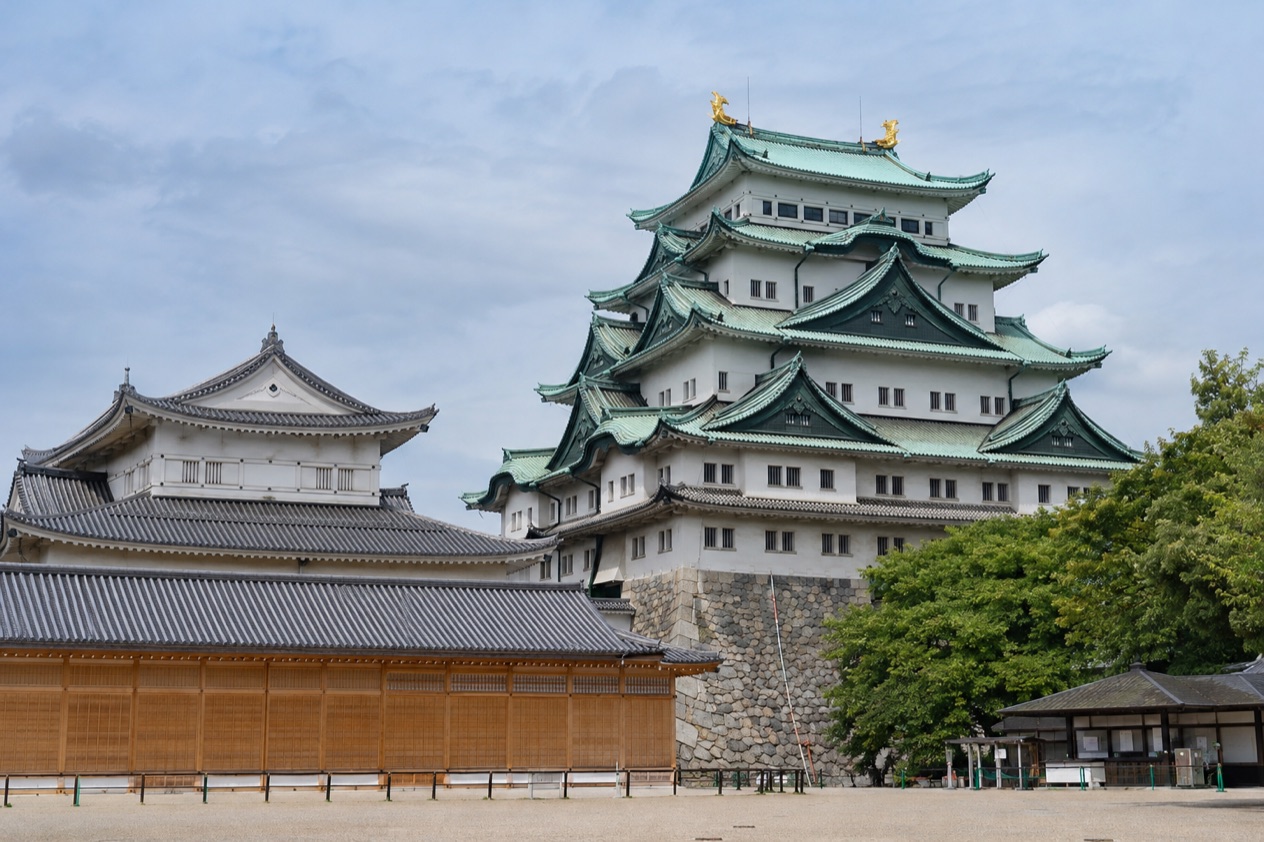
You come up to Nagoya Castle across a wide moat edge and a stone wall, and the keep rises ahead with its green copper roofs and the pair of golden shachi, the tiger-headed fish, set on the top ridge. Inside the grounds the picture widens into a palace of painted rooms, gardens laid out for walking and a museum of treasures. This is the castle of Nagoya, a visit that combines a reconstructed keep, a rebuilt residence and a few garden corners in the middle of the city.
Is visiting Nagoya Castle worth it?
Yes, for anyone who likes Japanese history told through buildings, gardens and craftsmanship, and especially for travelers who are already in Nagoya and want one anchor for a day. The castle suits couples wandering between gardens, families who like a landmark with a clear silhouette, and visitors curious about how a lost building comes back to life.
What sets it apart is the story of rebuilding. The two main keeps were reconstructed from 1957 to 1959, and the keep you see today is a postwar replacement of the one lost in the war, so the exterior carries the look of the original in modern materials.
The real surprise is the Honmaru Palace, rebuilt with original methods and materials and reopened in 2018. Here you can see what careful reconstruction looks like in wood, paper and painted panels, which gives the castle a second layer that a keep alone would not have.
Nagoya is a large city with several well-known landmarks, among them Atsuta Shrine, Higashiyama Zoo and Botanical Gardens and the Port of Nagoya Public Aquarium, and the castle is the one that gives the city its historic face. Plan it as a visit about architecture and gardens, with room to wander between the palace, the grounds and the museum rather than a single photo stop at the gate.
What to see at Nagoya Castle
The main keep
The keep is what you notice first and what appears on every postcard of the city. The reconstructed main keep was completed on October 3, 1959 and opened to the public that day, and its stone base and white walls still shape the skyline above the grounds. The castle was built as a seat of power for a branch of the Tokugawa family, and the keep was meant to announce that authority to everyone approaching the city.
Look up at the roof ridge, where the golden shachi sit facing each other. These mythical fish were believed to protect a building from fire, a fitting charm for a wooden-era castle. Walk around the base of the walls to see how the large stones fit together, and notice how the green roof tiles contrast with the white plaster.
Honmaru Palace
Honmaru Palace is the part of the visit that rewards slow walking. It has more than 30 rooms, and it was rebuilt using original methods and materials before reopening to the public in 2018. The reconstruction ran from 2009 to 2018, which tells you something about the care involved. Rooms follow one another along wooden corridors, with tatami floors, carved transoms and walls and sliding doors covered in painted scenes.
As you pass through, notice how the decoration changes with the rank of the room: the rooms where visitors were received are the most richly painted, and the private spaces are plainer. Gold leaf, tigers, pines and other classic motifs fill the panels. The palace was a residence as well as a place of ceremony, and the layout makes that clear.
Ninomaru Garden and the grounds
The Ninomaru Garden was designated a National Place of Scenic Beauty in 1953, and the Ninomaru East Garden was opened to the public in April 1978. Together they offer a counterweight to the monumental keep: a garden of ponds, stones, pines and clipped shrubs where paths bend so that every turn frames a new view.
Tea house corners dot the grounds. The tea house area known as Kinjo-en is open to the public only twice a year, so finding it open is a matter of timing rather than a standard stop. The Ofuke Garden is now part of Meijo Park, which became public in 1931, and it shows how the castle estate was gradually opened to the city.
Nishinomaru Okura Museum and the Enokida Gate
The main entrance to the castle is the Nishinomaru Enokida Gate, reconstructed with reinforced concrete in 1959. It is the threshold of the visit, and it is worth a pause to look at the heavy wooden-style doors and the stone around it before you go in.
The Nishinomaru Okura Museum opened on November 1, 2021, and it exhibits important cultural properties. Think of it as the place where the objects tied to the castle and its history can be seen up close, a useful complement to the buildings that surround it.
Hours, tickets and rules
The details that shape a visit are few and specific. Honmaru Palace has a last-admission rule tied to the Nagoya Castle Autumn Festival, and the Kinjo-en tea house area opens to the public on only two days a year. Beyond that, the castle works as a normal daytime attraction with a gate that closes at the end of the visiting day.
| Site | Open |
|---|---|
| Honmaru Palace | During the Nagoya Castle Autumn Festival, admission until 1 hour before gate closing |
| Kinjo-en tea house area | Open to the public twice a year |
The Nagoya Castle Autumn Festival is the one occasion when the palace admission is tied to the gate closing time, so anyone planning around the festival should treat the last hour before closing as the end of the palace visit. The NAGOYA Sightseeing Pass lists Nagoya Castle among the major attractions it covers, along with Chubu Electric Power MIRAI TOWER, Nagoya Port Aquarium and Higashiyama Zoo and Botanical Gardens.
When to visit Nagoya Castle
Autumn is the season with a named event, since the castle holds its Autumn Festival then, and it is also a comfortable time for walking the grounds. In October the average high reaches the low 70s, and rain falls on about nine days, usually as a passing spell rather than a continuous gray stretch. That suits a visit that mixes indoor rooms with outdoor gardens.
Spring brings milder days, with April highs in the upper 60s and a bit more sun overall. Winter is cooler, with highs in the upper 40s and some snow or sleet on a good number of days in January, so the gardens look bare but the keep stands out against the sky. July is the hottest and wettest of the four months, with warm nights and humid air, so the palace rooms and the museum make a welcome break from the heat.
| Month | Avg high (°F) | Avg low (°F) | Precipitation (in) | Rain days | Sunshine (hours) |
|---|---|---|---|---|---|
| January | 48.7 | 34.0 | 2.00 | 5.2 | 174 |
| April | 68.2 | 49.5 | 5.02 | 9.4 | 200 |
| July | 88.5 | 74.3 | 8.32 | 12.0 | 166 |
| October | 73.9 | 58.6 | 6.48 | 9.0 | 169 |
Arrive with enough hours ahead to see the palace before its last admission, and keep the gardens for the end of the visit, since they can be walked right up to the closing of the grounds.
Tips for your visit
Think of the castle as a visit with three parts: the keep, the palace and the gardens, with the museum as a fourth stop. Giving each its own stretch of time makes the day feel like a walk through different periods of the castle’s life, from the stone walls to the painted rooms to the tea house corners.
Wear shoes that are simple to take off and put on, since the palace is a traditional-style interior, and bring something to protect you from sun or rain depending on the month. The grounds include stone paths and garden routes, so comfortable footwear is worth having. In summer, carry water and plan indoor stops, and in the cooler months a layer helps when you pause in the gardens.
Nagoya has other landmarks that pair naturally with a castle day. Atsuta Shrine, Higashiyama Zoo and Botanical Gardens and the Port of Nagoya Public Aquarium are all known city sights, and the NAGOYA Sightseeing Pass includes the castle alongside several of them. Meijo Park, which now includes the Ofuke Garden, gives a green setting for a break between sights.
Families will find a good deal to talk about here: the golden fish on the roof, the tiger paintings in the palace and the story of a castle that was lost and rebuilt. Anyone who wants to see the Kinjo-en tea house area should remember that it opens only twice a year, so it is a bonus when the visit lines up with one of those days rather than something to count on.
Good to know before you go
The castle stands in the middle of Nagoya, Japan’s fourth-largest city, so the visit fits into a city day rather than a separate trip. Much of the structure is a careful reconstruction, and it is more rewarding to enjoy it as a rebuilt landmark than to expect an unbroken original. Rain can arrive in any of the seasons in the table, so the covered rooms of the palace and the museum are useful when the weather turns, and the Autumn Festival adds a reason to plan a visit around the season.
Sources
- Wikipedia, Nagoya Castle (https://en.wikipedia.org/wiki/Nagoya_Castle), checked October 11, 2026
- Visit Nagoya, the Nagoya city guide (https://www.nagoya-info.jp/en/), checked October 11, 2026
- Wikivoyage, Nagoya (https://en.wikivoyage.org/wiki/Nagoya), checked October 11, 2026
- Japan Meteorological Agency (JMA), Normal values 1991-2020, monthly (https://www.data.jma.go.jp/stats/etrn/view/nml_sfc_ym.php?prec_no=51&block_no=47636), station Nagoya, elevation 51 m, checked October 11, 2026
To plan your stay
- Best Time to Visit Nagoya: Cherry Blossoms, Autumn Leaves, Weather and Festivals
- Where to Stay in Nagoya: Nagoya Station, Sakae, Osu and the Castle Area
- Nagoya from Tokyo: Shinkansen Services, Local Trains, Centrair Airport and a Day in the City
- Know Before You Go to Nagoya: Entry, Money, Getting Around and Local Etiquette