
You pass under a torii and the noise of Nagoya falls away behind a wall of tall camphor trees. Gravel crunches underfoot, the air smells of cedar and damp earth, and the path to the main hall bends gently out of sight. Atsuta Shrine is the city’s great Shinto sanctuary, a place for slow walking, a look at old swords and a feel for the festival calendar.
Is visiting Atsuta Shrine worth it?
Yes, if you like shrines that feel like a forest with a story, and especially if you are curious about the sword legends that sit under Japan’s imperial history. Atsuta Shrine houses the sacred sword Kusanagi no Tsurugi, one of the three Imperial Regalia of Japan. That single fact gives the grounds a weight that many city shrines do not have.
The complex covers 200,000 square meters (2,200,000 sq ft), and over 9 million visitors come each year. That is a lot of footsteps, yet the layout is a woodland precinct rather than a single building, so the visit is about wandering between groves, halls and a museum rather than ticking off one monument.
It suits travelers who want a shrine visit with real content: a treasure hall with thousands of relics, a gallery devoted to swords, and a calendar of ceremonies that reach back to the Heian court. Photographers, history readers and people who simply like walking under big trees will find plenty to do.
What sets it apart from the other sights in town is its character. The castle is about a fortress and the zoo and aquarium are about animals, while Atsuta is about belief, ritual and objects that carry the weight of legend.
If you are going to see only one religious site in Nagoya, this is the one that explains the city’s spiritual side. Visitors who have already seen the great temples of Kyoto will find it a different register: less a single showpiece, more a living shrine where local people stop on the way through their day.
What to see at Atsuta Shrine
The approaches and the main precinct
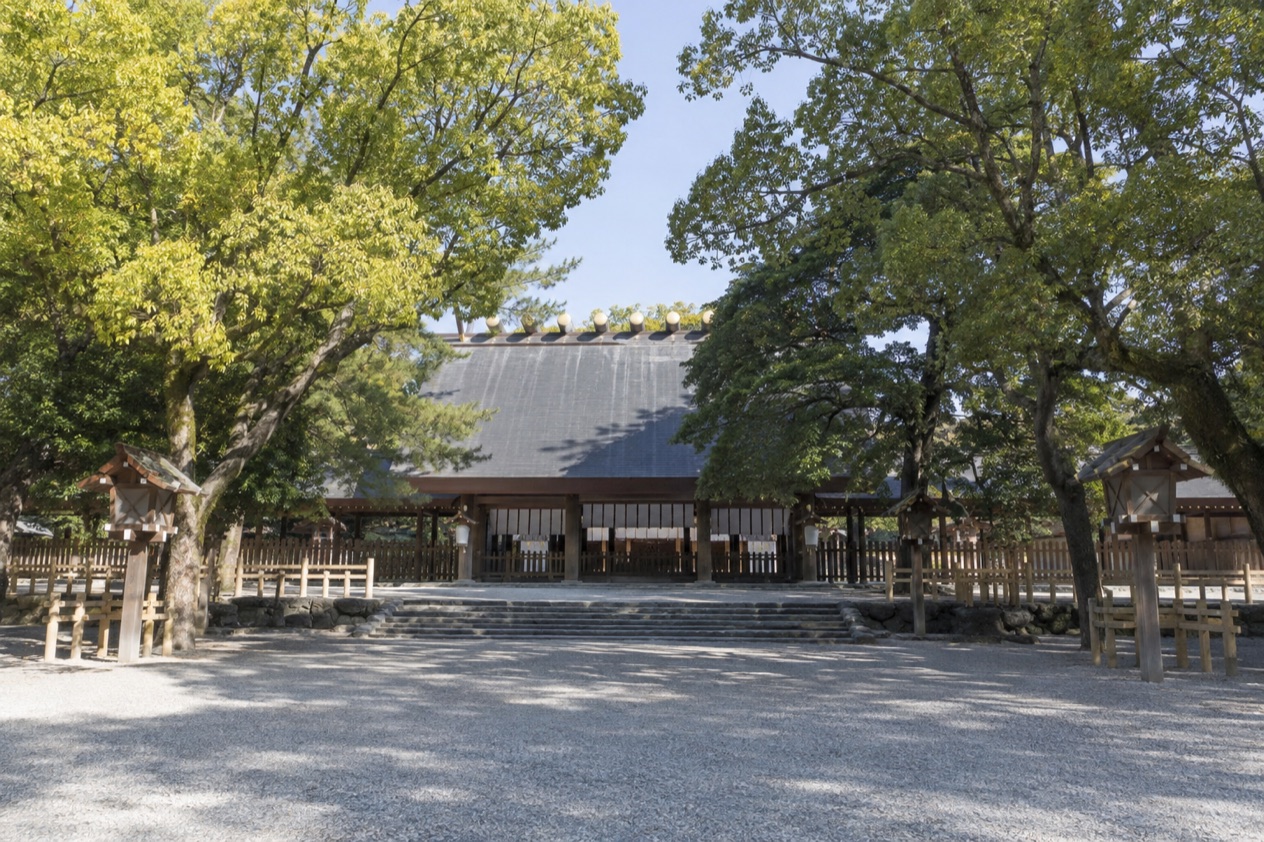
The shrine stands at 1-1-1 Jingu in Atsuta Ward, Nagoya, and the walk in is part of the experience. Broad gravel paths run beneath old trees, with stone lanterns lining the way and small subsidiary shrines tucked among the trunks. Take your time here, because the atmosphere of the place is built from these quiet stretches.
Look for the way worshippers pause, bow, toss a coin, clap twice and bow again before the main hall. Watching that rhythm for a few minutes tells you more about Shinto practice than any sign. During festivals these same approaches fill with processions, which changes the whole feel of the grounds.
Kusanagi no Tsurugi, the sacred sword
The sword is the reason Atsuta is spoken of across Japan. Kusanagi no Tsurugi is counted among the three Imperial Regalia, and the shrine is its home. In the old stories it is the blade tied to the storm god Susanoo and later to the hero Yamato Takeru, whose tale runs through this part of Japan.
You will not see the sword itself, since it is kept as a sacred object within the shrine. What you can do is stand before the main hall and take in the setting that protects it. The Eyoudo Shinji festival on May 4 commemorates the return of the sacred sword during Emperor Tenji’s reign, so the legend is still marked on the calendar.
Bunkaden, the treasure hall
The Bunkaden houses over 4,000 relics, including 174 Important Cultural Properties and a designated National Treasure dagger. It is the place to understand how long people have been bringing offerings here. Expect swords, ritual objects and items given by rulers and local lords over the generations.
Go in with an eye for craftsmanship. Blades, fittings and ceremonial pieces are the kind of thing that rewards close looking, and the contrast with the green grounds outside makes the dim display rooms feel like a different world.
Kusanagi-kan, the sword museum
The shrine’s collection of swords is displayed in the Kusanagi-kan, built to celebrate the Reiwa era beginning in 2019. It is the newer face of the precinct, a purpose-built space for blades that sits alongside the older halls.
For anyone who enjoys Japanese swords, or who has been drawn in by the Kusanagi legend, this is where the story becomes visible. Look at how each blade is mounted and lit, and how the display moves from legend toward actual craft. Pair it with the Bunkaden and you have the full picture of what the shrine has collected.
When to visit Atsuta Shrine
Here the date matters more than the weather, since the shrine’s ceremonies are what set one visit apart from another.
Festival dates through the year
January is full. Hatsu-Ebisu on January 5 seeks good fortune from Ebisu, the kami of fortune. On January 7 the Yodameshi Shinji prophesies the projected annual rainfall by measuring water in a pot beneath the Eastern Treasure House floor. January 11 brings the Touka Shinji, a variation of a Heian period Imperial Court ceremony with shrine dance praying for bumper crops, and on January 15 the Hosha Shinji involves shooting an arrow at a wooden piece called chigi fixed at the center of a huge mark.
In May, the Bugaku Shinji on May 1 features a ceremonial Heian-era dance performed outdoors on a red painted stage. The Eyoudo Shinji follows on May 4, and on May 5 the Shinyo to Gyoshinji festival carries a portable shrine (mikoshi) in procession to the western gate Chinko-mon for prayers for Imperial Palace security.
The main festival, Atsuta-sai, is held annually on June 5. The Rei Sai festival that day features portable tabernacles (mikoshi) carried along the shrine approaches and 365 lanterns lit at the gates at night. If you want the shrine at its most theatrical, this is the date to aim for.
Seasons and weather in Nagoya
Nagoya in January is cold and fairly bright, with highs near 49°F and lows around freezing, and the city sometimes sees a little snow. Dress in layers if you come for the New Year ceremonies, since you will be standing outdoors.
April is mild, with highs in the upper 60s and showers on a good share of days, a pleasant frame for walking under the trees. July is hot and humid, with highs near 89°F and rain on about twelve days, so expect to sweat on the long paths.
October is the gentlest for strolling, with highs in the low 70s and cool evenings, though it is still a fairly wet month.
| Month | Average high (°F) | Average low (°F) | Precipitation (in) | Rain days |
|---|---|---|---|---|
| January | 48.7 | 34.0 | 2.00 | 5.2 |
| April | 68.2 | 49.5 | 5.02 | 9.4 |
| July | 88.5 | 74.3 | 8.32 | 12.0 |
| October | 73.9 | 58.6 | 6.48 | 9.0 |
Tips for your visit
Wear shoes that handle gravel and plan to be outdoors for most of the visit. The grounds are large, so comfortable footwear matters more than anything you carry. In summer bring water and a hat, and in January bring gloves, because ceremonies are held outside.
Think of the shrine as a visit in two parts. The first is the walk through the trees and the main hall, where you simply take in the setting. The second is the indoor side, the Bunkaden and the Kusanagi-kan, where the treasures are. Give yourself room for both rather than rushing to the museum, because the forest walk is half the point.
Combining Atsuta with other Nagoya sights
Atsuta is one of the landmarks Nagoya is known for, alongside Nagoya Castle, Higashiyama Zoo and Botanical Gardens, and the Port of Nagoya Public Aquarium. A day that pairs the shrine with the castle gives you the sacred and the military sides of the city’s history.
The NAGOYA Sightseeing Pass offers a great-value way to enjoy Nagoya’s major tourist attractions, including Nagoya Castle, Chubu Electric Power MIRAI TOWER, Nagoya Port Aquarium, and Higashiyama Zoo and Botanical Gardens. It is worth looking at if you plan several of those stops.
Families and getting around the grounds
Children tend to enjoy the festival days, when mikoshi, lanterns and dance give them something to watch. On ordinary days the open paths and the trees give room to move, and the swords in the museum can hold the attention of older kids who like legends.
The paths are gravel, which can be slow going with a stroller or a wheelchair, so allow extra time. Visitors arriving from abroad land at Chubu Centrair International Airport, Japan’s third major international gateway, on an artificial island 30 minutes south of central Nagoya.
Good to know before you go
Nagoya is a large city, Japan’s fourth-largest, and the shrine sits within it, so you will be in an ordinary urban setting before and after your visit. A little cash is handy for the offering you toss at the main hall, a habit worth following as you watch others do it. Summer brings a rainy, humid stretch, and the typhoon season can add heavy weather, so keep an eye on the forecast if you travel then.
Sources
- Wikipedia, Atsuta Shrine (https://en.wikipedia.org/wiki/Atsuta_Shrine), checked October 11, 2026
- Visit Nagoya, the Nagoya city guide (https://www.nagoya-info.jp/en/), checked October 11, 2026
- Wikipedia, Nagoya (https://en.wikipedia.org/wiki/Nagoya), checked October 11, 2026
- Wikivoyage, Nagoya (https://en.wikivoyage.org/wiki/Nagoya), checked October 11, 2026
- Japan Meteorological Agency (JMA), Normal values 1991-2020, monthly (https://www.data.jma.go.jp/stats/etrn/view/nml_sfc_ym.php?prec_no=51&block_no=47636), station Nagoya, elevation 51 m, checked October 11, 2026
To plan your stay
- Best Time to Visit Japan: Cherry Blossoms, Autumn Colors, Weather and Festivals
- Where to Stay in Japan: Ryokan, Temple Stays, Capsule Hotels and the Best Cities to Base In
- Sending Luggage from the Airport in Japan: Hands-Free Travel, Hotel Delivery and Coin Lockers
- Know Before You Go to Japan: Entry, Money, Etiquette and Getting Around