
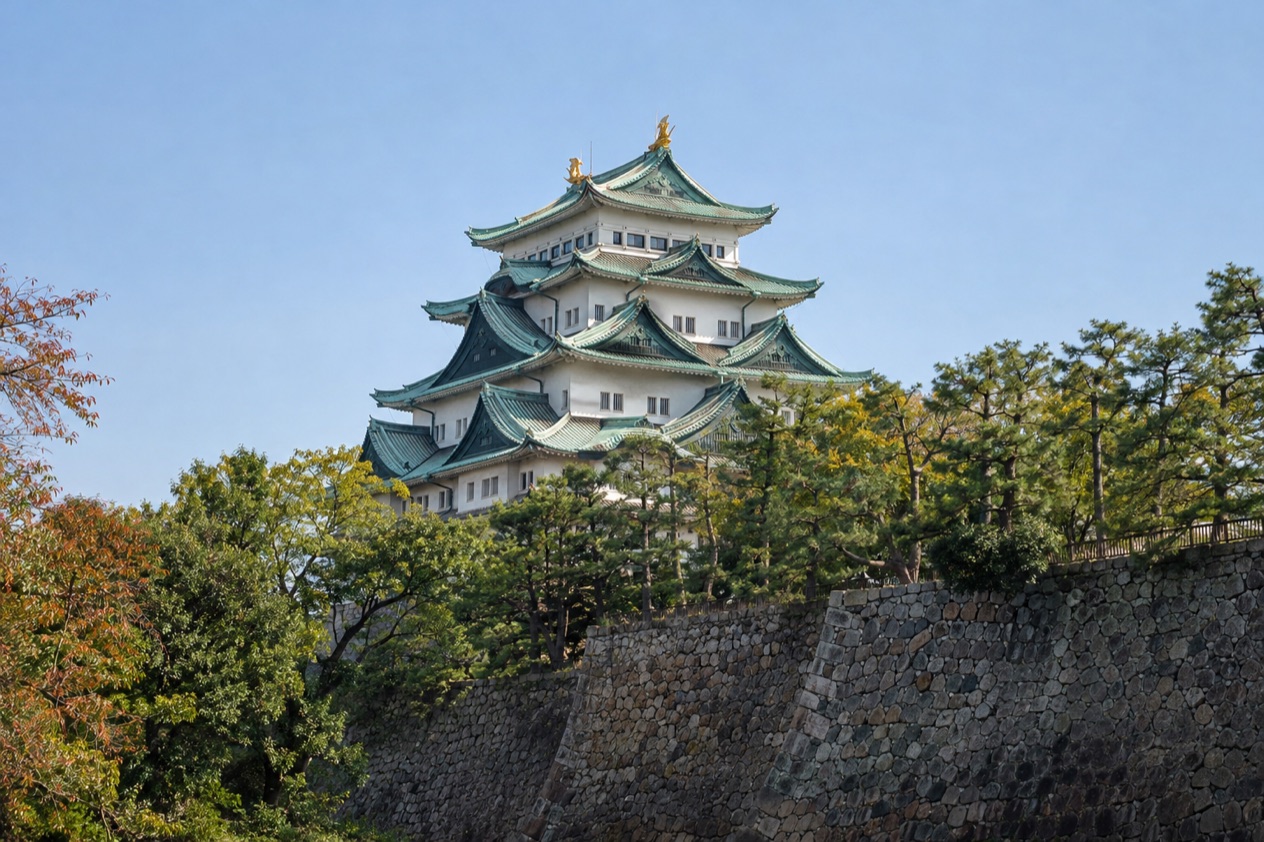
You step out of the station into a city that feels like a working town more than a postcard, with office workers heading to lunch, department store basements filling with the smell of sweet and savory snacks, and the castle’s gold-topped roofline somewhere over the buildings. Nagoya, the capital of Aichi Prefecture in central Honshu, rewards a little preparation. A few facts about entry, paying, moving around and the weather make the first day go more smoothly.
What should you know before visiting Nagoya?
Four things matter most here: carry your passport, expect cards to work in most places but ask when you do not see a logo, take your shoes off when the room calls for it, and pack for the season, because Nagoya runs from a cold, occasionally snowy January to a humid July. Beyond that, the city is easy to enjoy at your own pace.
What tends to surprise first-time visitors is the scale. Nagoya is Japan’s fourth-largest city, and the metropolitan area around it holds about 10 million people, yet it does not announce itself the way Tokyo or Osaka does.
The sights are spread across the city: Nagoya Castle, Atsuta Shrine, Higashiyama Zoo and Botanical Gardens and the Port of Nagoya Public Aquarium are each their own outing. The NAGOYA Sightseeing Pass is built around that spread, and it covers major attractions including the castle, Chubu Electric Power MIRAI TOWER, the aquarium and the zoo and gardens.
Another surprise is how much history sits inside a modern city. Atsuta Shrine is said to date back to around 100 AD and houses the sacred sword Kusanagi, one of the Imperial Regalia of Japan.
The sword is never shown to the public, so what you see is the shrine grounds, the wooden halls and the quiet of the trees around them. Plan for that kind of contrast, with glass towers and station crowds on one side and a shrine forest on the other.
Entry, customs and paperwork
According to the U.S. State Department, U.S. citizens visiting Japan for tourism or business can enter visa free for stays up to 90 days. You need a valid passport, and the same source says you should have proof of a return or onward ticket. The passport must be valid for the entire time you are staying in Japan, so check the expiration date against your whole itinerary rather than just your arrival.
A visa-free stay is a visit, not a work permit. The State Department notes that you cannot work on the local economy while in Japan on a visa-free stay, which rules out paid work of any kind during a tourist trip.
Once you are in the country, the passport stays with you. The State Department says you must always carry your U.S. passport (or a Japanese Residence Card, for residents) and that you may be questioned or detained if you cannot show proof of identity and status. Tuck it into a bag or an inside pocket each morning, the same way you would a wallet.
One more item for the packing list: CBD products. The State Department warns that CBD may be illegal in Japan depending on the amount of THC it contains, so it is simplest to leave such products at home.
Money, cards and tipping
International credit, debit and prepaid cards are generally accepted throughout Japan, according to the Japan National Tourism Organization. That covers most hotels, department stores and larger restaurants, and it means a card can carry much of a trip through a city like Nagoya.
Not every shop makes it obvious, though. Some stores do not display the symbols of the cards they accept, so the habit that works is simply asking the person at the register whether your card can be used. A smile and a held-up card usually get the message across without a shared language.
Tipping is not part of the everyday rhythm of eating out or taking a taxi in Japan, and the check you receive is the amount you pay. Many visitors find that a sincere thank-you, said on the way out of a restaurant, lands better than anything left on the table. Whether you are in a ramen counter near the station or a sit-down dinner, you settle up at the register by the door rather than at your seat.
Getting around and staying connected
It sits on an artificial island 30 minutes south of central Nagoya, so you arrive on the water’s edge and then head into the city.
Once in the city, the sights are spread out, which is where the NAGOYA Sightseeing Pass comes in. It is described as a great-value way to enjoy Nagoya’s major attractions, among them Nagoya Castle, Chubu Electric Power MIRAI TOWER, Nagoya Port Aquarium and Higashiyama Zoo and Botanical Gardens. If your plans include several of those, it is worth knowing it exists.
Nagoya Castle has its own seasonal rhythm. During the Nagoya Castle Autumn Festival, admission to the Honmaru Palace runs until one hour before the gate closes, a detail that matters if you plan to arrive late in the day during the festival.
For staying connected, plan your phone or data arrangements before you land so that maps and messages work from the moment you leave the airport. Then spend the first evening wandering a station district, where the city’s food and the noise of the crowd tell you more than any map.
Health, water and the weather
Nagoya has four distinct seasons, and the weather shapes what you pack more than anything else on this list.
| Month | Average high (°F) | Average low (°F) | Precipitation (inches) | Days with rain or more (1 mm+) | Sunshine (hours) |
|---|---|---|---|---|---|
| January | 48.7 | 34.0 | 2.00 | 5.2 | 174 |
| April | 68.2 | 49.5 | 5.02 | 9.4 | 200 |
| July | 88.5 | 74.3 | 8.32 | 12.0 | 166 |
| October | 73.9 | 58.6 | 6.48 | 9.0 | 169 |
January is cold and bright, with a light snowfall in an average year and snow or sleet falling on a number of days, so a warm coat is the right call. April is mild, with comfortable afternoons and cooler mornings, and a layer you can take off works well.
July is the hard month. Highs climb toward the high 80s, nights stay warm, and the air is humid, which makes midday sightseeing tiring. Light clothes, a hat and a plan to spend the hottest hours indoors at the aquarium or a museum make sense. October settles into pleasant afternoons in the low 70s, though it is also a wetter month, with showers fairly frequent.
Local customs and etiquette
In Japan it is customary to remove your shoes at the entrance when entering a building, put on indoor slippers and place your shoes in a shoe box or to the side. You will meet this at ryokan, some restaurants, temples and homes, and the cue is usually a raised step or a row of slippers by the door.
There is a second layer inside. In a Japanese home or ryokan, slippers come off again when you step onto tatami mats, and in the bathroom a separate pair of toilet slippers is often provided. The small trick is remembering to switch back, because wearing toilet slippers out into the hallway is a classic first-trip slip.
Beyond shoes, everyday manners follow a quiet, considerate pattern. People speak softly on trains, line up in orderly rows on platforms, carry their trash with them until they find a bin and bow slightly as a greeting or thanks. You do not need to bow perfectly. A small nod and a friendly face are understood anywhere.
At a shrine such as Atsuta, the same spirit applies. You walk the gravel paths unhurried, keep your voice low beneath the trees and watch what others do at the purification fountain and the offering hall before copying them.
Good to know before you go
The U.S. State Department rates Japan Level 1: Exercise Normal Precautions.
Keep your passport on you, keep a card handy and carry a little patience for shoe-removal at the door. Those three habits cover most of what a first visit asks.
Sources
- Visit Nagoya, the Nagoya city guide (https://www.nagoya-info.jp/en/), checked October 11, 2026
- Wikipedia, Nagoya (https://en.wikipedia.org/wiki/Nagoya), checked October 11, 2026
- Wikivoyage, Nagoya (https://en.wikivoyage.org/wiki/Nagoya), checked October 11, 2026
- U.S. Department of State, Japan travel information, local laws and special circumstances (https://travel.state.gov/content/travel/en/international-travel/International-Travel-Country-Information-Pages/Japan.html), checked October 11, 2026
- Japan National Tourism Organization, manners, etiquette, shoes, bowing, chopsticks, public behavior (https://www.japan.travel/en/guide/understanding-and-mastering-japanese-manners-and-etiquette/), checked October 11, 2026
- Japan National Tourism Organization, credit cards and cash, where cards are accepted (https://www.japan.travel/en/plan/credit-cards/), checked October 11, 2026
- U.S. Department of State, Japan travel advisory (https://travel.state.gov/content/travel/en/international-travel/International-Travel-Country-Information-Pages/Japan.html), checked October 11, 2026
- U.S. Department of State, Japan travel information, entry and exit requirements (https://travel.state.gov/content/travel/en/international-travel/International-Travel-Country-Information-Pages/Japan.html), checked October 11, 2026
- Japan Meteorological Agency (JMA), Normal values 1991-2020, monthly (https://www.data.jma.go.jp/stats/etrn/view/nml_sfc_ym.php?prec_no=51&block_no=47636), station Nagoya, elevation 51 m, checked October 11, 2026
To plan your stay
- Best Time to Visit Nagoya: Cherry Blossoms, Autumn Leaves, Weather and Festivals
- Things to Do in Nagoya: Castle, Atsuta Shrine, Nagoya-meshi and Day Trips
- Where to Stay in Nagoya: Nagoya Station, Sakae, Osu and the Castle Area
- Nagoya from Tokyo: Shinkansen Services, Local Trains, Centrair Airport and a Day in the City