
A Nagoya morning can begin in a kissaten, one of the old coffee shops where a cup of coffee arrives with toast and a boiled egg, and the salarymen read their newspapers under yellowed lamps. By evening the same city smells of miso simmering over katsu and of chicken wings glazed with pepper, in alleys lit by paper lanterns. The question for a visitor is which neighborhood to wake up in, since the choice sets the rhythm of every day.
What is the best area to stay in Nagoya?
For a first visit, the area around Nagoya Station is the sensible base, and Sakae suits travelers who want evenings out, shopping and restaurants on the doorstep. Sightseers who care most about the castle and the shrines can look at the quieter districts near them, while budget travelers will find the plainest rooms in business-hotel districts close to the rail lines.
Families usually do best where a station is close and restaurants are many. Nightlife sits mostly in Sakae and in the lanes around it.
Nagoya is the capital of Aichi Prefecture and, as a city, the fourth largest in Japan. It sits on the Pacific coast in central Honshu, in a metropolitan area of about 10 million people. That scale explains why the neighborhoods feel so different from each other.
This is not a city with one old quarter and one new one. It is a working, manufacturing and commercial city, and its hotel districts follow the logic of business travel as much as tourism.
The station district is where trains arrive and where towers of offices, department stores and underground shopping arcades gather. Sakae is the city’s shopping and entertainment heart, with department stores by day and a dense grid of bars and eateries after dark.
Osu is a different mood altogether, a market quarter of covered arcades with vintage clothing, electronics, snacks and a temple at its center. Around the castle, the streets thin out and the city opens onto moats and old stone walls.
Most visitors are drawn to Nagoya for a short list of landmarks: Nagoya Castle with its golden tiger-headed carp on the roof, Atsuta Shrine, the Higashiyama Zoo and Botanical Gardens, and the Port of Nagoya Public Aquarium. Because those sit in different parts of the city, no single neighborhood is next to everything. The better question is where you want to eat dinner and which station you want to return to at night.
Think of the choice in three layers. First, how you arrive: by rail at Nagoya Station, or by air at Chubu Centrair International Airport on its artificial island, 30 minutes south of central Nagoya.
Second, how you spend evenings: in a lively restaurant district or in a calmer residential street. Third, what kind of room you want: a compact business hotel, a larger international hotel, or a traditional inn with tatami floors. The sections that follow take each area in turn.
The best areas to stay in Nagoya
Nagoya Station area
This is the district of arrivals. Long-distance trains, the Shinkansen and local lines meet here, and the streets around are lined with tall hotels, department stores and restaurant floors stacked high above the pavement. It is where you will find the widest range of lodging: international-style hotels with large lobbies, business hotels with compact rooms, and a scattering of capsule-style options for travelers on a tight plan.
It suits first-time visitors, anyone changing trains often, and travelers who plan to use Nagoya as a base for other cities. Food is part of the draw. The city’s own dishes, known together as Nagoya-meshi, are easy to find in the station buildings and the streets nearby: hitsumabushi (grilled eel over rice that you eat in stages, first plain, then with condiments, then as a broth), kishimen (flat wheat noodles), and tebasaki (peppery fried wings).
The trade-off is atmosphere. Around the station the feeling is of commerce and movement rather than old streets, and evenings are brisker and more office-like than in other districts. A tip: choose a hotel whose exit leads directly into the station complex if you are traveling with luggage, then spend your evenings elsewhere in the city.
Sakae
Sakae is Nagoya’s downtown for shopping and going out. Department stores, boutiques, underground malls and a park with a tall tower in its middle form its center, and after sunset the neighborhood turns to izakaya (casual pubs serving small plates), karaoke rooms, cocktail bars and late-night noodle shops. Hotels here range from mid-sized business towers to boutique-style properties and apartment-style stays.
It is the natural choice for travelers who want to walk out of the lobby and straight into dinner. Couples, friends traveling together and anyone who wants a late evening will like it. Nagoya-meshi has many homes here: miso katsu (pork cutlet under a dark, sweet miso sauce), miso-nikomi udon simmered in a clay pot, and the breakfast habit of the region, a morning set served in cafés that comes with coffee.
Rooms facing the main avenues can pick up the sound of the city, so those who sleep lightly may ask for a higher floor or a room at the back. Sakae connects by subway to other districts, which makes it a workable base even if your sightseeing lies elsewhere.
Osu and the Kamimaeda side of town
Osu feels like a town within the city. Covered shopping arcades run in several directions, past stalls selling street snacks, secondhand kimono, retro games, anime goods and electronics. A Buddhist temple stands at its heart, and the lanes around it hold small restaurants and cafés where locals stop in for a quick bowl or a sweet.
Lodging here is smaller in scale: guesthouses, small boutique hotels, apartment-style rooms and compact business hotels in the surrounding streets. The area suits independent travelers, repeat visitors and those who like to browse and snack without a plan. Evenings feel relaxed, with the arcades winding down and the surrounding bars picking up.
A tip: go for a place that keeps a lamp lit near its entrance if you plan to come back late, and ask the host about the nearest subway station, since the arcades can feel like a maze when you first arrive. If you prefer a larger hotel with a full-service desk, Sakae and the station area are the better match.
Around Nagoya Castle and Atsuta Shrine
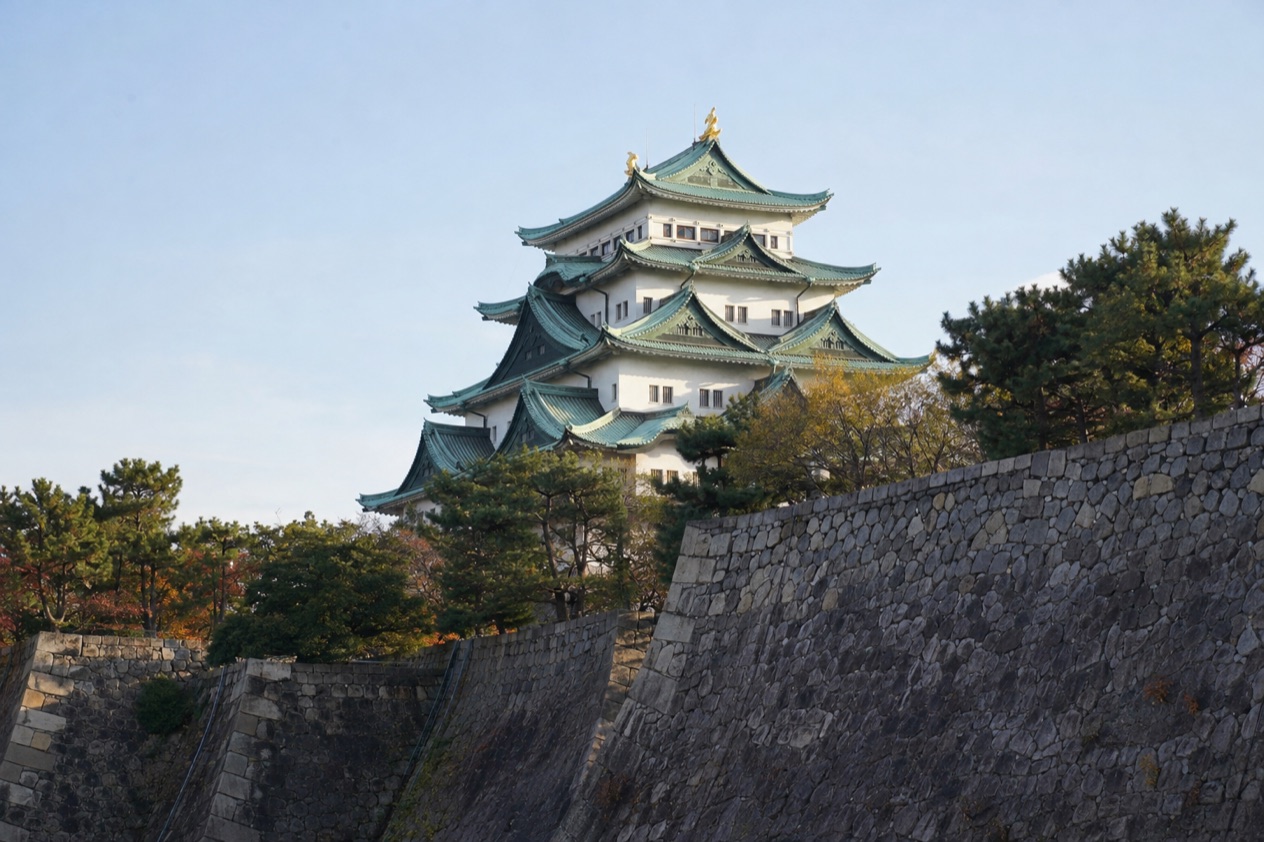
The castle district is where Nagoya shows its older side. Nagoya Castle was built in 1612 by Tokugawa Ieyasu, and a large part of it burned down during the Pacific War before its restoration in 1959. Its golden tiger-headed carp, the Kin no Shachihoko, are often used as the symbol of Nagoya. Wide moats and stone walls give the surroundings a spacious feel, and the Honmaru Palace is part of the grounds.
Atsuta Shrine lies elsewhere in the city, in a wooded precinct. It is one of the most significant Shinto shrines in Japan, and its sacred sword, Kusanagi, one of the Imperial Regalia, is never shown to the public.
Staying near either site gives a slower evening, with fewer restaurants but a different light on the stone and trees. Lodging is mostly business hotels and a few traditional-style inns, and travelers should plan to take a train or subway into the city for dinner.
It suits visitors whose first interest is history, repeat travelers and anyone who prefers a calmer end to the day. A tip: during the Nagoya Castle Autumn Festival, admission to the Honmaru Palace runs until 1 hour before gate closing, so plan your visit with that in mind.
Nagoya areas compared
| Area | Best for | Feel | Getting around |
|---|---|---|---|
| Nagoya Station area | First visit, rail travel | Commercial, hotel towers, department stores | Trains, Shinkansen and subway meet here |
| Sakae | Shopping, dining, nightlife | Downtown, lit at night | Subway |
| Osu | Browsing, snacks, independent travel | Covered arcades, small shops, a temple | Subway |
| Castle and Atsuta Shrine | History, a calmer evening | Moats, stone walls, wooded shrine grounds | Subway and train |
The main trade-off is between being close to the rail hub and being close to the evening life of the city. Staying at Nagoya Station puts the trains right under you, which matters when you are moving on to other cities or arriving with heavy bags. Staying in Sakae or Osu puts dinner and a late stroll on your doorstep, and a short subway ride brings you back to the station when it is time to go.
The other trade-off is old against new. The castle and the shrine give a sense of history and open space, but dining options are thinner and you will usually travel to eat. The newer districts give you more choice for every meal, but the older landmarks are a trip away. Because Nagoya’s sights are spread across the city rather than clustered, many visitors accept a short commute in one direction or the other.
If you plan to use the NAGOYA Sightseeing Pass, which offers a great-value way to enjoy attractions including Nagoya Castle, the Chubu Electric Power MIRAI TOWER, the Nagoya Port Aquarium and the Higashiyama Zoo and Botanical Gardens, any of these areas works as a base, since the attractions themselves are scattered.
For a short stay, pick one base and move out from it. For a longer stay, you might split the trip: a few nights in the station or Sakae area for restaurants and trains, then a night or two nearer the castle or Atsuta Shrine for a slower pace. Moving between them is a short change of subway line rather than a major relocation.
How to choose your hotel in Nagoya
A city hotel is the standard choice in Nagoya, and the range runs from large international towers to business hotels with compact, efficient rooms. The business hotel is a Japanese category of its own: a small private room with a bed, a tiny bathroom, a desk and little else, often with a breakfast room downstairs. It suits solo travelers and short stays, while a larger hotel gives more space for couples, families and longer visits.
A capsule hotel is a very different thing: a sleeping pod in a shared space with common bathing and storage. It is a way to sleep cheaply near a station and is best treated as a place to rest rather than a base for lingering. Guesthouses and apartment-style rooms offer more of a lived-in feel, with shared lounges or small kitchens, and they appear most often in districts like Osu, where the streets are smaller in scale.
A ryokan is the traditional Japanese inn, and the form is believed to have emerged in the 8th century. A stay typically brings tatami floors, futons laid out for the night, private baths (sometimes outdoor), a yukata (a light cotton robe) to wear, a kaiseki dinner (a multi-course meal of small seasonal dishes) and a traditional Japanese breakfast. In a city like Nagoya, a ryokan-style stay is a change of pace from the towers, and it suits travelers who want one evening of ritual and quiet.
Heritage Stays are another route to something traditional. At these properties, visitors can take part in cultural activities such as tea ceremony, calligraphy and wearing traditional Japanese clothing. Reservations are required and can often be made through the property’s website or by phone. They are a good fit for travelers who want their lodging to be part of the experience rather than only a place to sleep.
Think about distance to a station more than distance to a landmark. In Nagoya, the subway and the trains carry you everywhere, so a hotel close to a station gives you the whole city. If you arrive through Chubu Centrair International Airport, on its artificial island, remember the ride into town before you pick a hotel far from the main rail hub.
For families, choose a room with enough floor space for everyone to move about, and a location near a station with plenty of restaurants. For travelers with limited mobility, a hotel with an entrance that connects directly to a station reduces the stairs and streets between you and your bed. Staying near the zoo and botanical gardens, or near the aquarium, suits families with young children whose day centers on those attractions.
Finally, think about food. Nagoya is a city that eats well, and the best evenings often start with a plan: eel one night, miso katsu the next, a pot of miso-nikomi udon on a cool evening. A base in Sakae or the station area puts those meals within reach of your hotel door, while a stay near the castle may mean a train ride to dinner.
Good to know before you go
Chubu Centrair International Airport, Japan’s third major international gateway, sits on an artificial island 30 minutes south of central Nagoya, and the city’s main rail hub lies at Nagoya Station. Most hotels cluster around the station, Sakae and Osu, so you can step off a train and be at your lodging soon after. Nagoya-meshi can be found in all three districts, so you will not need to travel far for a first meal.
Sources
- Visit Nagoya, the Nagoya city guide (https://www.nagoya-info.jp/en/), checked October 11, 2026
- Wikipedia, Nagoya (https://en.wikipedia.org/wiki/Nagoya), checked October 11, 2026
- Wikivoyage, Nagoya (https://en.wikivoyage.org/wiki/Nagoya), checked October 11, 2026
- Japan National Tourism Organization, ryokan stays, what is included, etiquette (https://www.japan.travel/en/guide/japanese-ryokan/), checked October 11, 2026
- Japan National Tourism Organization, heritage stays (https://www.japan.travel/en/heritage-stays/), checked October 11, 2026
To plan your stay
- Best Time to Visit Nagoya: Cherry Blossoms, Autumn Leaves, Weather and Festivals
- Things to Do in Nagoya: Castle, Atsuta Shrine, Nagoya-meshi and Day Trips
- Nagoya from Tokyo: Shinkansen Services, Local Trains, Centrair Airport and a Day in the City
- Know Before You Go to Nagoya: Entry, Money, Getting Around and Local Etiquette