
Early May in Nagoya is a month of paper carp. Koinobori, the colorful windsock streamers shaped like koi, ripple from poles and balconies for Children’s Day, and the city hums with a long holiday mood before settling back into work.
Then the greenery thickens, the days stretch toward evening, and the table fills with miso katsu and eel. May is a month for castle grounds, shrine paths and long, unhurried meals in one of Japan’s great food cities.
What is the weather like in Nagoya in May?
Warm and mostly comfortable, with a clear step up from April and a first hint of the damp that arrives in June.
| Month | Average high (°F) | Average low (°F) | Precipitation (in) | Days with 1 mm or more of precipitation | Hours of sunshine | Daylight on the 15th |
|---|---|---|---|---|---|---|
| April | 68.2 | 49.5 | 5.02 | 9.4 | 200 | 13 h 02 min |
| May | 76.3 | 58.8 | 5.92 | 9.7 | 206 | 13 h 59 min |
| June | 81.7 | 66.9 | 7.34 | 11.6 | 152 | 14 h 31 min |
Afternoons in the mid-70s are made for walking outdoors in short sleeves, and the nights are mild enough that a thin layer is all you need after dinner. A light jacket or a simple sweater covers most of what spring in Japan asks of a traveler. Pack light layers that you can add or remove as temperatures change.
May has slightly fewer rainy days and considerably more sunshine than June. A compact umbrella earns its place in the bag. The sunshine total is the highest of the three months, which means real sun on castle walls and garden paths, and a hat is welcome.
May’s longer days leave more daylight for late-afternoon sightseeing. Humidity creeps up compared with April, a first taste of the sticky weather that defines the weeks ahead, though May stays far more pleasant than the summer months.
What to do in Nagoya in May
The month opens inside Golden Week, the holiday stretch that runs from late April into the first days of May. Three of its public holidays land in May: Constitution Memorial Day, Greenery Day and Children’s Day. Streets and parks take on a family feel, and the carp streamers are the signature of the season. After the holiday, Nagoya returns to its ordinary rhythm of office workers, lunch sets and department store food halls.
Nagoya is a city of big, solid attractions rather than a single historic quarter, and May weather suits them well. The NAGOYA Sightseeing Pass is a value-minded way to enjoy several of them, including Nagoya Castle, Chubu Electric Power MIRAI TOWER, the Nagoya Port Aquarium and the Higashiyama Zoo and Botanical Gardens.
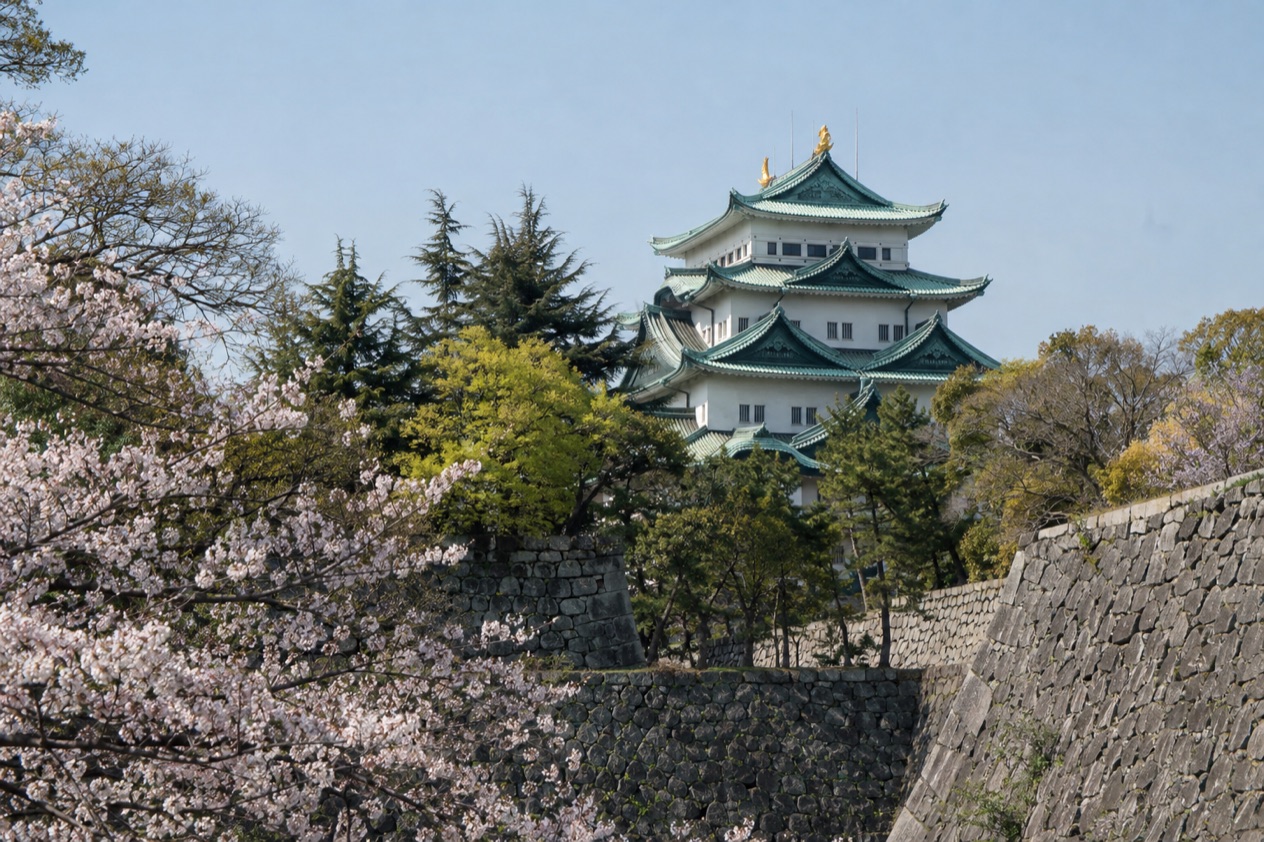
Nagoya Castle and its grounds
The new leaves on the old trees frame the keep and the stone walls, and the lawns fill with families on holiday days. You can spend a long, slow visit taking in the moats, walls and spring greenery.
The sun is strong enough by midday that a hat helps on the open ground, and the shaded paths under the trees give welcome relief. Pair the castle with a lunch of local specialties nearby, and let the afternoon go to another sight. It suits anyone who likes history told in architecture rather than in museum labels, and children enjoy the sheer scale of the walls.
Atsuta Shrine
Atsuta Shrine is among the most important Shinto sites in the country, and it sits in its own pocket of woodland in Atsuta-ku. Walking the gravel approach under tall camphor trees is the main pleasure, and in May the canopy is thick and green overhead. Along the path you pass offering halls, stone lanterns and small subsidiary shrines, and the quiet works as a break from the city’s pace.
Visitors pair the shrine with a bowl of hitsumabushi, Nagoya’s grilled eel served over rice and eaten in three stages: plain, with condiments, then as a tea-poured soup. Eel restaurants cluster around the shrine, so a meal here makes a natural pairing for the walk. It suits travelers who like their sightseeing with a clear, tasty reward at the end.
Higashiyama Zoo and Botanical Gardens
A day at Higashiyama Zoo and Botanical Gardens works well with May temperatures. The grounds combine animal enclosures with planted gardens and a greenhouse, so you can follow the season in the flower beds while moving from one exhibit to another. In warm spring weather, long strolls through the garden side feel more pleasant than they would in July.
It fits families, and also anyone who likes botanical gardens in leaf. If a shower rolls in, the indoor buildings give you shelter, and you can pick the outdoor paths back up once the rain stops.
The waterfront and the tower
The Port of Nagoya Public Aquarium is a dependable indoor stop, handy when May rain turns the afternoon gray. Chubu Electric Power MIRAI TOWER gives a view over the city grid and, on a clear day, a sense of how far the metropolitan area stretches. Together they make a gentle contrast with the castle and shrine, one a modern waterfront outing, the other an urban lookout.
Food is the thread through all of this. Nagoya’s cooking is known for its bold, dark flavors: miso katsu, pork cutlet under a sweet-savory red miso sauce, tebasaki chicken wings with pepper and sesame, kishimen flat noodles and ankake spaghetti in a thick, peppery sauce. A May day of walking makes any of them welcome, and the season’s warmth makes a cold beer with the wings an easy choice.
Cherry blossom season has already passed through this part of Japan by May, since the Somei-Yoshino trees reach the Tokai area in late March. What you get instead is deep green, flowering shrubs and the bright costumes of spring festivals, a very different kind of beauty. Fresh tea and sweets made with seasonal ingredients appear in shops and department store food halls as well.
A two-day itinerary for Nagoya in May
Day 1 belongs to the castle and the shrine. Start at Nagoya Castle in the morning, when the paths under the new leaves are cool and the walk around the moat and walls goes pleasantly. Take your time with the palace interiors, then stop for lunch at a local restaurant serving miso katsu, a dish that suits a hungry sightseer.
In the afternoon, go to Atsuta Shrine and walk the long approach under the camphor trees. If you skipped a heavy lunch, an eel restaurant near the shrine is the natural place for a late meal of hitsumabushi. With the day long and light, you can continue the evening in an izakaya, a casual pub, with tebasaki wings and a drink, and still walk back in the last light.
Rain plan for Day 1: make the Port of Nagoya Public Aquarium your indoor alternative. Day 2 turns to animals, gardens and the view. Spend the morning at Higashiyama Zoo and Botanical Gardens, tracing the planted areas and the greenhouse, and finish with a simple lunch of kishimen noodles. By early afternoon, move on to the Port of Nagoya Public Aquarium, a good fit for the warmest hours since you are indoors.
Close the day at Chubu Electric Power MIRAI TOWER as the city lights come on, and have dinner in the same area. If the weather turns, the aquarium moves to the morning and the zoo’s indoor buildings fill the gaps, so the plan holds with only small changes. Ankake spaghetti makes a fitting last meal for a damp evening.
Is Nagoya busy in May?
The first days of the month fall inside Golden Week, the holiday period from 29 April to 5 May, so that is when the city’s pace is most shaped by the calendar. Four days of the period are official public holidays: Showa Day, Constitution Memorial Day, Greenery Day and Children’s Day. After the last of them, the month goes back to its everyday rhythm.
Two rules can stretch the holiday. When a national holiday falls on a Sunday, the next working day becomes a public holiday, known as furikae kyujitsu. And a day that sits between two other national holidays becomes a holiday itself, known as kokumin no kyujitsu. When a national holiday falls on a Sunday, the next working day becomes a public holiday, which can extend Golden Week in some years.
Nagoya is the fourth-largest city in Japan, and the metropolitan area around it has about 10 million people, so the city has the capacity of a major urban center in any month. May’s other effect is on the weather and the light, which draw people outdoors.
What to pack for Nagoya in May
The month calls for layers that you can shed as the day warms, with light protection from sun and rain.
- A light jacket or a simple sweater, for cooler mornings and evenings.
- Short-sleeved shirts, for warm afternoons of castle and garden walking.
- A compact umbrella, because showers come on roughly one day in three.
- A sun hat, for the open grounds of the castle and the zoo gardens.
- Comfortable walking shoes, for long gravel paths at the shrine and castle.
- A small day bag, for the layers you will shed as the day warms.
Good to know before you go
May is dominated by the Golden Week holidays in its first days, and by the ordinary city rhythm afterward. Shops in urban areas keep steady hours, which helps when you shop between sights.
| Place | Open |
|---|---|
| Shops in urban areas | Generally 10:00 a.m. to 8:00 p.m. every day |
Rural areas are different, with shops that often close earlier, sometimes as early as 6:00 p.m. If you plan a side trip outside the city, keep that in mind for dinner. June brings more rainy days than May, so the damper weather is a few weeks away.
Nagoya in May vs April and June
An April trip is cooler, with highs in the upper 60s and lows near 50, so you want a real jacket in the evening. April is cooler, while May brings fuller spring greenery. Golden Week begins at the very end of April, so the tail of that holiday can fall in the earlier month too.
A June trip is warmer and stickier, with highs in the low 80s and lows in the mid-60s. Rain falls on more days and the sunshine drops sharply, so the gray spells run longer. The evenings are the longest of the three months, which helps, but you will feel the humidity on any serious walk.
Travelers who want warm, sunny days for the castle, the shrine and the gardens should choose May. Those who prefer cooler air for long walks, or who want to follow the bloom’s tail, should move earlier. If long evenings matter more than dry afternoons, June may suit you better.
Is May a good time to visit Nagoya?
Yes, for travelers who like warm days, green grounds and a food-focused trip. May suits families, who catch the Children’s Day mood, and food lovers, who get to work through eel, miso katsu and chicken wings with the weather on their side. It also suits anyone who wants to alternate outdoor and indoor sights, since the sunshine is generous and rain tends to come in interruptions.
Those who want the cherry blossoms should choose a different month, since the blooms have passed through the Tokai area by now. Travelers who dislike humidity should keep an eye on the second half of the month, as the damp creeps in.
On arrival, start with Nagoya Castle and its grounds, then let the shrine and a bowl of hitsumabushi fill the afternoon. What sets May apart here is the mix of fresh leaves, carp streamers in the first days, and dinners eaten in daylight that lingers well past the sights.
Sources
- Japan Meteorological Agency (JMA), Normal values 1991-2020, monthly (https://www.data.jma.go.jp/stats/etrn/view/nml_sfc_ym.php?prec_no=51&block_no=47636), station Nagoya, elevation 51 m, checked October 11, 2026
- Computed from the date and the latitude of the place (sunrise equation, solar elevation -0.833 degrees), October 11, 2026
- Japan National Tourism Organization, shop and attraction hours, national holidays (https://www.japan.travel/en/plan/business-hours-and-holidays/), checked October 11, 2026
- Wikipedia, Golden Week (Japan) (https://en.wikipedia.org/wiki/Golden_Week_(Japan)), checked October 11, 2026
- Wikipedia, Public holidays in Japan (https://en.wikipedia.org/wiki/Public_holidays_in_Japan), checked October 11, 2026
- Japan National Tourism Organization, flowers by season: cherry blossom, plum, wisteria, hydrangea, where and when (https://www.japan.travel/en/see-and-do/flowers/), checked October 11, 2026
- Wikipedia, Wisteria (https://en.wikipedia.org/wiki/Wisteria), checked October 11, 2026
- Japan Meteorological Agency, sakura2020.pdf (https://www.data.jma.go.jp/sakura/data/sakura2020.pdf), checked October 11, 2026
- Japan National Tourism Organization, spring in Japan (https://www.japan.travel/en/guide/spring-guide/), checked October 11, 2026
- Wikipedia, Kanda Matsuri (https://en.wikipedia.org/wiki/Kanda_Matsuri), checked October 11, 2026
- Wikipedia, Sanja Matsuri (https://en.wikipedia.org/wiki/Sanja_Matsuri), checked October 11, 2026
- Japan National Tourism Organization, festivals and events (https://www.japan.travel/en/see-and-do/festivals-and-events/), checked October 11, 2026
- Wikipedia, Gion Matsuri (https://en.wikipedia.org/wiki/Gion_Matsuri), checked October 11, 2026
- Wikivoyage, Nagoya (https://en.wikivoyage.org/wiki/Nagoya), checked October 11, 2026
- Visit Nagoya, the Nagoya city guide (https://www.nagoya-info.jp/en/), checked October 11, 2026
- Wikipedia, Nagoya (https://en.wikipedia.org/wiki/Nagoya), checked October 11, 2026
- Wikipedia, Atsuta Shrine (https://en.wikipedia.org/wiki/Atsuta_Shrine), checked October 11, 2026
- Japan National Tourism Organization, anime and manga (https://www.japan.travel/en/guide/japanese-anime-and-comics/), checked October 11, 2026
- Wikipedia, Ghibli Park (https://en.wikipedia.org/wiki/Ghibli_Park), checked October 11, 2026
- Wikipedia, Studio Ghibli (https://en.wikipedia.org/wiki/Studio_Ghibli), checked October 11, 2026
To plan your stay
- Things to Do in Nagoya: Castle, Atsuta Shrine, Nagoya-meshi and Day Trips
- Where to Stay in Nagoya: Nagoya Station, Sakae, Osu and the Castle Area
- Nagoya from Tokyo: Shinkansen Services, Local Trains, Centrair Airport and a Day in the City
- Know Before You Go to Nagoya: Entry, Money, Getting Around and Local Etiquette