
THE ALGARVE · FEBRUARY · 37.0° N
February hands the Algarve back to the people who walk it. Afternoons on the clifftops sit around 62.6°F, the light holds until 6:12 in the evening, and the coast road between Lagos and Sagres runs without the summer convoy. This is the month of long headland walks, town lunches and a rental car that actually gets to park where you wanted.
What it takes away is the beach day. The sea reads 61.3°F, and by law there is not a lifeguard on duty anywhere on the coast until Albufeira opens its season on May 15. So February is a very good Algarve trip with the swimming removed, which is a fair trade for some travelers and a deal-breaker for others.
THE MONTH AT A GLANCE · THE ALGARVE · FEBRUARY
February is the driest of the Algarve’s three winter months and the easiest one to walk, but the sea sits at 61.3°F and no council has lifeguards on duty until June 1 (Albufeira, May 15).
AVG HIGH 62.6°F · 5.4 WET DAYS · SEA 61.3°F · NO LIFEGUARDS UNTIL MAY 15
Go for: cliff walking and coastal driving in shirtsleeve afternoons, monuments without a line, and the lowest-demand stretch of the Algarve year.
Think twice before: booking a beach week. A February swim is a cold, unsupervised swim on every beach from Aljezur to Castro Marim.
Normals: IPMA station 554, Faro · Sea: Open-Meteo Marine · Bathing season: Diário da República · full sources at the end
On this page
- Algarve weather in FebruaryHighs of 62.6°F and 5.4 wet days
- Can you swim in the Algarve in February?A 61.3°F sea and no lifeguards
- February crowds and pricesWhere February sits in the demand year
- Things to do in the Algarve in FebruarySagres fortress hours and the Benagil cave rules
- A two-day February planTwo days built on 10 h 53 min of light
- February vs January and MarchThree months of normals in one table
- Is February a good time to visit the Algarve?Who it suits, and who should wait for March
One caution before the figures. They all come from a single station at Faro, and the Algarve is a 150 km coast: the higher ground inland reads colder and considerably wetter than anything here, and the Atlantic end past Sagres keeps its own weather. For the twelve-month picture across the country, the Portugal calendar does the wider comparison.
Algarve weather in February: average highs, lows and rain days
| February at Faro · 1991–2020 | Value |
|---|---|
| Average high | 62.6°F |
| Average low | 47.8°F |
| Precipitation | 1.65 in |
| Days with 0.04 in (1 mm) or more | 5.4 |
| Days with 0.39 in (10 mm) or more | 1.4 |
| Daylight on February 15 | 10 h 53 min |
These are IPMA normals, from Portugal’s national weather service: station 554 at Faro, 5.0 meters above sea level, averaged 1991 to 2020. It is worth knowing which kind of number you are reading. This is a real thermometer with a station number, not a reanalysis grid cell interpolated over a stretch of coast, and the difference shows up the moment you leave the shoreline for a hill road.
On the rain: 5.4 days in an average February record at least 0.04 inch, and 1.4 of them pass 0.39 inch. Those are IPMA’s own 1 mm and 10 mm thresholds, not the 0.10-inch line American tables use, so the counts are not interchangeable. Practically, expect around five days with something falling and one that arrives hard enough to end a cliff walk. The monthly total, 1.65 inches, is the lowest of the three winter months.
The spread is the part people underpack for: 62.6°F by mid-afternoon, 47.8°F before dawn, roughly 15 degrees between the two. A fleece and a shell over a T-shirt covers the whole day, and the shell earns itself on that one heavy-rain day. The packing guide handles the rest, including the shoes the limestone paths demand.
Light is the real constraint. On February 15 the Algarve gets 10 hours 53 minutes of daylight: sunrise at 7:19 and sunset at 6:12, local time, since Portugal runs on UTC through the winter. That means clifftop viewpoints are done by six, dinner happens after dark, and any drive along the coast wants to start before nine to be worth the daylight.
Can you swim in the Algarve in February? Sea temperature and what it feels like
The sea surface off the Algarve averages 61.3°F in February, from the Open-Meteo Marine dataset over 2015 to 2024. Read that number as a ceiling rather than a middle: it is the mean of daily maxima, so it sits a shade above what a 24-hour average would give you, and a 7 a.m. entry will be colder than the figure suggests.
At 61.3°F, an unprotected swim is a short one, measured in minutes rather than a morning. It is wetsuit water, which is why the surf schools keep working through winter while the sunloungers stay stacked. There is also a legal layer: Portaria n.º 204-A/2026/1 fixes the lifeguarded season beach by beach, and Lagos, Lagoa, Loulé, Faro, Olhão, Tavira, Silves, Aljezur and Vila do Bispo all run June 1 to September 30. Albufeira starts earliest, May 15, across 25 listed beaches. February falls outside every one of them.
On wind and swell we have no February normals for this coast that we were able to verify, so no figures appear here. What is documented is the water traffic: the maritime authority’s Edital 019/2024, amended in 2025, bans swimming into the Benagil sea cave and bans any craft from landing on the beach inside it. Guided kayak and paddleboard visits are allowed with a licensed guide and a cap on how many craft are inside at once.
How busy is the Algarve in February? Crowds, prices and the demand peak
The Algarve’s commercial year is bolted to the bathing season, and that season is written into the official gazette: June through September for nine of its councils. February sits four months clear of it. Hotels along the strip run reduced service and restaurant hours shorten. No rate series for the Algarve sits in our sources, so no month here gets crowned the cheapest. What the calendar does say is that February falls squarely in the low season.
Booking pressure follows the same curve. Two or three weeks of lead time is usually plenty for a coastal hotel and a car (est.), and there is no February equivalent of the August scramble. The one item with a hard ceiling is the guided cave trip: the number of craft allowed inside Benagil at any moment is capped by the maritime edital, and operators run fewer boats in winter, so that reservation gets made before the hotel does.
On the municipal tourist tax, our cards on the table: we could not confirm a per-night figure for Algarve councils at source, so no amount is quoted here. Ask at check-in and expect it on the folio rather than the booking. For everything else on the ledger, from car hire to a dinner for two, the Portugal trip-cost guide carries the tiers.
The one line where spending more genuinely changes February is the car. Without it the month shrinks to whichever town you slept in, because the walking is spread along 150 km of headlands. The A22 Via do Infante is reported to have been toll-free since January 1, 2025, though we could not confirm that on a readable operator page, so check before you drive. Our car guide covers the transponder question, and getting around handles the train alternative.
Things to do in the Algarve in February
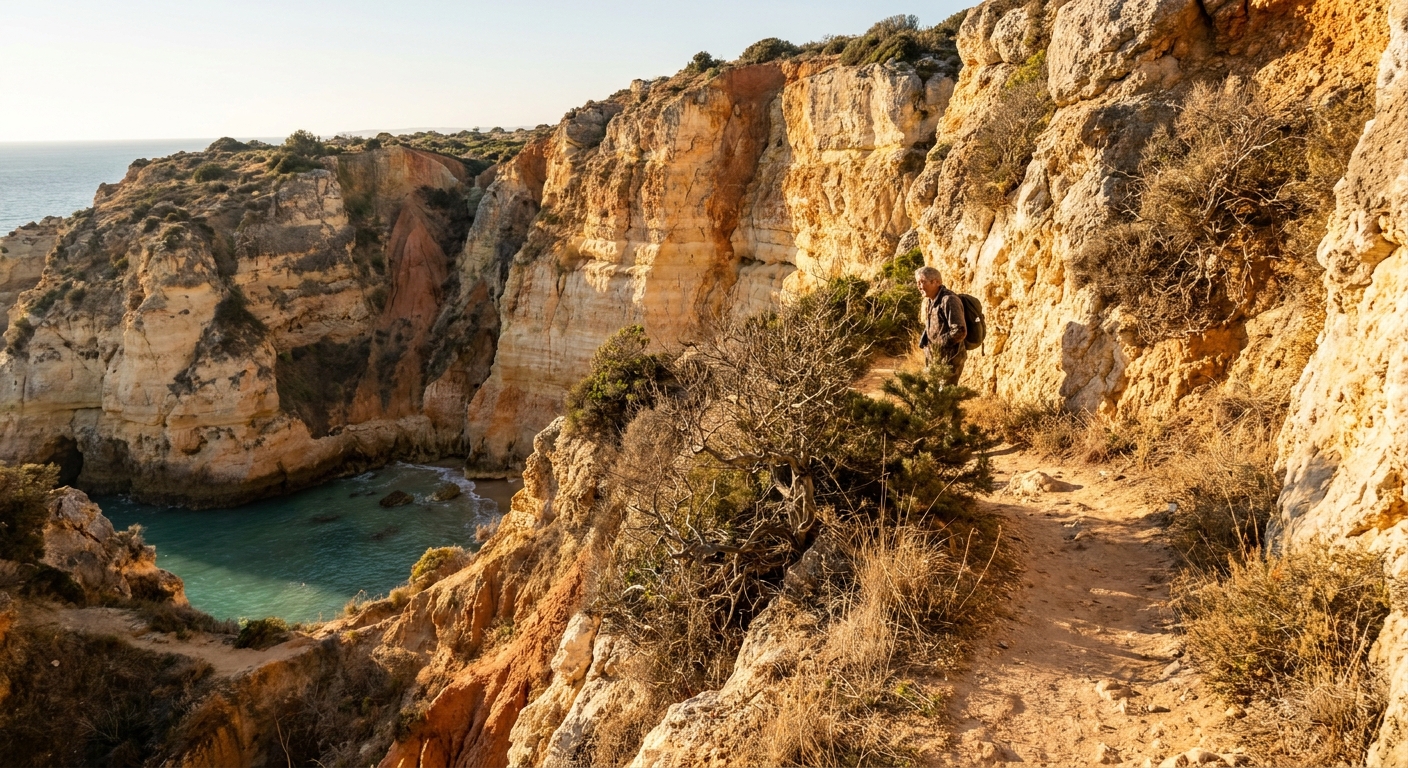
February’s specialty is distance on foot. A 62.6°F afternoon lets you walk the full headland circuits that turn punishing in July, and the paths above Ponta da Piedade and out to the Benagil arch are at their emptiest of the year. The trade is daylight: with the sun gone at 6:12, a long walk starts in the morning, not after lunch.
For the ticketed hours, the Fortaleza de Sagres opens 09:30 to 17:30, last entry half an hour before closing, and one ticket covers the fortress and the walk out along the promontory. We could not read the current adult price at source, because the monument publishes its table in JavaScript and the regional ticket shop was down, so ask at the gate. Note too that the Sunday and public-holiday free entry before 14:00 applies to residents of Portugal, not to visitors.
What costs nothing this month is most of the good part: the clifftop trails, the salt-pan and lagoon edges around Faro, and the tiled lanes and river bridge of Tavira, all of them free and all of them better without August heat. Beach access is free as well, with the obvious asterisk that nobody is watching the water until May 15.
The Algarve in February: a two-day itinerary
Day one, the western end. On the road by 8:30, while the air is still near the 47.8°F overnight mark, coffee in Lagos by nine. Walk the Ponta da Piedade cliffs from 09:30 to 11:30, when the low sun is still angling into the stacks. Drive west for lunch, then take the Fortaleza de Sagres in the early afternoon and keep an eye on 17:00, the last entry. Be back on the coast road before the 18:12 sunset.
Day two, the eastern end. Faro old town and the lagoon in the morning, Tavira after lunch, both walkable and both indifferent to the season. If the day turns into the month’s heavier one, the 1.4-day case, swap the headland for indoor hours: Faro’s museums and market, Tavira’s churches, and a long afternoon table. Save Carvoeiro and the guided cave paddle for whichever of the two mornings looks calmest, since the water plan is the weather-dependent one.
The Algarve in February vs January and March
| Measure · Faro, 1991–2020 | January | February | March |
|---|---|---|---|
| Average high | 61.3°F | 62.6°F | 66.0°F |
| Average low | 46.9°F | 47.8°F | 51.4°F |
| Precipitation | 1.94 in | 1.65 in | 1.84 in |
| Days with 0.04 in or more | 6.0 | 5.4 | 5.6 |
| Sea surface (daily-max mean) | 62.0°F | 61.3°F | 60.9°F |
Air and water move in opposite directions across these three months. The high climbs steadily, 61.3 to 62.6 to 66.0°F, while the sea drains the other way, 62.0 to 61.3 to 60.9°F, because the Atlantic is still cooling long after the land has turned around. February takes the driest slot of the three at 1.65 inches and the fewest wet days at 5.4, with January the wettest at 1.94 inches over 6.0 days.
Shift four weeks forward and March buys you 3.4 degrees on the afternoon and 3.6 on the night, plus close to an hour more daylight by month’s end. You give up 0.4 degrees of sea and 0.19 inch of extra rain, and you still have no lifeguard. Shift backward into January and the water is warmest of the three, which changes nothing for a swimmer and everything for nobody.
Is February a good time to visit the Algarve?
Yes, for walkers, drivers, photographers and anyone whose ideal day ends at a table rather than on a towel. A 62.6°F afternoon with 5.4 wet days in the whole month is generous weather for a coast this dramatic, at the year’s lowest rates. No, for a family beach week: the swimming is cold, unsupervised, and the beach clubs behind it are shut.
If that verdict lands on the wrong side, March is the near miss and June is the real answer. March adds warmth and light for the same walking trip. June opens the lifeguarded season across nine councils on the first of the month and puts the water back in the itinerary, at high-season prices, which is exactly what you would be paying for.
What no other month gives is this combination: the driest normals of the Algarve winter, 1.65 inches over 5.4 days, on a coast where you can have the Benagil headland path more or less to yourself at ten in the morning.
The last word
Come in February for the walking and the driving, book the car before the room, and stop negotiating with the sea. One last figure to file: the same 2026 gazette order that gives Albufeira five months of lifeguards gives a single beach in Castro Marim just two, July 1 to August 31. Even in the height of summer this coast is supervised unevenly, which makes February’s blanket answer, nobody on duty, easier to plan around than it first sounds.
Sources & data for this guide
- February, January and March normals (highs, lows, precipitation, wet days) · IPMA, climatological normals 1991–2020, station 554 Faro, 5.0 m · checked Sep 14, 2026
- Scope caution: Faro sits at the eastern end of a 150 km coast, and inland high ground is colder and wetter · IPMA station metadata · checked Sep 14, 2026
- Sea surface 61.3°F, and 62.0°F / 60.9°F for January and March · Open-Meteo Marine API, mean of daily maxima 2015–2024 · checked Sep 14, 2026
- Daylight 10 h 53 min, sunrise 07:19 and sunset 18:12 UTC on February 15, converted to Europe/Lisbon · sunrise-sunset.org · checked Sep 14, 2026
- Lifeguarded season by council, including Albufeira May 15 to Oct 15 and Castro Marim’s single Jul 1 to Aug 31 beach · Diário da República, Portaria n.º 204-A/2026/1, annex I · checked Sep 14, 2026
- Benagil cave rules: no swimming in, no landing inside, guided craft capped · Autoridade Marítima Nacional, Edital 019/2024 as amended by Edital 009/2025. The edital text itself was not read at source, so tonnage and duration details are unconfirmed · checked Sep 14, 2026
- Fortaleza de Sagres hours 09:30–17:30 and resident-only free entry before 14:00 on Sundays and holidays · Monumentos do Algarve / DRC Algarve. The adult ticket price loads in JavaScript and the regional ticket shop was unreachable, so no price is quoted · checked Sep 14, 2026
- A22 Via do Infante reported toll-free since Jan 1, 2025 · unconfirmed: vialivre.pt and Infraestruturas de Portugal serve their pages in JavaScript · verification attempted Sep 9, 2026
- Rate and lead-time statements marked (est.) are editorial signals, not quotes · operators change winter hours without notice, so confirm when you book.