
ALGARVE · SAFETY · 150 KM OF COAST
The Algarve’s dangers are not the ones travelers pack for. What hurts people on this coast is water, height and the drive between them: a swim on a beach nobody is watching, a photograph taken one step past a sandstone lip, a cove that fills in while you doze. Crime barely registers in the file. So the useful questions here are about dates, tides and published rules, and most of them have answers you can look up before you fly.
Those answers start with a date that changes as you drive. Portugal fixes its bathing season by law, council by council, and for 2026 Albufeira’s lifeguards go on duty about two weeks before the rest of the coast and stay roughly a fortnight after. The gap matters most in May and October, when one council is covered and the neighboring nine are not.
SAFETY AT A GLANCE · ALGARVE
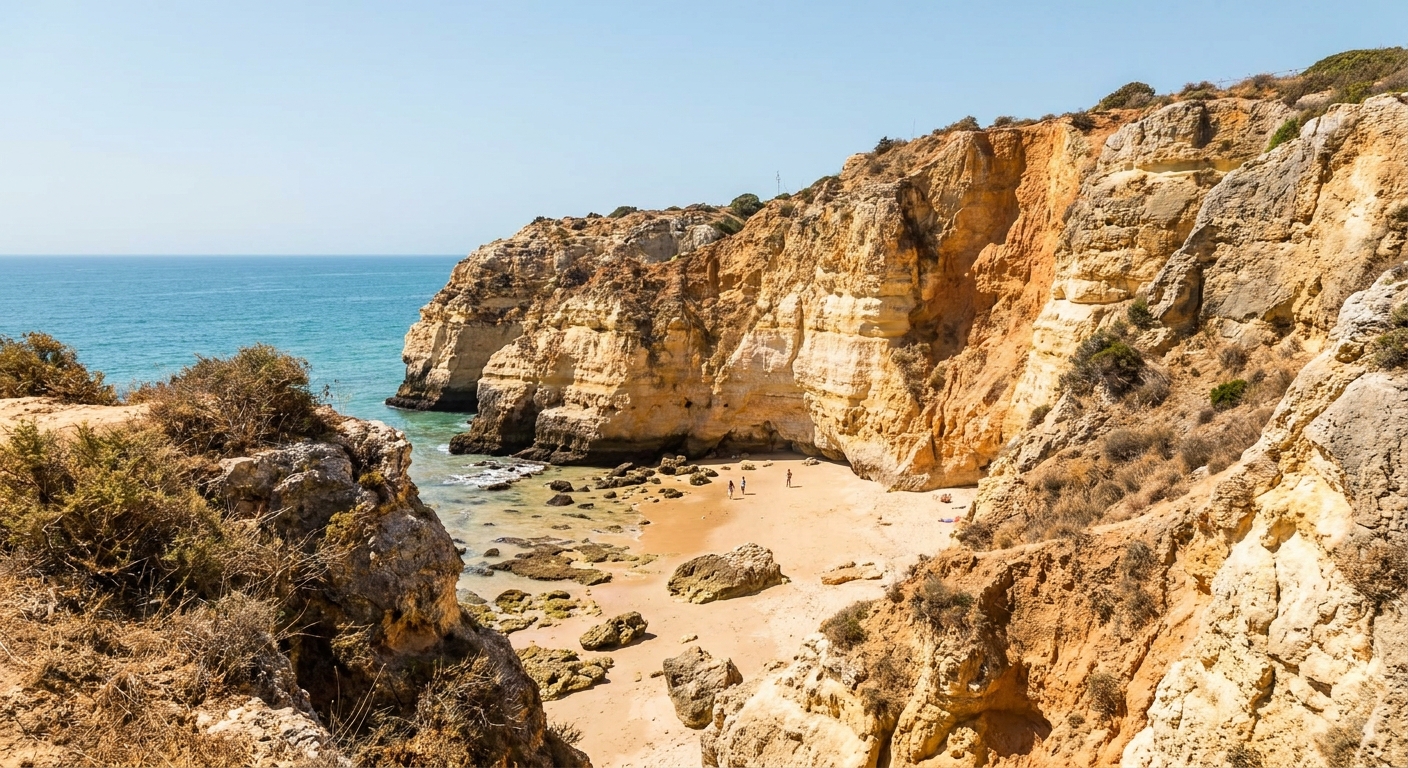
The real risks on this coast are the unwatched swim, the crumbling cliff edge and the cove that closes behind you, and all three are managed by dates, tide times and posted rules rather than by luck.
LIFEGUARDS JUN 1 – SEP 30 IN MOST COUNCILS · ALBUFEIRA MAY 15 – OCT 15 · NO SWIMMING INTO BENAGIL
Go for: a coast where the rules are written down, published beach by beach, and posted at the top of the steps.
Think twice before: swimming outside the guarded season, napping under an overhang, or descending into a pocket cove without knowing when the tide turns.
Season: Diário da República, Portaria n.º 204-A/2026/1 · Cave: Autoridade Marítima Nacional, Edital 019/2024 · full sources at the end
On this page
- When Algarve beaches have lifeguardsThe 2026 dates, council by council
- Cliff edges and clifftop pathsWhere the rock gives way, and the beaches under it
- Coves that cut off at high tideHow to check before you take the steps down
- Benagil cave rulesThe swimming ban, the arches and the timed stay
- Emergency calls in PortugalWhere the number is posted
- Pickpockets and beach theftWhat is not the problem in the Algarve
Every figure here that describes weather or water comes from one instrument: IPMA station 554 at Faro, a real thermometer at 5.0 m, sitting at the eastern end of a 150 km coast. Inland high ground is colder and far wetter, and the western end runs on its own Atlantic weather. Read Faro as Faro, not as the whole Algarve.
When are Algarve beaches supervised?
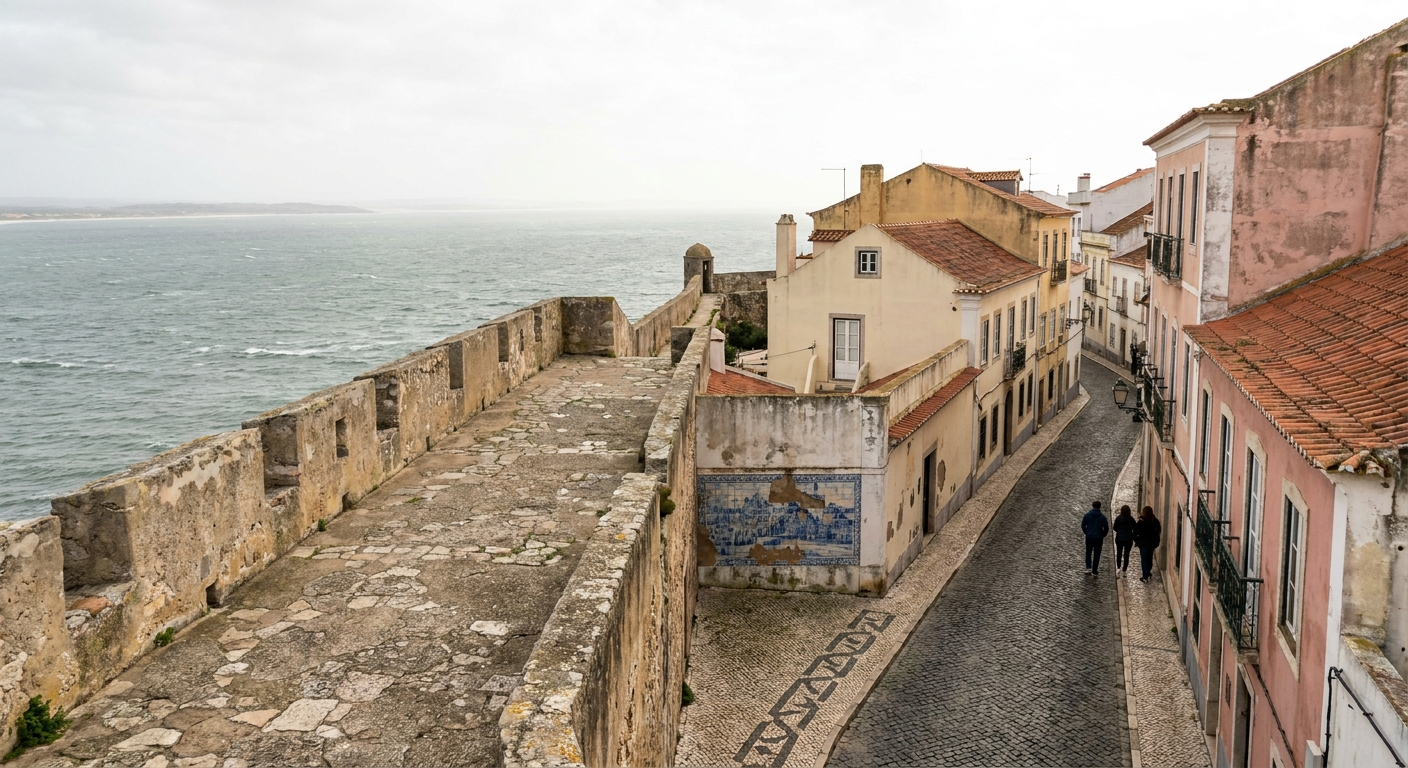
The season is set in the official gazette, not by the resort. Portaria n.º 204-A/2026/1, published April 30, 2026, fixes it beach by beach: Albufeira runs May 15 to October 15 across its 25 listed beaches, while Lagos, Lagoa, Loulé, Faro, Olhão, Tavira, Silves, Aljezur and Vila do Bispo all run June 1 to September 30. One beach in Castro Marim is shorter still, July 1 to August 31.
Supervised covers less ground than the word suggests. The same order designates which beaches count as bathing beaches and where lifeguard cover is guaranteed, and any beach absent from that list had no assured cover on the date of publication. A good number of the Algarve’s prettiest pockets of sand sit in exactly that category. Water quality on the listed beaches is published through the season by the national environment agency, which is a separate question from whether anyone is watching the water.
Out of season the map goes quiet fast. In May and in October, Albufeira is the only Algarve council with lifeguards on duty, so a swim anywhere else in those two months is an unsupervised swim whatever the thermometer says. The sea itself stays cooler than first-timers expect at both ends of the year: 62.0°F in January and 66.8°F in July, measured as the mean of daily maxima from 2015 to 2024. Our May and October pages carry the rest of the shoulder-season picture.
Are the Algarve cliffs safe to walk on?
The cliffs are why this coast photographs the way it does, and they are also why it fails. The rock is soft and layered, undercut from below by the same surf you came to swim in, and it comes down without a warning creak. Stay well back from any lip. Treat a fence as the minimum distance rather than a suggestion, and keep in mind that the ground nearest the drop is the part with nothing left underneath it.
That geology follows you down to the sand. At the coves around Ponta da Piedade and below the ochre walls at Carvoeiro, the only shade at midday sits directly beneath an overhang. Blocks the size of a cooler come off there, usually in winter and occasionally not. Put the towel on open sand and give up the shade.
Access is nearly always a staircase: timber, concrete or steps cut into the rock, often steep, sometimes damp long after the last rain. Handrails are not universal. Whatever you carry down, cooler, umbrella, small child, you carry back up in the afternoon, and July at Faro averages a high of 84.9°F. Shoes with grip beat flip-flops on wet stone.
What we cannot give you is a beach-by-beach ruling. The 2026 order tells us which beaches are designated and guarded, not which staircase is shut this month, and we found no machine-readable list of cliff closures at our last check. The sign at the top of the steps and the lifeguard at the bottom are better informed than any guide written in advance. Where a barrier says no, that is the answer for the day.
Which Algarve coves cut off at high tide?
A cove that is a beach at low water can be a wall of cliff and swell three hours later. The famous pockets along this coast have no back door: the sand does not run on to the next bay, and the way out is the way you came in. Nothing about the descent warns you, because at low tide the beach looks generous enough for a whole afternoon.
Check the tide before you take the first step, not once you are standing on the sand. Look up the day’s high water for the nearest port, note the hour it turns, and add the climb back. Down below, read the debris line against the rock: that dark band of wet stone and dried weed marks where the sea last reached, and everything under it is borrowed ground. Between June and September on a listed beach, the lifeguard will simply tell you.
If the water is already at the rocks, walk out now, while sand remains. Swimming around a headland to the next bay is how a pleasant afternoon becomes a rescue, since the current runs along the cliff rather than across it. Winter shortens the margin further: about 9 hours 57 minutes of daylight on January 15, with the sun gone at 17:39 local time. Stuck at the bottom, call for help instead of climbing.
Benagil cave rules: access, tours and swimming
The rules at Benagil are published, and they are stricter than the postcards suggest. Under the maritime authority’s Edital 019/2024, in force since August 13, 2024 and amended by Edital 009/2025, you cannot swim into the sea cave from the beach or from a boat, with or without a float, and no boat or kayak may land inside it. Guided kayak and paddleboard tours are allowed again, with a licensed guide, a cap on how many craft are inside at once, and a limit on how long each group stays.
Inside the arches, traffic is managed and the clock runs. Motorized boats must keep 15 meters off the arches and enter by the western one, while non-motorized craft use the eastern arch, and the visit is timed at two minutes for a motorized boat and up to eight for a guided paddle group. Renting a kayak to go in alone has been off the table since July 2025. Beyond all of that, the Atlantic has the final say, and a swell that builds through the morning can end the day’s trips.
A price is the one thing we will not put here. No tour fare was read at source, so none appears. We also have not read the text of the edital itself: the two-minute and eight-minute stays and the July 2025 end of unguided rentals reach us by way of the Capitania do Porto de Portimão. Before paying, ask the operator to name the license and the stay, and see our Benagil guide for the trip itself.
The emergency number in the Algarve
Portugal runs on the single Europe-wide emergency number, the one call that reaches police, ambulance and the maritime authority. We are not printing the digits here, because they were not re-read at an official source and a guessed number is worse than none. They are posted at manned lifeguard stations through the season, printed on rental car paperwork, and set out on our Portugal safety guide. Learn them before you land.
Crime in the Algarve: pickpockets and beach theft
Now the part that gets oversold. Nothing in our verified file points to crime as the visitor’s problem in the Algarve. We carry no regional crime statistics and will not manufacture any, but the incidents travelers actually describe are the ordinary resort-strip kind: a phone left on a towel while the whole group swims, a bag visible in a rental car at a trailhead. That is a locker habit, not a danger, and it should not shape your itinerary.
The national layer sits elsewhere. Documents, insurance, and what to do when a passport goes missing belong to our Portugal safety page, while the everyday practicalities, from pharmacies to tipping, live in Know Before You Go.
Your caution is better spent on the road than the sidewalk. Coastal lanes are narrow and blind, roundabouts arrive quickly, and a scraped rental is a common way for the week to go wrong. On the billing side, the A22, the Via do Infante that runs the length of the region, is reported to have been toll-free since January 1, 2025, though we could not confirm it on a government or operator page a machine can read, so check before you drive. Tolls are an invoice question, not a safety one. Our car guide handles the rest.
For a closing piece of reassurance, take the clifftop walk that looks most alarming from the road. The Fortaleza de Sagres opens 09:30 to 17:30, last entry half an hour before closing, and the ticket covers the fortress and the promontory behind it: a marked route on the cliff top with a gate, staff and a closing time. Sundays and public holidays are free until 14:00, but only for people resident in Portugal, not for visitors. The full adult fare could not be read at source, so ask at the gate, and see Sagres.
Sources & data for this guide
- Lifeguard season by council, Albufeira May 15 – Oct 15 and the nine councils on Jun 1 – Sep 30 · Diário da República, Portaria n.º 204-A/2026/1 of April 30, 2026, annex I · checked Sep 13, 2026
- Designated bathing beaches and guaranteed cover · same order, article 2 and the note to annex II · checked Sep 13, 2026
- Benagil access, arches, 15 meters and timed stays · Autoridade Marítima Nacional, Edital 019/2024 in force August 13, 2024, amended by Edital 009/2025 · checked Sep 13, 2026. Reserve: the edital’s own text was not re-read here; the two-minute and eight-minute stays and the July 2025 end of unguided rentals come by way of the Capitania do Porto de Portimão
- Fortaleza de Sagres hours and resident free entry · Monumentos do Algarve / Direção Regional de Cultura do Algarve · checked Sep 13, 2026. Reserve: the full adult ticket price loads in JavaScript and the regional ticket shop was unreachable, so no figure is given
- A22 toll status since January 1, 2025 · unconfirmed. vialivre.pt and Infraestruturas de Portugal serve their pages in JavaScript · attempted September 9, 2026
- Faro normals (61.3°F and 46.9°F in January, 84.9°F in July), daylight and sea temperature · IPMA station 554, Faro, 5.0 m, 1991-2020; Open-Meteo Marine 2015-2024; sunrise-sunset.org · checked Sep 13, 2026
- Cliff, staircase and tide guidance is editorial. No per-beach closure list was verified · read the signage and ask the lifeguard on the day.
To plan your stay
- Best Time to Visit the Algarve: Month-by-Month Weather, Sea Temperature and the Quiet Season
- Things to Do in the Algarve: Sea Caves, Cliff Trails, Lagoon Ferries and Winter Golf
- Where to Stay in the Algarve: Sagres, Albufeira, Tavira and the Car Question
- The Algarve in January: Weather, Sea Temperature, Crowds and Things to Do