
THE ALGARVE · MARCH · 37.0° N
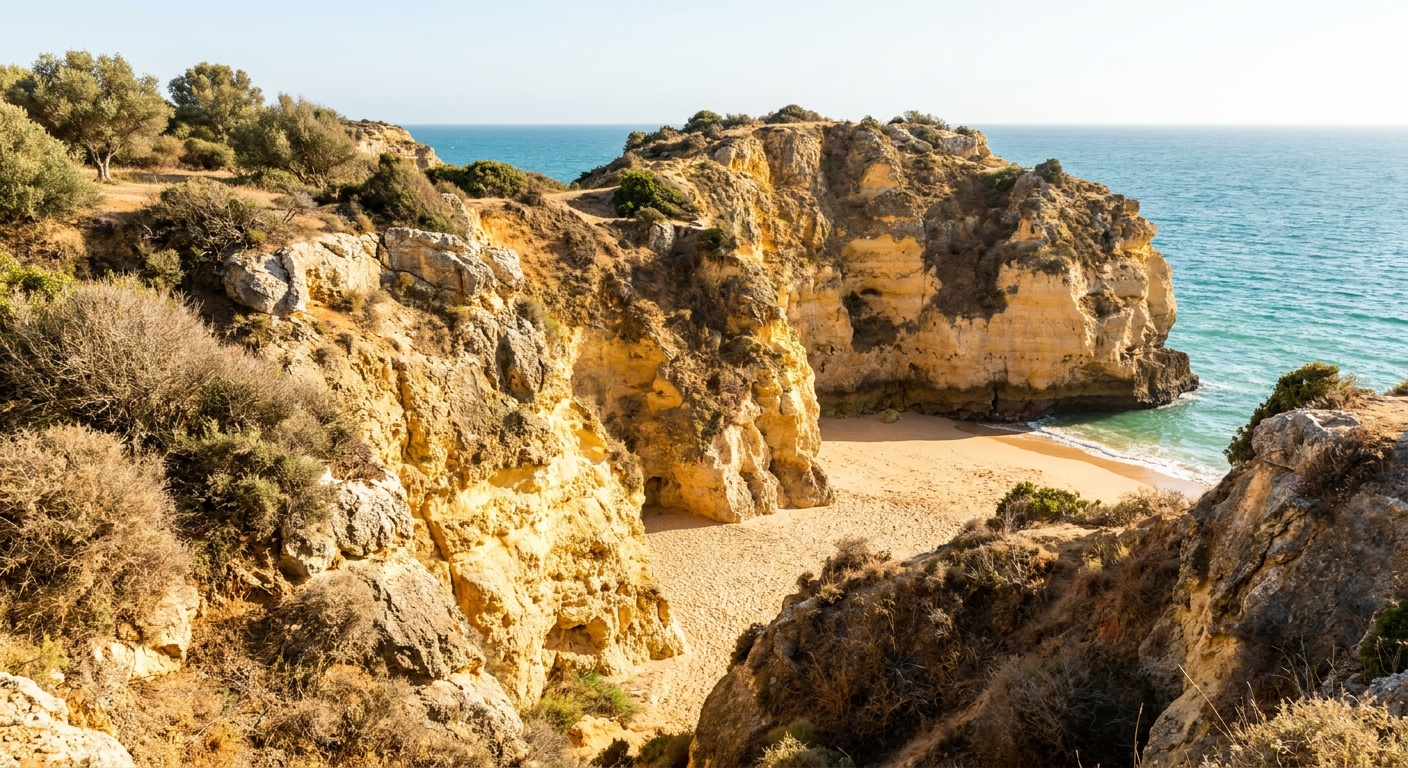
March is the month the Algarve stops being a winter coast and starts being a spring one, without yet becoming a beach coast. The official normals put the average high at 66.0°F and the average low at 51.4°F: shirtsleeves at lunch, a jacket by nine. Cliff paths are green, the arches at Benagil are quiet, and the water is colder than it was in February.
So the question is not whether the Algarve is nice in March. It is what these four weeks hand you (light, space, prices set before the season) and what they hold back (the swim, the lifeguards, the beach-club machinery). Both halves are numbers, and all of them are below.
THE MONTH AT A GLANCE · THE ALGARVE · MARCH
March gives you 66°F afternoons, 12 hours of daylight and cliff paths without company, and it withholds the swim: the sea averages 60.9°F and no Algarve beach has a lifeguard before May 15.
AVERAGE HIGH 66.0°F · 5.6 WET DAYS · SEA 60.9°F · NO LIFEGUARDS UNTIL MAY 15
Go for: coastal walking at 66°F, light from 6:40 a.m. to 6:40 p.m., Benagil by guided kayak, and rooms priced weeks before the bathing season opens.
Think twice before: booking March as a swimming trip. The sea reads 60.9°F as a mean of daily maxima, and the legal lifeguarded season starts May 15 in Albufeira and June 1 in nine other councils.
Normals: IPMA station 554, Faro, 1991–2020 · Sea: Open-Meteo Marine, 2015–2024 · Lifeguards: Diário da República, Portaria 204-A/2026/1 · full sources at the end
On this page
- Average highs, lows and rain days in March66.0°F high, 5.6 wet days
- Can you swim in the Algarve in March?Sea at 60.9°F, no lifeguards
- Crowds and prices before the bathing seasonWhere March sits in the year
- Things to do in the Algarve in MarchSagres hours, Benagil rules
- A two-day itinerary for MarchTwo days on 12 hours of light
- March, February or April?Three months side by side, in figures
- Is March a good time to visit?Who should book, who should shift
Four weeks either side changes the arithmetic more than you would guess, and both neighbors have their own page: the Algarve in February and the Algarve in April. For the full twelve-month view of the country, start with when to visit Portugal.
Algarve weather in March: average highs, lows and rain days
| Measure | March (Faro, 1991–2020) |
|---|---|
| Average high | 66.0°F (18.9°C) |
| Average low | 51.4°F (10.8°C) |
| Precipitation | 1.84 in (47 mm) |
| Days with 0.04 in (1 mm) or more | 5.6 |
| Days with 0.39 in (10 mm) or more | 1.6 |
| Sea surface | 60.9°F (16.1°C) |
| Daylight, March 15 | 12 hr 00 min |
Every temperature here comes from one thermometer: IPMA station 554 at Faro, five meters above sea level, averaged over 1991–2020. That distinction is worth a sentence, because a station record and a model grid cell are not the same claim. The March normals read 66.0°F for the high, 51.4°F for the low and 1.84 inches of rain. Faro also sits at the eastern, sheltered end of a 150-kilometer coast: the high ground inland runs colder and far wetter, and the west-facing shore keeps its own weather.
On rain, the count is 5.6 days recording at least 0.04 inch (1 mm), of which 1.6 reach 0.39 inch (10 mm) or more. Those are IPMA’s thresholds, not the 0.10-inch cutoff that American tables use, so the two sets of numbers do not swap. Translated into a trip: about five days with visible rain, most of it in bands that cross and leave the afternoon usable, one or two days when an outdoor plan genuinely breaks, and roughly twenty-five dry days in between.
The spread between a 66.0°F mid-afternoon and a 51.4°F pre-dawn is 14.6 degrees, and it lands in your suitcase rather than your schedule. A fleece or a light down layer for terrace evenings, a shell for the 5.6 wet days, and shoes with grip, because water sits in the limestone dips on the cliff paths for a day afterward. Our packing guide handles the rest of the list.
On March 15 the sun rises at 6:40 a.m. and sets at 6:40 p.m. local time: 12 hours 00 minutes, near enough the equinox split. That sunset hour sets the shape of the day. A cliff walk begun at nine finishes inside the warmest part of the afternoon, and dinner in Tavira or Lagos starts after dark rather than in it. Sunrise and sunset are calculated for the coast, and the last usable light on a west-facing beach runs a few minutes past the printed time.
Can you swim in the Algarve in March? Sea temperature and what it feels like
The sea surface off the Algarve averages 60.9°F in March. One nuance before anyone packs a swimsuit on that figure: it is the mean of daily maxima over 2015–2024, from the Open-Meteo Marine dataset, which makes it a shade warmer than a true 24-hour average. Water reading 60.9°F in the afternoon reads a little less at eight in the morning.
Sixty-one degrees is swimmable and not comfortable. Reckon on the first thirty seconds taking your breath, five to ten minutes of useful time bare-skinned, and a full hour if you have a 3/2 wetsuit, which the surf schools rent. Nobody is watching either: Portaria 204-A/2026/1 fixes the lifeguarded season beach by beach, opening May 15 in Albufeira and June 1 in Lagos, Faro, Tavira, Olhão, Loulé, Lagoa, Silves, Aljezur and Vila do Bispo. Every March swim on this coast is an unsupervised swim.
Wind and swell are the missing figures here. We found no March normal for either from a source worth printing, so none appears here: read the forecast for your dates, and treat the west-facing beaches around Sagres as the exposed flank of the coast. The Atlantic groundswell that made those beaches famous does not take the spring off.
How busy is the Algarve in March? Crowds, prices and the demand peak
March sits in the low half of the Algarve year, and the calendar explains why better than the thermometer does. The legal bathing season, the one that puts lifeguards on the sand, opens May 15 in Albufeira and June 1 in nine other councils. Hotels, beach concessions and boat operators build their pricing around that line. A March week therefore costs less than the same week in July, and the resort strips that fill with charter arrivals in August are quiet enough that plenty of restaurants keep winter hours.
The month’s quiet advantage is simple: you can watch a forecast before committing money. Two caveats. If your dates touch Easter, check them early, because the date moves every year and it lifts demand along the central coast. And boat operators run smaller March fleets, so a specific kayak departure sells out long before a hotel does.
We have no confirmed figure for a municipal tourist tax in the Algarve, so we prints none. If a nightly charge appears on your booking, it will be levied per person per night rather than as a lump sum, and it is normally collected at the property. Ask at check-in, and read the confirmation before you pay. Our Portugal trip-cost guide keeps the running budget lines.
One line is worth paying up for in March: the car. Cliff paths, the western beaches and the inland hills are all reached from a parking lot, and bus frequency between coastal towns is set for residents rather than visitors. The A22, the Via do Infante along the length of the coast, is reported to have run toll-free since January 1, 2025, though we could not confirm it on a page a machine can read, so verify before you drive. Details in renting a car in Portugal and getting around.
Things to do in the Algarve in March
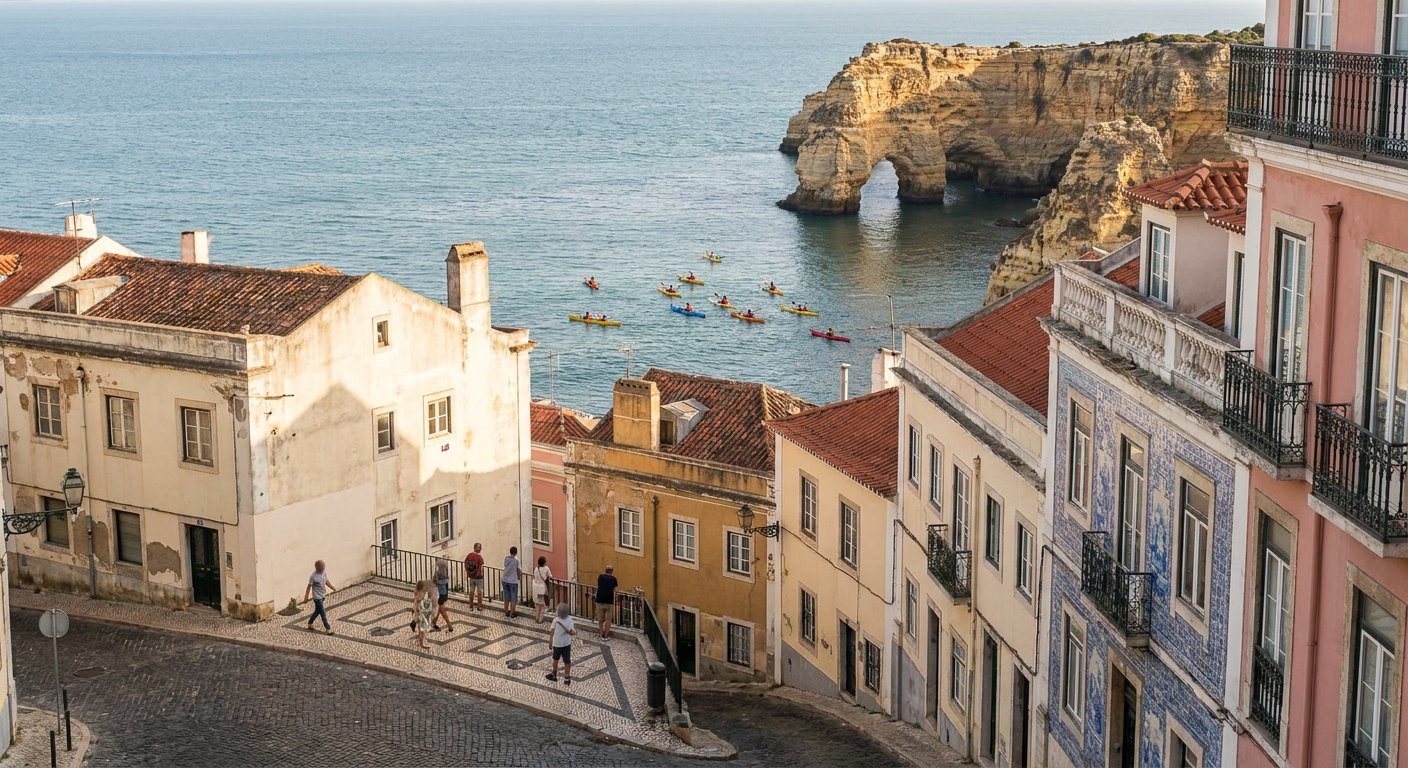
March hands you what midsummer cannot. The first is walking: 66.0°F at mid-afternoon is the temperature the cliff trails were built for, and 12 hours of daylight is enough for a long coastal stage with time to spare. The second is space on the water. Kayaks and paddleboards go out under the arches in small numbers this month, and the same route in August is a traffic pattern.
Named and dated: the Fortaleza de Sagres opens 09:30 to 17:30, last entry 17:00, and one ticket covers the fortress and the promontory walk behind it. We could not read the current adult price at source, because the monument serves its price table in JavaScript and the regional ticket shop was down, so ask at the gate. At Benagil, the maritime authority’s Edital 019/2024, amended by Edital 009/2025, bans swimming into the cave from shore or boat and bans any craft from landing inside. Guided kayak and paddleboard tours run with a licensed guide, a cap on craft inside and a time limit per group. Motorized boats stay 15 meters off the arches and enter by the western one, paddlers by the eastern.
Free this month: the sand, since no concession is renting loungers before the season, plus the cliff-top footpaths and the old-town streets of Tavira and Faro. One freebie that is not yours, though it is advertised everywhere: Sagres is free on Sundays and public holidays until 2 p.m. for residents of Portugal only. Visitors pay full price whatever the day, and Ponta da Piedade costs nothing from the clifftop.
The Algarve in March: two-day itinerary and daylight hours
Day one, central coast. Coffee at eight, on the trail by nine while the air is still in the fifties. Walk the clifftop out of Carvoeiro for two hours, when the sun is high enough to warm the limestone. Book a guided paddle to the arches for late morning, when the light comes through them. Lunch at two, in the warmest hour of the day. Keep 5 p.m. to 6:40 p.m. for the cliffs above Albufeira, then dinner after dark.
Day two, the west. Drive to Sagres for the 09:30 opening, walk the promontory before the wind builds, and give the afternoon to the surf beaches north of the cape with no intention of a long swim at 60.9°F. If the day turns into one of the 1.6 heavy-rain days, swap the exposed coast for Faro’s old town and the Tavira ferry-side lanes, then move the walking to the following morning: bands cross this coast quickly, and the afternoon usually comes back.
The Algarve in March vs February and April
| Measure | February | March | April |
|---|---|---|---|
| Average high | 62.6°F | 66.0°F | 69.3°F |
| Average low | 47.8°F | 51.4°F | 54.3°F |
| Precipitation | 1.65 in | 1.84 in | 1.54 in |
| Days with 0.04 in or more | 5.4 | 5.6 | 5.3 |
| Sea surface (daily-max mean) | 61.3°F | 60.9°F | 63.5°F |
All three columns come from the same IPMA station and the same 1991–2020 period, and the sea figures from the same marine series, so they compare cleanly. March is the wettest of the trio at 1.84 inches and carries the most wet days at 5.6. It is also the coldest water of the three, 60.9°F against February’s 61.3°F, because the sea lags the air by weeks. Air temperature, meanwhile, climbs steadily: 3.4 degrees on the high from February, another 3.3 into April.
Shift four weeks later and you gain a 69.3°F afternoon, 2.6 degrees of water and 0.30 inch less rain, and you pay for it in company and room rates as the season approaches. Shift four weeks earlier and February gives you slightly warmer water than March at 61.3°F with a 62.6°F high, which is a walking month and not a beach one either. The two neighbors are laid out in full on the February page and the April page.
Is March a good time to visit the Algarve?
Yes, for walkers, drivers, golfers, photographers and anyone whose ideal day ends with a two-hour dinner rather than a sunburn. A 66.0°F high with 12 hours of light is close to ideal for covering ground on foot, and the coast has room. No, for a family whose children measure a holiday in hours spent in the sea: 60.9°F water with no lifeguard on any beach until May 15 is a bad match for that trip, whatever the air does.
If the swim is the point, June through September is the answer, and the reason is legal rather than thermal: those are the months when lifeguard cover is guaranteed in every coastal council on the list. For a compromise, late May puts Albufeira inside its supervised season from the 15th while the rest of the coast is still quiet. The country-wide comparison lives in best time to visit Portugal.
What March alone offers: guided paddling under the Benagil arches at 66°F with a handful of craft in the water, on a coast that will not allow that combination again until autumn.
The last word
Book the room late and the car early, and let the 5.6 wet days rearrange your order of play rather than your trip. One last figure to file: Albufeira’s supervised season covers 25 listed beaches from May 15, and Portaria 204-A/2026/1 also names one beach in Castro Marim that gets lifeguards only from July 1 to August 31. Whichever month you choose, the sand in front of you is either on that list or it is not, and in March it never is.
Sources & data for this guide
- March, February and April normals (highs, lows, precipitation, wet days) · IPMA climatological normals 1991–2020, station 554 Faro, altitude 5.0 m · checked Sep 13, 2026
- Reach of those normals: a coastal station at the eastern end of a 150 km coast, inland high ground colder and wetter · IPMA, same record · checked Sep 13, 2026
- Wet-day thresholds are IPMA’s 1 mm and 10 mm, not the 0.10-inch cutoff used in US tables · checked Sep 13, 2026
- Sea surface 60.9°F (March), 61.3°F (February), 63.5°F (April), as means of daily maxima · Open-Meteo Marine API, 2015–2024 average · checked Sep 13, 2026
- Daylight 12 hr 00 min on March 15, sunrise 06:40 and sunset 18:40 UTC, converted to local time · sunrise-sunset.org · checked Sep 13, 2026
- Lifeguarded season by council, Albufeira May 15 to Oct 15, nine councils Jun 1 to Sep 30, one Castro Marim beach Jul 1 to Aug 31 · Diário da República, Portaria n.º 204-A/2026/1 of Apr 30, 2026, annex I · checked Sep 13, 2026
- Benagil access rules · Autoridade Marítima Nacional, Edital 019/2024 (in force Aug 13, 2024) amended by Edital 009/2025 · we did not read the edital text at source: treat the craft cap and time limit as unconfirmed · checked Sep 13, 2026
- Fortaleza de Sagres hours 09:30–17:30, last entry 17:00, resident-only free entry Sundays and holidays until 14:00 · Monumentos do Algarve / DRC Algarve · the adult price is served in JavaScript and the regional ticket shop was unreachable, so no price is printed · checked Sep 13, 2026
- A22 / Via do Infante reported toll-free since Jan 1, 2025 · unconfirmed: vialivre.pt and Infraestruturas de Portugal serve their pages in JavaScript · verification attempted Sep 9, 2026
- Booking lead times, in-water comfort durations and March boat traffic are editorial estimates, marked (est.); no tourist-tax figure is printed because none could be confirmed.