
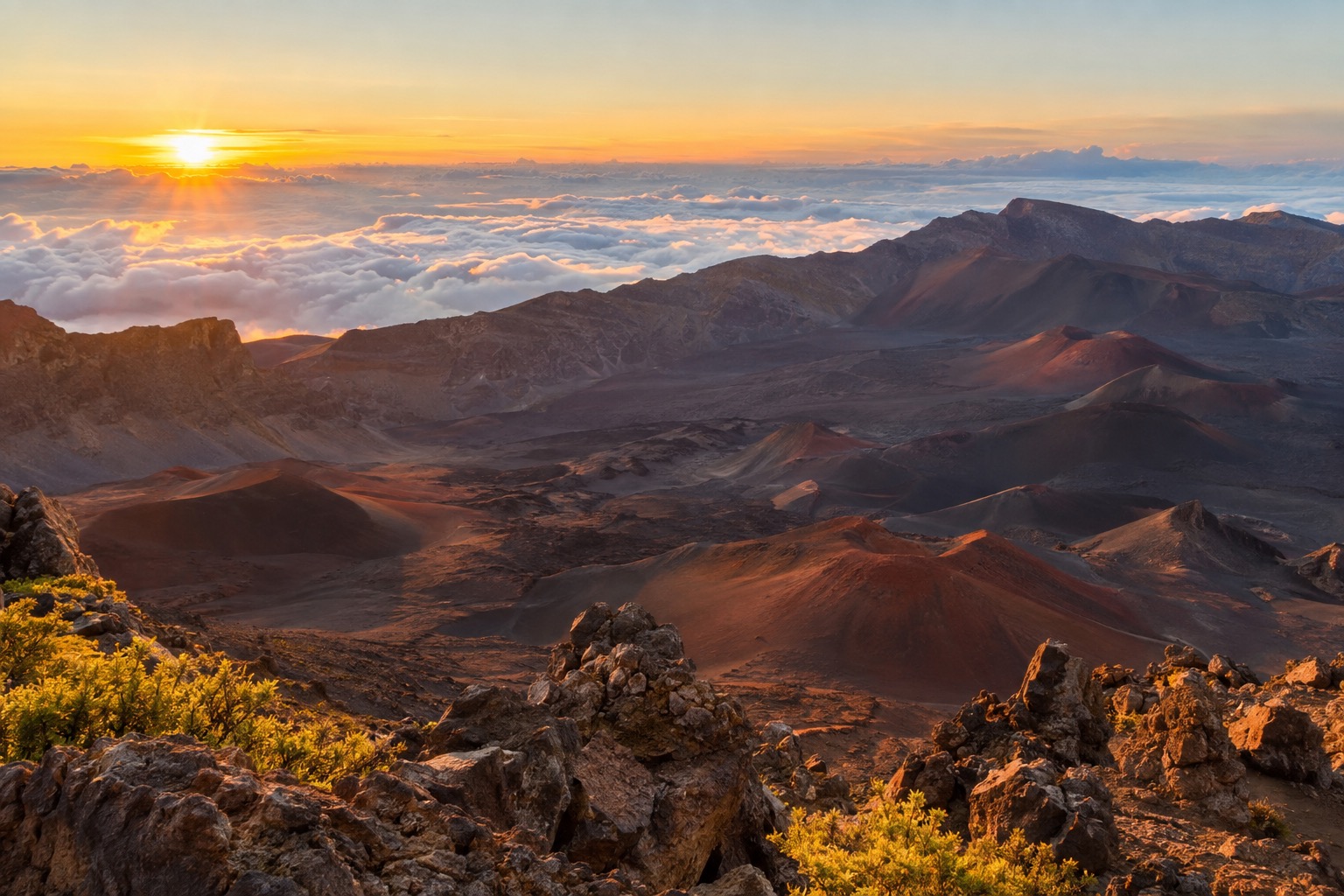
Before dawn on Haleakala the parking lots fill with people in borrowed blankets, stamping their feet and watching a thin orange line grow over the clouds. Then the light spills across a crater of red and black cinder cones, and the whole crowd goes quiet. This is the volcano that rises above Maui, a national park of high desert, rare plants and coastal waterfalls, made for travelers who like their vacations to include a mountain.
Where is Haleakala and what is it like?
Haleakala is the great volcano that makes up the eastern half of Maui, and its summit, Puuulaula, is the highest point on the island. The national park has two districts: the summit crater high above the island, and Kipahulu, far down on the wet coast past Hana. No road crosses the park between the two, so they feel like two different destinations.
The summit is a quiet, windswept place of cinder desert, thin air and enormous sky. Nothing is sold there, so the pace is set by the mountain itself. Kipahulu is the opposite, green, damp and loud with water. Travelers who love big landscapes and early alarms will be happy here. Those who want a beach day with a cocktail should treat Haleakala as an outing rather than a base.
What is there to do in Haleakala?
Sunrise at the summit
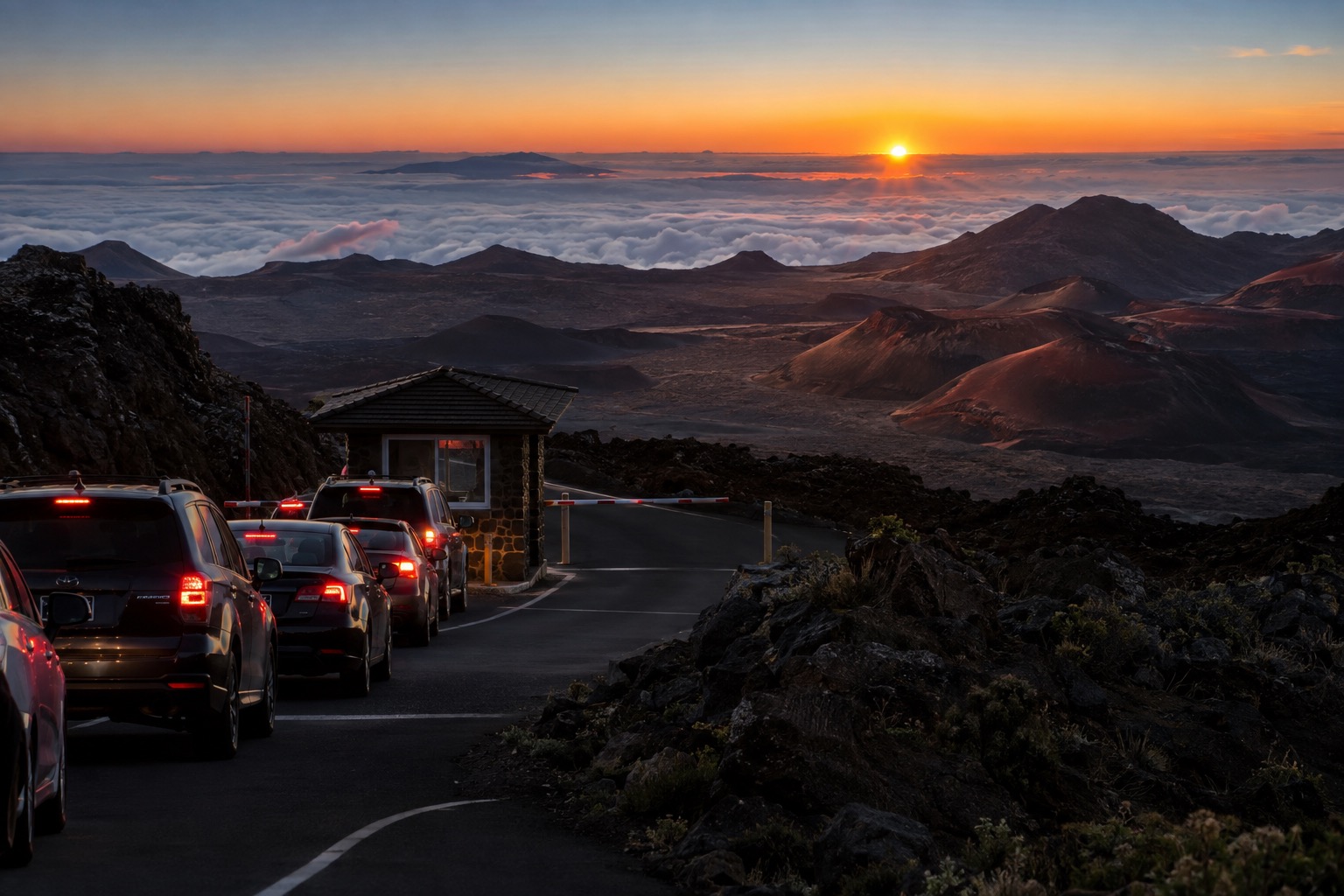
Watching the sun come up above the clouds is the reason most people drive up. The summit stands above 10,000 feet, and before dawn it is regularly wet, windy and below freezing, so dress for winter even if you slept on the beach. The Haleakala Visitor Center sits just below the top, and parking at both spots is very limited.
Every vehicle entering between 3 a.m. and 7 a.m. needs a sunrise reservation, which is booked in advance on Recreation.gov. If the crowd at the summit is not your idea of a peaceful morning, the park points to the Leleiwi and Kalahaku overlooks, where fewer people gather. They also work well in the daytime, when the crater colors turn deep rust and the clouds drift beneath the rim.
The crater and its wildlife
The crater floor is a cinder desert of red and black cones that looks more like another planet than Hawaii. This is the home of the silversword, a spiky silver plant found nowhere else, and of the nene, the Hawaiian goose, which the park protects. Walking here is slow work in thin air, so go gently and carry water.
For birds, Hosmer Grove is where native forest species are seen, and it makes a gentler stop lower on the mountain. Staying overnight is allowed only in designated camping areas. Neither gas nor food is sold in the park, so fill up and pack lunch before you climb.
Kipahulu and Waimoku Falls
Kipahulu lies on the coast 12 miles past Hana, at the end of the long, winding road that many visitors drive for its scenery alone. A trail leads to Waimoku Falls, a 400-foot ribbon of water dropping through bamboo and lush forest. The Pools of Oheo are closed to entry, so you look and photograph rather than swim.
Because no road links the two districts, plan Kipahulu as its own day, ideally combined with the Hana drive. It suits travelers who prefer rainforest and sound of falling water to high-altitude deserts.
How many days do you need in Haleakala?
One long day is enough for the summit, and two days let you add Kipahulu without rushing. A sunrise visit usually means an early start and a quiet afternoon, so pair it with a slow second half of the day rather than a packed schedule.
With more time, spend a full day on the Hana side for Kipahulu, then return to the summit another morning for a daytime walk among the cinder cones and the silverswords. A third visit at sunset or in the clear light after dawn shows how different the crater looks when the crowds are gone.
Where to stay in Haleakala
There is no lodging inside the summit area, and the only overnight option in the park is designated camping. Most visitors sleep elsewhere on Maui and drive up, which makes the choice of base a question of which coast you prefer.
Staying near Kahului puts you closest to the airport and the road up the mountain. Resort areas on the sunny coasts offer beaches and dining but mean a longer, earlier drive for sunrise. For Kipahulu, a night in or near Hana spares you the long road both ways in one day.
How do you get to Haleakala and get around?
The drive from Kahului Airport to Haleakala takes about 1 hour 50 minutes, and from the entrance gate to the summit takes roughly another 30 minutes. A car is the way to do it, since the park has no food, no gas and no electric-vehicle chargers.
Fill the tank and bring snacks before you leave the lowlands. Emergency medical help is at least one hour away from the summit, which is another reason to start the climb prepared. The two districts are not connected by road, so reaching Kipahulu means a separate drive along the coast.
When is the best time to visit Haleakala?
May through September is the best stretch for the summit, with the fewest rainy days. June, July and August are the driest, with only a handful of days of measurable rain, while the cooler months from November to March bring more showers and wetter mornings on the mountain.
The summit is cold in every month, at least 20 degrees below sea level and often below freezing before dawn, so the season changes how wet you get more than how warm. Kipahulu is a rainforest coast, and showers can arrive there at any time of year.
The Central Pacific hurricane season runs from June 1 to November 30, which covers much of the drier summer. Summer family weeks and the winter holidays tend to bring the most visitors, so sunrise reservations are worth securing early in those periods.
Good to know before you go
Bring layers, a hat, gloves and water, and fuel up before the climb. The air is thin at the top, so move slowly, and keep in mind that help is far away.
| Fee | Amount | Who pays |
|---|---|---|
| Private vehicle (valid three days, both districts) | $30 | Per vehicle |
| Motorcycle | $25 | Per motorcycle |
| On foot or bicycle | $15 | Per person, ages 16 and up |
| Sunrise reservation (3 a.m. to 7 a.m.) | $1 | Per vehicle, in addition to entrance |
Sources
- NPS, pages Puuulaula (nps.gov/places/puuulaula.htm) and Plan Like a Park Ranger: Top 10 Tips, checked September 25, 2026
- NPS, Haleakala, pages Summit District and Sunrise, checked September 25, 2026
- NPS, Haleakala National Park, pages Sunrise (nps.gov/hale/planyourvisit/sunrise.htm) and Fees & Passes, checked September 25, 2026
- NPS, Haleakala National Park, Fees & Passes, checked September 25, 2026
- NPS, Sunrise ; HVCB, map Driving Times from Kahului Airport (2010), checked September 25, 2026
- NPS, Haleakala, Summit District, checked September 25, 2026
- NPS, Haleakala, pages Sunrise and Summit District, checked September 25, 2026
- NPS, Haleakala, Kipahulu District, checked September 25, 2026
- NOAA NCEI, normals 1991-2020, station USC00511004, via PLAN-HAWAII.md §1
- NWS Honolulu / Central Pacific Hurricane Center, « 2026 Central Pacific Hurricane Season Outlook », weather.gov/hfo/hurricaneOutlook2026, checked September 24, 2026
- NOAA NCEI, monthly normals 1991-2020, station USC00511004, checked September 8, 2026
All our pages
When to go
- Best Time to Visit Haleakala: Weather by Month, Sunrise Seasons, Crowds and Events
- Haleakala in January: Weather, Summit Sunrises and What to Do
- Haleakala in February: Summit Sunrise, Cool Weather and Whale Season
- Haleakala in March: Weather, Sunrise, Hiking and Whale Season
- Haleakala in April: Weather, Sunrise and Summit Hikes
- Haleakala in May: Summit Sunrise, Mountain Weather and What to Do
- Haleakala in June: Summit Sunrise, Cool Weather and Crater Hikes
- Haleakala in July: Weather, Sunrise and Stargazing, and Two Days on the Mountain
- Haleakala in August: Summit Sunrise, Cool Weather and Starry Nights
- Haleakala in September: Weather, Sunrise and Stargazing, and What to Do
- Haleakala in October: Summit Sunrise, Cool Weather and Two Days on the Mountain
- Haleakala in November: Cool Weather, Sunrise Mornings and What to Do
- Haleakala in December: Cold Summit Sunrises, Winter Weather and What to Do