
In the dark before dawn, headlights crawl up the switchbacks of Haleakala while the clouds spread out far below like a second ocean. At the summit crowd, people stand wrapped in blankets, stamping their feet, waiting for the first orange line to appear over the crater rim. This is Maui’s most famous early morning, a cold and quiet ritual high above the island.
Is visiting Haleakala at sunrise worth it?
Yes, if you like big landscapes and can live with a very early start and a real chill. It suits travelers who want one unforgettable morning more than a comfortable one, and it works for most ages as long as everyone is bundled up and willing to wait in the dark.
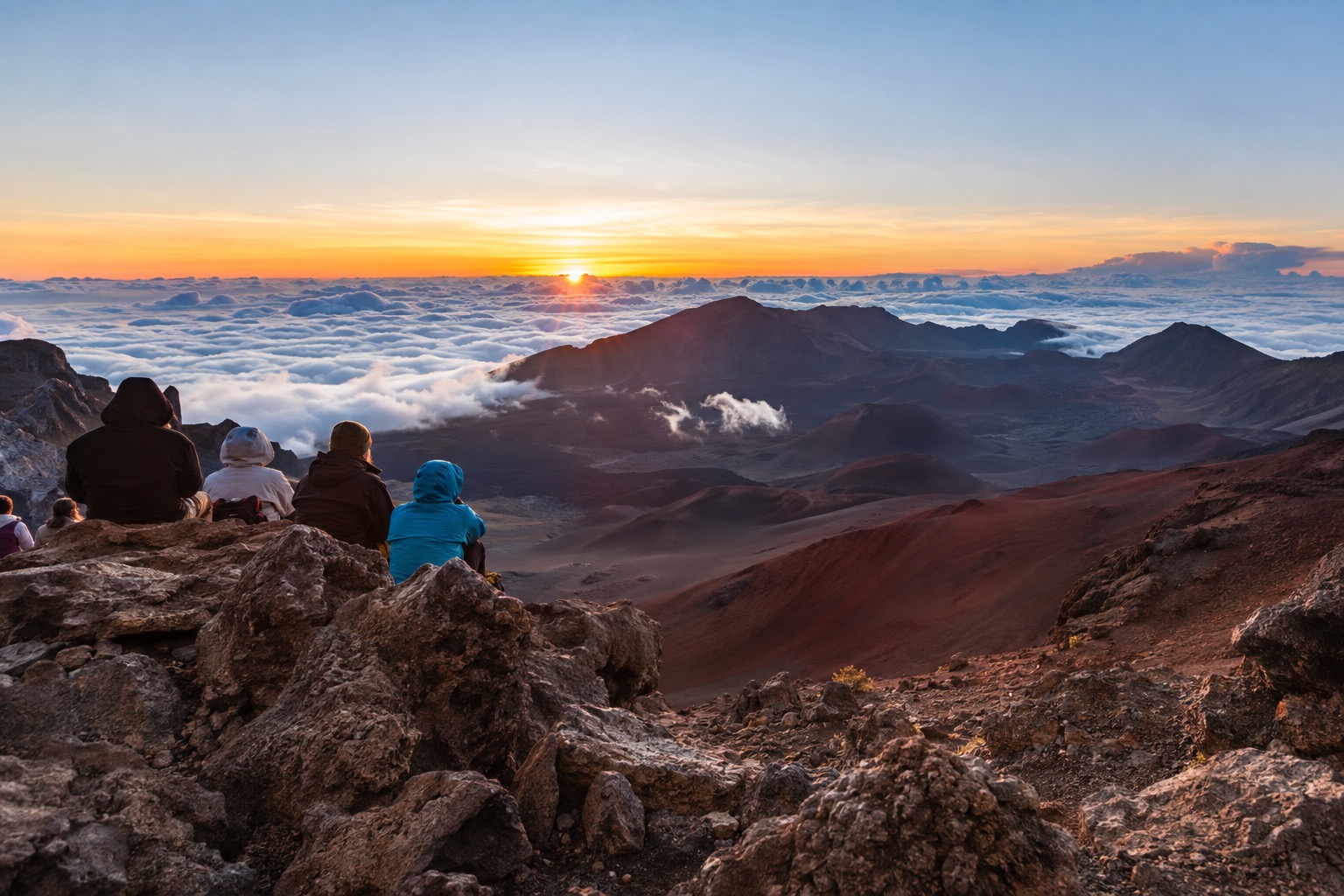
What sets it apart from other Hawaii sunrises is the vantage point. You are not at the shore watching light touch the water, you are standing above the clouds at the edge of a vast volcanic crater, and the light slowly reveals red and brown cinder slopes. The sense of altitude and silence is something a beach sunrise cannot give.
What to see at Haleakala at sunrise
The summit and the sky before dawn
The summit stands at 10,023 ft, and the wait begins in the cold dark. Stars are often sharp overhead, and below you the cloud deck glows faintly as the sky lightens from deep blue to violet.
Conditions just before dawn are regularly wet, windy and below freezing, so the wait can feel long. Layers, a hat and gloves make it pleasant. Many people arrive early to claim a spot along the wall, then simply watch the horizon change color.
The drive from the entrance gate to the summit takes about 30 minutes, which shapes how early you need to be on the road. The reward is the moment the sun clears the horizon and the light spreads across the crater floor.
The crater at first light
As the light grows, the crater reveals itself in shades of rust, ochre and gray. The cinder cones inside it, the colored ridges and the thin trails that cross the floor become visible one by one, and the scale becomes clear.
In Hawaiian tradition the mountain is a place of deep spiritual meaning, and many visitors fall quiet as the sun appears. Look for the shadows sliding across the cones and the clouds breaking against the rim. It is a scene that rewards patience more than a quick photo.
Once the sun is up, the temperature starts to climb and the crowd thins quickly. Linger a little, since the daylight view of the crater is just as striking as the dawn itself.
The sea of clouds below
Standing above the clouds is the other half of the show. The cloud layer often sits well below the summit, and the sun lights its tops in gold and pink while the island below is still hidden.
On some mornings the clouds drift up and swallow the view, and on others the sky is crystal clear. That uncertainty is part of the experience, and a gray start can turn dramatic within minutes as gaps open in the cloud.
Turn around after sunrise to see the light sweep down the slopes toward the coast. The Maui lowlands slowly appear beneath the clouds, a reminder of how far you have climbed from the beach.
Hours, tickets and rules
Sunrise visits need a reservation for each vehicle, and the reservation is separate from the park entrance fee. It is valid only for the day you reserve, and you can buy only one per three-day period. The reservation costs $1.00 per vehicle, and the window runs from 3:00 a.m. to 7:00 a.m.
| Site | Open | Admission |
|---|---|---|
| Haleakala summit at sunrise (vehicle reservation) | Entry between 3:00 a.m. and 7:00 a.m. requires a reservation | $1.00 per vehicle, on top of park entry |
| Haleakala National Park entrance, private vehicle | Valid three days | $30 |
| Haleakala National Park entrance, motorcycle | Valid three days | $25 |
| Haleakala National Park entrance, on foot or bicycle | Per person | $15 |
Reservations open on recreation.gov up to 60 days ahead at 7:00 a.m. Hawaii time, and a portion of each day’s reservations is released two days ahead at the same hour. The daily inventory often sells out within fifteen minutes of release. At the gate, the reservation holder shows valid ID, the confirmation email, and a park pass or a way to buy one.
How to get to Haleakala at sunrise
You reach the summit by vehicle, driving up to the park entrance gate and then on toward the top. From the entrance gate to the summit takes about 30 minutes, and that drive happens in the dark on a winding mountain road.
Because each vehicle needs its own reservation, the car you reserve for is the car you take up. Plan your departure from your Maui base so that you pass the gate with time to spare before the sky begins to lighten.
When to visit Haleakala at sunrise
The best time of day is simply the one the mountain sets, which is before the sun clears the rim. Sunrise moves through the year, from about 5:42 a.m. in mid-June to 7:02 a.m. in mid-January, so the wake-up call is gentler in winter and harsher in early summer.
In October, sunrise comes around 6:19 a.m. in the middle of the month. The sky is often clearer in the drier months of May to October, though the summit can be cold and windy at any time of year. Winter brings more rain, so a clear sky is less certain then.
October sits within the Central Pacific hurricane season, which runs from June 1 to November 30. The season rarely changes plans on the mountain, but it is part of the dates you are traveling in.
Tips for your visit
- Wear warm layers, a hat and gloves, since the summit sits far above the beach and is colder than the lower slopes.
- Bring a blanket or extra jacket for the wait, and a thermos of something hot if you like.
- Keep your ID and confirmation email easy to reach for the gate.
- Stay a while after the sun rises, when the crater looks its best in full light.
Families can enjoy it too, but children need real warmth and patience for the cold early hours. After sunrise, many visitors head back down for a late breakfast and a nap, then spend the afternoon at the beach, which suits the early start well.
Good to know before you go
Expect a big temperature change between the beach and the summit, and remember that the air is thin at 10,023 ft, so move slowly. The park pass options include the Hawaii Tri-Park Annual Pass at $55 and the America the Beautiful nonresident pass at $250 for non-US residents, which can make sense if you plan other national park visits.
Sources
- National Park Service, nps.gov/hale/planyourvisit/sunrise.htm, checked September 25, 2026
- National Park Service, sunrise reservations FAQ, nps.gov/hale/planyourvisit/haleakala-sunrise-reservations-faq.htm, checked September 25, 2026
- National Park Service, nps.gov/hale/planyourvisit/fees.htm, checked September 25, 2026
- NOAA NCEI, normals 1991-2020, station USC00511004, checked September 25, 2026
- sunrise-sunset.org (UTC converted to HST, UTC-10), checked September 25, 2026
- NOAA NCEI, monthly normals 1991-2020, station USW00022516, checked September 8, 2026
- NWS Honolulu / Central Pacific Hurricane Center, « 2026 Central Pacific Hurricane Season Outlook », weather.gov/hfo/hurricaneOutlook2026, checked September 24, 2026