
TAVIRA · EASTERN ALGARVE · THE ISLAND FERRY
The beach here is not at the end of the street. It sits on the far side of a lagoon, and reaching it costs you a boat ride, a glance at a timetable and the discipline of packing lunch. That small inconvenience is why the prettiest river town on the eastern Algarve never became a beach strip: with the sand offshore, the streets kept their fishmongers, their hardware shops and their Sunday quiet. Most people book for the island. What they remember is the town the island protected.
TAVIRA AT A GLANCE
The last boat back shapes every day here: cross early with water and food, keep the town for the evening, and let the ferry be the plan instead of the obstacle.
EASTERN ALGARVE · BEACH BY BOAT · TRAIN FROM FARO
Go for: the first crossing of the morning, the garden inside the castle walls with the roofs below it, and the salt pans at low water with flamingos standing in them.
Think twice before: pinning a family beach day on the final boat, or assuming the island has shade and shops. It has a cluster of seasonal cafés and then it has dunes.
Ferry frequency is seasonal and posted at the landings · full sources at the end of this guide
On this page
- Reaching the island beachTwo landings and the last boat back
- The old town on footThe bridge, the castle garden, the market
- Birds, salt pans, flamingosThe Ria Formosa from Tavira
- Hour by hourA day built around the ferry
- Which bank to sleep onFour zones, named
- Arriving without a rental carThe train from Faro
What to see in Tavira on foot: the Gilão bridge, the castle garden and the market
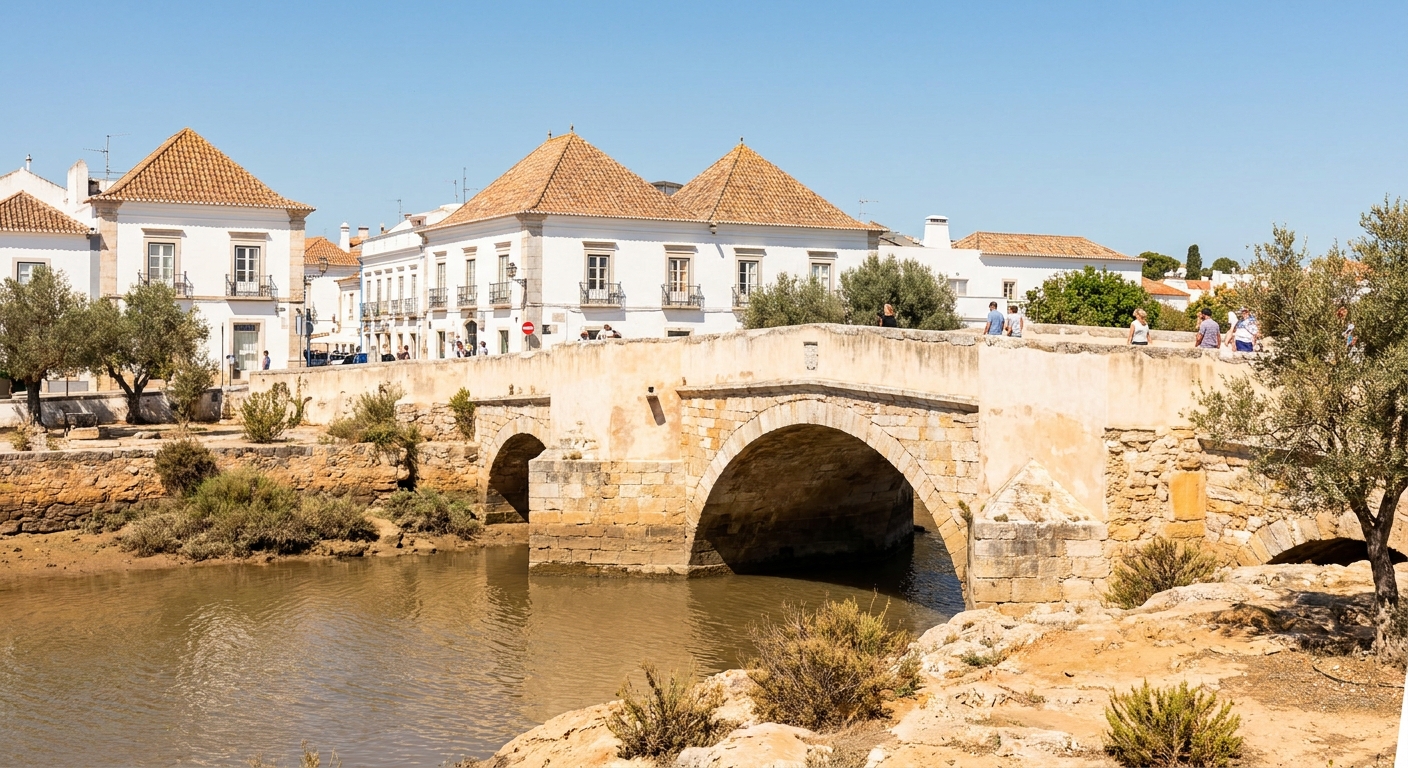
Cross the low arched bridge that everyone calls Roman out of habit and the town sorts itself into halves. The castle side gathers the churches, the market square and the shopping streets. The far bank keeps a quieter grid of single-story houses and neighborhood taverns that fill with the same faces each evening. Look up from either side and you get the local signature: tesouro roofs, small four-sided pyramids set side by side over one house, a shape you find yourself counting without meaning to. Nobody sells them as an attraction. They are simply what the roofline does here.
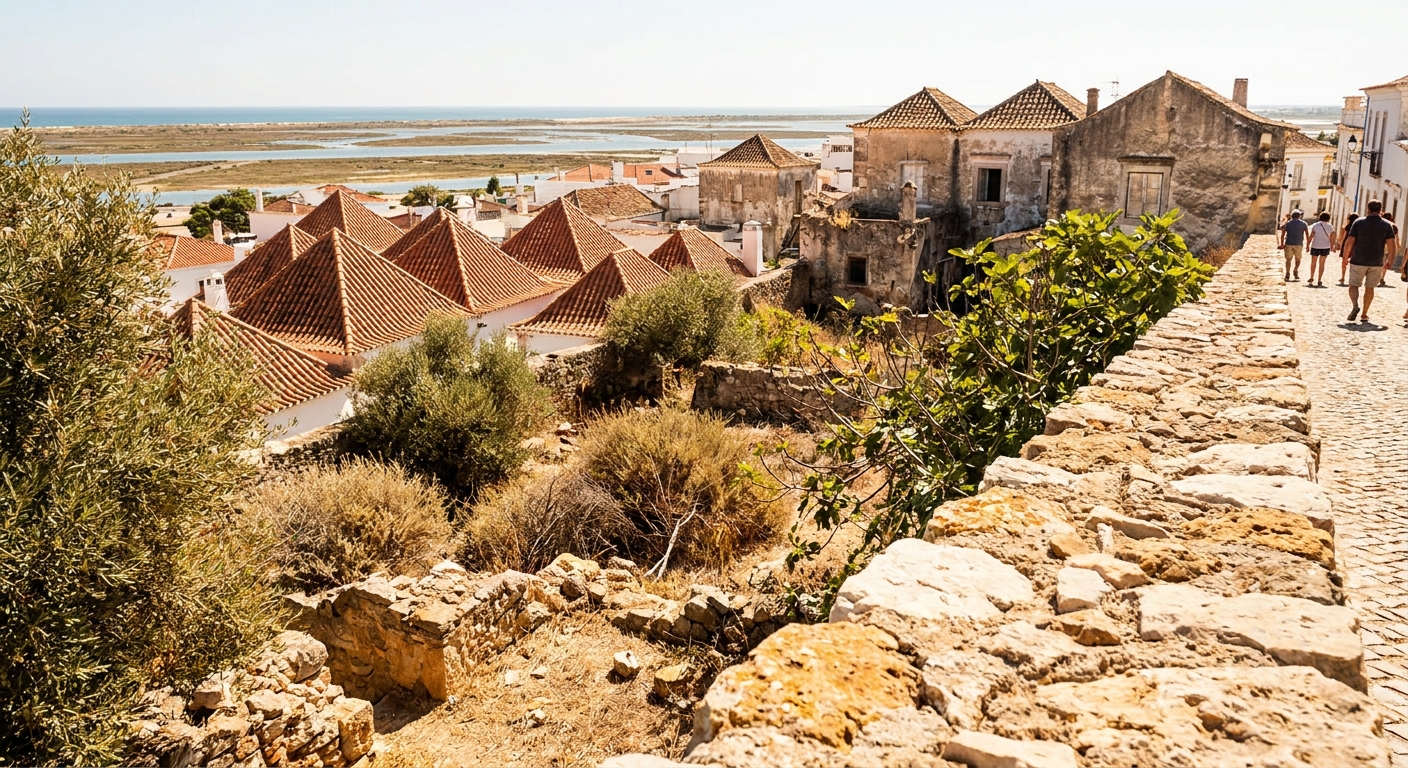
Walk up to the castle, where the walls hold a garden rather than a museum: from the parapet the roofs read as a field of little pyramids, with the lagoon lying flat and silver behind them. Santa Maria do Castelo stands at the top of that climb, the Igreja da Misericórdia keeps its carved Renaissance doorway further down, and the covered market works in the morning like a market and not a souvenir hall. That is the test this town passes. The commercial streets still stock what residents need, which is why they are open in February.
Getting to Ilha de Tavira: the two landings and the last boat back
Boats to the island leave from two places, and the choice matters more than the fare. The town quay puts you on the water within a walk of the market square, which is the answer for anyone travelling without a car. Quatro Águas, out at the river mouth past the salt pans, is where the crossing is shortest and where most of the lagoon operators tie up. Both drop you on the inner shore of the same barrier island, at different points along it.
Read the return times posted at the landing before you buy anything else. The final crossing, not the sun, ends your beach day, and frequency changes with the season, which is why we publish no times on this page: the board at the jetty is the only current one. Cross with water, a hat and food, and treat the last two departures as a queue rather than a schedule, because strollers, coolers and sunburnt teenagers all arrive at the pontoon together. The people who get the sand at its emptiest take the first boat out, not the last one back.
What waits on the far side is scale. Sand runs out of sight in both directions, the water shelves so gently that children walk a long way before it reaches their waists, and the lagoon’s shelter keeps it warmer than the open coast west of here (the region page carries the sea numbers). Services amount to a cluster of seasonal cafés near the landing; past the last one there is dune, boardwalk and nothing. At the island’s western end, Praia do Barril is reached from the mainland instead, on foot or by the little train across the marsh from Pedras d’El Rei, with its field of rusting anchors above the beach.
The Ria Formosa from Tavira: island boats, salt pans and flamingos
The same jetties that serve the beach serve the lagoon. From Quatro Águas and the town quay, small operators run trips out to the other barrier islands and along the channels, and this eastern stretch is where the Ria Formosa is at its widest and least trafficked. The region guide covers the park itself, its islands and its ferries, so this page stays with what Tavira does with them: half-day boats, and a boardwalk you can reach on foot before breakfast.
Low water is the birding hour whenever it happens to fall. The tide pulls back off the mudflats, waders come in to feed on them, spoonbills work the shallows, and flamingos stand in the salt pans between town and Santa Luzia in loose pink lines. Low water moves through the day, so check a tide table rather than the clock, then use early or late for the light. The pans are industrial and beautiful at once: white heaps of salt beside geometric water, with a bicycle track running past them.
Those flats are also a workplace. Clam beds here are held and harvested under concessions, so the traveller’s move is to watch the bent backs, then buy the result in town where the grilled-fish habit makes sense of it. Santa Luzia, a short way west, is the octopus port and sends its own boat to Praia da Terra Estreita. Cabanas de Tavira, east along the lagoon, does the same to its own sandbank. Three villages, three little ferries, one lagoon.
A day in Tavira, built around the ferry
| Time of day | Where | Why then | The trap |
|---|---|---|---|
| Early morning | Market and the streets behind it | Bread, fruit and cold water bought before you cross; the town is at its most local | Treating the market like a café that opens late |
| Mid morning | Town quay or Quatro Águas | Read the posted return times first, then board: that number sets the whole day | Buying a ticket without looking at the last crossing |
| Midday | Ilha de Tavira | Shallow, sheltered water and sand in both directions | Shade you assumed would be for rent |
| Mid afternoon | Walk out along the island | Ten minutes past the last café the crowd thins to nothing | Losing track of the walk back to the jetty |
| Late afternoon | The return crossings | Everyone leaves at once, so the boat before the final one is the calm one | Making the last boat your plan with small children |
| Evening | Castle garden, then dinner in town | Low light on the pyramid roofs, then the fish that came off the lagoon | Expecting nightlife: this town closes gently |
Where to stay in Tavira: old town, both banks, Quatro Águas or the coast east
The historic center is the default and it earns it: market, quay, castle and restaurants all within a flat walk, noise that stays at the level of a late terrace rather than a club. On the castle-side bank you are among the churches and the shopping streets, which means footsteps under the window on summer nights. Across the bridge, the far bank trades two minutes of walking for a quieter street and cheaper dinners, and it is where a lot of the small guesthouses are.
Quatro Águas suits people who intend to be on the water daily, since the boats leave from the doorstep, but the town is a walk or a short drive away and evenings out there are quiet by design. Further east, Cabanas de Tavira and the resort strip beyond it give you lagoon-front rooms, more apartment blocks and a beach that costs a shorter hop. Zone-by-zone thinking for the whole country sits in our where-to-stay guide, and the base comparison lives on the region page.
Getting to Tavira by train from Faro, and how many nights to give it
The Algarve regional line stops in Tavira, and that single fact makes this one of the few beach bases on the coast where a rental car is optional rather than assumed. Trains run in from Faro, which is where flights land and where the airport connects to the station by city bus. Once you are here, the station sits a short walk from the old core, the island boats leave from the middle of town, and the villages along the lagoon are on the same rail and bus threads. Our getting-around guide has the mechanics.
If you do drive, park once and leave it parked: the lanes inside the old town were laid out for donkeys, and the honest use of a car here is the day trip inland or east, not the trip to dinner. The car guide covers tolls and the rest. For pairing a second base, Lagos is the simplest by rail, since it sits at the far end of the same line. Carvoeiro has no station at all, so its last leg needs a bus, a taxi or a car.
How long to stay is a question the region already answers in its base table, and the number there assumes at least one full island day plus one lagoon morning. When to come belongs to the calendar rather than to this page: the month-by-month guide and the Algarve’s climate table hold the temperatures, the crowd peaks and the seasons when the boats run thin. Families weighing shallow water against boat logistics will find the trade-off argued in our Portugal with kids guide.
When to go. The month-by-month case for Tavira — what the normals say, when the sea is warm enough to swim and which weeks fill up — sits on the best time to visit Tavira.
The last word
What the ferry buys is a town that never had to perform. Because the sand is offshore, nobody built a promenade of inflatable-shark shops along the river, and the shopping streets still sell buttons, screws and sardines to people who live here. The crossing also gives your day a spine: an early boat, a long empty walk on the island, a return that arrives with the light still on the roofs. The region guide explains where this fits on the coast, and the country hub handles the rest of the trip.
Take the tide table seriously, take the last departure more seriously still, and give the evening back to the castle garden and the fish restaurants under the roofs. The regret people voice at the jetty is never the boat. It is having booked two nights and worked out, on the way back across the water, that the town they had been using as a ferry terminal was the reason to come.
Sources & data for this guide
- Town, churches, castle and roof architecture · visitportugal.com (Turismo de Portugal) plus ground observation · checked Sep 3, 2026
- Island ferries from the town quay and Quatro Águas: operators post seasonal timetables at the landings. We deliberately publish no times or fares here because both change with the season and the operator · checked Sep 3, 2026
- Ria Formosa natural park, barrier islands and salt-pan habitat · ICNF park information and the region guide · checked Sep 3, 2026
- Tides for the mudflats and bird-feeding hours · consult the Instituto Hidrográfico tide tables for Tavira on the day; low water shifts through the day · checked Sep 3, 2026
- Algarve regional rail line serving Tavira and continuing west toward Lagos · CP timetables; airport-to-station bus links are documented on our Algarve region page · checked Sep 3, 2026
- Editorial note: neighborhood character, noise levels and the queue behavior on the final crossings are our own observations, not published data