
THE ALENTEJO · SOUTHERN PORTUGAL · PLAINS AND WHITE HILL TOWNS
The Alentejo is the southern third of mainland Portugal, and it is the part most travelers cross rather than plan. The highways from Lisbon to the Algarve run straight through it, which is why it is often omitted from first-time itineraries. What you drive past is a plain of cork oaks and wheat, punctuated by white towns on the only hills available, with long stretches where the traffic thins to nothing. The product here is quiet, and slowing down enough to notice it is the trip.
Inland, the region is not organized around a big river city the way the north is around the Douro. Beyond Évora, a walled university town with a Roman temple standing in the middle of it, the settlements are small by design: shade, whitewash, a castle, a café. The Atlantic edge, the Costa Alentejana, has cliffs and cold water and behaves like a separate trip. Between the two sits Alqueva, a reservoir big enough to give the interior a shoreline.
THE REGION AT A GLANCE · ALENTEJO
Spring and autumn are the season here: base in Évora for the old town, add a night at Monsaraz or on a farm for the dark sky, and let the driving be the sightseeing.
BEST: SPRING & AUTUMN · HARDEST: HIGH SUMMER INLAND · CAR: ESSENTIAL BEYOND ÉVORA
Go for: Évora’s Roman temple and walled center, the megaliths west of it, dark skies over the Alqueva reservoir, big Alentejo reds and slow country cooking.
Think twice if: you are traveling without a car, or your dates land in high summer, when inland afternoons close the towns down.
Region character: Turismo de Portugal · Évora old town: UNESCO · climate and price figures delegated to our month and cost pages · full sources at the end
Alentejo Portugal: where it is and what it’s like
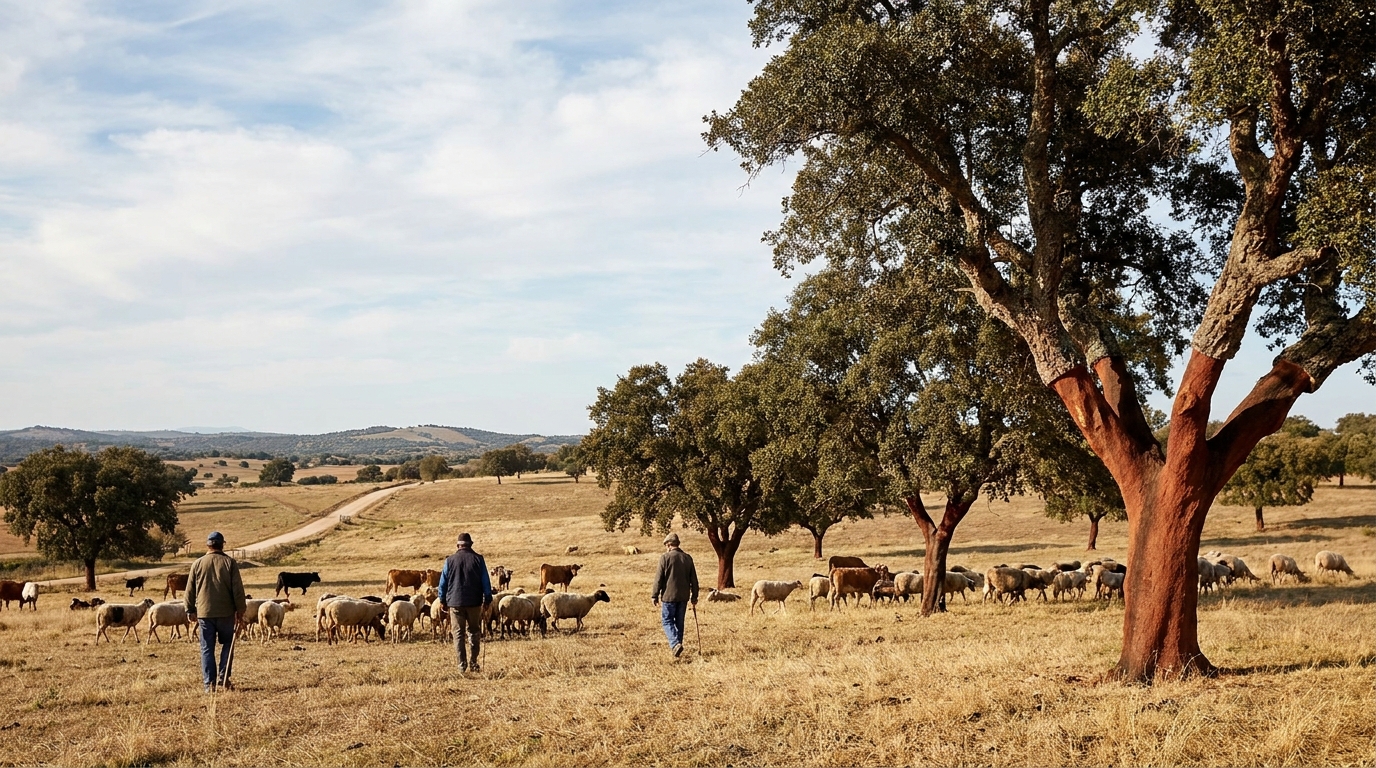
The plain and its cork oaks. The region’s signature is the montado: open oak savanna grazed by sheep and black pigs, the trunks stripped waist-high to a raw bark that stays red-orange for years between harvests. Portugal produces roughly half the world’s cork, and the Alentejo is the country’s main production area, so the numbers stencilled on those trunks are a working calendar.
In late spring the wheat between the trees turns gold, then stubble. Distance is the other feature: you see the next town long before you reach it.
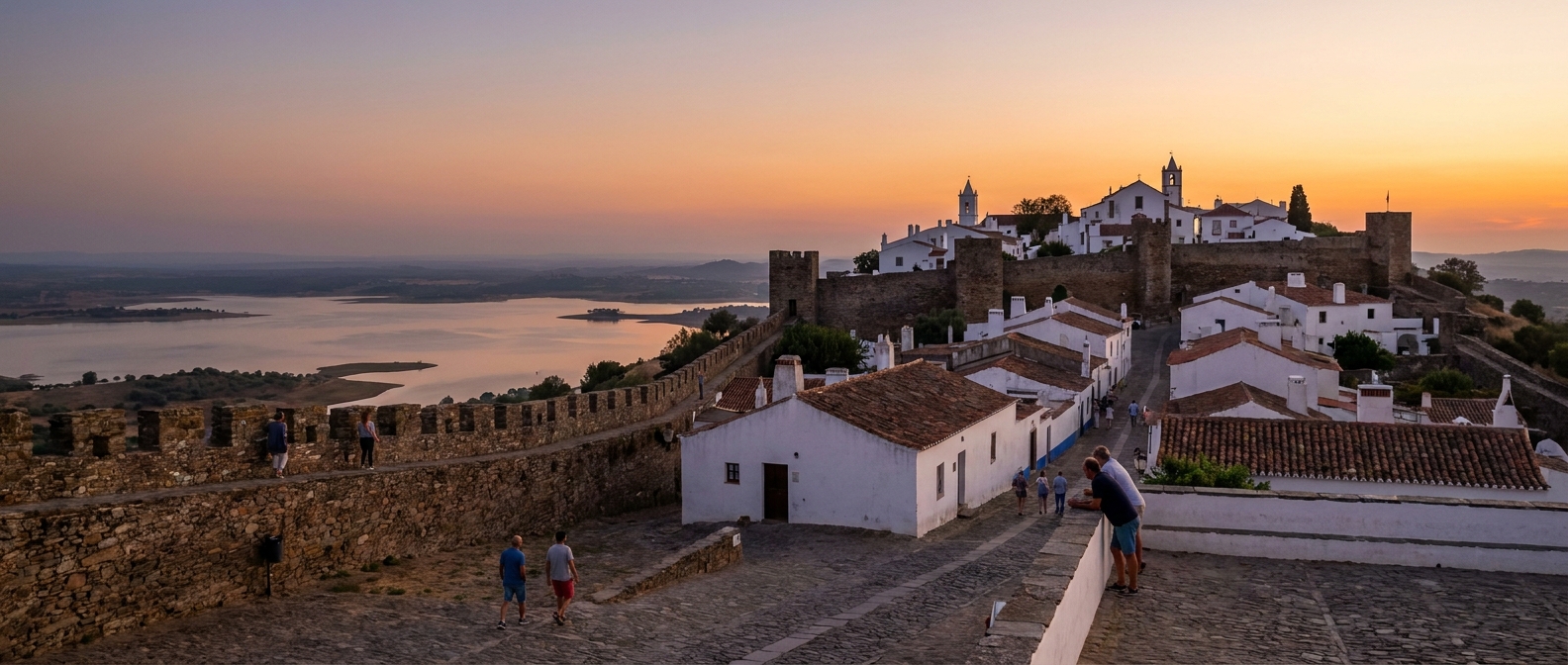
The white towns. Whitewash with ochre or blue trim, streets narrowed to hold the shade, a castle wall doing the framing: Monsaraz above the reservoir, Marvão on its crag near the Spanish border, Mértola over the Guadiana in the deep south. Estremoz and Vila Viçosa sit on marble and use it for kerbs and doorsteps where other towns use granite. Évora is the full-size version, with aqueduct arches that houses have simply been built into and a university that keeps the cafés busy.
The coast is another vacation, not a day trip. The Costa Alentejana runs south from the Sado to the Algarve border with cliffs, river mouths and surf beaches at Vila Nova de Milfontes and Zambujeira do Mar, laced together by the Rota Vicentina footpaths. The water is cold Atlantic and the wind is a fixture. From an Évora base it is a long drive for a swim, so give it its own nights, or fold it into a run south toward the Algarve.
Where to base yourself in the Alentejo: Évora, Monsaraz, the coast or a herdade
| Base | What it gives | For whom | The drawback | Nights (est.) |
|---|---|---|---|---|
| Évora | Roman temple, walled old town, university cafés | First-timers, and the one base that works without a car | The only place on tour-coach hours | 2–3 |
| Monsaraz | Walled hilltop village above the reservoir | Stargazers, couples, slow days | Very limited evening activity | 1–2 |
| Costa Alentejana | Cliffs, river mouths, Atlantic surf beaches | Hikers, surfers, cold-water swimmers | Cold ocean and wind · needs its own trip | 3+ |
| A herdade or rural pousada | Silence, night sky, farm cooking | Anyone who came for the quiet | You drive for everything, dinner included | 1–2 |
| Estremoz / Vila Viçosa | Marble streets, ducal palace, a weekly market | Drivers routing between Lisbon and Spain | Little holds you after dark | 1 |
| Beja / Mértola | Castle towns, far quieter than Évora | The leg between the plain and the Algarve | Thin restaurant choice off season | 1 |
The pairing that works: one town where dinner is a walk away, then one night in open country for the sky. Évora plus Monsaraz covers both within an hour of driving. If the plain is a chapter in a longer route, our 10-day itinerary and its two-week version show where it fits.
Things to do in the Alentejo: the Roman temple, the megaliths, Alqueva and the wine
Évora’s old town is the region’s one unmissable set piece and a UNESCO site: the Roman temple’s columns rising from a small square in the middle of a working city, a fortress-like cathedral with a roof you can climb, the São Francisco church and its chapel lined in bones, the aqueduct walking into the housing. It is compact enough to cover on foot in a day, and that day goes better if you start before the Lisbon coaches arrive around midday.
West of town, the megaliths. The Cromeleque dos Almendres is a field of standing stones on a hillside among cork oaks, and the Anta Grande do Zambujeiro is a dolmen you can walk inside. Visiting arrangements at Almendres changed when a new circuit opened, so check current municipal information rather than an old blog post before you drive out. The access track is dirt, and its last stretch is unkind to a low rental car.
Alqueva, and the sky above it. The dam turned a stretch of the Guadiana into a lake with real shoreline, freshwater beaches for July swimming and boat trips from Amieira. The area holds a dark-sky certification, and with little competing light there are better conditions for seeing faint stars than anywhere on the Portuguese coast. Guided sessions with telescopes run near Monsaraz and should be booked directly in advance, since they depend on cloud cover and on somebody being there to open up.
Wine, including the amphora kind. Alentejo reds come from sub-regions such as Reguengos, Borba and Vidigueira, and a handful of producers still ferment vinho de talha in clay amphorae, a method of Roman ancestry that came back into fashion. Many estates are working farms rather than visitor centers, so book cellar visits directly in advance. Tasting rooms cluster close enough around Évora and Reguengos that a single afternoon can take in two or three.
The table is heavy and slow. Bread does the structural work: açorda with garlic and coriander, migas pressed alongside pork, sopa de cação with dogfish. The prized meat is porco preto, black pig fattened on acorns from those same oaks, and the cheeses are sheep’s milk, Serpa and Nisa among them. Dessert tends toward sericaia with Elvas plums. In village cafés you may still catch cante alentejano, the amateur choral singing without instruments that UNESCO lists as intangible heritage.
On this page
- Roman temple, bone chapel, a walled center on footÉvora
- Where to sleep: Évora, Monsaraz or the coastChoosing your base
- Standing stones and a dolmen you can walk intoThe megaliths west of Évora
- Dark skies and a freshwater beachMonsaraz & the Alqueva reservoir
- Cliffs, surf and cold Atlantic waterThe Costa Alentejana
- Which months, and what heat does inlandSpring, autumn and high summer
- Whether a car is really necessaryDriving the plain
- Where the region fits in a longer routeBetween Lisbon and the Algarve
Not for: travelers without a car who came for the villages, or anyone who needs an evening program. Outside Évora, the plan after dinner is the sky.
Alentejo trip cost per day
Three tiers, relative rather than quoted. Lean is a village guesthouse and the daily set lunch at the café where the farm crews eat. Middle is turismo rural: a converted farmhouse with a pool and breakfast under the vines. High is the pousadas installed in old convents and the design herdades that sell the silence on purpose. Country tables and rural rooms are where this region undercuts the coast, and where a given budget buys more space.
The line item Americans forget is the car. You drive to dinner here, so fuel and rental days belong in the sightseeing column rather than in transfers.
Dates move the rest: shoulder and winter weeks often carry lower rates than spring or the harvest season. For tiers with figures attached, our Portugal trip cost guide does the arithmetic, and the month-by-month guide flags which weeks are priced at peak.
When to visit the Alentejo: spring, autumn, and what high summer does inland
| Season | Inland | The coast | What to do with it |
|---|---|---|---|
| Mar–May | Green plain, wildflowers, warm afternoons | Cool water, steady wind | The region at its best · figures in April and May |
| Jun | Wheat gold, heat building | Swimmable for the hardy | Long light, cellars open · June |
| Jul–Aug | Severe heat, towns closed at midday | Cooler, windier, busier | Lake and coast only · July, August |
| Sep–Oct | Harvest, cooling evenings | Sea at its least cold, quieter | Wine season · September, October |
| Nov–Feb | Cold nights, rain, low sun | Storm light, closed kitchens | Fireplaces and empty roads · December |
Of the two extremes, high summer inland is the one that costs a traveler most, and not in euros. Heat takes the middle of the day away: the stone towns bounce it back, the terraces empty, and the megalith track is no place to be in the early afternoon. Winter costs you daylight and a share of closed kitchens, but the light is clear, the cellars are working and the plain is yours. Between August and February, February gives you more usable hours.
Crowds behave differently here than on the coast. Évora absorbs day coaches from Lisbon in the middle of the day and hands the town back at dusk, which is the argument for sleeping inside the walls.
Villages fill on Portuguese holiday weekends and around local festivals, then empty again. The rest of the time the density is low, which is what people actually come for.
How to get to the Alentejo: Lisbon, Faro and driving beyond Évora
Lisbon airport is the practical door for Évora and the northern half of the region, Faro serves the run up from the beaches, and Porto works as the far entrance for anyone stitching the plain onto the Douro and the north. Coaches link the bigger towns and trains reach a few of them, but the timetable thins once you leave the main axes, and a village like Monsaraz is not on it. Service by service, Getting Around Portugal lays out the options.
Distances mislead on the map. A short hop between two white towns can mean single-lane roads, farm traffic and a climb to a walled center where you park outside and walk in.
Portugal’s motorway tolls come in more than one system, and the difference between conventional plazas, Via Verde lanes and electronic gantries is spelled out in our car rental guide, alongside the rule about reserving an automatic explicitly. Check your range before long rural stretches, and treat unlit roads after dark with respect: curves, cork oaks, animals.
The last word
Slow to the region’s speed and it hands you concrete things: the harvest number stencilled on a stripped cork trunk, marble kerbs in Estremoz worn round by a century of shoes, bread smelling out a Monsaraz lane too narrow for cars, the reservoir below holding the constellations a second time.
Nobody comes home from the Alentejo with a highlight reel. They come home describing the drive between Évora and the lake late in an afternoon, when the wheat goes copper and the only other vehicle is a tractor. Leave a couple of unplanned hours in the middle of the plain and it delivers that on its own schedule.
Sources & data for this guide
- This page carries no temperature, price or driving-time figures by design: the region’s climate and cost numbers live on our month-by-month guide and the Portugal trip cost page · checked Sep 14, 2026
- Region character, white towns, wine sub-regions · visitportugal.com (Turismo de Portugal) · checked Sep 14, 2026
- Historic Centre of Évora inscription · UNESCO World Heritage List · checked Sep 14, 2026
- Cante alentejano, amateur unaccompanied choral singing (male, female and mixed groups exist) · UNESCO intangible heritage · checked Sep 14, 2026
- Cork: Portugal accounts for roughly half of world production, with the Alentejo as the main Portuguese growing area · Turismo de Portugal and industry sources · checked Sep 14, 2026
- Almendres stone circle: visiting arrangements changed with a new circuit, so confirm with Évora’s municipal tourism information before driving out · checked Sep 14, 2026
- Dark-sky certification around the Alqueva reservoir · Dark Sky Alqueva · checked Sep 14, 2026