
ALENTEJO · MARCH · 1991-2020 NORMALS
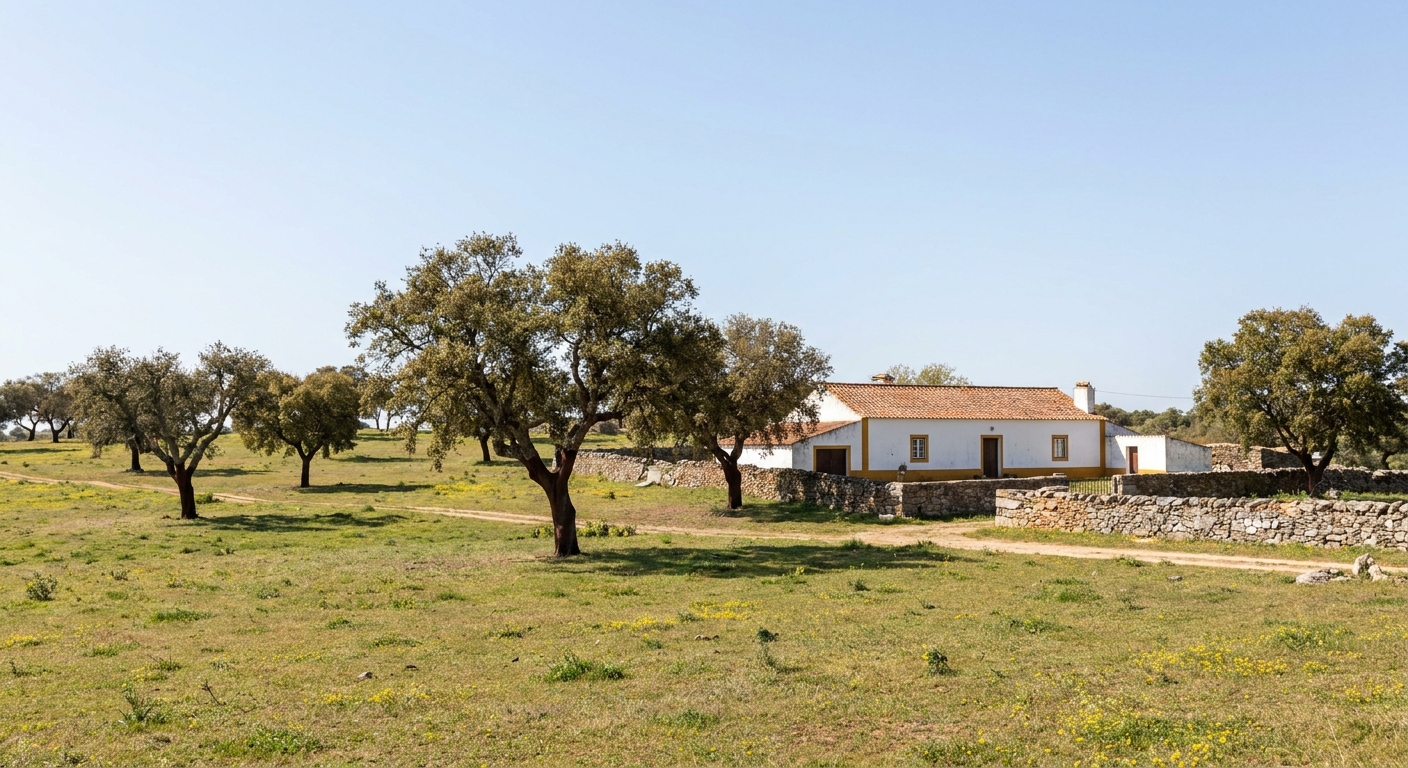
March is a driving month in the Alentejo. The cork oaks throw shade nobody needs yet, the plains still hold their green, and the afternoon settles around 65.7°F, which is walking weather inside a walled town and picnic weather on a hillside above a reservoir. The same thermometer logs mornings at 44.4°F, so the day opens in a jacket and closes in shirtsleeves.
What the month does not hand you is a beach holiday. It also asks for a plan B about one day in four: 7.5 days in an average March record measurable rain, and two of them come down hard. Book a car, pick one base with real heating, and March turns into the version of the Alentejo most people never see.
THE MONTH AT A GLANCE · ALENTEJO IN MARCH
March buys you twelve-hour days and 65.7°F afternoons for walking, driving and hill towns, at the cost of 44.4°F dawns and a wet day roughly every fourth day.
IPMA NORMALS 1991-2020 · STATION 558, ÉVORA, 247.6 M · 2 NIGHTS MINIMUM, 4 IF YOU DRIVE THE COAST
Go for: long walking days in Évora and the hill towns, empty back roads, green plains, and afternoons cool enough to climb a castle without pausing.
Think twice before: planning around swimming or a lounger, and before booking a stone farmhouse without asking how it heats at 44.4°F.
Climate: IPMA station 558, Évora · Light: sunrise-sunset.org · full sources at the end
On this page
- March weather in the AlentejoHighs of 65.7°F, 2.39 inches, 7.5 wet days
- How cold Alentejo mornings get in MarchLows of 44.4°F, and the frost question
- Crowds, booking and the tourist taxWhat we can date, and what we could not price
- Things to do in the Alentejo in MarchÉvora, Monsaraz and the northern hill towns
- A two-day plan for twelve hours of daylightDay one, day two, and the rain version
- March or April in the Alentejo?February, March and April, number by number
- Is March a good time to go?Yes for drivers and walkers, no for swimmers
Looking for the region rather than the date? The Alentejo guide handles bases, drives and how many nights, and the twelve-month verdict ranks the whole year. Every number here is a March number.
Alentejo weather in March: average highs, lows and rain days
| March at Évora, 1991-2020 | Normal |
|---|---|
| Average high | 65.7°F (18.7°C) |
| Average low | 44.4°F (6.9°C) |
| Precipitation | 2.39 in |
| Days with 0.04 in (1 mm) or more | 7.5 |
| Days with 0.39 in (10 mm) or more | 2.0 |
| Daylight on March 15 | About 12 hours, 6:40 a.m. to 6:40 p.m. |
The numbers come from IPMA, Portugal’s national weather service, and specifically from its 1991-2020 normals for station 558 at Évora, a real thermometer standing at 247.6 m inside the Alentejo rather than a model grid cell or a coastal stand-in. March there averages a high of 65.7°F, a low of 44.4°F and 2.39 inches of rain. IPMA’s own caveat travels with those figures: the region is large, high ground to the north runs colder and considerably wetter, and the coast keeps its own weather.
Rain arrives on 7.5 days of an average March, so about one day in four gets something measurable and the other three stay dry. Two of those days deliver 0.39 inch or more, the kind of afternoon that sends you to a museum or a tasting room. One warning on the arithmetic: IPMA counts from 1 mm, a lower bar than the 0.10-inch threshold American tables use, so these day counts do not swap cleanly with a NOAA figure for a US city.
Between the dawn low and the mid-afternoon high sits a 21.3°F swing, and that spread, more than any single reading, writes the packing list. A fleece or light down for breakfast outdoors, a shirt by two o’clock, a windproof shell for the hour after sunset, and shoes that cope with wet cobbles twice in the week. Our Portugal packing guide handles the rest of the suitcase.
Light is generous by mid-month. On March 15 the sun comes up at 6:40 a.m. and goes down at 6:40 p.m. local time, a flat twelve hours, per sunrise-sunset.org. That gives you two towns in a day without rushing either, and it puts golden light on a castle wall at around six rather than at four, the way February does.
How warm is Alentejo in March?
The two headline readings are 65.7°F by afternoon and 44.4°F before dawn. That 21.3°F gap is wider than February’s, which runs 19.3°F between its normals, and narrower than April’s 22.0°F: spring in the Alentejo widens the day before it warms the night.
In practice the morning belongs to the car heater and the second coffee. Nine o’clock is still cold in the shade of a granite lane, noon is pleasant, and roughly two to five in the afternoon is when 65.7°F feels like the number on the page. Evening drops fast once the sun goes at 6:40, so an outdoor dinner in March is a decision, not a default.
On frost: the IPMA normals we read give the monthly mean low of 44.4°F but no count of nights at or below 32°F, so we publish no frost-night figure. A mean is not a floor, and a clear inland night in early March can sit well under it. We also found no sea-surface temperature series for the Alentejo coast, so no water figure appears from us. Where other tables do publish one, most average the daily maxima, which reads warmer than a full 24-hour mean.
How busy is Alentejo in March? Crowds, prices and booking
March is a low-season month on the Portuguese calendar, and that is a statement about the calendar only. We found no occupancy series and no monthly room-rate data for the Alentejo, so we crown no month cheap and no month expensive. For real figures on what a trip absorbs, our cost breakdown does that arithmetic, and flights from the US covers the airfare half.
We could not verify a booking-lead-time series for Alentejo lodging either, so we give no number of weeks. The structural point holds without one: beds here sit in small town guesthouses and converted farms rather than in hotel blocks, and one place filling can move your base twenty miles and rewrite a driving day. Settle the base before the flights if you can, using our where-to-stay guide.
On the tourist tax, we could not verify whether Évora or the other Alentejo municipalities levy one in 2026, nor at what rate, so we quote no per-night amount. Ask at check-in and leave a little slack in the budget. The practical paperwork, from tolls to ID rules, sits in know before you go.
One upgrade genuinely changes March, and it is heating. A thick-walled stone farmhouse holds the 44.4°F night well into the morning, so ask what the heating is before you book. The second line worth funding is the rental car: the distances between Alentejo towns are the whole reason the region stays quiet, and public transport will not fill a two-day itinerary here.
Things to do in Alentejo in March
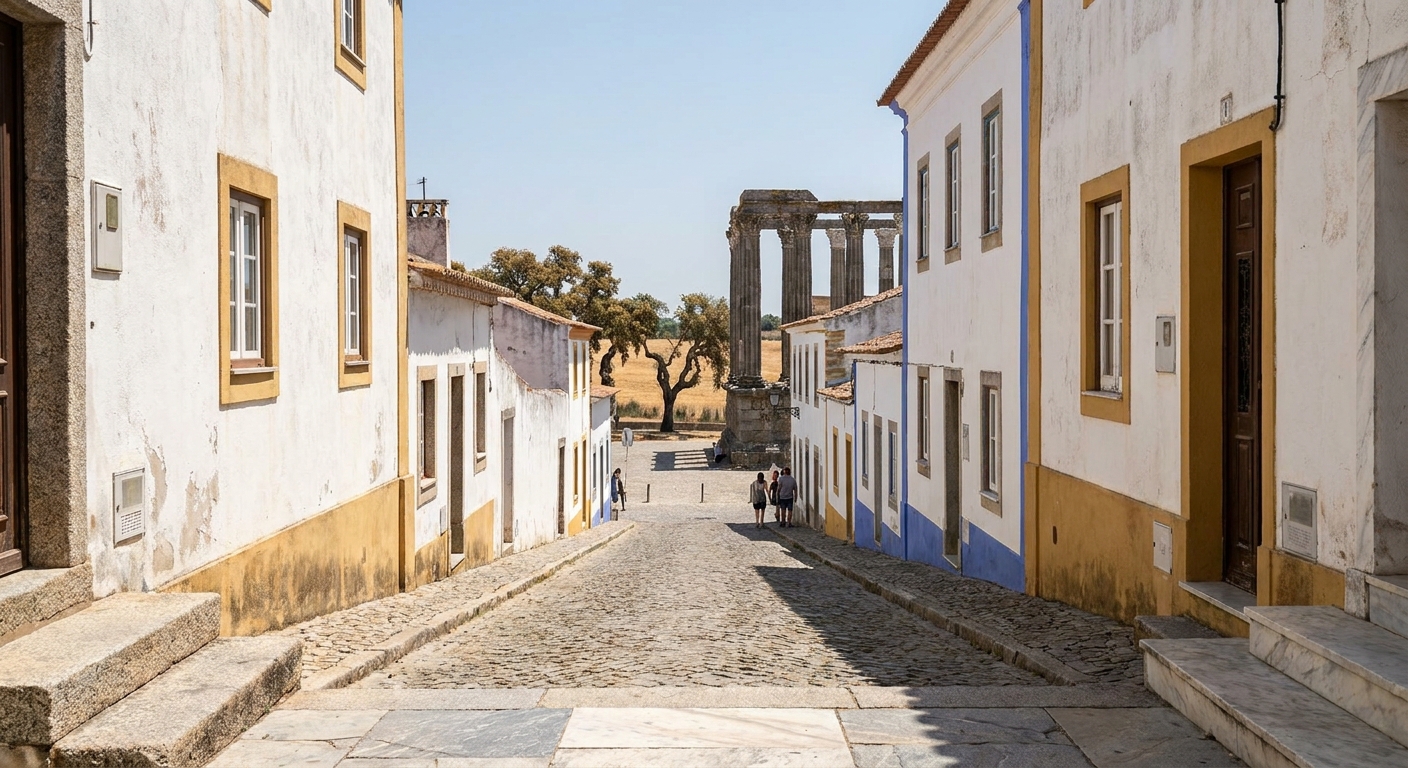
March hands you a combination the calendar only offers briefly: twelve hours of daylight paired with afternoons that stop at 65.7°F. That is enough light for two hill towns between breakfast and sunset, and cool enough to walk up to a castle gate without stopping halfway. February gives the same walk at 60.3°F, which is brisk rather than pleasant, and does it with less light at both ends of the day.
The shortlist writes itself around driving distance. Évora is the anchor, with its Roman temple, the walled center and the bone chapel, and it takes a full slow day. East, the hilltop of Monsaraz looks down on the Alqueva reservoir. North, Marvão and Castelo de Vide stand on granite ridges. West, the Costa Vicentina cliffs and Comporta’s pines. We could not verify current opening hours or ticket prices for any of these, so we quote none: check the operator when you book.
The month changes the air around those places, not the places themselves. IPMA’s caveat matters most here: 65.7°F and 44.4°F are read at 247.6 m in Évora, and the northern ridges run colder and much wetter than that, so a Marvão morning can feel like a different trip from an Évora afternoon on the same day. Keep the shell layer in the car rather than in the room.
We found no free-admission scheme dated to March, so we name none. What costs nothing all month: the circuit of Évora’s walls on foot, the view from Monsaraz over the water, the empty back roads through cork country, and a beach walk on the Costa Vicentina with the wind doing what it does in March.
Alentejo in March: a two-day itinerary
Day one, Évora. Breakfast indoors at eight, because dawn sits near 44.4°F. Walk the center from nine, when the lanes are still cold and empty, and put the walled circuit and the Roman temple in the morning. Lunch long, outdoors if the sun holds. Two to five is the warmest stretch of the day, so spend it on the aqueduct walk or a drive out to a wine estate. Aim to be somewhere with a view before the 6:40 p.m. sunset, then dinner inside.
Day two heads east to Monsaraz and the Alqueva, an hour of good empty road, with the castle walk best before the afternoon wind. If the sky turns, and it does on 7.5 days of the month, swap the ridge for cellars and museums in Évora or Reguengos and accept losing the view. Two of March’s wet days deliver 0.39 inch or more, which is the difference between a damp walk and a day you spend indoors on purpose.
Alentejo in March vs February and April
| February | March | April | |
|---|---|---|---|
| Average high | 60.3°F | 65.7°F | 69.3°F |
| Average low | 41.0°F | 44.4°F | 47.3°F |
| Precipitation | 2.06 in | 2.39 in | 2.44 in |
| Days with 0.04 in or more | 7.0 | 7.5 | 8.0 |
| Sea temperature | We found no series | We found no series | We found no series |
March runs 5.4°F above February on the afternoon and 3.6°F below April. The nights move less: up 3.4°F from February, still 2.9°F short of April. Rain rises steadily across the three, 2.06 to 2.39 to 2.44 inches, and the wet-day count climbs by half a day each step, from 7.0 to 7.5 to 8.0. None of the three months has a verified water temperature from us, so swimming stays unanswered in all three columns.
Shift four weeks forward and you gain 3.6°F of afternoon and warmer dawns, at a cost of half an extra wet day and 0.05 inch more rain, plus the Easter and spring-break traffic that April carries. Shift four weeks back and February returns 0.33 inch of rain and half a wet day, then charges you 5.4°F of afternoon and a shorter day at both ends. Our February page makes that case in full.
Is March a good time to visit Alentejo?
Yes if you came to drive, walk and eat. Afternoons at 65.7°F, twelve hours of light and quiet roads make a strong case for the towns, the estates and the hill forts. No if the trip is built around water or a lounger: mornings at 44.4°F and a coast whose water temperature we could not verify are not the ingredients of a beach week.
If that rules March out for you, April is the small move rather than a big one. It adds 3.6°F to the afternoon and 2.9°F to the night for 0.05 inch more rain, and it comes with more company. For a genuine swimming trip, look further into the year and start with the month-by-month verdict instead of guessing.
Of the three months in play, March is the only one that pairs a full twelve-hour day with afternoons that stay under 66°F, which is the exact recipe for a long walking day that ends without a sunburn.
The last word
Book two nights in Évora, collect the car at Lisbon airport on the way out, and treat the rain as a scheduling detail rather than a threat: those 2.39 inches arrive in installments of roughly 0.3 inch across 7.5 days, not in one drowned week. Keep one indoor afternoon unbooked, point the car east on the clear morning, and stand on the wall at Monsaraz at 6:30 with ten minutes of light left.
Sources & data for this guide
- March, February and April normals, 1991-2020, average high, average low, precipitation and wet-day counts · IPMA (Instituto Português do Mar e da Atmosfera), station 558 Évora, altitude 247.6 m · checked Sep 23, 2026
- Thresholds behind the wet-day counts (1 mm and 10 mm, not the 0.10-inch bar used in US tables) · IPMA normals documentation · checked Sep 23, 2026
- Sunrise 6:40 a.m., sunset 6:40 p.m. and about 12 hours of daylight on March 15, converted to local time · sunrise-sunset.org · checked Sep 23, 2026
- Sea temperature: we found no sea-surface series for the Alentejo coast, so no water figure is given anywhere above
- Crowds and prices: we found no occupancy series and no monthly room-rate data for the region, and we could not verify a municipal tourist tax or its rate, so no ranking and no per-night amount appear
- Opening hours and ticket prices for Évora, Monsaraz, Marvão and Castelo de Vide were not verified and change often · check the operator when you book
To plan your stay
- Things to Do in the Alentejo: Évora, the Almendres Stones, Alqueva's Dark Sky and the Wine Towns
- Best Time to Visit the Alentejo: Weather Month by Month, Summer Heat and the Quiet Season
- Alentejo in February: Weather, Rain Days, Crowds and How It Compares to January and March
- Alentejo in April: Weather, Rain Days, Crowds and a Two-Day Plan