
ALENTEJO · FEBRUARY · IPMA NORMALS 1991–2020
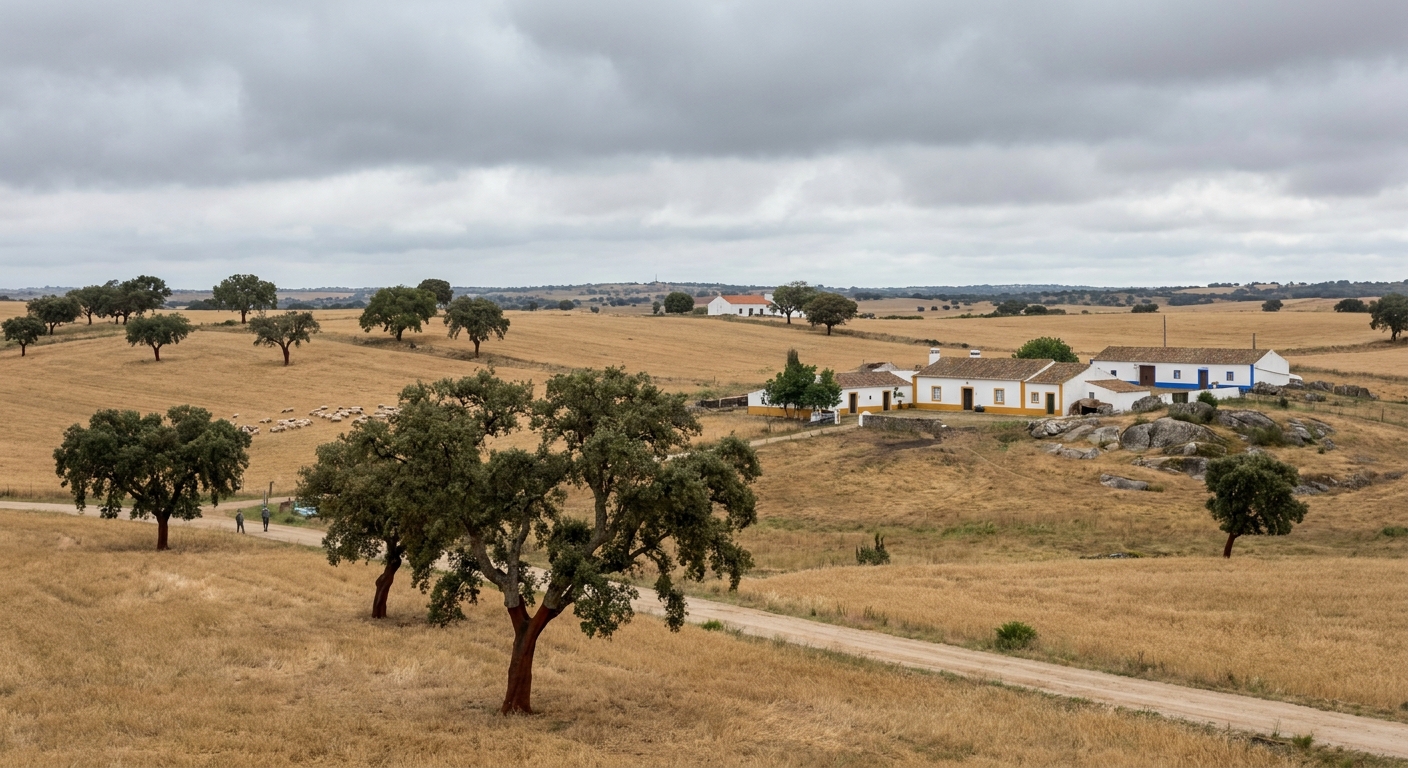
Drive southeast out of Lisbon in February and the Alentejo you find is green. Winter rain has done its work on the wheat plain, the cork oaks stand in grass instead of dust, and afternoons average 60.3°F: sweater weather with the sun on your back, comfortable for a full day on Évora’s marble streets. Overnight the average drops to 41.0°F, and thick stone walls hold that cold well into the morning.
That is the trade. February is the driest month of the late-winter run at 2.06 inches, against January’s 2.70, and it delivers the kind of midday temperature that makes a long walk pleasant rather than punishing. It takes away long evenings, terrace dinners and any thought of swimming. Seven days in an average February record measurable rain. Where to base yourself and whether to rent a car are settled in our where-to-stay guide and the car guide.
THE MONTH AT A GLANCE · ALENTEJO · FEBRUARY
February is the driest of the Alentejo’s late-winter months and its best month for midday walking, as long as you accept 41.0°F nights, darkness at ten past six and no swimming.
AVERAGE HIGH 60.3°F · AVERAGE LOW 41.0°F · 7.0 RAIN DAYS · 10H 49M OF DAYLIGHT
Go for: midday walking at 60.3°F, a green plain, Évora’s center on foot, unhurried wine estates, and 2.06 inches of rain, less than January or March.
Think twice before: booking February for beach days or outdoor evenings: nights average 41.0°F, the sun is gone by 6:10 p.m., and we hold no verified sea temperature for this coast.
Normals: IPMA station 558, Évora, 1991–2020 · Daylight: sunrise-sunset.org · full sources at the end
On this page
- Alentejo weather in FebruaryHighs of 60.3°F and 7 rain days
- How cold the nights getLows of 41.0°F, and the frost question
- Crowds, prices and the tourist taxWhere February sits in the year
- Things to do in Alentejo in FebruaryÉvora, Monsaraz and the megalith country
- A two-day plan for the monthTwo days timed to a 6:10 p.m. sunset
- February vs January and MarchThe three months, figure by figure
- Is February a good time to visit?Our verdict, and who should shift to March
One caveat before you pack. Every figure here comes from IPMA’s station 558 at Évora, a thermometer at 247.6 m standing in the middle of the plain, and the Alentejo is a large region. The high ground toward the Serra de São Mamede runs colder and considerably wetter, and the coast around Sines and Milfontes keeps its own weather. Read the normals below as the plain’s numbers, not the coast’s, and not a mountain trail’s.
Alentejo weather in February: average highs, lows and rain days
| February at Évora (1991–2020) | Value |
|---|---|
| Average high | 60.3°F (15.7°C) |
| Average low | 41.0°F (5.0°C) |
| Precipitation | 2.06 in |
| Days with 0.04 in (1 mm) or more | 7.0 |
| Days with 0.39 in (10 mm) or more | 1.7 |
| Daylight on February 15 | 10h 49m |
| Sunrise / sunset on February 15 | 7:21 a.m. / 6:10 p.m. |
The numbers come from the Instituto Português do Mar e da Atmosfera, whose 1991–2020 normals for station 558 at Évora put the February average high at 60.3°F (15.7°C), the average low at 41.0°F (5.0°C) and the month’s precipitation at 2.06 inches. That is a real instrument at a real altitude, not a reanalysis grid cell averaged across southern Portugal, and the two readings are not the same thing. Thirty Februaries went into each of those figures.
Seven days in an average February record at least 0.04 inch of rain, so measurable wet lands roughly one day in four, and 1.7 days reach 0.39 inch or more, the kind of fall that ends an afternoon outdoors. Those are IPMA’s own thresholds, 1 mm and 10 mm, and they are not the 0.10-inch threshold most US tables use, so the counts do not swap. Duration is what a count cannot tell you: a February day on the plain can take one shower at eleven and dry out by three.
Nineteen degrees separate the average afternoon from the average night, and that gap is the whole packing problem. A shell over a mid-layer you can strip at lunch beats one heavy coat, a hat for the 8 a.m. walk to the café matters more than it sounds, and boots need to cope with wet cobbles after a shower. Our packing guide covers the rest. The February addition is a scarf: the plain is open ground and the wind crosses it unbroken.
February 15 brings 10 hours 49 minutes of daylight, with sunrise at 7:21 and sunset at 6:10 in the evening. Portugal runs on UTC through the winter, so those are clock times and no conversion is needed. Count on usable light from about eight to about half past five, and note where the late hour puts the best of it: the last hour before sunset on Évora’s marble and whitewash lands before dinner in February rather than after it.
How warm is Alentejo in February? Days at 60.3°F, nights at 41.0°F
An average high of 60.3°F and an average low of 41.0°F leave a spread of 19.3 degrees inside a single day. That swing is wider than January’s 17.3 and narrower than March’s 21.3, and it is what a dry inland plain does in late winter: the sun has real strength by noon, and nothing holds the heat once it goes.
In practice you dress twice a day. Mornings in Évora at first light want a proper jacket, gloves if you feel the cold, and coffee taken indoors rather than at an outside table. By one in the afternoon, in sun and out of the wind, a shirt and one light layer are plenty and lunch outdoors is genuinely pleasant. Interiors are the surprise: a thick-walled convent or a village church can sit colder than the street at two o’clock, so keep the jacket with you instead of in the car.
How many February nights actually reach freezing, we cannot tell you. IPMA’s monthly normals give the mean minimum, 41.0°F, and no frost-night count that we could verify, so treat that figure as the average of thirty Februaries of nights, which means colder ones exist and more of them on high ground. On the water, we found no sea-surface series for this coast we were prepared to publish, so we give no number. If you find one elsewhere, check what it averages: coastal tables often report a mean of daily maxima, a little warmer than a true 24-hour average.
How busy is Alentejo in February? Crowds, prices and the tourist tax
Where February sits is easy to say and hard to price. It falls between the New Year holidays and Easter, well outside the July and August weeks when Portugal’s coast fills. We found no occupancy series and no monthly room-rate series for the Alentejo, so we crown no month cheapest and publish no nightly figure. What the season does change is availability: much of the region’s lodging is small country estates running a handful of rooms, and a handful of rooms sells out even in a quiet month.
Book the weekend nights first and the midweek ones later. A small herdade has no slack in its inventory, and a February Saturday in a walled town is a short drive from Lisbon for anyone with a car. We could not verify a lead-time figure for the region, so take that as our reading rather than a measurement; two or three weeks out is usually workable midweek. Where to stay in Portugal sorts the regions, and the trip-cost guide handles the budget.
On the tourist tax, we have nothing to give you. Some Portuguese municipalities charge a per-person, per-night tax on overnight stays, and we could not verify whether Évora or any other Alentejo town charges one, or at what rate, so no percentage and no euro figure comes from us. Ask at check-in, and expect it as a line on the final bill rather than inside the booking price.
The one line worth paying up for in February is heat. A whitewashed farmhouse with thick walls and no real heating is charming at two in the afternoon and grim at seven in the morning, so read the listing for a wood-burner, underfloor heating or room units before you read the photographs. The second is the car: this is a region of long distances between small towns, and the getting-around guide explains what you can and cannot reach without one.
Things to do in Alentejo in February
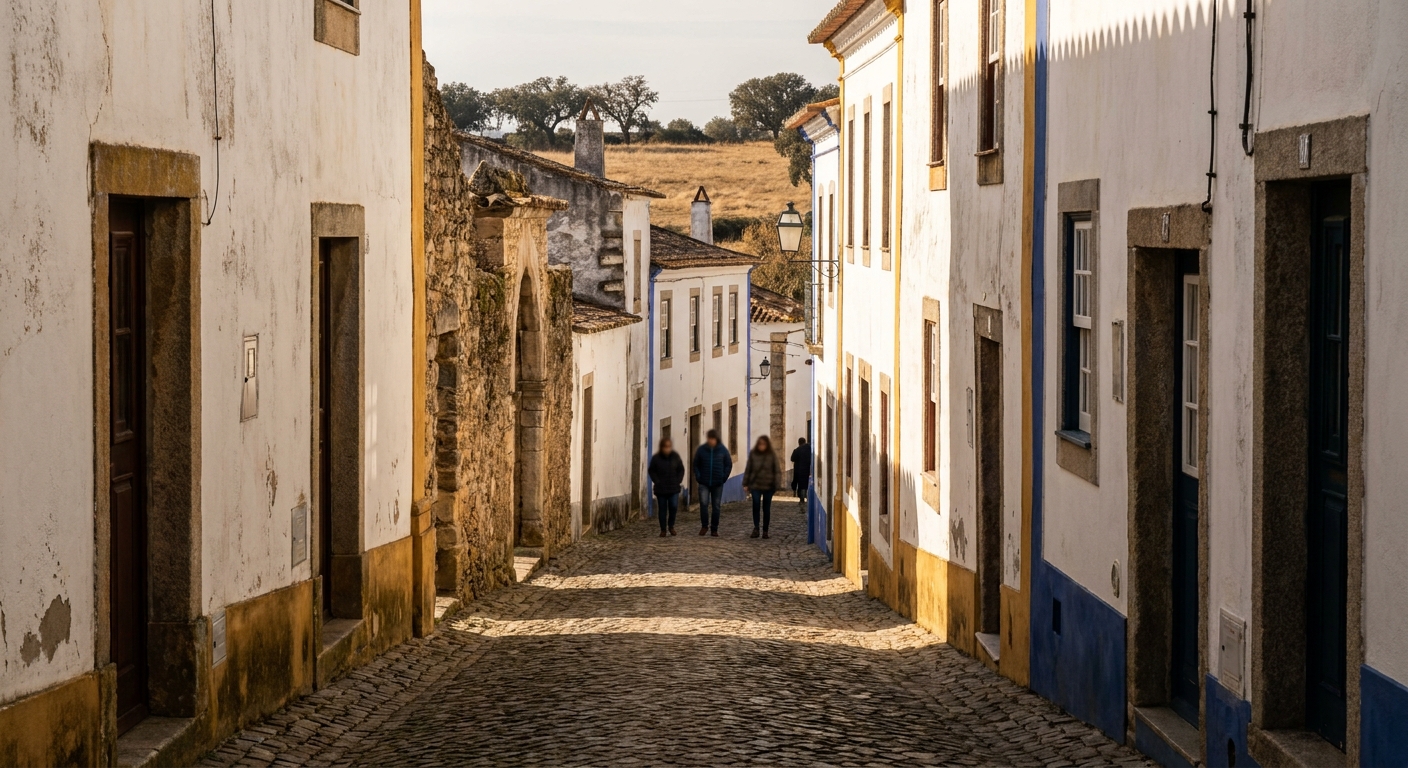
What February gives and high summer cannot is the middle of the day. At 60.3°F you can walk Évora’s full circuit of walls at one in the afternoon, cross an open field to a stone circle with the sun overhead, or spend three hours between two wine estates without planning around heat. Summer in the Alentejo is an early-morning and late-evening region. In February the midday hours are the best of it, and all 10 hours 49 minutes of light are usable.
Base yourself in Évora, whose Roman temple, cathedral and bone chapel sit inside one compact walled center. Beyond it: the megalith sites west of town, Monsaraz on its hill above the Alqueva reservoir, marble Estremoz and Vila Viçosa to the north, Arraiolos for carpets, and the coast at Vila Nova de Milfontes. We could not verify current winter hours or ticket prices for any of them, and small-town timetables shift in the off months, so call or check the site before you drive out.
What the month changes is the air, not the stone. The bone chapel reads the same in February as in August, and the Roman temple has stood in the open for centuries either way. Around them, though, February is a different place: the plain is green rather than bleached, the reservoir sits high after the winter rain, and at five in the afternoon the light comes in low and long across the fields. Two of your seven wet days will probably fall on a driving day, so keep one indoor plan in reserve.
Free in February is what the month does best, which is walking: the walled streets, the back roads across the plain, the climb to the ramparts at Monsaraz, the view down over the reservoir. Whether any ticketed site runs a free-admission day in winter, we could not verify, so budget as though everything with a turnstile charges full price.
Alentejo in February: a two-day itinerary
Day one runs on February’s clock. Breakfast indoors at eight, out the door by nine once the edge is off the 41.0°F night, and give the whole morning to Évora’s center on foot. Take lunch long and late, one to half past two, at an outdoor table if the sun holds. Drive out at three to the megaliths and the cork country, with the afternoon at its warmest. Be back inside the walls by 6:10 p.m., when the sun goes and the temperature follows it down.
Day two goes east or stays put depending on the sky. Clear, and it is Monsaraz and the reservoir road: a hilltop town to walk, water below, home before dark. Wet, which happens on roughly one February day in four, and the day turns indoor, with Évora’s churches and museums, a wine estate with a covered tasting room, and a lunch that runs to three. The 1.7 days a month that bring 0.39 inch or more are the ones to keep flexible.
Alentejo in February vs January and March
| Évora, 1991–2020 | January | February | March |
|---|---|---|---|
| Average high | 57.4°F | 60.3°F | 65.7°F |
| Average low | 40.1°F | 41.0°F | 44.4°F |
| Precipitation | 2.70 in | 2.06 in | 2.39 in |
| Days with 0.04 in or more | 8.6 | 7.0 | 7.5 |
Across the three, February is the dry one. Its 2.06 inches come in under January’s 2.70 and March’s 2.39, and its 7.0 rain days are fewer than January’s 8.6 and March’s 7.5. On temperature it lands in the middle and nearer the bottom: 60.3°F by day against 57.4 and 65.7, and 41.0°F at night against 40.1 and 44.4. Moving from January to February adds 2.9 degrees to the afternoon; moving on to March adds 5.4 more.
Shift four weeks later and the gains are real: 5.4 degrees more by day, 3.4 more at night, longer evenings, and a plain further along in its spring. The cost is 0.33 inch more rain and half a rain day. Shift four weeks earlier and January takes 2.9 degrees off the afternoon and hands back 1.6 rain days for the same scenery. None of the three is swimming weather, and we hold no verified sea reading for this coast either way.
Is February a good time to visit Alentejo?
Yes, if you are coming to drive, walk and eat. February hands you the plain at its greenest, afternoons warm enough for a midday walk, the driest of the three late-winter months, and towns with room in them. No, if you need beach days, evenings outdoors, or a week with no wet afternoon in it: 7 rain days out of 28 is a real proportion, and darkness at 6:10 p.m. shortens the day for anyone used to summer travel.
If that no is yours, take March. It costs a third of an inch more rain and half a rain day, and it returns 65.7°F afternoons, 44.4°F nights and evenings that stretch past dinner. If the sea is the point of the trip, neither month serves it, and the twelve-month verdict is where that call gets made.
What February alone offers is a green plain, a midday you can spend outdoors without negotiating with heat, and the lightest rain of the late-winter run, on the single condition that you put a coat back on at six.
The last word
Book the room with the wood-burner, rent the car, and the rest of an Alentejo February is weather you can dress for. One last number for perspective: 2.06 inches spread across 7.0 rain days works out to roughly 0.29 inch on a wet day, less than a third of an inch, with only 1.7 days in the month heavy enough to reshuffle a plan. Pack the shell, take the midday walk, and let dinner start when the light goes at ten past six.
Sources & data for this guide
- February normals, rain-day counts and the 1 mm / 10 mm thresholds · IPMA, Normais Climatológicas 1991–2020, station 558 Évora, altitude 247.6 m · checked Sep 23, 2026
- January and March normals used in the comparison · same IPMA station, same 1991–2020 period · checked Sep 23, 2026
- Daylight of 10h 49m, sunrise 07:21 and sunset 18:10 on February 15, Portugal on UTC in winter · sunrise-sunset.org · checked Sep 23, 2026
- We found no occupancy series, no monthly room-rate series and no municipal tourist-tax rate we could verify for the Alentejo, so we give no price figure and crown no month cheapest.
- We could not verify a sea-surface temperature series for the Alentejo coast · checked Sep 23, 2026
- Site hours, winter timetables and ticket prices change · check the operator before you drive out.
To plan your stay
- Things to Do in the Alentejo: Évora, the Almendres Stones, Alqueva's Dark Sky and the Wine Towns
- Best Time to Visit the Alentejo: Weather Month by Month, Summer Heat and the Quiet Season
- Alentejo in January: Weather, Rain Days and What to Do
- Alentejo in March: Weather, Crowds, Prices and a Two-Day Driving Plan