
GUIMARÃES · PORTUGAL · THE 12-MONTH VERDICT
Portugal’s north is green because it rains, and Guimarães takes its share: 6.53 inches in November against 0.65 in July at the reference station. The temperature range is far gentler. Average highs run from 57.2°F in January to 76.6°F in August, a spread of 19.4 degrees across the whole year.
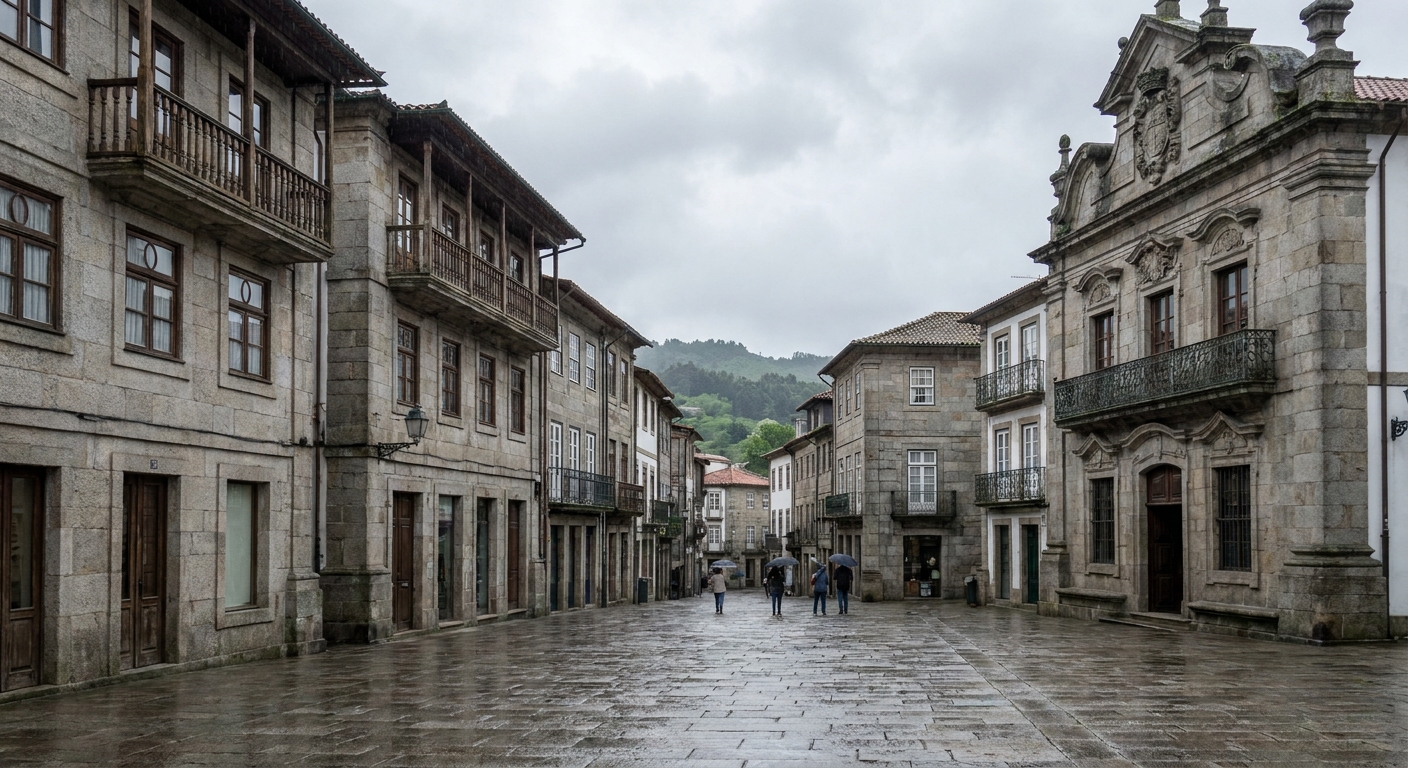
A visit here is spent on foot, on granite that turns slick, climbing to the castle and, for many, up to Penha above town. Wet days, not degrees, are what an itinerary feels. June averages 4.9 of them, November 13.0.
THE YEAR AT A GLANCE · GUIMARÃES
June is the pick: 72.9°F afternoons, 1.33 inches of rain over 4.9 wet days, and the longest daylight of the twelve months behind it.
BEST: JUNE · WETTEST: NOVEMBER, 6.53 IN · QUIETEST BY CALENDAR: JANUARY AND FEBRUARY
Go for: June and September, with 1.33 and 2.69 inches of rain, afternoons in the low to mid 70s, and daylight enough to climb to Penha before dinner.
Think twice before: booking November, which brings 6.53 inches of rain over 13.0 wet days and 9 hours 55 minutes of daylight to a town you walk.
Normals: IPMA station 545, Porto Pedras Rubras · Daylight: sunrise-sunset.org · full sources at the end
On this page
- Twelve months of highs, lows and rain daysThe full table
- The best month, with its rainfallJune: 72.9°F and 1.33 inches
- How hot summer afternoons getJuly and August highs
- The quietest weeks in the old townJanuary and February
- The month with the most rainNovember, 6.53 inches
- May or September for a first visitHow the two shoulder months compare
The town is small and most of what you came for stands outdoors: the castle on its rock, the courtyard of the Paço dos Duques, Largo da Oliveira, and the hill of Penha above the roofs. Wet days therefore do more damage to a Guimarães itinerary than a few degrees either way.
Guimarães weather month by month: highs, lows and rainfall
| Month | Avg high | Avg low | Rain | Days ≥1 mm |
|---|---|---|---|---|
| January | 57.2°F | 43.5°F | 5.94 in | 12.8 |
| February | 59.0°F | 44.2°F | 3.85 in | 10.0 |
| March | 62.6°F | 47.8°F | 3.98 in | 9.9 |
| April | 64.6°F | 50.2°F | 3.76 in | 10.4 |
| May | 68.5°F | 54.1°F | 3.37 in | 8.9 |
| June | 72.9°F | 58.1°F | 1.33 in | 4.9 |
| July | 75.7°F | 59.9°F | 0.65 in | 3.1 |
| August | 76.6°F | 60.3°F | 1.15 in | 3.2 |
| September | 74.3°F | 58.6°F | 2.69 in | 5.8 |
| October | 69.3°F | 55.2°F | 5.86 in | 11.1 |
| November | 62.2°F | 48.9°F | 6.53 in | 13.0 |
| December | 58.5°F | 45.7°F | 6.04 in | 12.4 |
Rain splits the Guimarães year into two unequal halves. From June through September the town dries out, down to 0.65 inches in July and 1.15 in August, while October to January pours: 5.86, 6.53, 6.04 and 5.94 inches back to back. Average highs move far less, never below 57.2°F and never above 76.6°F.
May into June is the sharpest improvement of the year, as 3.37 inches over 8.9 wet days becomes 1.33 inches over 4.9. The return trip is quicker still: September’s 2.69 inches more than double to October’s 5.86, and wet days climb from 5.8 to 11.1. February is the other swing, dropping to 3.85 inches from January’s 5.94.
November punishes a walking visit hardest: 6.53 inches of rain, the wettest of the twelve months, spread over 13.0 days at 1 mm or more and 5.9 days at 10 mm or more, both the highest counts of the year. Daylight is down to 9 hours 55 minutes on the 15th, with the sun gone by 5:16 p.m. For a trip built on the Penha climb, the castle walls and dinner reached on foot, no other month costs as much.
Every figure here comes from IPMA’s 1991-2020 normals, measured at station 545, Porto Pedras Rubras, a real thermometer at 67.7 meters rather than a model grid cell. That station sits at Porto’s airport on the coast, while Guimarães lies inland, with warmer summer afternoons and colder winter nights than these numbers show. The wet-day counts use the Portuguese service’s own thresholds, 1 mm (0.04 inch) and 10 mm (0.39 inch), which are not interchangeable with the 0.10-inch threshold in American tables.
When is the best time to visit Guimarães?
June is the answer for most travelers: an average high of 72.9°F, lows of 58.1°F, 1.33 inches of rain across 4.9 wet days and only 0.9 day with 10 mm or more. It also carries the longest daylight of the twelve months, 15 hours 12 minutes on June 15, with sunset at 9:11 p.m. local time.
May looks close on paper and isn’t in practice. It carries 3.37 inches against June’s 1.33, 8.9 wet days against 4.9, and afternoons 4.4 degrees cooler at 68.5°F. July is drier still at 0.65 inches, but its average high climbs to 75.7°F on a station that understates inland afternoons, and the old town is into its summer season by then.
The wider calendar is settled elsewhere. Portugal is graded month by month in our national verdict, the logistics of the region sit in Porto and the North, Braga pairs with the same base, and what to pack covers the rain shell that 4.9 wet days still argue for.
How hot does Guimarães get in summer?
July averages 75.7°F by day and 59.9°F at night, August 76.6°F and 60.3°F, the warmest pair of the year. Those highs are averages of daily maximum temperatures, so about half of summer afternoons land above them and some well above. Rain nearly stops: 0.65 inches over 3.1 wet days in July, 1.15 inches over 3.2 days in August. The inland correction runs against comfort here, since the source states plainly that Guimarães gets warmer summer afternoons than the coastal station records.
The normals we read carry temperature, precipitation and wet-day counts, and nothing else. No humidity figure, no heat index, no record maximum, which means we cannot put a number on how a July afternoon feels in the granite lanes. What the thermometer supports is the average: 76.6°F in August, with 3.2 wet days that month to interrupt it.
When is Guimarães quietest?
January and February are the quiet weeks, and the reason is the calendar rather than any price list. They fall with the Christmas and New Year period behind them and Easter still ahead, outside the summer season that fills the north from June onward. November works the same way, sitting after the last September visitors and before the December holidays.
February is the pick of the three on the numbers: 3.85 inches of rain and 10.0 wet days, against January’s 5.94 inches and 12.8. Daylight is already back to 10 hours 41 minutes on February 15, an hour and six minutes more than mid-January. In practice that buys the castle, the Paço dos Duques and Largo da Oliveira without a queue, and a café table whenever you want one.
What you give up is the afternoon. On January 15 the sun is up for 9 hours 35 minutes and sets at 5:31 p.m., so the Penha viewpoint has to happen before mid-afternoon. January also brings 5.5 days with 10 mm of rain or more, second only to November’s 5.9, and an average low of 43.5°F, the coldest of the twelve months, from a station the source says runs milder on winter nights than the town itself.
Which month should you avoid in Guimarães?
Move November if your dates allow, and the people it hurts are walkers. The month takes 6.53 inches of rain, the wettest total of the year, across 13.0 days at 1 mm or more and 5.9 days at 10 mm or more, and daylight is down to 9 hours 55 minutes on the 15th. A plan built on the Penha climb, the castle walls and evenings outdoors loses more here than anywhere else on the calendar.
It is not a cold month, though. The average high of 62.2°F beats February’s 59.0°F and sits within half a degree of March’s 62.6°F, so an umbrella does more work than a heavy coat. And 13.0 wet days out of 30 still leave 17 days that record less than 1 mm, while the Paço dos Duques, the museums and a long lunch absorb the wet ones.
Is the shoulder season worth it in Guimarães?
The shoulder months are May and September, on either side of the July and August peak. September runs 74.3°F by day against August’s 76.6°F, barely more than two degrees cooler, while May’s 68.5°F sits 8.1 degrees below it. Rain is where the two separate: September takes 2.69 inches, May 3.37, August only 1.15.
September gives the summer temperature without the summer itinerary. The sun sets at 7:45 p.m. local on the 15th, with 12 hours 31 minutes of daylight, enough for the castle in the morning and Penha before dinner. May gives the longest evenings of the shoulder, 14 hours 34 minutes on May 15 and sunset at 8:48 p.m., 63 minutes later than September’s.
Both pay for it in rain. September’s 5.8 wet days and 2.1 days at 10 mm or more run well above August’s 3.2 and 0.9. May is heavier again at 8.9 wet days and 2.9 heavy ones, nearly triple July’s 3.1 wet days.
Take September. It is 5.8 degrees warmer than May at 74.3°F, drier by 0.68 inches, and it holds 12 hours 31 minutes of daylight, which covers a two-day visit comfortably. May earns the nod only if long evenings are the whole point, and they cost 3.1 extra wet days.
The last word
Settle the month first, because the gap between the best and worst of them is wider than the thermometer suggests: 1.33 inches in June against 6.53 in November, and 15 hours 12 minutes of daylight on June 15 against 9 hours 16 minutes on December 15, a swing of nearly six hours. Whatever you book, the old wall still carries its lettering, Aqui Nasceu Portugal, in characters you can read from across the street, rain or not.
Sources & data for this guide
- Monthly normals 1991-2020, highs, lows, precipitation and wet-day counts · IPMA station 545, Porto Pedras Rubras, altitude 67.7 m · checked Sep 12, 2026
- Wet-day thresholds of 1 mm (0.04 in) and 10 mm (0.39 in) are IPMA’s own and do not match the 0.10-inch threshold used in US tables · checked Sep 12, 2026
- Scope caveat: the station stands at Porto’s airport on the coast, while Guimarães is inland, with warmer summer afternoons and colder winter nights · IPMA · checked Sep 12, 2026
- Sunrise, sunset and daylight length on the 15th of each month · sunrise-sunset.org, UTC times converted to local · checked Sep 12, 2026
- We read no hotel-rate or airfare series for Guimarães, so the quiet months here are named by calendar and never ranked by price.
- Sight names, walking notes and the seasonal reading are editorial · opening hours change, check before you go.