
GUIMARÃES · MAY · 1991-2020 NORMALS
May hands Guimarães the two things its old town was built for: long light and mild air. The 1991-2020 normals put the average afternoon at 68.5°F and the average night at 54.1°F, and on May 15 the sun stays up for 14 hours 34 minutes. That is a full evening of granite squares on top of a full day of them. A town founded in the 10th century and made the first capital of Portugal in the 12th has never needed heat to be good company. It needs daylight, and May carries far more of it than April.
What May takes back is dryness. An average May records 3.37 inches of rain over 8.9 days with measurable fall, so this is still a spring month rather than a summer one. Four weeks later, June’s total drops to 1.33 inches. The whole decision sits in that gap: cooler climbing weather and green hills now, or dry afternoons and a warmer stone later.
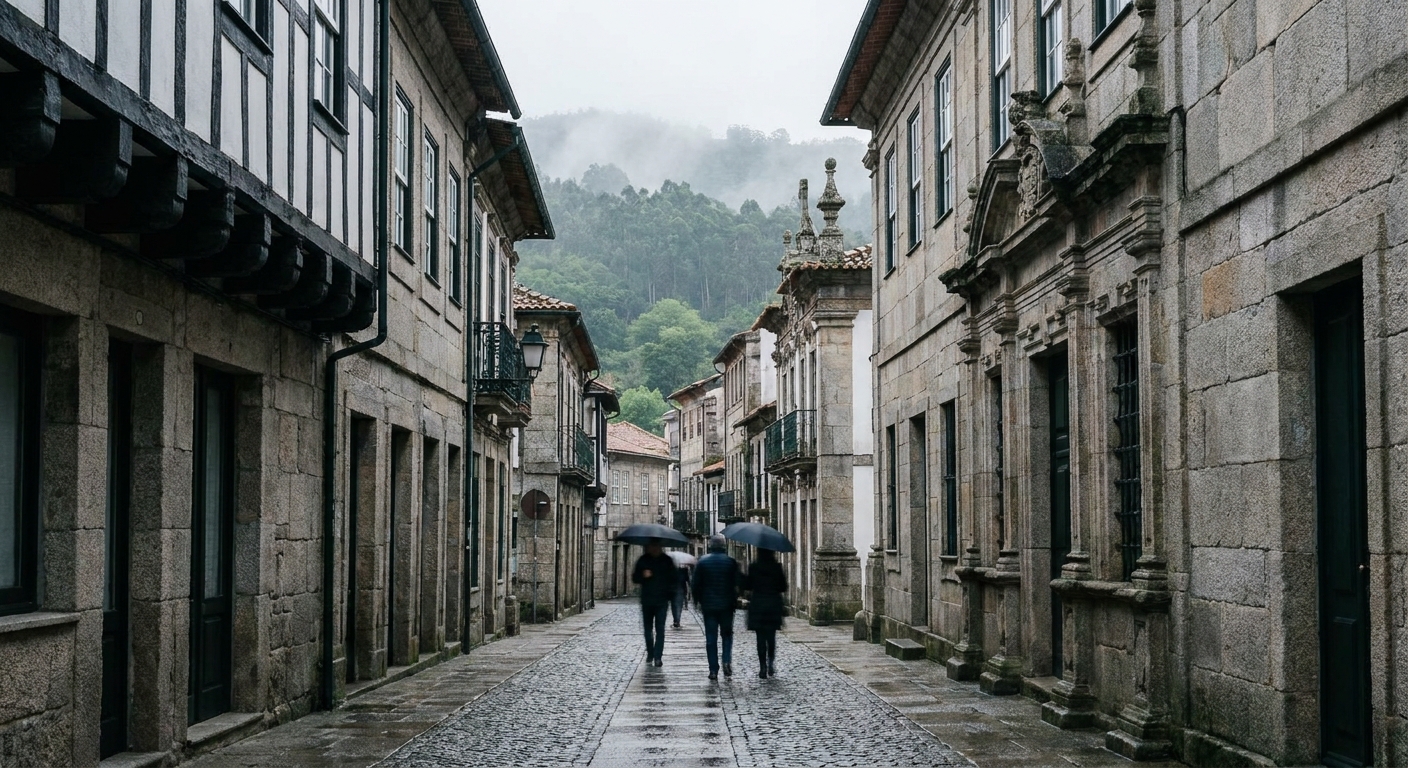
THE MONTH AT A GLANCE · GUIMARÃES IN MAY
May gives Guimarães 68.5°F afternoons, 14 hours 34 minutes of daylight and 8.9 days of measurable rain: enough light for two full days on foot, enough wet to keep a shell in the bag.
AVERAGE HIGH 68.5°F · 8.9 RAIN DAYS · SUNSET AT 8:48 P.M. ON MAY 15
Go for: walking a 38.2-hectare old town in cool air, evenings that run to 8:48 p.m., and hills still green from 3.37 inches of spring rain.
Think twice before: counting on dry afternoons. Nearly three days in an average May drop 10 mm (0.39 inch) or more, and we hold no opening hours or admission prices for the castle or the palace.
Normals: IPMA station 545, Porto Pedras Rubras · Heritage: UNESCO file 1031bis · full sources at the end
On this page
- May highs, lows and rain daysGuimarães weather in May
- How warm it feels, morning and afternoonThe 14.4°F gap between day and night
- Crowds and how far ahead to bookWhat we can and cannot verify on prices
- Things to do in Guimarães in MayThe castle, the palace and the Couros Zone
- A two-day plan for GuimarãesTwo days, hour by hour
- May or April or June?How the three months compare
- Is May a good time to visit Guimarães?The verdict, and who should shift
Every figure here comes from one thermometer: IPMA station 545 at Porto Pedras Rubras, 67.7 m above sea level, out on the coast at Porto’s airport. Guimarães lies inland from it, with warmer summer afternoons and colder winter nights than the coastal record, and the high ground beyond the town is colder and a good deal wetter again. Read the normals below as a regional baseline, then add a layer for the hills.
Guimarães weather in May: average highs, lows and rain days
| Measure | May normal (1991-2020) |
|---|---|
| Average high | 68.5°F |
| Average low | 54.1°F |
| Precipitation | 3.37 in |
| Days with 1 mm (0.04 in) or more | 8.9 |
| Days with 10 mm (0.39 in) or more | 2.9 |
| Daylight on May 15 | 14 h 34 min |
The source has a name and an address: IPMA, the national weather service, and its 1991-2020 normals for station 545 at Porto Pedras Rubras. Average high 68.5°F, average low 54.1°F, 3.37 inches of precipitation across the month. That is a real instrument standing at 67.7 m, not a reanalysis grid cell averaged over several miles of map, and the difference matters when a page tells you what to wear.
An average May logs 8.9 days with at least 1 mm of rain, roughly three days in ten. Of those, 2.9 reach 10 mm or more, the kind of fall that ends an afternoon outdoors rather than dampening it. One caution on arithmetic: IPMA counts on its own thresholds, while US tables usually start at 0.10 inch, so the two sets of rain-day numbers are not interchangeable. Treat 8.9 as days when something falls, not as nine days written off.
Pack for 14.4°F of daily swing and for wet stone. A light rain shell earns its space in a month with 3.37 inches, and the granite paving of the old town turns slick fast, so the shoes matter more than the jacket. Inland nights run below the coastal reading, so the sweater you would leave in Porto stays in the bag here. Our Portugal packing guide has the full list for a spring trip.
On May 15 the sun rises at 6:14 a.m. and sets at 8:48 p.m. local time, which works out at 14 hours 34 minutes of daylight. Practically, that means the castle hill is still lit at half past eight and the squares stay usable until dinner instead of before it. Mid-May evenings give you a second walk you would not get in March.
How warm is Guimarães in May?
The month averages a 68.5°F high against a 54.1°F low: 14.4°F between the warmest hour and the coldest. Inland Guimarães sits on the wider side of that spread rather than the narrower, because the station reading comes off the coast, where the Atlantic flattens both ends. Nothing in May reads as hot, and nothing reads as cold.
In practice you leave the room at eight in a sweater and carry it by eleven. Afternoons at 68.5°F are climbing weather rather than shade weather, so the stairs to the castle cost nothing. After sunset at 8:48 p.m. the temperature slides back toward the night figure within an hour or two, and the granite stops giving heat back well before the streets empty.
On frost: IPMA’s monthly normals give averages, not extremes, so we hold no count of May nights at or below freezing and we will not invent one. Guimarães is an inland town, not a coastal resort, and we found no water-temperature series for the rivers here or the beaches west of the city. No swimming figure appears for that reason.
How busy is Guimarães in May? Crowds, prices and how far ahead to book
We could not verify an occupancy series or a monthly room rate for Guimarães, so we crown no month the cheapest and none the dearest. What we can date is the weather, and the weather is what moves the European calendar around here: the dry run starts in June, when rainfall falls to 1.33 inches, and May sits in the wetter spring ahead of it. Anyone selling you a percentage for May is estimating too.
Supply is the part worth planning around. UNESCO records that most of the building stock inside the 38.2-hectare perimeter is privately owned, and the beds inside the walls come from small conversions of those houses rather than from a hotel district. A core of private houses does not add rooms the way a chain does. Settle the in-walls room first, then the flights: US arrivals land at the same airport where these normals are recorded, and our where-to-stay guide covers the fallback outside the perimeter.
We could not verify whether Guimarães charges a municipal tourist tax, so no per-night figure and no rate appear anywhere here. Ask the property when you book, so the line on the check-out bill is one you already knew about. Our Portugal trip-cost guide carries what we have confirmed elsewhere in the country.
If you spend up on one thing this month, spend it on location rather than floor space. With light until 8:48 p.m. and rain falling on nearly nine days, the gap between sleeping inside the perimeter and sleeping a drive away is three easy returns to the room in a day against none. A car adds little inside the walls, and our car guide explains why you collect one on the way out rather than on the way in.
Things to do in Guimarães in May
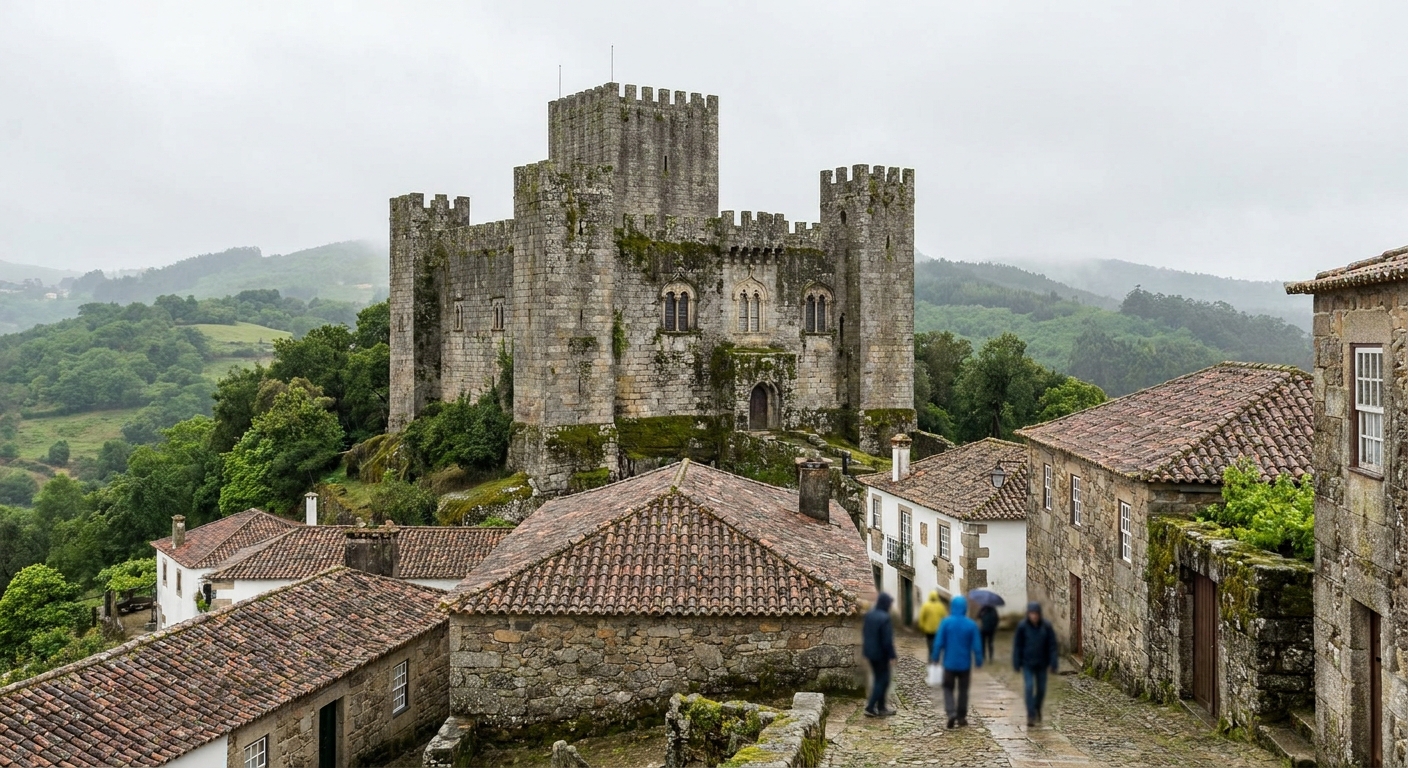
May’s advantage over the rest of the calendar is walking hours at a walking temperature. Fourteen and a half hours of daylight is more than April offers, and 68.5°F is 4.4°F below the June afternoon, which is the difference between climbing a hill and pacing yourself up it. The 8.9 rain days are the price, and they are why a day here wants an indoor half kept in reserve.
The walled town has two anchors, both standing from between 950 and 1498: the castle at the north end and the monastic complex at the south. Outside the walls, the Couros Zone takes its name from the leather tanning once practiced there, and so does the river. The craft stopped, the tanneries and workers’ houses of the 19th and early 20th centuries did not. Nineteen properties inside the perimeter are legally protected, ten as National Monuments and nine as properties of Public Interest. We hold no opening hours and no admission price for any of them, so check with the operator the week you travel.
The stone does not change month to month, the air does. Ground floors here are granite carrying a half-timbered structure above, a method developed in the Middle Ages that traveled with the Portuguese to Africa and the New World and became a signature of building there. Granite keeps its lower rooms cool in any season. What May moves is the open-air half: the squares laid out during the rebuilding between 1498 and 1693 sit at 68.5°F instead of June’s 72.9°F, and the medieval street plan underneath them survived all of that work intact.
The free half of the town is large. Public spaces belong to the municipality, so the squares, the surviving medieval streets and the walk out to Couros cost nothing in May or any other month. Couros is where we would put the money instead of saving it: UNESCO singles that zone out as needing an urgent conservation and rehabilitation strategy, and names tourism-driven gentrification as a pressure on the property. The long evening makes the walk easy, since the light holds until 8:48 p.m.
Guimarães in May: a two-day itinerary
Day one starts on the castle hill by eight, when the air still sits nearer the 54.1°F night than the 68.5°F afternoon and the climb costs you nothing. Take the palace beside it mid-morning, then the squares of the 1498 to 1693 rebuilding around midday, when the granite is giving back its heat. Keep four in the afternoon until eight in the evening for the 38.2 hectares on foot. Sunset at 8:48 p.m. means dinner follows the walk rather than replacing it.
Day two goes outside the walls: Couros in the morning, then the quarters that grew around the Franciscan and Dominican complexes once the town outgrew its perimeter, with the 129.4-hectare buffer zone as the edge of the day. If the sky turns, and 2.9 days in an average May bring 10 mm or more, flip the order and put the interiors of the protected nineteen in the wet hours. Wet granite is the real hazard of a May afternoon, not the temperature.
Guimarães in May vs April and June
| Measure | April | May | June |
|---|---|---|---|
| Average high | 64.6°F | 68.5°F | 72.9°F |
| Average low | 50.2°F | 54.1°F | 58.1°F |
| Precipitation | 3.76 in | 3.37 in | 1.33 in |
| Days with 1 mm (0.04 in) or more | 10.4 | 8.9 | 4.9 |
May’s afternoon runs 3.9°F above April’s and 4.4°F below June’s, and the nights follow the same steps: 50.2°F, then 54.1°F, then 58.1°F. Rain tells a less even story. April to May drops the wet-day count from 10.4 to 8.9 and the total by under half an inch, while May to June cuts 2.04 inches and four more rain days. The big step of the spring is the one after this month, not the one before it. No water temperature appears in any column, because we found none for this inland town.
Shift four weeks forward and you buy dry afternoons, 4.9 rain days and a third of May’s rainfall, at the cost of climbing hills at 72.9°F and losing the green that 3.37 inches keeps on them. Shift four weeks back and April gives cooler walking at 64.6°F with 10.4 wet days and a shorter day. June is the drier bet, plainly.
Is May a good time to visit Guimarães?
Yes for anyone whose trip is mostly walking: a 68.5°F afternoon and 14 hours 34 minutes of light are close to ideal for a town of stairs and squares. No for a single fixed weekend that has to stay dry, because 8.9 wet days out of 31 is a real share of the calendar, and one of those weekends in an average month catches the heavier 10 mm fall.
If the answer came out no, June is the month to take: 1.33 inches over 4.9 days, for afternoons 4.4°F warmer. Travelers who would rather have the cooler climb and can absorb the sky should look the other way, to April at 64.6°F and 10.4 wet days. The year-round view for Portugal puts both in context, and the north reads the same way.
Of the three months here, only May pairs an afternoon under 70°F with more than fourteen and a half hours of daylight, and that combination is what lets a first-time visitor see the walled town twice in one day.
The last word
Book the bed inside the walls, and May does the rest of the work: with the sun down at 8:48 p.m., the 38.2-hectare core becomes a place you leave and re-enter three times a day instead of a single morning’s tour. One fact we have kept back until now. The perimeter you will be walking was redrawn in 2023, when UNESCO modified the boundaries of the 2001 inscription to take in the Couros Zone, and the listing rests on criteria (ii), (iii) and (iv). The master plan that governs what can be altered dates from 1994 and was revised in 2015.
Sources & data for this guide
- May normals (68.5°F / 54.1°F, 3.37 in) · IPMA, climatological normals 1991-2020, station 545 Porto Pedras Rubras, altitude 67.7 m · checked Sep 24, 2026
- Rain-day counts (8.9 days at 1 mm or more, 2.9 at 10 mm or more) and the note that IPMA thresholds differ from the 0.10-inch threshold of US tables · IPMA, same station and period · checked Sep 24, 2026
- April and June normals used in the comparison · IPMA, same station and period, not estimates · checked Sep 24, 2026
- Daylight on May 15 (sunrise 05:14 UTC, sunset 19:48 UTC, converted to local time) · sunrise-sunset.org · checked Sep 24, 2026
- Perimeter (38.2 ha), buffer zone (129.4 ha), 2001 inscription with 2023 boundary modification, criteria (ii)(iii)(iv), the nineteen protected properties, the granite and half-timbering method, the Couros Zone and the 1994 master plan revised in 2015 · UNESCO World Heritage List, file 1031bis · checked Sep 24, 2026
- Scope note: the normals are measured at Porto’s coastal airport station, while Guimarães lies inland with a wider day-night spread, and the high ground nearby is colder and wetter still.
- We found no occupancy series and no monthly room-rate series for Guimarães, so we crown no month cheap or expensive. We could not verify a municipal tourist tax, so we give no rate. We hold no opening hours and no admission price for the castle, the palace or any other monument, and UNESCO describes a property rather than running visits · checked Sep 24, 2026